


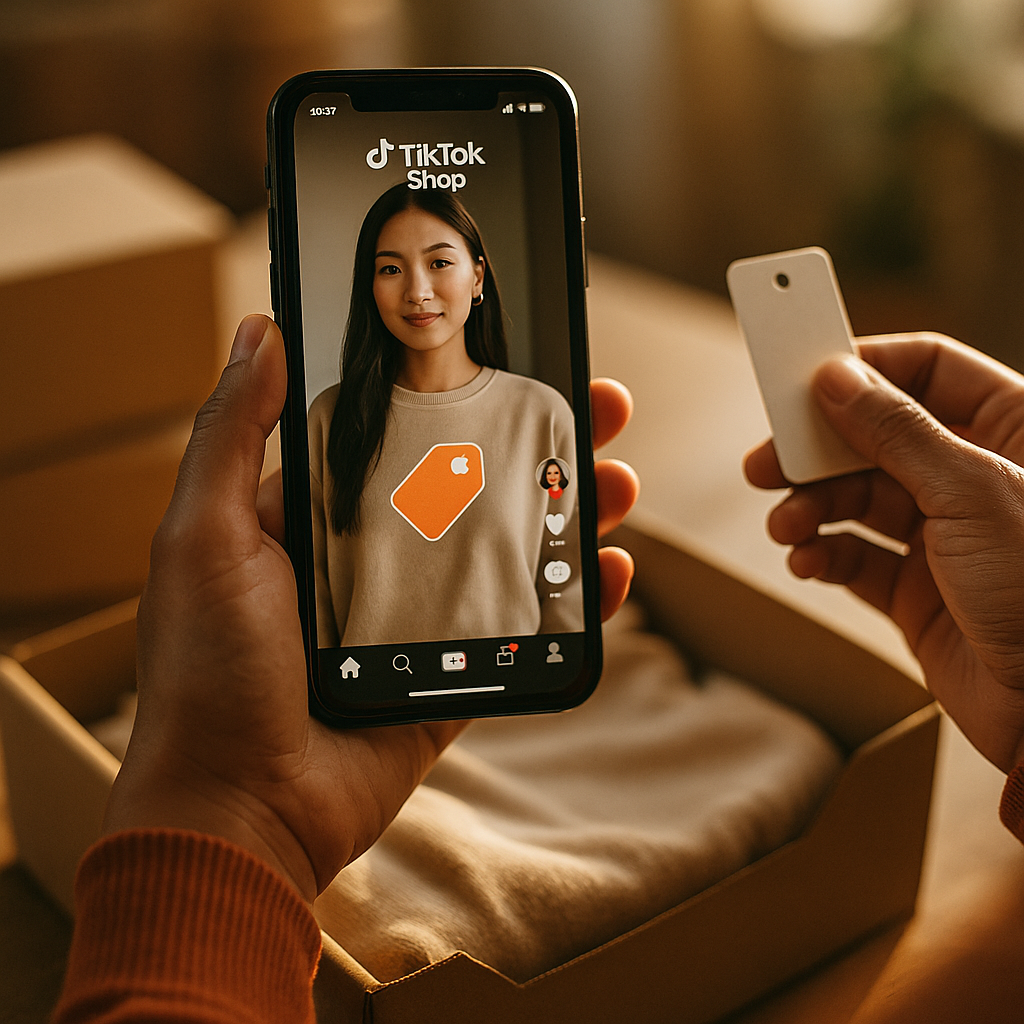
TikTok Shop videos with product tags get measurably more distribution than identical videos without them. No boosted post required, no whitelisting fee, no media buy. Just a tag. If your team is still treating TikTok Shop as a checkout feature bolted onto content, you’re leaving reach on the table that competitors are already claiming for free.
This isn’t a rumor from a creator Discord. It’s a pattern visible across thousands of Shop videos, and it changes how brands should brief creators, allocate budget, and think about “organic” in 2026.
The Mechanic: Why Tagged Videos Travel Further
TikTok’s recommendation system was never a pure engagement engine. It’s a commerce engine now, and it optimizes for signals that predict transactions, not just watch time. A product tag tells the algorithm something a caption or hashtag never can: this video has commercial intent, and TikTok can attribute a sale to it.
That attribution matters more than most marketers assume. TikTok Shop’s system tracks a full funnel from view to cart to purchase, and videos that convert get redistributed to look-alike audiences who share behavioral traits with buyers, not just viewers. A video without a tag can go viral and generate zero commercial signal. A tagged video with a fraction of the views can trigger a distribution loop because TikTok can see it’s driving GMV.
Product tags don’t just add a “shop now” button — they hand TikTok a conversion signal it actively rewards with incremental reach, effectively functioning as a free promotion layer for commerce content.
This is consistent with what we found when we dug into how product tags boost reach on the platform: tagged content gets pushed into secondary distribution windows that untagged content simply never enters. It’s not a conspiracy. It’s TikTok optimizing for its own revenue.
What “Winning Distribution” Actually Looks Like
Brands often expect a hockey-stick spike. That’s rarely what happens. Instead, tagged videos tend to show a longer tail: a second and third wave of impressions days after the initial push, often correlated with add-to-cart events rather than likes or shares. If you’re only checking view counts at the 24-hour mark, you’re measuring the wrong window.
- Initial distribution (0-24 hours): standard For You Page seeding, similar to any other video.
- Commerce signal window (24-72 hours): TikTok evaluates click-through and conversion rate on the tag.
- Amplification phase (72+ hours): high-converting videos get pushed to shopping-intent audiences, sometimes weeks after posting.
That third phase is the one brands miss. Teams pull reports at day three, declare a video “flat,” and move budget elsewhere, right before the algorithm decides to give it a second life.
Stop Briefing for Views. Brief for Tag Compliance and Conversion Cues.
Most creator briefs still read like they were written for 2021 UGC campaigns: hook in three seconds, brand mention by second five, CTA at the end. None of that is wrong, but it’s incomplete. If the brief doesn’t explicitly require a product tag, placed early and visible, you’re asking creators to leave organic reach on the table.
Compare this to how discovery-based distribution already forced brand teams to rethink briefs across the platform. We covered this shift in our discovery-over-reach playbook, and the same logic applies here: TikTok isn’t rewarding follower count anymore, it’s rewarding signals it can act on. A tag is the clearest signal a video can send.
Practical brief additions that actually move the needle:
- Require the product tag to appear within the first 3 seconds of on-screen action, not buried in a caption edit after posting.
- Ask creators to demonstrate the product in use, not just hold it up. TikTok’s system appears to weight watch-through combined with tag interaction, not just tag presence.
- Direct creators to pin a comment linking to the Shop listing. It’s a small redundancy, but it gives the algorithm a second commerce signal if the primary tag underperforms.
- Avoid stacking more than one product tag per video unless it’s a genuine multi-item haul. Diluted tags seem to dilute the conversion signal per SKU.
None of this requires paid spend. It requires rewriting the brief.
The Affiliate Layer Changes the Math
Tagged videos don’t operate in isolation. They interact with TikTok Shop’s affiliate program, and that interaction is where a lot of brands underestimate their own leverage. When a creator is enrolled as an affiliate and tags a product, TikTok appears to weight that video slightly differently than a brand-owned tagged post, likely because affiliate content carries a built-in commission incentive that correlates with lower return rates and higher intent-to-purchase.
We’ve tracked this in detail in our breakdown of real-time affiliate commission tracking, and the operational takeaway for brand teams is simple: don’t run product tagging and affiliate enrollment as separate workstreams. Every tagged video from an enrolled affiliate is doing double duty, driving a sale and reinforcing the algorithm’s confidence in your catalog.
This also explains why some brands report stronger results from the Real IP Merchant Program than from traditional creator partnerships. Verified merchant status appears to carry its own trust signal, and when combined with tagged, affiliate-driven content, it compounds the distribution advantage rather than just adding to it.
Livestream Tags Behave Differently — And Brands Keep Getting This Wrong
Everything above applies to short-form video. Livestream commerce runs on a related but distinct logic, and treating it identically is a common, costly mistake.
In livestreams, product tags refresh in real time as hosts move through a catalog, and TikTok’s algorithm seems to reward streams that maintain consistent tag-to-sale velocity over the full session, not just spikes during a flash promotion. We’ve written extensively about structuring these sessions in our guide to livestream scripts for impulse buys, and the segment-level breakdown in livestream segments that capture impulse buys is worth pairing with any tagging strategy, because the tagging cadence needs to match the script’s pacing, not just the product lineup.
One nuance that trips up compliance teams: countdown timers and urgency language inside tagged livestreams sit close to FTC scrutiny on false scarcity. If your livestream script leans on “only 3 left” framing while also running high-frequency product tag refreshes, you need a compliant structure. Our breakdowns of countdown timers that avoid FTC scarcity risk and countdown timer scripts built for FTC risk both apply directly here. The algorithm doesn’t care about your legal exposure. Your compliance team does.
Beauty and supplement categories carry extra weight here. If you’re running restock drops, see our category-specific guide on beauty restock livestreams and compliant urgency, and if your catalog includes supplements, the FTC-risk framework in supplement livestreams without FTC risk is close to mandatory reading before your legal team asks questions you can’t answer.
Human Creators Still Outperform AI-Generated Product Demos
Worth flagging given how many brands are testing AI avatars for Shop content: TikTok’s recommendation system has shown a measurable bias toward human-presented product videos over AI-generated equivalents, even when the tag structure is identical. We detailed this shift in why TikTok now favors human video over AI, and it’s a direct warning for teams trying to scale tagged product content through synthetic media to cut production costs. The tag gets you into the commerce evaluation. The human presenter appears to be what keeps you there.
Operational Checklist: Turning This Into a Repeatable Program
None of this works as a one-off campaign tactic. It needs to be a standing operational discipline, the same way SEO briefs became standard for content teams a decade ago. Here’s a rough framework for building it into your program:
- Audit your last 90 days of Shop content. Segment tagged versus untagged videos and compare reach curves at the 72-hour and 7-day marks, not just 24 hours.
- Rewrite creator briefs to make tag placement and timing non-negotiable deliverables, not optional add-ons.
- Cross-reference affiliate enrollment with your top-performing creators. If they’re tagging but not enrolled, you’re missing a compounding signal.
- Build a compliance pass for any livestream script involving urgency language alongside product tags.
- Test human-hosted versus AI-assisted product demos on identical SKUs to quantify the distribution gap for your specific catalog.
According to eMarketer, social commerce spend continues to climb faster than overall social ad spend, which means the platforms with built-in organic commerce mechanics, like TikTok Shop’s tagging system, will only become more valuable relative to paid distribution. Statista‘s creator economy data tells a similar story: the gap between brands that operationalize platform-native commerce features and those still buying reach is widening, not narrowing.
For teams benchmarking this against other platforms, it’s worth comparing how Instagram’s GEM algorithm rewards tagged Reels in a structurally similar way. The pattern isn’t unique to TikTok. It’s becoming the standard playbook across short-form commerce.
What This Means for Budget Conversations
If your media team is still allocating a fixed “boost budget” for every Shop video, you’re solving a problem the algorithm already solves for free, provided the tag and content structure are right. That doesn’t mean paid spend disappears. It means paid spend should go toward videos that are already showing organic signal in the 72-hour window, not blanket-boosting everything at hour one before the algorithm has had a chance to evaluate the tag.
Reallocate that early boost budget toward creator briefing, compliance review, and affiliate enrollment instead. That’s where the actual leverage lives. For a related shift in how platforms are forcing brands to rethink distribution assumptions entirely, see our coverage of the force-feed algorithm and content brief rewrites, which pairs well with the tagging strategy outlined here.
For general platform guidance on Shop features and merchant requirements, TikTok’s own TikTok for Business resources are worth checking quarterly, since Shop mechanics shift faster than most brand playbooks get updated.
Frequently Asked Questions
Does adding a product tag actually increase organic reach, or is that a myth?
Evidence across Shop content patterns shows tagged videos consistently receive extended distribution windows compared to untagged equivalents, particularly in the 72-hour-plus phase when TikTok evaluates conversion signal. It’s not guaranteed virality, but it’s a measurable reach advantage.
How soon should we expect results after tagging a video?
Don’t judge performance at 24 hours. The commerce signal evaluation window typically runs from 24 to 72 hours post-publish, and amplification for high-converting tagged videos can occur a week or more after posting.
Should every Shop video have a product tag, even non-promotional content?
Not necessarily. Tags work best paired with genuine product demonstration or use-case content. Forcing a tag onto unrelated content can hurt engagement and signal quality without adding real commercial intent.
Does affiliate enrollment change how tagged videos perform?
Affiliate-tagged content appears to carry additional weight, likely because commission structures correlate with stronger purchase intent and lower return rates. Enrolling top creators as affiliates alongside tagging is a compounding strategy, not a redundant one.
Are AI-generated product demos a viable shortcut for scaling tagged content?
Current signals suggest human-presented product videos outperform AI-generated equivalents even with identical tagging structures. AI can support production efficiency, but it shouldn’t fully replace human hosts in tagged Shop content right now.
What compliance risks come with product tags in livestreams?
The main risk is combining urgency or scarcity language with tag refresh cadence in ways that could trigger FTC scrutiny around false scarcity claims. Script structure and legal review matter as much as the tagging strategy itself.
Next step: pull your last 90 days of TikTok Shop content, split it by tagged versus untagged, and check reach at the 7-day mark, not 24 hours. That single audit will tell you whether your briefs need rewriting before your next budget cycle.
Top Influencer Marketing Agencies
The leading agencies shaping influencer marketing in 2026
Agencies ranked by campaign performance, client diversity, platform expertise, proven ROI, industry recognition, and client satisfaction. Assessed through verified case studies, reviews, and industry consultations.
Moburst

-
2

The Shelf
Boutique Beauty & Lifestyle Influencer AgencyA data-driven boutique agency specializing exclusively in beauty, wellness, and lifestyle influencer campaigns on Instagram and TikTok. Best for brands already focused on the beauty/personal care space that need curated, aesthetic-driven content.Clients: Pepsi, The Honest Company, Hims, Elf Cosmetics, Pure LeafVisit The Shelf → -
3

Audiencly
Niche Gaming & Esports Influencer AgencyA specialized agency focused exclusively on gaming and esports creators on YouTube, Twitch, and TikTok. Ideal if your campaign is 100% gaming-focused — from game launches to hardware and esports events.Clients: Epic Games, NordVPN, Ubisoft, Wargaming, Tencent GamesVisit Audiencly → -
4

Viral Nation
Global Influencer Marketing & Talent AgencyA dual talent management and marketing agency with proprietary brand safety tools and a global creator network spanning nano-influencers to celebrities across all major platforms.Clients: Meta, Activision Blizzard, Energizer, Aston Martin, WalmartVisit Viral Nation → -
5

The Influencer Marketing Factory
TikTok, Instagram & YouTube CampaignsA full-service agency with strong TikTok expertise, offering end-to-end campaign management from influencer discovery through performance reporting with a focus on platform-native content.Clients: Google, Snapchat, Universal Music, Bumble, YelpVisit TIMF → -
6

NeoReach
Enterprise Analytics & Influencer CampaignsAn enterprise-focused agency combining managed campaigns with a powerful self-service data platform for influencer search, audience analytics, and attribution modeling.Clients: Amazon, Airbnb, Netflix, Honda, The New York TimesVisit NeoReach → -
7

Ubiquitous
Creator-First Marketing PlatformA tech-driven platform combining self-service tools with managed campaign options, emphasizing speed and scalability for brands managing multiple influencer relationships.Clients: Lyft, Disney, Target, American Eagle, NetflixVisit Ubiquitous → -
8

Obviously
Scalable Enterprise Influencer CampaignsA tech-enabled agency built for high-volume campaigns, coordinating hundreds of creators simultaneously with end-to-end logistics, content rights management, and product seeding.Clients: Google, Ulta Beauty, Converse, AmazonVisit Obviously →