


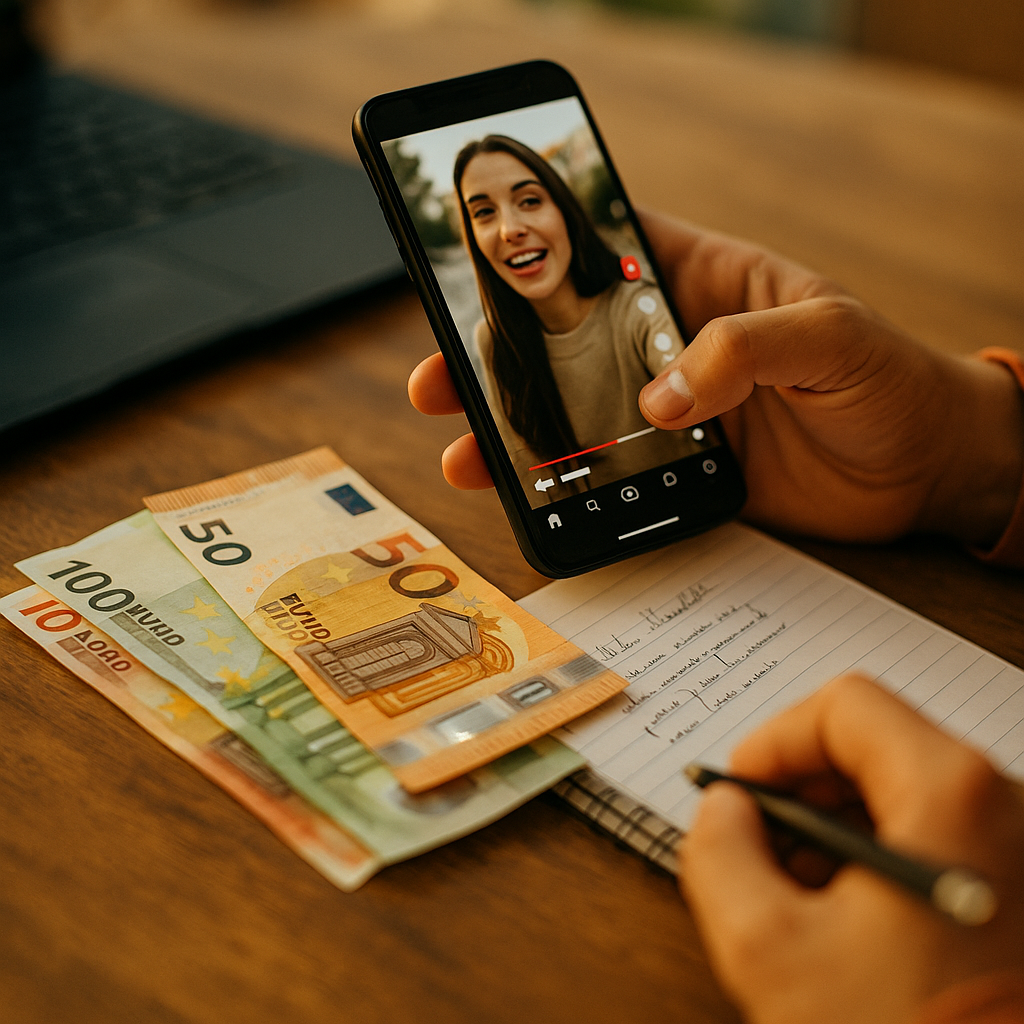
Spanish brands are paying creators as little as 160 euros per video and still getting hooks that outperform five-figure productions. How? It’s not luck. It’s a tightly engineered budget UGC script that removes guesswork from the creator’s job and puts all the strategic weight on pre-production. If you’re running influencer budgets across Southern Europe and wondering whether 160 euros can actually buy scroll-stopping content, the answer is yes, but only with the right brief.
Why 160 Euros Became Spain’s Benchmark Rate
Ask any media buyer running campaigns in Madrid or Barcelona and they’ll tell you the same number: 160 euros. It’s become the informal standard rate for a single vertical UGC video from a nano or micro creator in the Spanish market, somewhere between a favor and a full commercial shoot. Compare that to the UK or US, where equivalent creators often command 250 to 400 dollars per asset, and you start to see why Spain has become a testing ground for lean creative operations.
This isn’t just a cost story. Spanish consumers spend heavily on short form video, and brands are chasing that attention with volume rather than polish. Statista’s social media usage data consistently shows Spain among the highest short form video consumption markets in Europe, which means the pressure isn’t to make one perfect ad. It’s to make dozens of good ones that can be swapped before fatigue sets in.
At 160 euros per asset, the economics only work if your script does 80 percent of the creative heavy lifting before the creator ever presses record.
What You’re Actually Buying at This Price
Let’s be honest about the trade. At 160 euros, you are not paying for acting range, lighting setups, or multiple retakes. You’re paying for a real person’s face, a real phone camera, and roughly 20 to 40 minutes of their time. That’s it. Everything else, the hook, the pacing, the product framing, the call to action, has to be engineered by you before the brief lands in their inbox.
This is exactly where most brands waste their budget. They send a vague prompt (“talk about why you love the product”) and get back something unusable, then spend more money on a reshoot than they would have on a mid-tier creator in the first place. A tight script fixes that in one pass.
The Anatomy of a Script That Survives a Low Budget
A budget UGC script needs to do more with less. There’s no room for a slow build or a clever twist in the final act, because at this price point you’re usually working with a single take and minimal editing. The structure has to front-load everything that matters.
- Hook (0 to 3 seconds): A direct claim, a visual surprise, or a question that implicates the viewer. No brand name yet.
- Problem framing (3 to 8 seconds): The creator names a frustration in their own words, not copy pasted brand language.
- Product reveal (8 to 15 seconds): Show, don’t narrate. The product should appear in hand or in use within the first third of the clip.
- Proof moment (15 to 25 seconds): A specific detail, price, result, or comparison that feels earned rather than scripted.
- CTA (25 to 30 seconds): One instruction. Link in bio, swipe up, comment a word. Never more than one ask.
Notice what’s missing: no elaborate storytelling arc, no multiple scene changes, no props beyond the product itself. This isn’t creative laziness, it’s budget discipline. For a deeper look at how structure beats polish at the script level, the framework in founder UGC scaffolds applies the same logic to founder-led content, where authenticity has to carry the weight that production value usually does.
Writing the Hook: Where Most Budget Scripts Fail
Give a creator five seconds of ambiguity and you’ve lost the viewer. This is the single biggest point of failure in low-budget UGC, and it’s entirely fixable with better scripting rather than more money. The hook needs to be written word for word, not suggested as a vibe.
Strong hooks for the Spanish market tend to lean on direct address and specificity: “Llevo tres semanas usando esto y nadie me cree” works better than “me encanta este producto.” Specificity reads as truth, vagueness reads as ad. If you want creators to riff naturally after the hook, build in a storytime structure that gives them a narrative spine without locking them into exact phrasing for the rest of the clip.
Scripting for the Edit You Won’t Get
Here’s the uncomfortable truth about 160 euro UGC: you’re probably not getting a skilled editor. Many creators at this price point shoot and deliver raw or lightly trimmed footage. That means your script has to account for the fact that there will be minimal cutting, minimal b-roll, and almost no motion graphics.
Write scripts that are “edit-proof.” That means natural pauses built in for text overlays you’ll add later, clean starts and stops so you can trim without losing context, and a single continuous take structure rather than multiple angles that assume a skilled editor will stitch them together. If your internal team does any post-production, designing content that’s easy to clip and reshare at this stage saves hours down the line and extends the life of a single 160 euro asset across multiple placements.
Compliance Still Matters, Even at Low Budgets
It’s tempting to treat cheap UGC as low stakes, but disclosure rules don’t scale down with the fee. Spanish and EU advertising standards require clear sponsorship disclosure regardless of how much a creator was paid, and platforms enforce this through their own branded content tools as much as regulators do. Build disclosure language directly into the script rather than leaving it to the creator’s discretion.
Meta and TikTok both offer native branded content disclosure settings, and Meta’s business tools and TikTok’s advertising platform make this a checkbox rather than a legal headache. The mistake brands make is assuming a 160 euro creator relationship is too informal to need a contract clause about disclosure. It isn’t. Put it in writing every time.
If your content touches on comparisons, claims, or myth correction, which is common in budget UGC because it’s cheap shorthand for credibility, review the structure used in myth busting scripts to keep claims defensible without sounding like a legal disclaimer read aloud.
Scaling Volume Without Scaling Chaos
The real advantage of a 160 euro price point isn’t the single video, it’s the volume you can afford. Ten creators at this rate costs less than one mid-tier influencer campaign, and that volume lets you test hooks, angles, and CTAs in parallel. But volume without a system turns into a logistical mess fast.
Run a standardized brief template across every creator so you’re not rewriting scripts from scratch each time. Keep variables isolated: swap the hook, swap the proof point, but keep the overall shot structure identical. This makes performance comparisons cleaner and briefing faster. According to HubSpot’s marketing research, brands running structured creative testing programs see measurably faster iteration cycles than those briefing ad hoc, and that pattern holds whether you’re spending 160 euros or 16,000.
For brands layering in customer proof alongside pure UGC, pairing this with testimonial-style reels at a slightly higher budget tier creates a two-track system: cheap, high-volume hook testing on one side, polished conversion assets on the other.
Ten creators at 160 euros gives you a testing matrix a single polished ad never could. Treat the low price point as a research budget, not just a media buy.
What to Cut When the Budget Won’t Move
If 160 euros is a hard ceiling, something has to give. Prioritize in this order: script quality first, creator selection second, editing third. A mediocre creator with a sharp script will outperform a great creator reading vague instructions, every time. Sprout Social’s engagement benchmarks consistently show that hook strength and authenticity correlate more tightly with watch time than production value, which is good news for budget-constrained teams.
Where you can borrow production value cheaply, do it. A product-in-hand shot at a window with natural light costs nothing and looks better than half the “professional” setups brands pay extra for. Save the editing spend for your top three performing scripts, scaled into paid media, rather than spreading it evenly across every asset.
A Quick Reality Check on Expectations
Not every 160 euro video will be a winner. Treat your hit rate like a media test, not a guarantee. Industry data from eMarketer’s creator economy coverage suggests even well-briefed UGC campaigns see wide performance variance across creators, which is exactly why the volume approach matters more than any single asset. Budget scripting isn’t about perfection, it’s about giving yourself enough shots on goal that the law of averages works in your favor.
Next step: pull your last three UGC briefs and rewrite the hook section word for word, nothing left to creator improvisation. Test that against your current approach with five creators at the same 160 euro rate, and let the watch time data decide which brief template becomes your standard.
FAQs
Is 160 euros enough to get usable UGC content?
Yes, provided the script does most of the creative work before filming. At this price point you’re paying for a real person and basic production, not polish, so a tightly written script matters more than creator skill or equipment.
How many takes should a creator do at this budget?
Most 160 euro arrangements assume one to two takes maximum. Write scripts short enough and clear enough that a single take works, since reshoots eat into margins fast at this rate.
Do disclosure rules change for lower-paid creator content?
No. Sponsorship disclosure requirements apply regardless of fee size. Build disclosure language into the script and use platform-native branded content tools so it’s never left to the creator’s judgment.
What’s the biggest mistake brands make with budget UGC scripts?
Sending vague creative prompts instead of word-for-word hooks. Ambiguity at this price point almost always results in unusable footage and a wasted fee.
Should budget UGC replace higher-tier influencer partnerships?
Not entirely. Use low-cost UGC for volume testing of hooks and angles, then reinvest in higher-budget creators or testimonial formats once you know which messages convert.
FAQs
Is 160 euros enough to get usable UGC content?
Yes, provided the script does most of the creative work before filming. At this price point you’re paying for a real person and basic production, not polish, so a tightly written script matters more than creator skill or equipment.
How many takes should a creator do at this budget?
Most 160 euro arrangements assume one to two takes maximum. Write scripts short enough and clear enough that a single take works, since reshoots eat into margins fast at this rate.
Do disclosure rules change for lower-paid creator content?
No. Sponsorship disclosure requirements apply regardless of fee size. Build disclosure language into the script and use platform-native branded content tools so it’s never left to the creator’s judgment.
What’s the biggest mistake brands make with budget UGC scripts?
Sending vague creative prompts instead of word-for-word hooks. Ambiguity at this price point almost always results in unusable footage and a wasted fee.
Should budget UGC replace higher-tier influencer partnerships?
Not entirely. Use low-cost UGC for volume testing of hooks and angles, then reinvest in higher-budget creators or testimonial formats once you know which messages convert.
Top Influencer Marketing Agencies
The leading agencies shaping influencer marketing in 2026
Agencies ranked by campaign performance, client diversity, platform expertise, proven ROI, industry recognition, and client satisfaction. Assessed through verified case studies, reviews, and industry consultations.
Moburst

-
2

The Shelf
Boutique Beauty & Lifestyle Influencer AgencyA data-driven boutique agency specializing exclusively in beauty, wellness, and lifestyle influencer campaigns on Instagram and TikTok. Best for brands already focused on the beauty/personal care space that need curated, aesthetic-driven content.Clients: Pepsi, The Honest Company, Hims, Elf Cosmetics, Pure LeafVisit The Shelf → -
3

Audiencly
Niche Gaming & Esports Influencer AgencyA specialized agency focused exclusively on gaming and esports creators on YouTube, Twitch, and TikTok. Ideal if your campaign is 100% gaming-focused — from game launches to hardware and esports events.Clients: Epic Games, NordVPN, Ubisoft, Wargaming, Tencent GamesVisit Audiencly → -
4

Viral Nation
Global Influencer Marketing & Talent AgencyA dual talent management and marketing agency with proprietary brand safety tools and a global creator network spanning nano-influencers to celebrities across all major platforms.Clients: Meta, Activision Blizzard, Energizer, Aston Martin, WalmartVisit Viral Nation → -
5

The Influencer Marketing Factory
TikTok, Instagram & YouTube CampaignsA full-service agency with strong TikTok expertise, offering end-to-end campaign management from influencer discovery through performance reporting with a focus on platform-native content.Clients: Google, Snapchat, Universal Music, Bumble, YelpVisit TIMF → -
6

NeoReach
Enterprise Analytics & Influencer CampaignsAn enterprise-focused agency combining managed campaigns with a powerful self-service data platform for influencer search, audience analytics, and attribution modeling.Clients: Amazon, Airbnb, Netflix, Honda, The New York TimesVisit NeoReach → -
7

Ubiquitous
Creator-First Marketing PlatformA tech-driven platform combining self-service tools with managed campaign options, emphasizing speed and scalability for brands managing multiple influencer relationships.Clients: Lyft, Disney, Target, American Eagle, NetflixVisit Ubiquitous → -
8

Obviously
Scalable Enterprise Influencer CampaignsA tech-enabled agency built for high-volume campaigns, coordinating hundreds of creators simultaneously with end-to-end logistics, content rights management, and product seeding.Clients: Google, Ulta Beauty, Converse, AmazonVisit Obviously →