


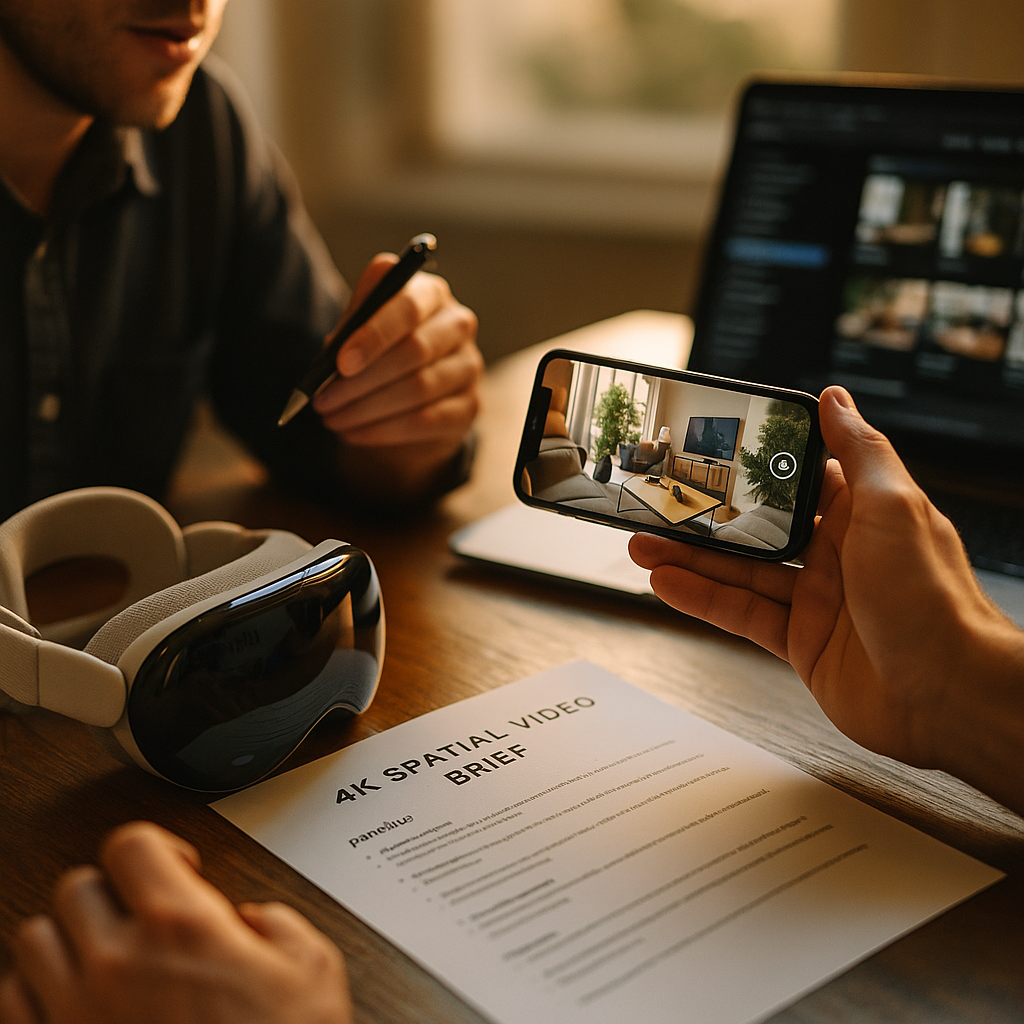
Fewer than 5% of brand campaigns have ever produced a single frame of spatial video. That gap is about to become a competitive fault line. As Apple Vision Pro’s YouTube app matures into a legitimate immersive channel, 4K spatial video is shifting from a novelty demo into a format that serious brand strategists need to evaluate, budget for, and brief correctly.
Why Spatial Video Is Different From Every Format You’ve Used Before
Standard video is a window. Spatial video is a room you walk into. That distinction sounds poetic, but it has hard operational consequences for every team involved in production, creative strategy, and brand safety.
In spatial video, depth is a primary creative variable. Objects can appear to exist in front of the screen plane, which means a product placed in the foreground of a frame doesn’t just look prominent — it occupies the viewer’s personal space. That’s a fundamentally different relationship than a 30-second pre-roll. The attention quality is incomparable.
Spatial video’s depth plane puts branded product moments inside a viewer’s perceived physical environment — a level of presence no flat-screen format can replicate. Brands that figure out spatial storytelling early will own a perception advantage that latecomers can’t buy their way into.
Apple’s Vision Pro YouTube app renders spatial content at up to 4K per eye, with the visionOS environment providing the contextual frame around that content. This means brand safety considerations extend beyond the video itself into how the viewer’s broader immersive environment is configured. It’s a new layer of context that brand teams haven’t had to consider before.
Evaluating Spatial Video as a Channel: The Four Questions Every Brand Team Needs to Answer
Before committing production budget, run this evaluation framework honestly.
1. Does your audience skew early-adopter or premium? Apple Vision Pro’s installed base remains concentrated among tech professionals, high-income households, and enterprise users. If your brand targets value-conscious mass-market consumers, spatial video ROI is speculative right now. If you’re in luxury, automotive, travel, real estate, or high-consideration B2C, the audience match is already reasonable and improving.
2. Is your product demonstrably better in three dimensions? Some categories are obvious: architecture, interior design, automotive interiors, fashion with texture and drape, travel destinations, surgical devices, and sports experiences. Others require more creative problem-solving. A CPG brand selling cereal has a harder spatial brief to write than a hotel brand showing a suite walkthrough.
3. Can your production infrastructure support dual-camera capture? Spatial video requires a stereoscopic camera rig — two lenses separated by roughly the same distance as human eyes (about 65mm). The Apple ecosystem has made this more accessible through iPhone 15 Pro and 16 Pro native spatial capture, but professional-grade spatial production still involves specialized rigs, spatial audio mixing, and post-production workflows that most agencies haven’t standardized yet.
4. How will you measure it? YouTube’s analytics for spatial content are still maturing. Watch time, rewatch rates, and engagement signals exist, but spatial-specific attention metrics (like gaze direction or depth interaction) require Vision Pro’s native app layer, not YouTube’s standard dashboard. Set measurement expectations before you set budgets.
What the Production Brief for Spatial Video Actually Needs to Include
Most creative briefs weren’t written with depth planes in mind. A standard brief asks for platform specs, tone, messaging hierarchy, and a call to action. A spatial video brief needs all of that plus a different layer of technical and experiential direction that most creative teams have never been asked to produce.
Here’s what a production brief for spatial video must address:
- Depth composition map: Specify which brand elements live in which depth plane — foreground (in front of the screen), mid-ground, and background. Product reveals, logos, and CTAs should be mapped explicitly, not left to the director’s interpretation.
- Interocular distance specification: For professional rigs, this is typically 63–65mm to match natural human vision. Deviation creates discomfort or a toy-world effect. Document the approved range and flag it for post review.
- Spatial audio direction: Sound in immersive video should spatially correspond to visual position. A voiceover “coming from” directly in front is different from a product sound that originates from where the product appears in 3D space. Brief this explicitly.
- Motion guidelines: Fast lateral movement and sudden depth shifts cause discomfort for some viewers. The brief should define maximum acceptable camera motion speed, prohibit certain transitions (like fast whip pans), and specify stabilization requirements.
- Screen-plane compliance: Some brands will want all content to stay “behind the screen” for a safer, less intrusive experience. Others will deliberately push elements forward for impact. This is a brand decision, not a director’s call. Write it into the brief.
- Flat-format derivative: Most spatial shoots should simultaneously capture a 2D version. Brief the crew on which shots are spatial-primary and which can be captured 2D-only. This protects your production investment across more distribution contexts.
- Compliance markers: FTC disclosure requirements don’t change in spatial video. Sponsored content disclosures must remain legible and prominent. In spatial content, this means testing disclosure placement at viewing distance in the Vision Pro environment, not just checking it looks fine on a monitor.
For teams building creator briefs that work across multiple delivery formats simultaneously, the frameworks outlined in multi-format creator brief planning offer a useful structural starting point before layering in spatial-specific requirements.
Creator Casting for Spatial: It’s Not the Same Criteria
Not every creator who shoots great vertical video can direct spatial content. The skill set is genuinely different. Spatial storytelling rewards creators who think in terms of physical staging and environmental design, not just frame composition. Theater directors, architecture photographers, and experiential event producers often have better spatial instincts than high-follower TikTok creators.
When evaluating creators for spatial briefs, look for demonstrated experience with depth-conscious cinematography, familiarity with Apple’s spatial video capture tools, and comfort working with technical post-production constraints. For deeper guidance on spatial video creator briefs specific to Vision Pro, the criteria for evaluating creator readiness deserve their own review.
The entertainment quality bar also rises in spatial. A viewer wearing Vision Pro is committed to the experience in a way that a phone-scroll viewer is not. Boring content feels worse in immersive environments, not better. Review entertainment-first brief principles before you finalize creative direction for spatial shoots, because passive brand messaging fails harder in this medium.
Budget Architecture for Spatial: Expect a 3–5x Premium
Spatial video production costs significantly more than comparable flat-video production. A realistic spatial production premium runs 3 to 5 times the cost of an equivalent 2D shoot, accounting for specialized equipment rental, dual-capture post-production workflows, spatial audio mixing, and quality assurance testing on actual Vision Pro hardware.
That cost structure means spatial is not a high-volume format. Treat it the way luxury brands treat 60-second broadcast spots: fewer executions, higher production value, longer shelf life. One exceptional spatial brand film with a 12-month distribution window often outperforms five mediocre spatial attempts produced for the same budget.
Agencies building multi-format budgets that include a spatial component should also plan for a multi-platform shoot brief structure that captures spatial and 2D assets simultaneously to maximize the production investment across YouTube spatial, standard YouTube, and other channels.
One well-produced spatial video can function as both a brand film and a platform-specific asset for years. The production premium is real, but so is the longevity advantage over formats with six-week creative lifespans.
Platform Distribution: YouTube Spatial Is Only the Beginning
YouTube’s spatial video support on Vision Pro is the most accessible distribution path for brand spatial content right now, but it’s not the only one. Apple’s visionOS supports native spatial video playback through the Photos and TV apps, and social media management platforms are beginning to track spatial content performance as a distinct content category. Meta’s mixed-reality platforms on Quest are a parallel ecosystem worth monitoring, though the Vision Pro audience currently offers higher purchase-intent demographics for premium brands.
YouTube’s algorithm does not currently surface spatial content with preferential ranking in standard search results, but spatial videos can be tagged and surfaced within Vision Pro’s YouTube app experience. This is a pull channel for now: viewers actively seek immersive content rather than being served it algorithmically. That changes your content strategy — you need compelling thumbnails and spatial-specific metadata to attract the segment that’s actively browsing for immersive experiences.
The Readiness Checklist Before You Greenlight a Spatial Budget
Before you approve a spatial video line item, confirm you have:
- A production partner with demonstrable spatial video credits (ask to see content played on actual Vision Pro hardware, not just on a monitor)
- A brief that specifies depth planes, motion limits, spatial audio direction, and screen-plane policy
- A 2D derivative capture plan baked into the shoot schedule
- Legal review of disclosure placement in the spatial environment
- A measurement framework agreed upon before production begins
- Internal alignment that this is a brand-building investment, not a direct-response channel
Start with one spatial hero asset. Test distribution on YouTube’s Vision Pro experience. Measure watch time, rewatch rates, and any brand lift signals you can access. Then scale the format based on data, not enthusiasm.
Frequently Asked Questions
What is 4K spatial video and why does it matter for brands?
4K spatial video is stereoscopic video captured at 4K resolution per eye, designed for playback on immersive devices like Apple Vision Pro. For brands, it creates a perceptual environment where viewers experience products and environments as if they were physically present, offering a level of attention quality and emotional presence that flat-screen video formats cannot replicate.
Does Apple Vision Pro’s YouTube app support brand-sponsored spatial content?
Yes. YouTube’s Vision Pro app renders spatial video uploaded in the MV-HEVC format with spatial audio. Brand-sponsored content, including influencer collaborations and direct brand uploads, can be distributed through this channel. Standard YouTube advertising policies and FTC disclosure requirements apply regardless of the playback device.
What camera equipment is needed for professional spatial video production?
Professional spatial video production typically uses stereoscopic rigs with two cameras or lenses separated at roughly 63–65mm interocular distance. Consumer-accessible options include iPhone 15 Pro and 16 Pro, which capture spatial video natively. Professional-grade productions use purpose-built rigs from manufacturers like Canon (the EOS VR system), Sony, and specialized rental houses. All require spatial-compatible post-production workflows and spatial audio mixing.
How should brands handle FTC disclosure requirements in spatial video content?
FTC disclosure requirements apply to spatial video just as they do to any other sponsored content format. Disclosures must be clear, conspicuous, and legible at the viewing distance typical of Vision Pro use. Brands should test disclosure placement on actual Vision Pro hardware before finalizing production, since text that reads well on a monitor may not scale appropriately in the immersive viewing environment.
What metrics should brands use to evaluate spatial video performance on YouTube?
Currently, YouTube Analytics provides watch time, average view duration, rewatch rates, and engagement signals for spatial content. Spatial-specific attention metrics like gaze tracking are not available through YouTube’s standard dashboard. Brands should prioritize watch-through rate and rewatch rate as primary performance indicators, supplemented by any brand lift studies conducted in partnership with Google’s measurement tools.
Is spatial video worth the production premium for most brands right now?
Spatial video makes the strongest ROI case for brands in high-consideration categories where product experience drives purchase decisions: luxury goods, automotive, travel, real estate, architecture, and premium consumer electronics. For mass-market CPG and price-sensitive categories, the current Vision Pro installed base and production cost premium make spatial video a longer-term investment rather than a near-term performance channel. The format’s value will increase as the device install base grows.
Top Influencer Marketing Agencies
The leading agencies shaping influencer marketing in 2026
Agencies ranked by campaign performance, client diversity, platform expertise, proven ROI, industry recognition, and client satisfaction. Assessed through verified case studies, reviews, and industry consultations.
Moburst

-
2

The Shelf
Boutique Beauty & Lifestyle Influencer AgencyA data-driven boutique agency specializing exclusively in beauty, wellness, and lifestyle influencer campaigns on Instagram and TikTok. Best for brands already focused on the beauty/personal care space that need curated, aesthetic-driven content.Clients: Pepsi, The Honest Company, Hims, Elf Cosmetics, Pure LeafVisit The Shelf → -
3

Audiencly
Niche Gaming & Esports Influencer AgencyA specialized agency focused exclusively on gaming and esports creators on YouTube, Twitch, and TikTok. Ideal if your campaign is 100% gaming-focused — from game launches to hardware and esports events.Clients: Epic Games, NordVPN, Ubisoft, Wargaming, Tencent GamesVisit Audiencly → -
4

Viral Nation
Global Influencer Marketing & Talent AgencyA dual talent management and marketing agency with proprietary brand safety tools and a global creator network spanning nano-influencers to celebrities across all major platforms.Clients: Meta, Activision Blizzard, Energizer, Aston Martin, WalmartVisit Viral Nation → -
5

The Influencer Marketing Factory
TikTok, Instagram & YouTube CampaignsA full-service agency with strong TikTok expertise, offering end-to-end campaign management from influencer discovery through performance reporting with a focus on platform-native content.Clients: Google, Snapchat, Universal Music, Bumble, YelpVisit TIMF → -
6

NeoReach
Enterprise Analytics & Influencer CampaignsAn enterprise-focused agency combining managed campaigns with a powerful self-service data platform for influencer search, audience analytics, and attribution modeling.Clients: Amazon, Airbnb, Netflix, Honda, The New York TimesVisit NeoReach → -
7

Ubiquitous
Creator-First Marketing PlatformA tech-driven platform combining self-service tools with managed campaign options, emphasizing speed and scalability for brands managing multiple influencer relationships.Clients: Lyft, Disney, Target, American Eagle, NetflixVisit Ubiquitous → -
8

Obviously
Scalable Enterprise Influencer CampaignsA tech-enabled agency built for high-volume campaigns, coordinating hundreds of creators simultaneously with end-to-end logistics, content rights management, and product seeding.Clients: Google, Ulta Beauty, Converse, AmazonVisit Obviously →