


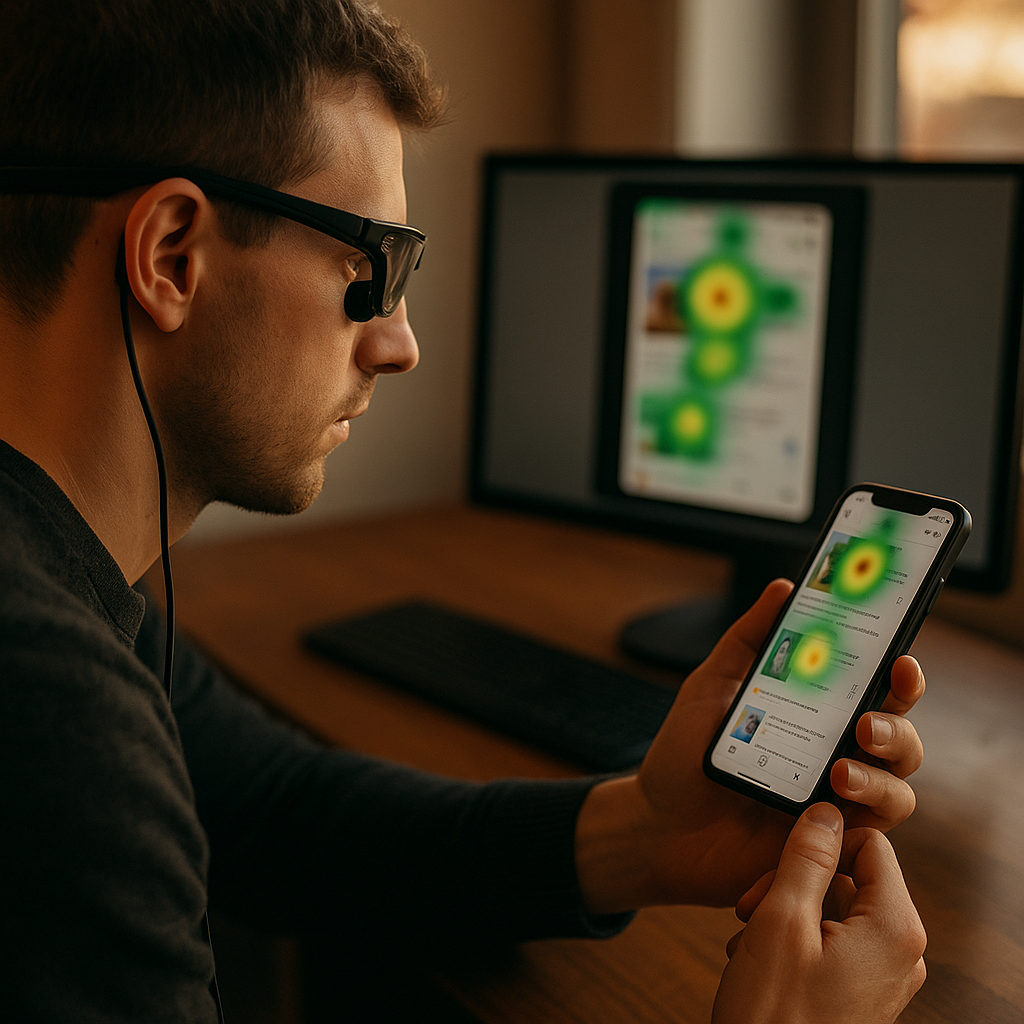
Marketers chase attention, but attention has rules. The science of scroll-stopping visuals comes from measuring where people actually look, not where we hope they look. Eye-tracking data reveals how layout, contrast, motion, and meaning compete in milliseconds—especially on mobile feeds. In 2025, brands that treat attention like measurable behavior win. Ready to see what your audience’s eyes really do?
Eye-tracking data insights: what “attention” really means
Eye-tracking turns “this looks good” into observable behavior. Most systems track gaze position and derive events such as fixations (when eyes pause to process), saccades (rapid jumps between points), and scanpaths (the sequence of viewing). For scroll-stopping creative, the key is understanding attention allocation: which elements attract the first glance, which hold focus long enough to process meaning, and which get ignored entirely.
In practical terms, you use eye-tracking to answer the questions decision-makers actually care about:
- Did the viewer notice the brand? Brand recall often fails because branding sits outside early fixations.
- Did the viewer read the message? Text can be “present” but unread if fixation duration is too short.
- Did the viewer understand the offer? Eyes can land on a discount badge without integrating it with the product.
- What stole attention? Background faces, high-contrast edges, and decorative icons can hijack gaze.
“Scroll-stopping” is often described as a single moment, but eye-tracking shows it’s a chain: capture (initial fixation), stabilize (keep attention), and resolve (convert attention into comprehension and action). Strong creative performs across all three.
Visual attention triggers: the brain’s fastest filters
To stop a thumb, visuals must win a competition that happens before conscious thought. Early attention is heavily influenced by bottom-up cues such as contrast and edges, while later attention is shaped by meaning and goals. Great creative aligns both: it earns the first look and then rewards it with clarity.
Common attention triggers that consistently show up in gaze data:
- Faces and eye direction: Faces attract fixations quickly; gaze direction can pull viewers toward text or products. If a model looks away from the message, the audience often follows.
- High contrast and sharp boundaries: Strong luminance contrast and crisp edges create “visual anchors” that pull early fixations.
- Single dominant subject: A clear subject reduces search time. Busy scenes force scanning, which can cause drop-off in fast feeds.
- Motion cues: Even implied motion (hair movement, dynamic angles) can attract attention, but excessive motion-like detail may scatter fixations.
- Novelty with relevance: Unusual compositions draw eyes, yet if the novelty isn’t connected to the value proposition, attention fails to convert.
Many teams over-index on “pattern interrupts” without planning the second step: comprehension. Eye-tracking helps you verify whether the interrupt points viewers toward the product, value claim, and call-to-action—or traps them in decorative elements.
Heatmaps and AOI metrics: how to read results without fooling yourself
Heatmaps are popular because they’re intuitive, but they’re also easy to misread. A red hotspot doesn’t automatically mean “effective.” It could mean confusion, search effort, or distraction. To interpret results well, combine visualization with structured metrics.
Use Areas of Interest (AOIs)—defined zones like logo, product, headline, price, CTA—to compute metrics that map to business outcomes:
- Time to First Fixation (TTFF): How quickly viewers look at the product, brand, and message. Lower TTFF for key AOIs usually indicates better capture.
- Dwell time: Total time spent on an AOI. High dwell can be good (engagement) or bad (confusion); interpret alongside comprehension checks.
- Fixation count: More fixations can signal interest or difficulty; compare across variants and audiences.
- Revisits: Returning to price or fine print may indicate hesitation—useful for diagnosing friction.
- Coverage: The percentage of participants who looked at each AOI. If only a minority ever sees the CTA, the layout is failing.
To avoid self-deception, apply three rules. First, tie each metric to a hypothesis (e.g., “moving the discount badge near the product reduces TTFF to price and increases comprehension”). Second, standardize viewing conditions: device type, distance, and exposure time matter. Third, pair eye-tracking with outcomes: quick recall questions, comprehension prompts, or a choice task so you can tell whether attention produced understanding.
Mobile feed design principles: building for the scroll context
Most scroll behavior happens on mobile, where the viewport is small and the decision window is short. Eye-tracking repeatedly shows that mobile viewers are less tolerant of searching. They reward clear hierarchy and punish clutter.
Design principles that reliably improve attention flow in feeds:
- Establish a single reading path: Guide the eye from subject to value claim to CTA. When gaze bounces between unrelated points, comprehension drops.
- Keep text minimal, but not cryptic: A few high-information words often outperform long copy. If the offer requires explanation, use tight phrasing and strong typographic contrast.
- Place the brand where it will be seen early: A logo in a corner may be missed. Consider integrating branding near the primary subject or within the first fixation cluster.
- Design for thumb-stopping contrast: Ensure the subject separates clearly from the background. Avoid mid-tone-on-mid-tone compositions that disappear in feeds.
- Use faces strategically: If you use a face, control where it directs attention. A face looking toward the headline often increases headline fixations.
- Reduce competing highlights: Multiple bright stickers, badges, and icons create parallel hotspots and dilute the message.
Readers often ask, “Should we always center the subject?” Not always. Eye-tracking supports off-center compositions when they create a clear visual route and preserve negative space for text. The practical test is whether TTFF to your headline and product improves without increasing search-like scanning.
Creative testing framework: experiments that make eye-tracking actionable
Eye-tracking becomes valuable when you treat it as an experiment system, not a one-off study. In 2025, teams move fastest when they test small design changes with clear hypotheses, then roll learnings into templates.
A reliable framework:
- Define the decision you’re optimizing: Awareness, offer comprehension, click intent, or brand association. Different goals change which AOIs matter most.
- Write measurable hypotheses: Example: “Increasing headline font size and moving it closer to the product reduces TTFF to headline by 20% and increases correct offer recall.”
- Create controlled variants: Change one major variable at a time: layout, contrast, face direction, headline placement, or CTA styling.
- Choose the right stimulus: Static images, short video, or scroll simulations. If the ad appears in a feed, test it in a feed-like environment.
- Combine gaze with comprehension and preference: Add a short prompt after exposure: “What is the offer?” “Which brand did you see?” “What would you do next?”
- Decide with a scorecard: Weight metrics (coverage of key AOIs, TTFF, recall accuracy) rather than chasing a single number.
Common follow-up: “How many participants do we need?” It depends on variability and stakes. For directional creative decisions, smaller studies can reveal obvious failures (missed branding, unreadable text). For high-stakes launches, increase sample size and segment by device and audience, because attention patterns can shift across demographics and familiarity levels.
EEAT and privacy considerations: trustworthy methods and ethical data use
Helpful, credible content requires more than clever charts. Apply EEAT principles to how you run, interpret, and communicate eye-tracking findings—especially when those findings influence public-facing messages.
Experience: Validate insights with real contexts: mobile devices, realistic viewing distances, and feed simulations. Report whether viewers could scroll, whether audio was present, and how long exposures lasted.
Expertise: Use established definitions (fixation, TTFF, AOIs) and avoid over-claiming. Eye-tracking shows where and when people look, not what they believe. Pair gaze with comprehension checks to support interpretation.
Authoritativeness: Document your method: recruitment criteria, calibration quality, stimuli order, and how AOIs were defined. Consistent reporting makes your learnings reusable across campaigns.
Trustworthiness: Treat eye-tracking as sensitive behavioral data. Minimize collection, anonymize outputs, and clearly disclose purpose and retention. If you use webcam-based eye-tracking, explain accuracy limits and ensure users opt in with informed consent.
Readers often ask if “attention metrics” can replace performance data like CTR or conversions. They can’t. Eye-tracking is best used to diagnose why performance differs between creatives and to reduce wasted spend by fixing obvious attention bottlenecks before scaling.
Conclusion: Eye-tracking turns scroll-stopping visuals from guesswork into a measurable system: capture attention fast, keep it focused, and convert it into understanding. Use AOIs, TTFF, coverage, and comprehension checks to identify what’s seen, what’s missed, and what distracts. In 2025, the winning approach is simple: test with realistic feed contexts, document methods, and design for the viewer’s actual gaze path.
FAQs about analyzing eye-tracking data for scroll-stopping visuals
-
What is the primary benefit of eye-tracking for creative?
It shows which elements attract the first look and whether viewers reach the product, message, and CTA quickly enough to understand the offer before they scroll.
-
Are heatmaps enough to choose a winning ad?
No. Heatmaps are a starting point. Use AOI metrics (TTFF, coverage, dwell, revisits) and pair them with recall or comprehension questions to confirm that attention led to understanding.
-
How do I know if high dwell time is good or bad?
Check comprehension. High dwell on the headline with high offer recall is usually good. High dwell with poor recall often means the text is hard to parse or the layout is confusing.
-
What elements most often steal attention from the message?
Faces looking away from the offer, high-contrast background objects, decorative icons, and competing badges. Eye-tracking helps you spot these “attention sinks” quickly.
-
Should logos be big to be noticed?
Not always. Placement and integration matter more than raw size. A smaller logo near the primary subject can get more early fixations than a larger logo isolated in a corner.
-
Is webcam-based eye-tracking accurate enough?
It can be useful for directional insights when you control lighting and device setup, but it’s typically less precise than dedicated hardware. Use larger AOIs and focus on robust patterns like coverage and TTFF to major elements.
Top Influencer Marketing Agencies
The leading agencies shaping influencer marketing in 2026
Agencies ranked by campaign performance, client diversity, platform expertise, proven ROI, industry recognition, and client satisfaction. Assessed through verified case studies, reviews, and industry consultations.
Moburst

-
2

The Shelf
Boutique Beauty & Lifestyle Influencer AgencyA data-driven boutique agency specializing exclusively in beauty, wellness, and lifestyle influencer campaigns on Instagram and TikTok. Best for brands already focused on the beauty/personal care space that need curated, aesthetic-driven content.Clients: Pepsi, The Honest Company, Hims, Elf Cosmetics, Pure LeafVisit The Shelf → -
3

Audiencly
Niche Gaming & Esports Influencer AgencyA specialized agency focused exclusively on gaming and esports creators on YouTube, Twitch, and TikTok. Ideal if your campaign is 100% gaming-focused — from game launches to hardware and esports events.Clients: Epic Games, NordVPN, Ubisoft, Wargaming, Tencent GamesVisit Audiencly → -
4

Viral Nation
Global Influencer Marketing & Talent AgencyA dual talent management and marketing agency with proprietary brand safety tools and a global creator network spanning nano-influencers to celebrities across all major platforms.Clients: Meta, Activision Blizzard, Energizer, Aston Martin, WalmartVisit Viral Nation → -
5

The Influencer Marketing Factory
TikTok, Instagram & YouTube CampaignsA full-service agency with strong TikTok expertise, offering end-to-end campaign management from influencer discovery through performance reporting with a focus on platform-native content.Clients: Google, Snapchat, Universal Music, Bumble, YelpVisit TIMF → -
6

NeoReach
Enterprise Analytics & Influencer CampaignsAn enterprise-focused agency combining managed campaigns with a powerful self-service data platform for influencer search, audience analytics, and attribution modeling.Clients: Amazon, Airbnb, Netflix, Honda, The New York TimesVisit NeoReach → -
7

Ubiquitous
Creator-First Marketing PlatformA tech-driven platform combining self-service tools with managed campaign options, emphasizing speed and scalability for brands managing multiple influencer relationships.Clients: Lyft, Disney, Target, American Eagle, NetflixVisit Ubiquitous → -
8

Obviously
Scalable Enterprise Influencer CampaignsA tech-enabled agency built for high-volume campaigns, coordinating hundreds of creators simultaneously with end-to-end logistics, content rights management, and product seeding.Clients: Google, Ulta Beauty, Converse, AmazonVisit Obviously →