


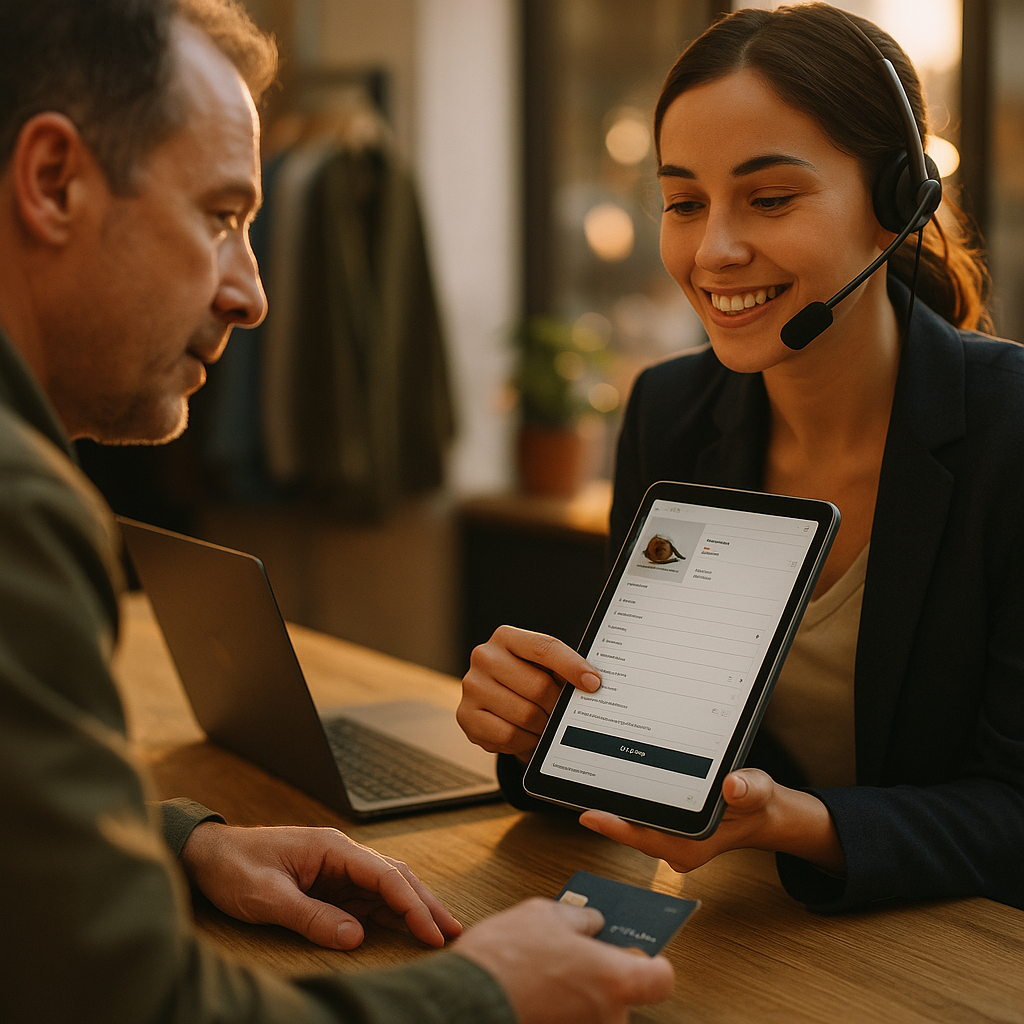
Writing compelling microcopy for agent-driven checkout is the fastest way to reduce friction when a human (or hybrid) agent guides a customer through payment, identity checks, and confirmation. In 2025, shoppers expect clarity, speed, and control—especially when someone else is “driving” the flow. The right words can prevent errors, build trust, and protect compliance while keeping momentum. Here’s how to craft microcopy that converts and reassures.
Agent-driven checkout microcopy: what it is and why it converts
Agent-driven checkout happens when an agent—sales, support, concierge, or a specialist—initiates or steers a checkout on the customer’s behalf. This can occur in a live chat, call center, co-browsing session, assisted web flow, or within a CRM-triggered payment link. Microcopy is the small, high-impact text that guides actions: button labels, hints, error messages, consent language, and reassurance statements.
Because the customer is not acting alone, they carry extra questions: What is the agent doing? What will happen next? Is this secure? Can I stop? Your microcopy must answer those questions at the exact moment they appear, in the fewest words possible. That is why it converts: it removes uncertainty and reduces back-and-forth.
Practical goal: Write microcopy that supports three outcomes simultaneously—customer confidence, agent efficiency, and compliant processing—without adding steps.
Checkout clarity and trust: microcopy that reassures in real time
Trust is fragile in assisted payment flows because the customer may be sharing personal details while an agent is present. “Reassurance microcopy” should be specific, verifiable, and aligned with what your system truly does. Avoid vague claims like “100% safe.” Instead, explain the safeguard and the customer’s control.
High-performing reassurance patterns:
- State who is doing what: “Your agent is preparing your order summary. You’ll review before paying.”
- Explain visibility: “Your agent can’t see your full card number.” (Only use if accurate.)
- Confirm control: “You can cancel any time before you confirm payment.”
- Define the next step: “Next: verify your delivery address.”
Place reassurance at decision points: before identity verification, before payment authorization, and on the final confirmation screen. When you need to mention security or privacy, keep it plain and actionable. If a customer wants details, include a short “Learn more” line only if your interface supports it—otherwise microcopy should direct them to what the agent can do: “Ask your agent to explain how payment is protected.”
Follow-up question you should answer in-line: “Why do you need this?” Use a brief reason statement where you request sensitive data: “We ask for your phone number to send delivery updates and a receipt.” Reason statements reduce abandonment and help agents avoid repeating explanations.
Conversion-focused microcopy: prompts, buttons, and next-step language
Agent-driven checkout often fails on momentum. Customers hesitate when the wording feels like a handoff to a faceless system, or when buttons don’t match what the agent just promised. Conversion-focused microcopy keeps customer and agent aligned through consistent verbs, predictable sequencing, and friction-aware defaults.
1) Use “progressive commitment” verbs
Buttons should reflect the customer’s immediate intention, not your internal process. Compare:
- Weak: “Continue”
- Better: “Review order”
- Best: “Review and confirm details” (only if the next screen is truly a review)
In assisted flows, clarity beats cleverness. Customers want to know exactly what will happen when they click—especially while an agent watches or waits.
2) Make next steps skimmable
Use short, structured microcopy above key sections:
- Step label: “Step 2 of 3: Payment”
- Expectation: “This takes about 30 seconds.” (Only if true.)
- Agency: “You’ll confirm before anything is charged.”
3) Reduce cognitive load with pre-filled summaries
When an agent selects products, shipping, or discounts, present a clean summary line: “Selected by your agent: Plan A, monthly, starts today.” Then add a microcopy link or expandable note for detail if your UI supports it. If not, keep the summary concise and readable on mobile.
4) Avoid microcopy contradictions
If the agent says “You won’t be charged today,” your UI cannot say “Pay now.” Choose language that matches the payment method:
- Authorization now, capture later: “Authorize payment”
- Invoice: “Confirm and request invoice”
- Subscription trial: “Start trial” + “First charge on [date]”
This alignment prevents disputes, chargebacks, and support escalations—key trust signals that directly affect conversion and retention.
Error prevention and recovery: validation microcopy that keeps customers moving
In agent-driven checkout, errors can feel more embarrassing because someone else is present. Your microcopy should protect the customer’s dignity, help the agent troubleshoot quickly, and preserve forward progress.
Principles for better error microcopy:
- Be specific: “Card number is missing a digit” beats “Invalid card.”
- Describe the fix: “Enter the 3-digit code on the back of your card.”
- Keep blame out: Avoid “You entered…” Use “We couldn’t verify…”
- Offer an alternative: “Try a different card” or “Use bank transfer” when possible.
Design your microcopy for the agent’s reality
Agents need copy they can read aloud without sounding robotic. Write it as spoken language: short sentences, familiar terms, no legal jargon. For example:
- Payment failed: “We couldn’t authorize this payment. Nothing was charged. Try again or use another method.”
- Address mismatch: “The postcode doesn’t match the city. Check spelling or pick from the suggestions.”
Recover without restarting
If the customer times out, don’t punish them with a full reset. Use microcopy that explains what was saved and what must be re-entered: “Your order is saved. For security, please re-enter your payment details.” This both reassures and reduces support load.
Follow-up question to answer in the moment: “Did it go through?” Always include an explicit status statement after payment attempts: “Payment not completed.” or “Payment confirmed.” Avoid ambiguous states like “Processing…” without a time expectation and a clear fallback.
Compliance and consent language: privacy, security, and disclosures that customers understand
Assisted checkout adds compliance complexity: consent, disclosures, and data handling must be clear to the customer and defensible for your business. The best microcopy meets legal requirements while staying readable. If you rely on terms, present them in plain language and ensure the customer takes an affirmative action when required.
Write consent as a clear choice
- Good: “I agree to the Terms and authorize this payment.”
- Better: “I authorize [Merchant Name] to charge [amount] today.” (For one-time charges.)
- Subscription: “I agree to recurring charges of [amount] every [period] until I cancel.”
Explain why data is collected
Reason statements are not just UX—they are compliance-friendly clarity. Place them next to sensitive fields:
- ID verification: “We use this to confirm your identity and prevent fraud.”
- Billing address: “Used to verify your payment method.”
Be precise about what the agent can access
If your system masks payment details or uses a secure field that the agent cannot view, say so in plain terms. If the agent can view certain fields, don’t imply they cannot. Overpromising on privacy damages trust and can create legal exposure.
Give customers a safe exit
Customers should always know how to stop or switch channels. Microcopy options:
- “Prefer to pay privately? Ask your agent to send a secure payment link.”
- “You can complete this on your own device at any time.”
This increases completion for customers who want assistance but not observation, and it reduces pressure during sensitive steps.
Microcopy testing and optimization: a practical workflow for 2025 teams
Microcopy is measurable when you connect it to behavior: completion rate, time to complete, error frequency, agent handle time, and post-checkout satisfaction. In 2025, the fastest path to improvement is a structured testing workflow with tight feedback loops between support, product, and compliance.
1) Build a microcopy inventory
List every string in the assisted checkout journey: prompts, helper text, consent lines, error states, status messages, and receipts. Tag each item by purpose (trust, action, compliance, recovery) and by screen.
2) Use voice-of-customer and voice-of-agent evidence
- Customer evidence: chat transcripts, call notes, abandonment reasons, post-purchase surveys
- Agent evidence: phrases agents repeat, common objections, steps they must re-explain
When you see the same question multiple times—“Will I be charged now?”—turn the best agent explanation into microcopy and place it where the confusion occurs.
3) Prioritize changes that reduce risk and friction
Start with: payment authorization wording, recurring billing disclosures, identity verification instructions, and the top 5 errors by frequency. These typically deliver the biggest gains in both conversion and support efficiency.
4) Run controlled experiments responsibly
A/B test microcopy only when it does not alter the legal meaning of consent. For consent text, coordinate with compliance and treat changes as regulated content. For reassurance and instruction text, test alternatives that differ in clarity and specificity, not hype.
5) Define “good” with shared metrics
- Checkout completion rate (assisted vs. unassisted)
- Error rate per field and per payment method
- Agent handle time for checkout assistance
- Refunds/chargebacks tied to “unexpected charge” complaints
This turns microcopy from “nice-to-have” into operational leverage, and it demonstrates EEAT through transparent, user-centered iteration.
FAQs: writing compelling microcopy for agent-driven checkout
-
What makes agent-driven checkout microcopy different from self-serve checkout copy?
It must explain the agent’s role, preserve customer control, and prevent awkward moments during sensitive steps. Self-serve copy can assume privacy and autonomy; assisted copy must clarify visibility, permissions, and what happens next.
-
Where should reassurance microcopy appear for the biggest impact?
Place it before identity checks, before payment authorization, and on the final confirmation step. Add short “nothing is charged yet” language right before the customer confirms, if that is accurate.
-
How do I write consent text that is both compliant and readable?
Use plain language, specify the merchant name, amount, and whether charges recur. Require an explicit customer action (checkbox or button) and avoid vague wording like “by continuing.” Coordinate any wording changes with compliance.
-
Should microcopy mention that the agent cannot see card details?
Only if it is true in your implementation. If fields are tokenized or masked, stating that the agent cannot view full card data can boost confidence. If agents can see any sensitive data, be transparent and offer a private payment link option.
-
What are the most common microcopy mistakes in assisted checkout?
Using vague buttons (“Continue”), inconsistent promises (“No charge today” vs. “Pay now”), blame-heavy error messages, and generic security claims. Another frequent mistake is hiding the reason for data collection, which increases hesitation.
-
How can I measure whether microcopy improvements work?
Track completion rate, time to complete, error frequency, and agent handle time before and after changes. Also monitor “unexpected charge” complaints and drop-off at consent and payment steps, where wording often drives outcomes.
Compelling microcopy in agent-driven checkout removes uncertainty at the exact moments customers hesitate: who is acting, what happens next, what data is needed, and when money moves. In 2025, the best results come from plain language, honest reassurance, and tight alignment between agent scripts and on-screen text. Audit every string, fix the biggest errors first, and test for clarity. The takeaway: write for trust, then conversion follows.
Top Influencer Marketing Agencies
The leading agencies shaping influencer marketing in 2026
Agencies ranked by campaign performance, client diversity, platform expertise, proven ROI, industry recognition, and client satisfaction. Assessed through verified case studies, reviews, and industry consultations.
Moburst

-
2

The Shelf
Boutique Beauty & Lifestyle Influencer AgencyA data-driven boutique agency specializing exclusively in beauty, wellness, and lifestyle influencer campaigns on Instagram and TikTok. Best for brands already focused on the beauty/personal care space that need curated, aesthetic-driven content.Clients: Pepsi, The Honest Company, Hims, Elf Cosmetics, Pure LeafVisit The Shelf → -
3

Audiencly
Niche Gaming & Esports Influencer AgencyA specialized agency focused exclusively on gaming and esports creators on YouTube, Twitch, and TikTok. Ideal if your campaign is 100% gaming-focused — from game launches to hardware and esports events.Clients: Epic Games, NordVPN, Ubisoft, Wargaming, Tencent GamesVisit Audiencly → -
4

Viral Nation
Global Influencer Marketing & Talent AgencyA dual talent management and marketing agency with proprietary brand safety tools and a global creator network spanning nano-influencers to celebrities across all major platforms.Clients: Meta, Activision Blizzard, Energizer, Aston Martin, WalmartVisit Viral Nation → -
5

The Influencer Marketing Factory
TikTok, Instagram & YouTube CampaignsA full-service agency with strong TikTok expertise, offering end-to-end campaign management from influencer discovery through performance reporting with a focus on platform-native content.Clients: Google, Snapchat, Universal Music, Bumble, YelpVisit TIMF → -
6

NeoReach
Enterprise Analytics & Influencer CampaignsAn enterprise-focused agency combining managed campaigns with a powerful self-service data platform for influencer search, audience analytics, and attribution modeling.Clients: Amazon, Airbnb, Netflix, Honda, The New York TimesVisit NeoReach → -
7

Ubiquitous
Creator-First Marketing PlatformA tech-driven platform combining self-service tools with managed campaign options, emphasizing speed and scalability for brands managing multiple influencer relationships.Clients: Lyft, Disney, Target, American Eagle, NetflixVisit Ubiquitous → -
8

Obviously
Scalable Enterprise Influencer CampaignsA tech-enabled agency built for high-volume campaigns, coordinating hundreds of creators simultaneously with end-to-end logistics, content rights management, and product seeding.Clients: Google, Ulta Beauty, Converse, AmazonVisit Obviously →