


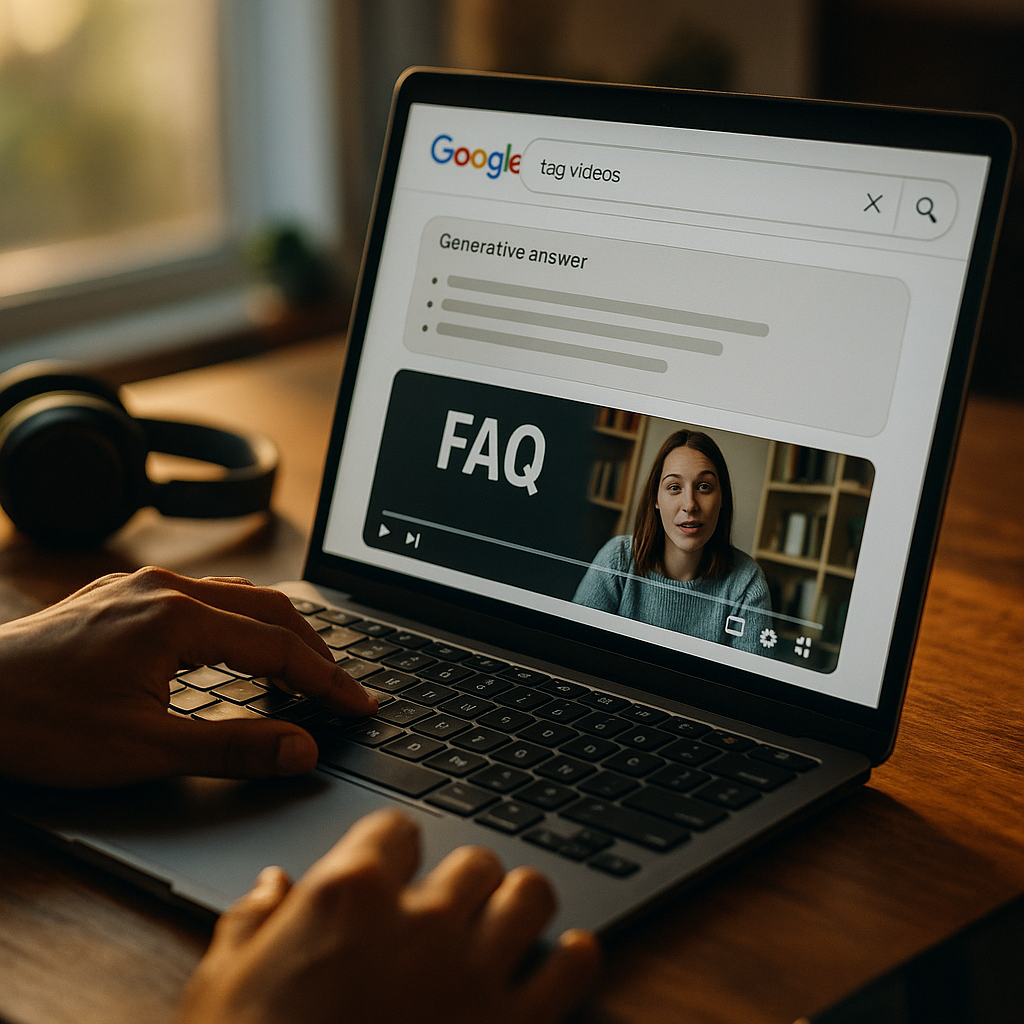
In 2025, generative search surfaces answers, not just links, and brands win when their content is easy to quote, verify, and summarize. Scripting FAQ videos to dominate generative search engine results means designing clear questions, concise answers, and proof-backed claims that AI systems can extract without confusion. Do it well and your videos become the default “source” across platforms—ready to capture demand before competitors notice.
Generative search optimization: Why FAQ videos win answers
Generative search engines synthesize responses from multiple sources and prefer content that is structured, specific, and corroborated. FAQ videos naturally align with that behavior because they are built around direct questions and direct answers. When you script and produce them correctly, you create “quotable units” that models can reliably extract.
FAQ videos also solve two competing needs at once:
- User intent clarity: The question defines intent, so the answer can be decisive and complete.
- Machine readability: A question-and-answer pattern is easy to segment in transcripts, captions, chapters, and on-page FAQ blocks.
To maximize visibility in generative answers, aim for content that is:
- Unambiguous: One question, one primary answer, minimal hedging.
- Evidence-forward: Any claim that could be disputed gets a source, method, or limitation.
- Entity-rich: Names of products, features, standards, locations, and roles included where helpful.
- Comparable: When users ask “X vs Y,” provide a crisp comparison table verbally and in the transcript.
The follow-up most teams miss: generative search does not only rank your page—it may quote your transcript. That means your spoken words and captions are now primary SEO assets.
FAQ video script structure: The repeatable blueprint
A high-performing FAQ script should read like a well-designed support article, but it must also sound natural on camera. Use a repeatable structure that is consistent across episodes so engines (and viewers) learn what to expect.
Recommended structure per question (60–120 seconds each):
- Restate the question verbatim (first sentence). This improves transcription accuracy and makes the clip self-contained.
- Give the direct answer in one line (the “quoted answer”). Imagine it appearing inside a generative response without context.
- Explain the “why” in 2–4 sentences (what changes for the user, trade-offs, edge cases).
- Show the proof (demo, quick steps, policy excerpt, screenshot callout, or measurable result with methodology).
- Handle the top follow-up (“If you’re doing X, choose A; if you’re doing Y, choose B”).
- Close with a next step (linkable action: checklist, template, booking, or related video).
Script formatting tips that improve extraction:
- Use exact-match phrasing for the question at least once, then vary it naturally.
- Front-load definitions: “In our platform, ‘workspace’ means…” so the model doesn’t guess.
- Avoid pronoun chains: Replace “it/this/that” with the entity name at least once per paragraph.
- Keep sentences short in the first 20 seconds; transcription errors cluster in long clauses.
Answer the likely follow-up: “How many FAQs should one video cover?” For generative search, one core question per clip usually performs better than a long compilation because it produces a clean, focused transcript and a clear topical signal. If you do compilations, chapter them and publish individual cut-downs too.
EEAT for video content: Build trust that AI can verify
Generative systems increasingly weigh trust signals. Your goal is to make expertise and accountability obvious to both humans and machines. Apply EEAT by embedding verifiable context into your scripts and your publishing workflow.
How to demonstrate Experience and Expertise in the script:
- State who is speaking and why they’re qualified: role, years in the field, or responsibility scope (avoid fluff).
- Use firsthand demonstrations instead of generic explanations: show the workflow, settings, or real interface.
- Disclose assumptions: “This applies to U.S.-based businesses,” or “This depends on your plan tier.”
How to demonstrate Authoritativeness and Trust:
- Cite primary sources when possible (official docs, standards, your own audited data). If you reference internal results, describe the method: sample size, time window, and what was measured.
- Include safety and compliance notes when relevant: privacy, refunds, medical/legal disclaimers, or security practices.
- Maintain consistency across video, transcript, and on-page copy. Contradictions reduce trust and increase model uncertainty.
Practical publishing details that strengthen EEAT signals:
- Visible author/presenter attribution on the page hosting the video and transcript.
- Update notes when product features or policies change in 2025; add a brief “What changed” line near the transcript.
- Clear contact path for support or corrections, especially for YMYL-adjacent topics like finance, health, or legal processes.
Answer the likely follow-up: “Do I need a famous expert?” No. You need traceable responsibility. A credible operator who owns the process and can demonstrate it often outperforms a generic spokesperson.
Video transcript SEO: Turn scripts into machine-readable assets
Your script becomes the transcript, and the transcript often becomes the citation. Treat it like a first-class SEO document, not an afterthought. The objective is to make every answer extractable, accurately transcribed, and context-complete.
Best practices for transcript publishing:
- Post a full transcript on the same page as the embedded video whenever possible. If platform constraints exist, publish a companion article that mirrors the Q&A.
- Use speaker labels when more than one person appears. This reduces ambiguity in quoted lines.
- Add timestamps or chapters aligned to each question. This helps retrieval systems pinpoint the exact segment.
- Keep Q&A formatting intact: each question as a standalone line followed by the answer paragraph(s).
On-page content elements that reinforce generative retrieval:
- FAQ block text that matches the spoken question closely.
- Definitions and constraints near the top of the page (“This tutorial covers…”).
- Link out to supporting references (official documentation, policy pages, calculators, or specifications).
Script for “quote readiness.” A generative engine may lift only one or two sentences, so write sentences that stand alone:
- Good: “A 2FA app is more secure than SMS because it isn’t vulnerable to SIM-swap attacks.”
- Weaker: “It’s better because it doesn’t have that phone-number problem.”
Answer the likely follow-up: “Should I stuff keywords into the transcript?” No. You should use the terms your audience uses and define them. Clarity beats repetition, and generative systems penalize content that feels engineered rather than helpful.
Secondary keyword strategy: Map questions to intent and entities
FAQ videos outperform when your question set mirrors real demand. Build your editorial map from bottom-of-funnel questions (pricing, setup, compatibility) and high-friction objections (security, migration, refunds), then expand into comparative and troubleshooting queries.
A practical question-mapping workflow:
- Collect questions from sales calls, support tickets, live chat logs, and onboarding emails.
- Cluster by intent: “evaluate,” “implement,” “fix,” “switch,” “cancel,” “integrate.”
- Add entity context: product names, integrations, standards, locations, user roles, and constraints (“for nonprofits,” “for teams of 50+”).
- Prioritize by business impact: conversion blockers first, then expansion and retention topics.
Question types to include (and why they get cited):
- “What is…” (definitions): establishes foundational authority.
- “How do I…” (steps): generates procedural snippets and checklists.
- “Why is…” (explanations): earns citations for reasoning and trade-offs.
- “X vs Y” (comparisons): frequently requested and easy to quote.
- “Does it work with…” (compatibility): high-intent, high-conversion.
Answer the likely follow-up: “How long should the series be?” Commit to a minimum of 20–30 high-intent questions for a meaningful footprint, then iterate monthly based on what gets impressions, citations, and conversions.
Measurement and iteration: Prove citations, conversions, and retention
To dominate generative results, you need feedback loops that connect content to outcomes. Views alone are not the goal; the goal is being selected as a source and driving qualified actions.
What to track in 2025:
- Search Console performance for the hosting pages: impressions, clicks, and query patterns shifting toward question formats.
- On-platform analytics: audience retention at the “direct answer” moment and drop-off after proof/demos.
- Referral quality: conversions from video pages, assisted conversions, demo requests, trial starts, or support deflection.
- Brand and product mentions across AI assistants and social search surfaces (spot-check prompts that mirror your FAQs).
Iteration tactics that compound results:
- Rewrite openings when retention drops in the first 10 seconds; keep the question and one-line answer tighter.
- Add a missing constraint when comments reveal confusion (“This is for the admin role only”).
- Split overloaded FAQs into two clips when the answer contains multiple separate decisions.
- Refresh transcripts after product updates; add a short “Update” line and re-upload captions if needed.
Answer the likely follow-up: “How do I know if a generative engine is using my content?” You often won’t get a perfect attribution report. Instead, look for rising impressions on long-tail questions, higher branded searches after publishing, and users arriving with phrasing that matches your scripted lines.
FAQs: Scripting and publishing FAQ videos for generative search
-
How long should an FAQ video be for generative search visibility?
Most FAQ clips perform best at 60–120 seconds per question: long enough to include a direct answer, brief reasoning, and proof, but short enough to stay tightly on-intent and produce a clean transcript segment.
-
Should I publish FAQ videos on YouTube, my site, or both?
Publish on both when possible. YouTube improves discovery and engagement signals, while your site gives you control over transcripts, supporting links, author attribution, and conversion paths—all useful for EEAT and citation readiness.
-
Do captions and transcripts really affect generative search results?
Yes. Captions and transcripts are machine-readable sources. Clear question phrasing, accurate terminology, and concise “quoted answers” increase the chance your content is extracted and summarized correctly.
-
What makes an FAQ answer “quotable” for AI-generated results?
A quotable answer is one or two sentences that stand alone, define key terms, state constraints, and avoid vague references. It should be accurate without requiring the rest of the video for context.
-
How do I show EEAT in a short video without sounding self-promotional?
Lead with demonstration and specificity: show the workflow, state the speaker’s role, disclose assumptions, and cite primary references. Keep credentials factual and minimal, and let the clarity of the explanation and proof carry the trust.
-
How many FAQ videos should I create before expecting results?
Plan for an initial library of 20–30 high-intent questions. This creates topical coverage, internal linking opportunities, and enough data to see which question patterns earn impressions, engagement, and conversions.
FAQ videos win in generative search when you script for extraction, publish for verification, and measure for business impact. Focus on one question per clip, open with a one-line answer, and support it with a quick demo or source-backed proof. Pair every video with a clean transcript and clear attribution. When your answers become the easiest to quote, visibility follows.
Top Influencer Marketing Agencies
The leading agencies shaping influencer marketing in 2026
Agencies ranked by campaign performance, client diversity, platform expertise, proven ROI, industry recognition, and client satisfaction. Assessed through verified case studies, reviews, and industry consultations.
Moburst

-
2

The Shelf
Boutique Beauty & Lifestyle Influencer AgencyA data-driven boutique agency specializing exclusively in beauty, wellness, and lifestyle influencer campaigns on Instagram and TikTok. Best for brands already focused on the beauty/personal care space that need curated, aesthetic-driven content.Clients: Pepsi, The Honest Company, Hims, Elf Cosmetics, Pure LeafVisit The Shelf → -
3

Audiencly
Niche Gaming & Esports Influencer AgencyA specialized agency focused exclusively on gaming and esports creators on YouTube, Twitch, and TikTok. Ideal if your campaign is 100% gaming-focused — from game launches to hardware and esports events.Clients: Epic Games, NordVPN, Ubisoft, Wargaming, Tencent GamesVisit Audiencly → -
4

Viral Nation
Global Influencer Marketing & Talent AgencyA dual talent management and marketing agency with proprietary brand safety tools and a global creator network spanning nano-influencers to celebrities across all major platforms.Clients: Meta, Activision Blizzard, Energizer, Aston Martin, WalmartVisit Viral Nation → -
5

The Influencer Marketing Factory
TikTok, Instagram & YouTube CampaignsA full-service agency with strong TikTok expertise, offering end-to-end campaign management from influencer discovery through performance reporting with a focus on platform-native content.Clients: Google, Snapchat, Universal Music, Bumble, YelpVisit TIMF → -
6

NeoReach
Enterprise Analytics & Influencer CampaignsAn enterprise-focused agency combining managed campaigns with a powerful self-service data platform for influencer search, audience analytics, and attribution modeling.Clients: Amazon, Airbnb, Netflix, Honda, The New York TimesVisit NeoReach → -
7

Ubiquitous
Creator-First Marketing PlatformA tech-driven platform combining self-service tools with managed campaign options, emphasizing speed and scalability for brands managing multiple influencer relationships.Clients: Lyft, Disney, Target, American Eagle, NetflixVisit Ubiquitous → -
8

Obviously
Scalable Enterprise Influencer CampaignsA tech-enabled agency built for high-volume campaigns, coordinating hundreds of creators simultaneously with end-to-end logistics, content rights management, and product seeding.Clients: Google, Ulta Beauty, Converse, AmazonVisit Obviously →