


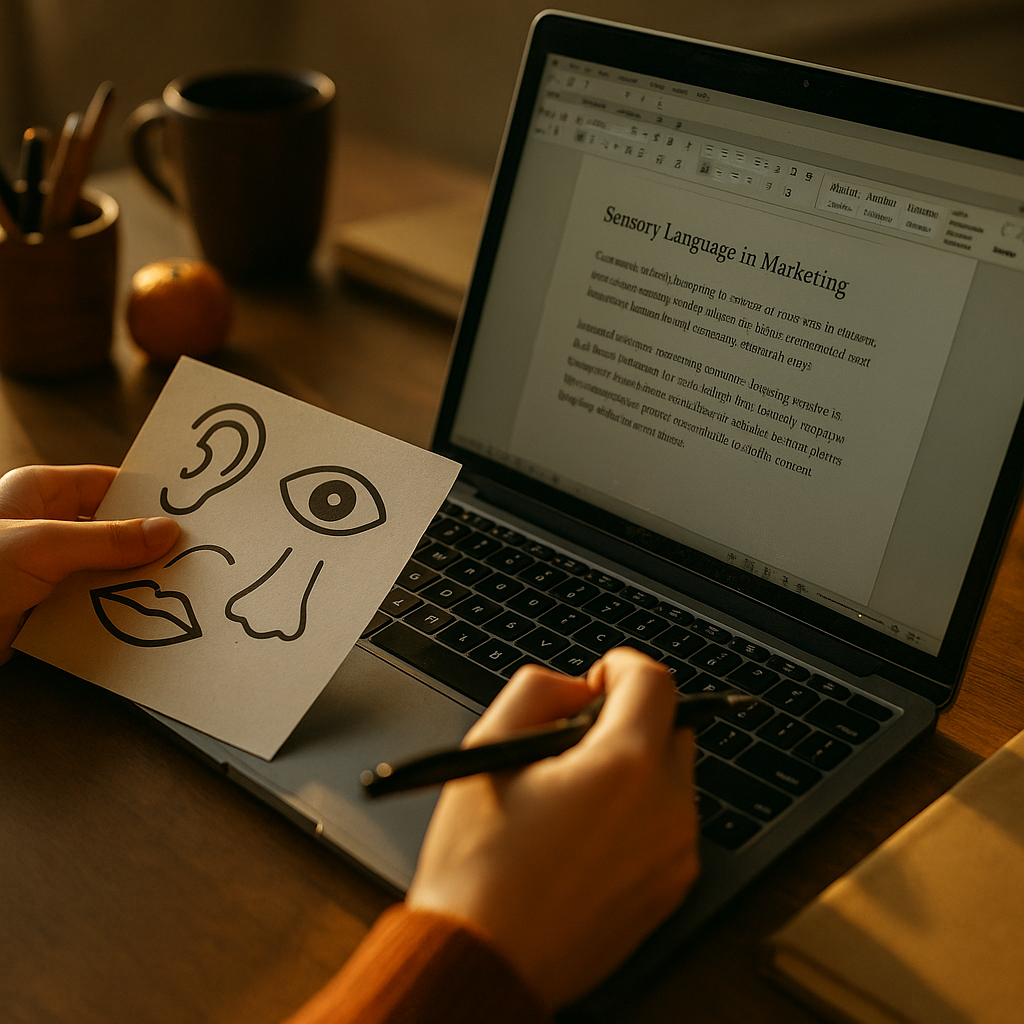
The Science Of Sensory Language shapes how readers feel before they decide what to do. In 2025, attention is scarce, and copy must land fast, clearly, and credibly. Sensory words work because they mirror real perception: sight, sound, touch, taste, and smell. When you write with controlled vividness, your message becomes easier to imagine—and easier to trust. Ready to make your copy feel real?
How sensory language works in the brain
Sensory language is not decoration; it is a cognitive shortcut. When readers encounter concrete sensory cues, they build a mental simulation of the experience. That simulation reduces uncertainty, which is a major barrier to action in marketing and UX. In practice, good sensory copy helps people answer the unspoken questions: What will this feel like? What will happen after I click? Will this fit my life?
From a behavior perspective, sensory words increase processing fluency: the ease with which information is understood. People tend to prefer what feels easy to process, especially under time pressure. That preference can translate into higher engagement, better recall, and clearer differentiation—without relying on hype.
Use sensory detail to make outcomes tangible, not exaggerated. A claim like “amazing results” is vague; “skin feels smoother after the first cleanse” is testable and specific. In EEAT terms, specificity supports trustworthiness because it signals you know the product experience and are willing to describe it plainly.
Sensory words in marketing copy: mapping senses to intent
Not every sense is equally relevant for every offer. Strong copy maps sensory cues to the reader’s context and intent. Start by identifying what the customer is trying to accomplish, then choose sensory language that makes that outcome vivid.
- Sight: best for products with visual transformation or clarity. Use cues like bright, matte, crisp, clean lines, high-contrast, glare-free.
- Sound: useful for apps, machines, entertainment, or environments. Try quiet, muted, low hum, click, crisp audio, echo-free.
- Touch: powerful for comfort, quality, durability, and usability. Use soft, weighted, cool to the touch, grippy, smooth, rigid.
- Taste: essential for food and drink, but also metaphorically for “preference.” Use carefully and literally when possible: citrusy, bittersweet, savory, clean finish.
- Smell: strong for memory and mood. Use fresh linen, woody, bright citrus, fragrance-free and be clear about intensity.
Then match the sense to funnel stage. In awareness, sensory hooks earn attention (“glare-free screen that stays readable in sun”). In consideration, sensory specifics reduce risk (“no sticky residue; dries in under a minute”). In decision, sensory reassurance supports confidence (“quiet close lid; no rattling in your bag”).
Answer follow-up questions directly in-line: if you say “fragrance-free,” clarify whether it is unscented or whether masking scents exist. If you say “quiet,” provide context such as “library-quiet” vs. “quiet compared to standard models” and add measurable proof when available (for example, decibel ratings).
Vivid writing techniques: precision, not purple prose
Vivid copy wins when it is controlled. Readers want realism, not theatrics. Use these techniques to create sensory richness while keeping clarity and credibility.
1) Replace abstractions with observable cues. Swap “premium” for what premium feels like: “dense, smooth metal body with a cool finish.” Swap “fast” for “opens in under two seconds on a typical connection” (only if you can support it).
2) Use the “one strong detail” rule. One precise sensory detail often outperforms three weak ones. “Butter-soft knit that doesn’t itch” is stronger than “soft, cozy, comfy.”
3) Pair sensory detail with outcome. Sensory detail should serve a benefit: “grippy handle” connects to “stays secure with wet hands.” “Muted notification sound” connects to “fewer interruptions in meetings.”
4) Borrow language from real users, then edit for accuracy. Mine reviews, support tickets, and interviews for sensory phrasing people naturally use: “stiff zipper,” “chemical smell,” “screen feels grainy.” Validate patterns before promoting them as claims.
5) Use micro-contrast to sharpen perception. Contrast makes sensations legible: “crisp edge-to-edge text, not hazy or washed out.” Keep contrasts factual and avoid unfair comparisons.
6) Avoid sensory overload. If every sentence is sensory, nothing stands out. Reserve vivid lines for key moments: headlines, product descriptions, CTAs, and critical reassurance points (shipping, returns, safety, compatibility).
Brand storytelling with sensory details: building trust and recall
Storytelling becomes more persuasive when it is grounded in sensory reality. The goal is not to “paint a picture” for its own sake; it is to help readers accurately forecast their experience. That supports lower returns, fewer complaints, and stronger loyalty—outcomes that also reinforce EEAT signals like satisfaction and reputation.
Structure sensory storytelling around three anchors:
- Environment: where the product lives. “Steamy bathroom,” “open-plan office,” “late-night kitchen,” “backpack on a crowded train.”
- Friction: the sensory annoyance the reader recognizes. “Cloying perfume,” “scratchy collar,” “loud fan noise,” “greasy after-feel.”
- Resolution: the sensory shift after using the solution. “Clean rinse,” “quiet airflow,” “non-slip grip,” “fresh, neutral finish.”
Keep it verifiable. If you describe a “cooling feel,” explain the mechanism (for example, breathable fabric weave, moisture-wicking finish) and add boundaries (“cool-to-the-touch at first contact; not an active cooling device”). That combination of imagery and specificity makes your copy feel experienced rather than invented.
If you work in regulated categories (health, finance, safety), sensory language must never imply outcomes you cannot substantiate. Replace “pain disappears” with “gentle support that feels stable during movement,” and link to evidence where you have it (clinical testing summaries, certifications, or methodology descriptions).
Conversion copywriting tips: sensory CTAs and UX microcopy
Sensory language can improve conversion when it reduces uncertainty at the exact moment people hesitate. Apply it to microcopy and CTAs where the reader’s brain asks, What happens next?
Use sensory reassurance in UX hotspots:
- Shipping: “Arrives in a sturdy, padded mailer” can reduce fear of damage.
- Returns: “No restocking fees; prepaid label” reduces emotional friction.
- Trials: “Cancel in two clicks” adds a tactile sense of ease.
- Onboarding: “Guided setup with clear prompts” supports confidence.
Make CTAs feel like a clean next step. Sensory does not mean “tasty” buttons; it means low-friction language that evokes ease and control. Examples:
- “See the glare-free demo” (sight-based, specific)
- “Hear the difference” (sound-based, experiential)
- “Feel the fit guide” (touch metaphor; use sparingly)
- “Try it risk-free” (not sensory, but reduces uncertainty when paired with sensory proof)
Answer the common follow-ups right beside the CTA: “Is it loud?” “Does it smell?” “Will it irritate skin?” “Is it sticky?” If you can provide measurable info (decibel range, ingredient standards, dermatologist testing, VOC disclosures), do it. If not, be careful: describe what you know, and avoid absolute promises.
Practical test: before publishing, highlight every adjective. If an adjective cannot be observed, measured, or tied to a credible source, rewrite it as a concrete sensory cue or remove it.
EEAT-friendly copy: evidence, ethics, and accuracy in sensory claims
Sensory language influences perception, so it carries responsibility. In 2025, helpful content is judged not only by style but by accuracy, transparency, and user benefit. Follow these EEAT-aligned practices to keep sensory copy credible.
1) Prove what you describe. Back sensory claims with:
- Testing: lab results, decibel readings, material specs, wash tests, wear tests.
- Standards: certifications relevant to the sensory claim (for example, fragrance-free labeling policies, textile standards, safety certifications).
- Methodology: a short “how we tested” note for key claims.
2) Disclose variability. Sensation differs by person and context. Say “light citrus scent” and clarify intensity, or provide options (“fragrance-free” versus “lightly scented”). For comfort claims, explain fit range, materials, and conditions.
3) Avoid manipulative sensory triggers. Sensory writing should clarify, not pressure. Do not use fear-based imagery (“toxic,” “disgusting,” “poison”) unless you can support it with reliable evidence and it is essential for safety communication.
4) Use expert input when stakes are high. For health, skincare, or accessibility, consult qualified reviewers and reflect their guidance accurately. If you cite professionals, be specific about their role and what they reviewed.
5) Keep language inclusive and accessible. Some readers have sensory sensitivities. Offer alternatives (“low-fragrance,” “silent mode,” “reduced brightness”) and avoid ableist assumptions. Clarity is also accessibility: short sentences, consistent terms, and plain descriptions win.
FAQs about sensory language in copywriting
What is sensory language in copywriting?
Sensory language uses words that evoke sight, sound, touch, taste, or smell to help readers imagine an experience. In copywriting, it works best when it describes specific, realistic product sensations that reduce uncertainty and support a clear benefit.
Does sensory language improve conversions?
It can, especially when it answers “what will this feel like?” at key decision points. Sensory detail often improves clarity and confidence, which can increase clicks and reduce returns. The impact is strongest when sensory claims are accurate and supported with proof.
How do I use sensory words without sounding exaggerated?
Choose one precise detail, tie it to an outcome, and avoid stacked adjectives. Replace vague superlatives with observable cues (texture, volume, brightness, residue, scent intensity) and add boundaries where needed (“light scent,” “dries quickly,” “quiet in normal use”).
Which sense should I focus on first?
Start with the sense most relevant to the purchase risk. For skincare, touch and smell often matter. For electronics, sight and sound. For clothing, touch and fit. Let customer questions, reviews, and support tickets guide your choice.
Can sensory language be used in B2B writing?
Yes, but it should describe operational experience: “quiet operation,” “clean dashboard,” “frictionless handoff,” “smooth approval workflow.” Keep it grounded in measurable outcomes like reduced errors, faster onboarding, or fewer interruptions.
How do I make sensory claims EEAT-friendly?
Use evidence (tests, specs, certifications), disclose variability, and avoid absolute promises. If you reference user experiences, treat them as examples, not guarantees. When stakes are high, involve qualified reviewers and document your methodology.
Sensory language turns abstract promises into experiences readers can picture, compare, and trust. In 2025, the best results come from precision: one strong detail, tied to a benefit, supported by evidence. Choose the sense that matches purchase risk, answer the “what will it feel like?” questions, and disclose boundaries. Write to clarify, not to impress—then let vivid accuracy do the selling.
Top Influencer Marketing Agencies
The leading agencies shaping influencer marketing in 2026
Agencies ranked by campaign performance, client diversity, platform expertise, proven ROI, industry recognition, and client satisfaction. Assessed through verified case studies, reviews, and industry consultations.
Moburst

-
2

The Shelf
Boutique Beauty & Lifestyle Influencer AgencyA data-driven boutique agency specializing exclusively in beauty, wellness, and lifestyle influencer campaigns on Instagram and TikTok. Best for brands already focused on the beauty/personal care space that need curated, aesthetic-driven content.Clients: Pepsi, The Honest Company, Hims, Elf Cosmetics, Pure LeafVisit The Shelf → -
3

Audiencly
Niche Gaming & Esports Influencer AgencyA specialized agency focused exclusively on gaming and esports creators on YouTube, Twitch, and TikTok. Ideal if your campaign is 100% gaming-focused — from game launches to hardware and esports events.Clients: Epic Games, NordVPN, Ubisoft, Wargaming, Tencent GamesVisit Audiencly → -
4

Viral Nation
Global Influencer Marketing & Talent AgencyA dual talent management and marketing agency with proprietary brand safety tools and a global creator network spanning nano-influencers to celebrities across all major platforms.Clients: Meta, Activision Blizzard, Energizer, Aston Martin, WalmartVisit Viral Nation → -
5

The Influencer Marketing Factory
TikTok, Instagram & YouTube CampaignsA full-service agency with strong TikTok expertise, offering end-to-end campaign management from influencer discovery through performance reporting with a focus on platform-native content.Clients: Google, Snapchat, Universal Music, Bumble, YelpVisit TIMF → -
6

NeoReach
Enterprise Analytics & Influencer CampaignsAn enterprise-focused agency combining managed campaigns with a powerful self-service data platform for influencer search, audience analytics, and attribution modeling.Clients: Amazon, Airbnb, Netflix, Honda, The New York TimesVisit NeoReach → -
7

Ubiquitous
Creator-First Marketing PlatformA tech-driven platform combining self-service tools with managed campaign options, emphasizing speed and scalability for brands managing multiple influencer relationships.Clients: Lyft, Disney, Target, American Eagle, NetflixVisit Ubiquitous → -
8

Obviously
Scalable Enterprise Influencer CampaignsA tech-enabled agency built for high-volume campaigns, coordinating hundreds of creators simultaneously with end-to-end logistics, content rights management, and product seeding.Clients: Google, Ulta Beauty, Converse, AmazonVisit Obviously →