


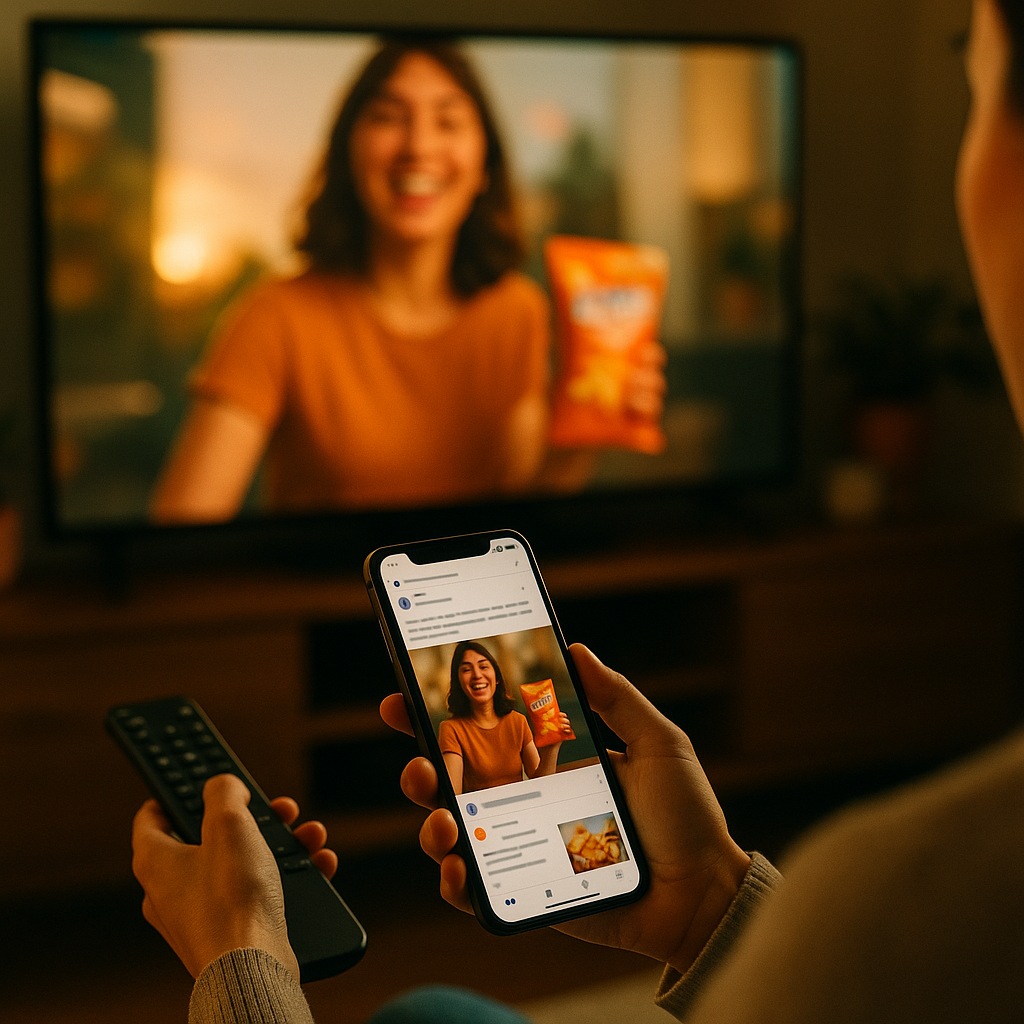
Designing For The “Second Screen” is now a practical requirement for campaigns competing for attention in 2025. People watch streaming video while scrolling product reviews, vote in live polls while checking messages, and compare prices while ads run on TV. Dual-device behavior changes timing, creative, and measurement. The brands that plan for it win more intent—so what should you do next?
Second-screen marketing: understand real dual-device behavior
Second-screen behavior is not a niche habit; it is a default mode for many audiences. Viewers often keep a phone in hand while watching connected TV (CTV), live sports, gaming streams, or long-form video. That means your campaign can influence decisions in the moment—if you design for the sequence of actions people actually take.
Map the most common second-screen journeys:
- Awareness → verification: A viewer sees a CTV spot, then searches the brand or product name on mobile to confirm price, reviews, availability, and credibility.
- Entertainment → interaction: A live show prompts voting, trivia, or social conversation on mobile while the big screen continues playing.
- Discovery → conversion: A product appears in a show or ad; the viewer taps a mobile ad, scans a QR code, or uses voice search to buy.
- Consideration → store visit: People check location, hours, inventory, or promotions on mobile while the CTV ad builds preference.
Design implications: You are not designing “one experience on two screens.” You are designing two coordinated moments that happen seconds apart. Treat the large screen as the emotional driver and the small screen as the action layer. This framing helps teams decide what belongs where: storytelling on CTV, frictionless tasks on mobile.
Answering the usual follow-up: “Do we need an app?” Not usually. In 2025, the fastest path is typically a mobile web landing experience with strong page speed, clean tracking, and clear next steps. Use app deep links only when you can prove they increase completion for your audience.
Cross-device user experience: align creative, timing, and CTAs
Dual-device campaigns fail when creatives compete or when CTAs assume too much attention. Align the message architecture so the second screen feels like a natural continuation of what the viewer just saw.
Best practices for coordinated creative:
- Keep the “memory hook” consistent: Use the same brand cue across both screens—distinctive color, tagline, product silhouette, or sonic mnemonic—so recognition is instant on mobile.
- Repeat the offer, not the whole story: CTV earns attention with narrative; mobile should restate the offer in a tight, scannable format and move to the next action.
- Design CTAs for interruptible attention: Use verbs that match the moment: “Check availability,” “Compare plans,” “Get the code,” “See ingredients,” “Watch the demo.” Avoid vague “Learn more.”
- Use “now/soon/later” CTA layering: On TV: “Search [brand] now.” On mobile: “Save for later” (wishlist, calendar reminder, email me the details) for users not ready to buy.
Timing matters as much as copy: Second-screen actions often occur within minutes of exposure. Coordinate bursts so mobile search, social, and display support the same creative window as the CTV spot. If your budget forces separation, keep always-on branded search coverage and a consistent mobile landing page so interest doesn’t decay.
QR codes and short URLs: QR can work when it is large enough, on-screen long enough, and lands on a mobile page that loads fast. Short URLs work when they are easy to type and match what people heard. Use one primary path per creative. If you include both, clearly label the preferred option.
Accessibility and clarity: Assume the living-room screen is viewed from distance. Use high contrast, large type, and minimal text. Then assume the mobile screen is used one-handed. Make tap targets large, forms short, and checkout forgiving.
Dual-device campaign strategy: build sequences, not single ads
A strong second-screen approach looks like a sequence: big-screen stimulus, mobile reinforcement, and a conversion step that feels easy. Plan the campaign as a system with roles for each channel.
Recommended planning model:
- Stage 1: Prime (big screen): CTV, linear TV, in-stream video, or live placements that establish the promise and emotion.
- Stage 2: Capture (mobile): Paid search coverage on brand and category terms, social retargeting, and landing pages tuned for the “just saw it” visitor.
- Stage 3: Confirm (mobile): Proof modules—reviews, guarantees, certifications, creator demos, FAQs—placed above the fold for high-intent visitors.
- Stage 4: Convert (mobile or desktop): Checkout, lead form, booking, store locator, or “text me the link” to move the user to their preferred device.
Design your landing pages for the second-screen moment:
- Mirror the creative: The first screen the user sees should match the ad they remember (headline, product image, offer). If it doesn’t, trust drops.
- Answer the top three questions immediately: What is it? How much is it? Why should I trust you?
- Reduce cognitive load: One primary CTA, one backup CTA. Everything else supports decision-making.
- Use intent-based routing: If the ad is about a specific product line, land users there—not on a generic homepage.
Operational follow-up: “How many variants do we need?” Start with two mobile landing versions: one optimized for speed and direct response, another for higher-consideration users with more proof and detail. Test by audience and placement, then consolidate around what performs.
Second-screen engagement: interactive formats that drive action
Second screens are ideal for interaction because they are personal devices. But interaction must earn its place; it should remove friction or increase confidence—not just add novelty.
High-performing interaction patterns:
- Live polls and voting: Useful for shows, sports, product launches, and brand events. Make the result meaningful (unlock a code, reveal content, influence a live outcome).
- “Send to phone” and “save” tools: Let users text themselves a link, save an offer, or add a reminder. This keeps momentum when purchase timing is later.
- Shoppable video and product carousels: Work best when product selection is limited and the value proposition is simple. Use clear pricing and shipping details early.
- Creator proof and quick demos: Short mobile-native video can validate claims made on CTV, especially for beauty, health, home, and apps.
- Store mode: For retail, a mobile overlay that prioritizes nearest location, inventory status, and pickup options can outperform generic ecommerce flows.
Guardrails for engagement:
- Keep it short: If an interaction takes more than 20–30 seconds, completion rates drop unless the reward is strong.
- Make privacy obvious: Clearly state what data you collect and why, especially for SMS and email capture.
- Design for imperfect conditions: Users may be on cellular networks, distracted, or mid-conversation. Prioritize resilience over complexity.
Answering a common question: “Should we push users to social?” Only if social is the best next step. If the goal is purchase, keep users on a controlled path. If the goal is conversation or community, design a deliberate handoff with a clear prompt and consistent hashtags/handles.
Cross-device attribution: measurement, privacy, and incrementality
Second-screen campaigns can look messy in analytics because the impression happens on one device and the conversion happens on another. In 2025, privacy controls and platform fragmentation make deterministic user-level tracking less reliable. Strong measurement relies on a blend of methods and clear definitions.
Measurement stack to prioritize:
- Clean event instrumentation: Ensure mobile landing pages track key actions (view content, click CTA, form start, purchase, store-locator usage) with consistent naming and documentation.
- Channel-level alignment: Coordinate UTMs, landing page variants, and creative IDs so you can connect outcomes to inputs without guessing.
- Brand and category search lift: Track changes in branded search volume and click share during CTV flights. This often captures second-screen behavior more reliably than last-click.
- Geo-based or time-based lift tests: Use holdouts by region or daypart to estimate incremental impact. This is especially useful when user-level linkage is limited.
- Media mix modeling (MMM) where appropriate: For larger budgets, MMM helps quantify the contribution of CTV and video to outcomes over time.
Attribution mistakes to avoid:
- Overvaluing last-click: Mobile search or social may “close” the conversion, but the big screen may have created the intent.
- Ignoring view-through windows: Set sensible lookback windows based on your buying cycle; don’t assume one size fits all.
- Measuring clicks instead of outcomes: Second-screen success is often a lift in search, site engagement, store visits, or qualified leads—not just click-through rate.
EEAT and trust in measurement: Document assumptions, keep a clear analytics change log, and align stakeholders on what “success” means before launch. Transparent methodology builds confidence and prevents post-campaign debates that stall learning.
Mobile-first landing pages: speed, credibility, and conversion
Most second-screen actions land on mobile web, so your landing experience determines whether the dual-device strategy pays off. If the page is slow, confusing, or untrustworthy, interest evaporates.
What to optimize first:
- Speed and stability: Minimize heavy scripts, compress images, and avoid layout shifts. A second-screen visitor is impatient because the big screen is still playing.
- Above-the-fold clarity: A single sentence that restates the offer, a relevant image, and one primary CTA.
- Credibility proof: Place the most persuasive trust elements early: verified reviews, transparent pricing, shipping/returns, warranties, certifications, and clear contact options.
- Short forms: If lead gen is the goal, ask only what you need. Consider progressive profiling after the first conversion.
- Frictionless handoffs: Offer “email me this,” “text me a link,” or “continue on desktop” for users who prefer a larger screen for checkout.
Content that supports EEAT: If you make claims (performance, ingredients, savings), show your evidence. Use plain language, avoid exaggerated promises, and make it easy to verify: specifications, methodology summaries, or third-party validations. Helpful content reduces returns, chargebacks, and support load—metrics your team will feel immediately.
Practical QA checklist before launch:
- Test QR and short URL on multiple phone cameras and browsers.
- Confirm the landing page matches each creative variant (headline and offer).
- Verify forms, payments, and confirmation pages on both iOS and Android.
- Ensure tracking fires once and respects consent choices.
- Check readability and tap targets for one-handed use.
FAQs
What is “second-screen” behavior in marketing?
It’s when a person uses a mobile device while watching content on a larger screen (CTV, TV, laptop, or live event stream). In campaigns, it often means the big screen creates interest and the phone captures searches, clicks, and conversions.
Which channels work best for dual-device campaigns?
CTV or premium video to prime demand, paired with mobile search, paid social, and fast mobile landing pages to capture and convert demand. Email or SMS can help when the decision happens later.
Are QR codes still effective in 2025?
Yes, when they are easy to scan and the landing page loads quickly. QR fails when it’s too small, shown too briefly, or leads to a generic homepage instead of a relevant, mobile-first page.
How do I measure cross-device impact without perfect user-level tracking?
Combine clean on-site event tracking with brand search lift, creative/flight timing analysis, and incrementality tests (geo or time holdouts). Use last-click as one input, not the verdict.
What should I put on a second-screen landing page?
A clear restatement of the offer, one primary CTA, fast-loading proof (reviews, guarantees, pricing clarity), and a frictionless next step. Keep navigation minimal and avoid distracting users with too many options.
How do I coordinate timing between TV/CTV and mobile?
Run mobile support during and immediately after CTV flights, and maintain always-on branded search coverage. If you can’t match timing perfectly, ensure creative cues and landing pages remain consistent so delayed second-screen actions still convert.
Second-screen campaigns succeed when you treat the big screen as the story engine and mobile as the action engine. Build a sequence: prime attention on CTV, capture intent on mobile, and convert with fast, credible landing experiences. Measure with lift and incrementality, not clicks alone. In 2025, the clearest competitive edge is coordination—will your next campaign behave like one system?
Top Influencer Marketing Agencies
The leading agencies shaping influencer marketing in 2026
Agencies ranked by campaign performance, client diversity, platform expertise, proven ROI, industry recognition, and client satisfaction. Assessed through verified case studies, reviews, and industry consultations.
Moburst

-
2

The Shelf
Boutique Beauty & Lifestyle Influencer AgencyA data-driven boutique agency specializing exclusively in beauty, wellness, and lifestyle influencer campaigns on Instagram and TikTok. Best for brands already focused on the beauty/personal care space that need curated, aesthetic-driven content.Clients: Pepsi, The Honest Company, Hims, Elf Cosmetics, Pure LeafVisit The Shelf → -
3

Audiencly
Niche Gaming & Esports Influencer AgencyA specialized agency focused exclusively on gaming and esports creators on YouTube, Twitch, and TikTok. Ideal if your campaign is 100% gaming-focused — from game launches to hardware and esports events.Clients: Epic Games, NordVPN, Ubisoft, Wargaming, Tencent GamesVisit Audiencly → -
4

Viral Nation
Global Influencer Marketing & Talent AgencyA dual talent management and marketing agency with proprietary brand safety tools and a global creator network spanning nano-influencers to celebrities across all major platforms.Clients: Meta, Activision Blizzard, Energizer, Aston Martin, WalmartVisit Viral Nation → -
5

The Influencer Marketing Factory
TikTok, Instagram & YouTube CampaignsA full-service agency with strong TikTok expertise, offering end-to-end campaign management from influencer discovery through performance reporting with a focus on platform-native content.Clients: Google, Snapchat, Universal Music, Bumble, YelpVisit TIMF → -
6

NeoReach
Enterprise Analytics & Influencer CampaignsAn enterprise-focused agency combining managed campaigns with a powerful self-service data platform for influencer search, audience analytics, and attribution modeling.Clients: Amazon, Airbnb, Netflix, Honda, The New York TimesVisit NeoReach → -
7

Ubiquitous
Creator-First Marketing PlatformA tech-driven platform combining self-service tools with managed campaign options, emphasizing speed and scalability for brands managing multiple influencer relationships.Clients: Lyft, Disney, Target, American Eagle, NetflixVisit Ubiquitous → -
8

Obviously
Scalable Enterprise Influencer CampaignsA tech-enabled agency built for high-volume campaigns, coordinating hundreds of creators simultaneously with end-to-end logistics, content rights management, and product seeding.Clients: Google, Ulta Beauty, Converse, AmazonVisit Obviously →