


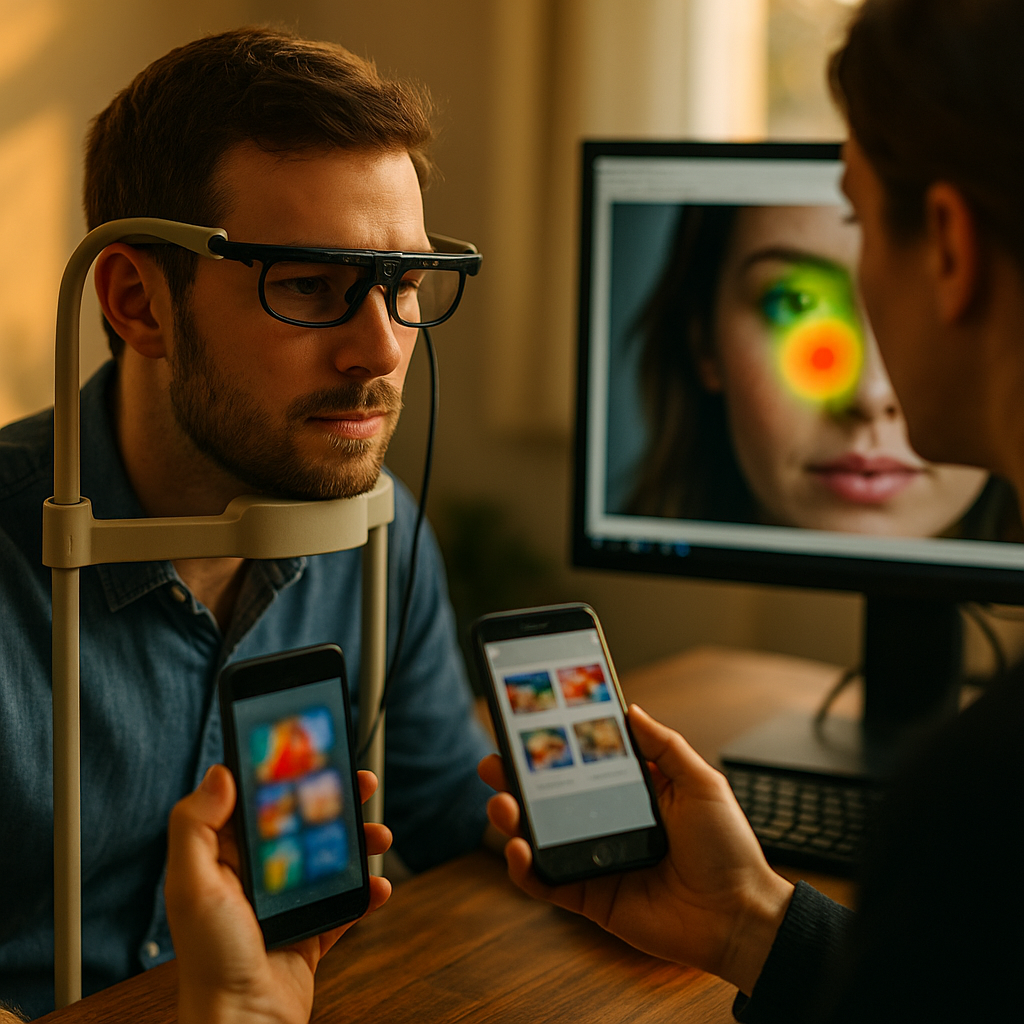
In 2025, brands fight for attention in feeds measured in milliseconds. The Science Of Scroll-Stopping Visuals: Analyzing Eye-Tracking Data explains what viewers actually notice, ignore, and remember—and how you can design with evidence, not guesses. By translating gaze patterns into practical creative rules, you’ll build visuals that earn attention ethically and predictably. Ready to see what eyes reveal?
Eye-tracking research basics for visual attention
Eye-tracking is a measurement method that records where people look, how long they look, and in what sequence. For marketers and designers, it turns “I think this works” into observable behavior. Modern systems typically combine infrared cameras with algorithms that estimate gaze direction, producing a stream of data you can map onto a design.
Key eye-tracking concepts you need to interpret results correctly:
- Fixations: moments when the eyes pause long enough to process information. Fixation duration often correlates with processing effort or interest, but context matters.
- Saccades: rapid jumps between fixations. People don’t “scan” smoothly; they hop. Designs should respect that reality.
- Areas of Interest (AOIs): defined zones (logo, headline, product, price, CTA) used to summarize attention with metrics like time-to-first-fixation.
- Heatmaps: aggregated attention density. Useful for quick communication, but they can hide important sequences.
- Gaze plots (scanpaths): ordered fixation points that show how attention flows. Better for diagnosing why a message fails.
Practical interpretation tip: Eye-tracking indicates attention, not persuasion. A long fixation can mean confusion, not preference. Pair it with comprehension checks, recall questions, or conversion proxies to avoid false confidence.
If you need a high-level goal for most feed-based creative, it’s this: reduce time-to-understand. Eye-tracking helps you locate the exact moment viewers hesitate, then redesign to remove the friction.
Eye-tracking data analysis: metrics that predict performance
Eye-tracking produces many numbers; only a handful routinely help teams make better creative decisions. In performance environments—social ads, product listings, landing pages—your goal is to connect attention metrics to outcomes like message recall, brand recognition, and clicks (where applicable).
Metrics that consistently translate into actionable design changes:
- Time to first fixation (TTFF): How quickly viewers notice an AOI. Lower TTFF on the core subject (product/face/headline) typically improves comprehension speed.
- Dwell time: Total time looking at an AOI. Useful for verifying that viewers actually engage with the value proposition, not only the imagery.
- Fixation count: More fixations can signal interest or difficulty. Compare it with comprehension scores to interpret correctly.
- Transition matrix: How often gaze moves from one AOI to another (e.g., product → price → CTA). This reveals whether your layout supports the intended decision path.
- Attention share: Percentage of total viewing time captured by each AOI. This helps defend creative choices with stakeholders: “The CTA only received 4% of attention; we need to redesign.”
How to connect gaze metrics to business goals without overclaiming:
- Define the task. “Choose which product you’d buy,” “Tell us what this ad is offering,” or “Find the free-shipping info.” Task clarity reduces noisy results.
- Set success criteria. For example: TTFF on the product under 500 ms, or at least one fixation on the offer line before the CTA.
- Triangulate. Combine eye-tracking with short surveys, aided/unaided recall, and basic behavior metrics (scroll-stop rate, CTR, add-to-cart) to validate conclusions.
When teams treat eye-tracking as a diagnostic tool—rather than a scoreboard—they move faster. You don’t need perfect prediction; you need clear direction on what to change first.
Scroll-stopping visuals: design principles proven by gaze patterns
Feeds reward speed. The best “scroll-stopping visuals” don’t rely on tricks; they deliver instant clarity. Eye-tracking repeatedly shows that attention gravitates to a few high-salience cues, then either collapses into understanding or disperses into confusion.
Design principles that eye-tracking commonly supports:
- One dominant subject. If viewers split attention across multiple competing focal points, comprehension slows. Choose a hero: product, face, or outcome.
- High-contrast hierarchy. Contrast should serve meaning: headline/offer, then product proof, then CTA. If the background competes, TTFF rises.
- Faces and gaze direction as guidance. Faces attract early fixations. When the subject’s gaze points toward the product or headline, scanpaths often follow.
- Text that is readable at feed speed. If viewers must zoom mentally, they won’t. Keep a short headline, large type, and strong foreground/background separation.
- Edge discipline. Busy borders and corner clutter pull fixations away from the message. Use negative space to keep the AOIs clean.
Answering the common follow-up: “Should we add more information to reduce questions?” Usually, no. Eye-tracking often reveals that extra copy increases fixation count but lowers comprehension because viewers bounce between elements. Put essentials in the creative, and move details to the landing page or carousel frames.
Another practical question: “Do logos need to be big?” Not necessarily. A logo can be noticed quickly if positioned consistently and supported by brand cues (color, typography, product silhouette). Oversizing the logo can steal attention from the offer and reduce message clarity.
Heatmaps and scanpaths: turning gaze insights into creative iteration
Heatmaps are persuasive in meetings, but scanpaths are persuasive in design work. Heatmaps tell you where attention pooled; scanpaths tell you why attention flowed the way it did. Use both, but prioritize sequence when you need to fix performance.
A practical workflow to iterate using gaze data:
- Start with the intent path. Define the ideal order: hook visual → offer line → proof → CTA. If you can’t articulate the path, the design won’t either.
- Compare ideal vs. actual scanpaths. If viewers look at decorative elements before the offer, you’ve created the wrong hook.
- Diagnose the break. Common breaks include: headline unreadable; product blends into background; CTA looks like a label; price isolated with no context.
- Make one structural change per variant. Eye-tracking is most useful when you can attribute improvement to a single change—like moving the offer above the fold of the image, increasing type size, or simplifying the background.
- Retest with the same task. Keep the question constant so the data stays comparable.
How to translate results into concrete design actions:
- If TTFF on the offer is high, increase typographic dominance, reduce competing imagery, and position the offer near the initial fixation zone (often center-left in many feed contexts, depending on layout).
- If dwell time on the product is low, improve product separation (lighting, outline contrast), add contextual cues (hand holding, in-use shot), or reduce visual noise.
- If viewers fixate on the CTA but don’t understand, change the CTA from generic to specific (e.g., “See shades” vs. “Learn more”) and place it after a clear benefit statement.
Important nuance: Don’t treat any single heatmap as universal truth. Device size, viewing distance, and context (platform UI, caption placement) can shift gaze behavior. Use platform-realistic mockups during testing whenever possible.
Neuromarketing ethics and EEAT: using attention data responsibly
Eye-tracking sits near “neuromarketing,” which can attract skepticism. In 2025, trust is a performance lever. If your process feels manipulative or opaque, you risk backlash and regulatory scrutiny. Responsible practice also improves data quality because participants behave more naturally when they understand what’s happening.
Ethical principles that protect users and strengthen your findings:
- Informed consent and clear purpose. Tell participants what you measure (gaze patterns), how you store data, and what decisions it informs.
- Minimize personal data. Prefer aggregated reporting and anonymization. Only collect demographics you will actually analyze.
- Avoid dark patterns. Designing to capture attention is valid; designing to mislead is not. If the visual implies an offer that the landing page contradicts, you may gain clicks but lose trust and long-term value.
- Accessibility-aware design. Eye-tracking typically reflects a subset of users. Validate that your final creative remains readable and clear for people with different visual needs and on different devices.
EEAT best practices for teams publishing or using eye-tracking insights:
- Experience: Document real tests, real tasks, and real constraints (platform UI, device types). Share what changed and what improved.
- Expertise: Explain metrics accurately and acknowledge limits. Avoid claiming eye-tracking “proves” what people think or feel.
- Authoritativeness: Use transparent methods: sample size range, stimulus examples, and analysis approach. When citing external studies, reference credible academic or industry research and disclose methodology.
- Trustworthiness: Be explicit about privacy, consent, and how conclusions were validated with additional measures (recall, comprehension, conversion data).
This approach doesn’t slow you down. It prevents expensive misreads—like optimizing for attention while harming comprehension, brand sentiment, or user autonomy.
Creative testing strategy: combining A/B tests with eye-tracking
Eye-tracking is most powerful when it complements A/B testing rather than replacing it. A/B tells you which variant wins; eye-tracking tells you why. Together, they reduce guesswork and help teams build repeatable creative standards.
A practical testing stack for scroll-based creative:
- Stage 1: Rapid heuristic review. Validate hierarchy: subject, offer, proof, CTA. Remove clutter before testing.
- Stage 2: Eye-tracking diagnostic. Test 3–6 variants focused on one variable each (headline size, background complexity, subject framing, CTA placement).
- Stage 3: Platform A/B test. Deploy top variants and measure business outcomes (thumb-stop, CTR, CVR, ROAS where applicable).
- Stage 4: Synthesis into guidelines. Convert findings into a short checklist for future briefs: “Offer appears within first fixation,” “One dominant focal point,” “CTA follows benefit.”
Common follow-up: “How many participants do we need?” For exploratory creative diagnostics, smaller samples can still reveal major hierarchy issues, especially when effects are large (e.g., nobody looks at the offer). For decisions with high spend, increase sample size, segment by device and audience, and confirm patterns with behavioral data.
Another follow-up: “What about short video and motion?” Eye-tracking can evaluate frames and timing. Measure whether viewers see the brand and offer early enough, and whether motion guides attention to the intended AOIs instead of pulling gaze to irrelevant animation.
FAQs
What is eye-tracking, and how does it help create scroll-stopping visuals?
Eye-tracking measures where people look and for how long. It helps you design scroll-stopping visuals by revealing whether viewers notice the subject, offer, brand, and CTA in the intended order—and where confusion or distraction slows comprehension.
Are heatmaps enough to make design decisions?
Heatmaps are a useful summary, but they can hide sequence. Pair heatmaps with scanpaths and AOI metrics like time-to-first-fixation to understand attention flow and diagnose why a layout underperforms.
Does more attention always mean better results?
No. Long fixations can indicate confusion. Validate eye-tracking insights with comprehension questions, recall checks, and performance metrics such as click-through rate or conversion rate to confirm that attention supports understanding.
How do I choose Areas of Interest (AOIs) for an ad creative?
Choose AOIs that map to decisions: product, headline/offer, price, proof (ratings, key benefit), brand mark, and CTA. Keep AOIs consistent across variants so comparisons remain meaningful.
Can eye-tracking be used ethically in marketing?
Yes. Use informed consent, collect minimal personal data, report results in aggregate, and avoid deceptive designs. Ethical practice builds trust and produces more reliable insights.
What’s the fastest way to improve a creative using eye-tracking findings?
Fix hierarchy first: ensure one dominant focal point, make the offer readable at feed speed, reduce background noise, and place the CTA after a clear benefit. Retest to confirm that time-to-first-fixation improves on the key message.
Eye-tracking makes attention measurable, revealing what viewers notice first, what they miss, and where they hesitate. In 2025, the winning creative process blends clear hierarchy with evidence: use AOI metrics to diagnose, scanpaths to explain, and A/B tests to validate outcomes. Design for fast understanding, not just visibility—and your visuals will earn attention without sacrificing trust.
Top Influencer Marketing Agencies
The leading agencies shaping influencer marketing in 2026
Agencies ranked by campaign performance, client diversity, platform expertise, proven ROI, industry recognition, and client satisfaction. Assessed through verified case studies, reviews, and industry consultations.
Moburst

-
2

The Shelf
Boutique Beauty & Lifestyle Influencer AgencyA data-driven boutique agency specializing exclusively in beauty, wellness, and lifestyle influencer campaigns on Instagram and TikTok. Best for brands already focused on the beauty/personal care space that need curated, aesthetic-driven content.Clients: Pepsi, The Honest Company, Hims, Elf Cosmetics, Pure LeafVisit The Shelf → -
3

Audiencly
Niche Gaming & Esports Influencer AgencyA specialized agency focused exclusively on gaming and esports creators on YouTube, Twitch, and TikTok. Ideal if your campaign is 100% gaming-focused — from game launches to hardware and esports events.Clients: Epic Games, NordVPN, Ubisoft, Wargaming, Tencent GamesVisit Audiencly → -
4

Viral Nation
Global Influencer Marketing & Talent AgencyA dual talent management and marketing agency with proprietary brand safety tools and a global creator network spanning nano-influencers to celebrities across all major platforms.Clients: Meta, Activision Blizzard, Energizer, Aston Martin, WalmartVisit Viral Nation → -
5

The Influencer Marketing Factory
TikTok, Instagram & YouTube CampaignsA full-service agency with strong TikTok expertise, offering end-to-end campaign management from influencer discovery through performance reporting with a focus on platform-native content.Clients: Google, Snapchat, Universal Music, Bumble, YelpVisit TIMF → -
6

NeoReach
Enterprise Analytics & Influencer CampaignsAn enterprise-focused agency combining managed campaigns with a powerful self-service data platform for influencer search, audience analytics, and attribution modeling.Clients: Amazon, Airbnb, Netflix, Honda, The New York TimesVisit NeoReach → -
7

Ubiquitous
Creator-First Marketing PlatformA tech-driven platform combining self-service tools with managed campaign options, emphasizing speed and scalability for brands managing multiple influencer relationships.Clients: Lyft, Disney, Target, American Eagle, NetflixVisit Ubiquitous → -
8

Obviously
Scalable Enterprise Influencer CampaignsA tech-enabled agency built for high-volume campaigns, coordinating hundreds of creators simultaneously with end-to-end logistics, content rights management, and product seeding.Clients: Google, Ulta Beauty, Converse, AmazonVisit Obviously →