


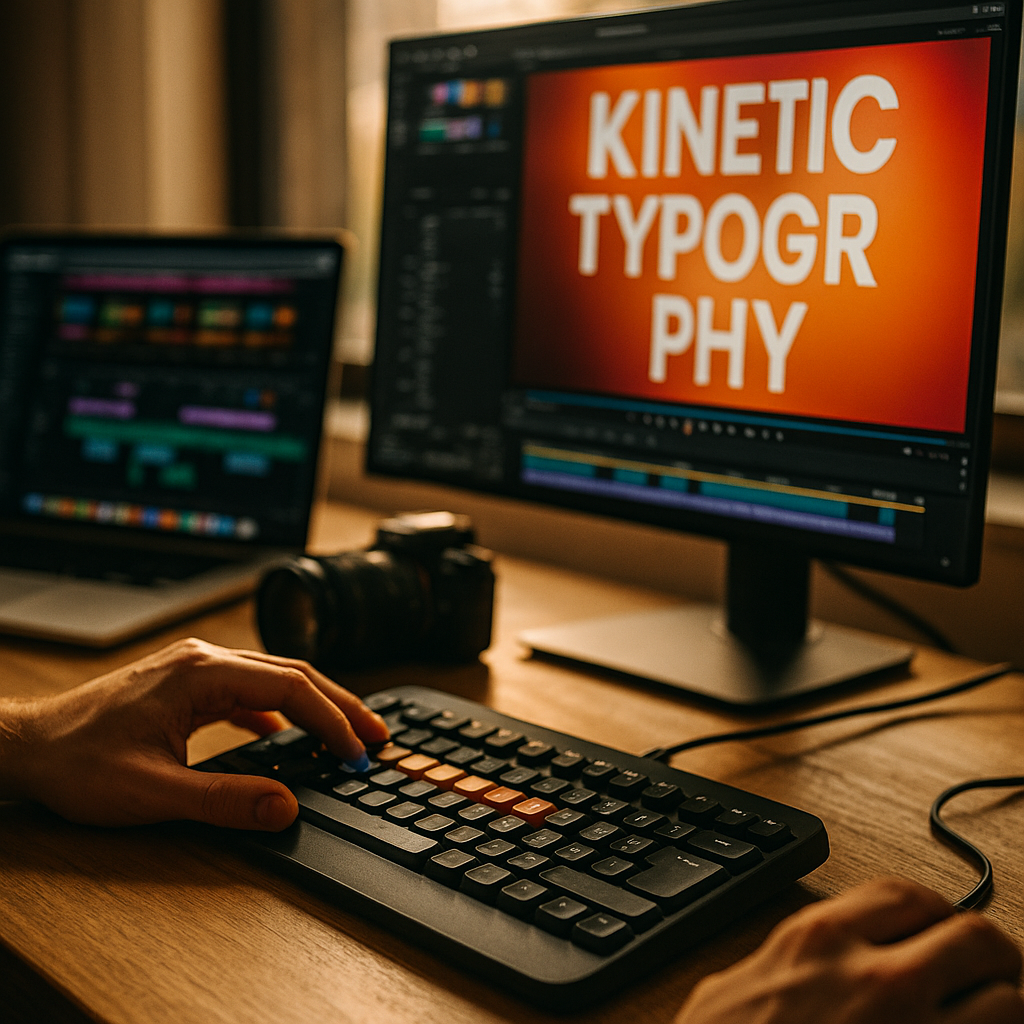
The power of kinetic typography is changing how audiences consume video in 2025, especially when attention is scarce and sound-off viewing is common. When animated text is timed to speech, music, and on-screen actions, it makes key ideas impossible to miss and keeps viewers oriented through the story. Used well, it lifts clarity, emotion, and retention—so what makes it work?
Why kinetic typography improves video view-through rate
View-through rate (VTR) rises when viewers quickly understand what they’re watching and feel rewarded for staying. Kinetic typography supports both outcomes by turning core messages into visual events. Instead of forcing viewers to “work” to follow a narrative, animated text reduces cognitive load: it highlights the point, clarifies the context, and creates a rhythm that invites continuation.
In 2025, two realities make this especially relevant: first, many viewers watch without audio in feeds and public spaces; second, videos increasingly compete with dense on-screen stimuli. Kinetic typography acts as a visual narrator. It reinforces meaning even when audio is muted and provides a clear hierarchy of information when the screen is busy.
It also improves “progress perception.” When the viewer sees structured, paced typographic beats (chapter-like phrases, counters, or promise statements), the content feels organized and finite. That reduces drop-off driven by uncertainty, particularly in explainer videos, product demos, and social ads where viewers decide within seconds whether to stay.
Practical takeaway: If your video asks viewers to remember a benefit, follow steps, or absorb comparisons, kinetic typography can hold attention by converting abstract points into timed, legible milestones—one of the most direct paths to higher VTR.
Kinetic typography for audience retention: the psychology of motion and readability
Audience retention improves when viewers experience constant, low-friction comprehension. Kinetic typography contributes through three primary mechanisms: attention capture, guided scanning, and emotional emphasis.
Attention capture: Human vision is tuned to notice motion. When text animates with purpose—appearing, transforming, or tracking with an object—it signals, “This matters now.” The key is restraint: motion should emphasize meaning, not create noise.
Guided scanning: Viewers read on screens by scanning. Kinetic typography creates a controlled reading path, limiting the number of competing focal points. Instead of a static subtitle block that competes with visuals, you can place keywords near the subject, stagger phrases, and use scale to indicate priority. That reduces eye travel and helps viewers keep up.
Emotional emphasis: Type has personality. Weight, speed, spacing, and easing can express urgency, confidence, calm, or excitement. When the typographic “performance” matches the speaker’s tone and the brand’s identity, the message feels more believable and cohesive, which supports trust and sustained viewing.
Common follow-up question: “Isn’t this just fancy captions?” Not quite. Captions primarily transcribe. Kinetic typography interprets—selecting, staging, and timing language to guide attention and reinforce narrative structure. You can use both: captions for accessibility and kinetic moments for emphasis.
Animated text best practices for watch time and message clarity
To lift watch time, animated text must stay legible, intentional, and consistent. The best-performing treatments typically follow a few production principles that reduce friction for the viewer.
- Prioritize hierarchy: Animate only the words that carry meaning. Keep supporting text smaller or static. If everything moves, nothing stands out.
- Design for sound-off first: Assume the viewer may not hear the audio. Ensure the main promise, offer, and key steps are readable without relying on voiceover.
- Keep on-screen reading time realistic: A practical baseline is to allow enough time for a viewer to read comfortably without rushing. If a phrase is essential, give it more frames, not more effects.
- Use contrast and safe margins: Maintain strong contrast against backgrounds and keep text away from UI overlays (especially in vertical formats). Treat readability as a performance metric.
- Match motion to meaning: Fast snaps can communicate energy; smooth slides can feel confident; subtle scale-ups can signal importance. Choose motion vocabulary deliberately and repeat it.
- Limit fonts and styles: Use one or two typefaces and consistent weights. Too many styles look untrustworthy and can feel like an ad trying too hard.
- Integrate with the scene: Track text to objects, align it with perspective, or anchor it near the speaker. When typography “belongs” in the world, it feels premium and keeps viewers engaged.
Answering the next likely question: “How much is too much?” If motion ever delays comprehension, you’ve crossed the line. The goal is faster understanding and stronger emphasis, not decoration.
Video marketing typography strategy: where it has the biggest impact
Kinetic typography is most effective where viewers make quick decisions, where the message is complex, or where trust must be earned fast. A strategy that ties typography to business goals makes the creative measurable and repeatable.
Top-of-funnel social ads: Use kinetic type to deliver the promise within the first seconds, then pace supporting benefits as the product appears. This improves “orientation,” which helps prevent early drop-off.
Explainer and onboarding videos: Convert steps into typographic checkpoints. For example, animate “Step 1,” “Step 2,” and key verbs (“Choose,” “Confirm,” “Track”) to reduce confusion and keep retention steady through procedural content.
Product demos and feature launches: Pair screen captures with animated labels and outcome statements. When viewers can instantly connect an action to a benefit, they stay longer and are more likely to replay segments.
Testimonials and case studies: Highlight proof points—results, timelines, or constraints—using subtle emphasis. This supports credibility without interrupting the human story.
Internal communications and training: In 2025, distributed teams rely on video. Kinetic typography can reduce misinterpretation and improve completion rates for mandatory modules by clarifying definitions, safety rules, and key takeaways.
How to align with EEAT: Use typography to reinforce accurate claims and precise language. If you cite results, animate the qualifier too (for example, “median,” “range,” or “conditions apply”). This prevents misleading impressions and supports trust.
Motion design for higher engagement: timing, pacing, and platform fit
Engagement improves when pacing matches platform behavior. Kinetic typography lets you shape pacing without reshooting footage—by accelerating understanding in dense sections and slowing down for key points.
Timing: Sync text beats to natural speech cadence and scene cuts. If a word lands before the idea is spoken, it can feel jarring; if it arrives too late, it loses impact. Tight synchronization keeps viewers “locked in.”
Pacing: Alternate intensity. A constant barrage of animated words causes fatigue. Instead, use cycles: a quiet beat (static or minimal motion) followed by a highlighted beat (animated emphasis). This variation sustains attention across longer runtimes.
Platform fit: In vertical feeds, large readable text wins; in connected TV, text must be larger than you expect and held longer due to viewing distance. In short-form environments, quick, bold keywords perform better than full sentences; in long-form, chapter-style headings and summaries help retention.
Accessibility: Kinetic typography should support, not replace, accessible captions. Ensure color contrast is strong, avoid flashing effects, and keep motion comfortable. If the video includes critical instructions, make sure they are presented long enough to read and also available in captions.
Brand consistency: Create a motion “style guide” so different editors produce consistent results: typography scale, easing curves, transition types, and emphasis rules. Consistency makes content feel authoritative, which can influence how long viewers trust the video enough to keep watching.
How to measure view-through lift and iterate with confidence
To claim that kinetic typography “works,” you need clean measurement and thoughtful iteration. The goal is not just better-looking content; it’s higher VTR and stronger downstream actions.
Start with clear hypotheses: Examples include “If we animate the offer and key benefit within the first five seconds, VTR will increase,” or “If we reduce on-screen words and emphasize verbs only, mid-video drop-off will decrease.”
Track the right metrics: VTR is central, but also watch average view duration, retention curves (drop-off points), rewatch behavior, and click-through rate when relevant. If VTR improves but clicks fall, your typography may be overemphasizing the wrong message.
A/B test thoughtfully: Compare a control version (static text or standard captions) to a kinetic version. Keep everything else constant: same footage, same audio, same length, same thumbnail. Change only the typography treatment to isolate impact.
Use retention graphs as a map: If you see a sharp dip at a specific timestamp, review what happens there. Is the text too dense? Did the motion obscure the subject? Did a key claim appear too late? Adjust pacing and hierarchy, then retest.
Don’t confuse novelty with performance: A flashy style can lift first-week engagement but fade as audiences acclimate. Aim for durable clarity: typography that consistently improves understanding will support long-term VTR across campaigns.
Operational tip: Build reusable templates for recurring formats (hooks, lists, comparisons, CTAs). Templates speed production while preserving a tested approach, which is especially useful for teams publishing weekly or running multiple ad variants.
FAQs
What is kinetic typography in video?
Kinetic typography is animated text designed to communicate meaning through motion, timing, and visual hierarchy. Unlike static titles or basic captions, it emphasizes key words, structures information, and synchronizes with audio and visuals to guide attention.
Does kinetic typography work if viewers watch with the sound off?
Yes. It can significantly improve comprehension in sound-off contexts by surfacing the promise, benefits, and steps as readable on-screen text. For best results, ensure strong contrast, adequate reading time, and a clear hierarchy.
How much text should be on screen at once?
As little as possible while preserving meaning. Highlight keywords or short phrases rather than full paragraphs. If you must show longer text (instructions, legal qualifiers), keep it static, large enough to read, and on screen longer.
Will kinetic typography hurt accessibility?
Not if implemented responsibly. Keep motion comfortable, avoid flashing, maintain contrast, and provide standard captions for full transcription. Kinetic typography should enhance comprehension without becoming the only way to access information.
Which videos benefit most from kinetic typography?
Social ads, explainers, product demos, onboarding/training, and testimonial-driven content often see the biggest gains because viewers need fast clarity and strong narrative structure to stay engaged.
How do I know if kinetic typography is improving view-through rate?
Run A/B tests where typography is the only variable, then compare VTR and retention curves. Look for reduced early drop-off, smoother mid-video retention, and improved completion rates without sacrificing clicks or other downstream goals.
What tools do teams use to create kinetic typography?
Many teams use professional motion design tools and template-based editors. The specific tool matters less than consistent typography rules, readable design, and tight timing aligned with the script and platform format.
How fast can a team implement this without a full redesign?
You can start by animating only the hook, the main benefit, and the call to action. Then expand into templates for lists, comparisons, and chapter headings. This phased approach typically delivers measurable improvements without slowing production.
Conclusion
Kinetic typography boosts view-through by making videos easier to understand, harder to ignore, and more structured to follow. When motion serves meaning—clear hierarchy, readable pacing, platform-fit sizing, and accessible presentation—it supports trust and sustained attention. In 2025, the teams that win VTR treat animated text as a measurable narrative tool, not decoration. Build a system, test, and iterate.
Top Influencer Marketing Agencies
The leading agencies shaping influencer marketing in 2026
Agencies ranked by campaign performance, client diversity, platform expertise, proven ROI, industry recognition, and client satisfaction. Assessed through verified case studies, reviews, and industry consultations.
Moburst

-
2

The Shelf
Boutique Beauty & Lifestyle Influencer AgencyA data-driven boutique agency specializing exclusively in beauty, wellness, and lifestyle influencer campaigns on Instagram and TikTok. Best for brands already focused on the beauty/personal care space that need curated, aesthetic-driven content.Clients: Pepsi, The Honest Company, Hims, Elf Cosmetics, Pure LeafVisit The Shelf → -
3

Audiencly
Niche Gaming & Esports Influencer AgencyA specialized agency focused exclusively on gaming and esports creators on YouTube, Twitch, and TikTok. Ideal if your campaign is 100% gaming-focused — from game launches to hardware and esports events.Clients: Epic Games, NordVPN, Ubisoft, Wargaming, Tencent GamesVisit Audiencly → -
4

Viral Nation
Global Influencer Marketing & Talent AgencyA dual talent management and marketing agency with proprietary brand safety tools and a global creator network spanning nano-influencers to celebrities across all major platforms.Clients: Meta, Activision Blizzard, Energizer, Aston Martin, WalmartVisit Viral Nation → -
5

The Influencer Marketing Factory
TikTok, Instagram & YouTube CampaignsA full-service agency with strong TikTok expertise, offering end-to-end campaign management from influencer discovery through performance reporting with a focus on platform-native content.Clients: Google, Snapchat, Universal Music, Bumble, YelpVisit TIMF → -
6

NeoReach
Enterprise Analytics & Influencer CampaignsAn enterprise-focused agency combining managed campaigns with a powerful self-service data platform for influencer search, audience analytics, and attribution modeling.Clients: Amazon, Airbnb, Netflix, Honda, The New York TimesVisit NeoReach → -
7

Ubiquitous
Creator-First Marketing PlatformA tech-driven platform combining self-service tools with managed campaign options, emphasizing speed and scalability for brands managing multiple influencer relationships.Clients: Lyft, Disney, Target, American Eagle, NetflixVisit Ubiquitous → -
8

Obviously
Scalable Enterprise Influencer CampaignsA tech-enabled agency built for high-volume campaigns, coordinating hundreds of creators simultaneously with end-to-end logistics, content rights management, and product seeding.Clients: Google, Ulta Beauty, Converse, AmazonVisit Obviously →