


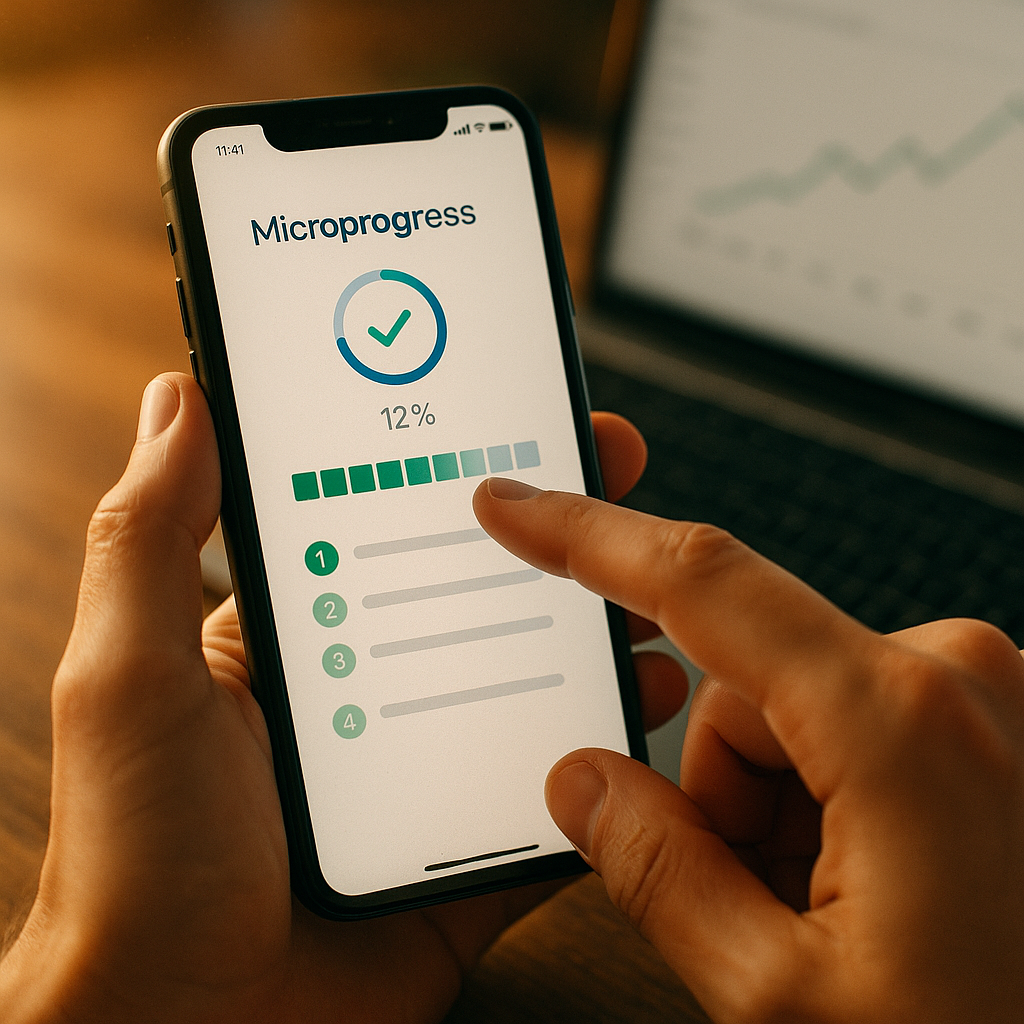
In 2025, teams obsessed with growth are rediscovering a quieter lever: inchstones in app design. Unlike big milestones, inchstones are tiny, frequent markers of progress that make users feel capable, oriented, and motivated. When crafted with behavioral science and ethical UX, they reduce drop-off and strengthen habits without gimmicks. The question is simple: what if retention improved by making progress feel inevitable?
Micro-progress psychology for habit formation
Inchstones work because the human brain is wired to chase progress. When users can see themselves moving forward, they persist longer, tolerate friction better, and return more reliably. This is not about “adding rewards”; it is about designing micro-progress that supports how people learn and build habits.
Several well-established mechanisms explain the effect:
- Goal-gradient effect: Motivation increases as people perceive they are closer to a goal. Inchstones create many “closer” moments rather than one distant finish line.
- Self-efficacy: Small wins reinforce the belief “I can do this,” which is a core driver of continued effort. A user who feels competent is less likely to churn.
- Cognitive load reduction: Big tasks feel ambiguous. Inchstones break ambiguity into clear next steps, reducing decision fatigue.
- Progress principle: Frequent evidence of progress improves engagement and mood, making the product feel supportive rather than demanding.
In practice, inchstones are designed signals that translate effort into meaning: “You completed your first setup step,” “You’re 2 actions away from a healthier recommendation feed,” or “Your streak reflects consistency, not perfection.” The best inchstones are tied to the user’s purpose, not the company’s funnel.
Behavioral design principles behind inchstones
To design inchstones that actually improve retention, anchor them to behavioral design principles that predict action. A useful mental model is that behavior happens when motivation, ability, and a prompt converge. Inchstones raise perceived ability and sharpen prompts at moments where users might stall.
Key principles to apply:
- Make the next action obvious: An inchstone should end with a clear “next best step,” not a vague celebration. If the user does not know what to do next, the progress marker backfires.
- Match difficulty to user stage: Early inchstones should be extremely easy (reduce time-to-value). Later inchstones can increase complexity as competence grows.
- Use variable pathways, stable outcomes: Let users choose how they get progress (e.g., multiple ways to complete onboarding), but keep the meaning consistent (“You’re set up for success”). Choice increases autonomy and reduces reactance.
- Encode progress as learning: Instead of “You earned 20 points,” prefer “You’ve completed 2 of 3 steps to personalize your plan.” Learning-based feedback supports long-term retention better than generic gamification.
A common follow-up question is whether inchstones are just “small milestones.” They are more specific: an inchstone is a psychological checkpoint designed to reduce uncertainty and increase momentum at high-risk drop-off moments—especially during onboarding, first success, and the second-week slump.
Onboarding UX patterns that increase app engagement
The fastest way inchstones influence retention is by improving onboarding. Most apps lose users because the path to first value is unclear or feels like work. Inchstones fix this by turning onboarding into a sequence of confidence-building steps that feel purposeful.
High-performing inchstone patterns for onboarding UX include:
- Progressive profiling: Ask for the minimum to deliver value now, then collect more later when trust is higher. Each completed micro-step becomes an inchstone that signals momentum.
- “First win” within minutes: Design an early action that produces a meaningful result (a recommendation, a saved item, a created draft, a matched plan). Mark it explicitly: “You’ve just unlocked your personalized view.”
- Guided choices with preview: When users choose preferences, show immediate impact (preview results changing). This makes the inchstone feel real rather than administrative.
- Checklist with intent: A 3–5 item checklist tied to benefits (“Complete to get smarter suggestions”) works better than a long list tied to internal setup tasks.
- Contextual tooltips only when needed: Teach at the moment of use. Each successful use becomes an inchstone: “Nice—your first saved search is active.”
Answering the next obvious question—how many inchstones is too many—depends on whether each one creates clarity. If you are adding steps that do not increase capability or understanding, you are inflating the journey and harming retention. In 2025, users have little patience for “busy progress.” The best test is simple: does each inchstone reduce uncertainty and move the user closer to the outcome they want?
Retention metrics and activation funnels
Inchstones should be measurable. If your team cannot connect them to activation and retention metrics, they will become decorative UI. The goal is to identify the moments where users decide to continue or leave—and to add micro-progress that makes continuation feel natural.
Start by mapping your activation funnel as behaviors (not screens). Example: “Create account → complete preference → perform core action → receive meaningful output → repeat core action within 48 hours.” Then identify friction points where drop-off spikes.
Practical ways to instrument inchstones:
- Define the “inchstone events”: Track each micro-win as an event (e.g., completed_step_1, first_result_generated, first_save, first_share, second_session_core_action).
- Measure time-to-first-value (TTFV): Inchstones should reduce TTFV. If TTFV rises after adding inchstones, you likely added ceremony, not clarity.
- Cohort retention by inchstone completion: Compare D1/D7/D30 retention between users who reached key inchstones and those who did not. This reveals which checkpoints are truly predictive.
- Quality guardrails: Add metrics that prevent “retention at any cost,” such as refund rate, uninstall reasons, support tickets per active user, or negative review sentiment after new inchstones launch.
A critical follow-up question: should inchstones optimize for “more time in app”? Not necessarily. For many products, retention improves when the app delivers value faster and then gets out of the way. Inchstones should focus on successful outcomes and repeated utility, not endless engagement.
Ethical gamification and trust-building UX
Inchstones sit close to gamification, which means they can either build trust or erode it. The difference is intent and transparency. Ethical inchstones respect user autonomy, avoid dark patterns, and reinforce meaningful progress rather than exploiting compulsive loops.
Guidelines for trust-building inchstones:
- Make progress truthful: Never show “90% complete” if the user is not meaningfully closer to value. False progress creates short-term clicks and long-term churn.
- Avoid shame mechanics: Streaks can motivate, but punishing resets can make users quit. Consider “streaks with forgiveness” or “consistency bands” that reflect real-life variability.
- Use reminders as service, not pressure: Notifications should reference the user’s goal (“Your saved route is ready”) rather than guilt (“You haven’t worked out in 3 days”). Offer easy controls to pause or tune reminders.
- Protect vulnerable users: For finance, health, and youth audiences, prioritize informed consent, clear defaults, and safety checks. Inchstones should guide better decisions, not accelerate risky behavior.
- Explain “why”: When you ask for data or permissions, connect it to a specific benefit inchstone (“Enable location to get accurate nearby results”).
In 2025, EEAT-aligned product content means your UI and messaging should demonstrate competence and integrity. That includes clear privacy explanations, honest progress indicators, and consistent value delivery. Users do not stay because they are nudged; they stay because they trust the app to help them succeed.
Personalization, feedback loops, and long-term user retention
Inchstones become more powerful when they adapt to the user. The same micro-progress marker will not motivate a beginner and an expert in the same way. Personalization lets you keep inchstones relevant, while feedback loops ensure they improve over time.
Ways to personalize inchstones without over-collecting data:
- Stage-based inchstones: Detect user stage through behavior (not demographics) and adjust guidance. New users get “setup” inchstones; experienced users get “mastery” inchstones like shortcuts and advanced features.
- Outcome-based dashboards: Show progress toward the user’s desired outcome (budget stability, learning consistency, task throughput), not just product usage.
- Adaptive difficulty: If a user struggles, reduce steps and provide clearer hints. If they move fast, remove handholding and offer power-user options.
- Closed-loop learning: Use in-app feedback prompts after key inchstones (“Was this recommendation useful?”). Tie responses to model improvements and communicate updates: “Your feed is now tuned to your choices.”
Teams often ask how to keep inchstones fresh without constant redesign. The answer is to build a system: a library of inchstone templates (copy + UI components), a rule engine for when they appear, and a testing cadence. Your best inchstones will be the ones that become nearly invisible—because the user feels guided, not managed.
FAQs
What is an inchstone in app design?
An inchstone is a small, intentional progress marker that confirms a user has moved forward and clarifies what to do next. It is designed to reduce uncertainty, increase confidence, and sustain momentum, especially during onboarding and early habit formation.
How are inchstones different from milestones or gamification?
Milestones are often infrequent and outcome-heavy (e.g., “completed course”). Gamification often adds points or badges. Inchstones are frequent psychological checkpoints tied to capability and clarity (e.g., “your first plan is ready”), and they can exist with or without game elements.
Where should I add inchstones to improve retention?
Start at the highest drop-off points: account creation, permission requests, first core action, first success moment, and the return-to-app prompt for the second session. Add inchstones where users hesitate, not everywhere.
Can too many inchstones hurt user retention?
Yes. Excess inchstones add friction, feel patronizing, or create “fake progress.” If an inchstone does not reduce cognitive load or move the user meaningfully closer to value, remove it or merge it into a clearer step.
What metrics prove inchstones are working?
Track time-to-first-value, activation rate, second-session rate, cohort retention (D1/D7/D30), and completion rates of the specific inchstone events. Pair these with trust signals such as fewer complaints, lower uninstall rates, and improved review sentiment.
How do I keep inchstones ethical and avoid dark patterns?
Ensure progress indicators are truthful, provide user control over reminders, avoid shame-based streak mechanics, and tie prompts to user goals rather than company-only KPIs. If an inchstone increases anxiety or regret, it is not ethical—or sustainable for retention.
Inchstones succeed because they make progress feel real, frequent, and user-centered. By turning ambiguous journeys into clear next steps, they boost confidence, shorten time-to-value, and create habits built on competence rather than pressure. In 2025, the retention advantage goes to products that measure these micro-wins, personalize them responsibly, and keep them honest. Design inchstones as guidance—and users will keep coming back.
Top Influencer Marketing Agencies
The leading agencies shaping influencer marketing in 2026
Agencies ranked by campaign performance, client diversity, platform expertise, proven ROI, industry recognition, and client satisfaction. Assessed through verified case studies, reviews, and industry consultations.
Moburst

-
2

The Shelf
Boutique Beauty & Lifestyle Influencer AgencyA data-driven boutique agency specializing exclusively in beauty, wellness, and lifestyle influencer campaigns on Instagram and TikTok. Best for brands already focused on the beauty/personal care space that need curated, aesthetic-driven content.Clients: Pepsi, The Honest Company, Hims, Elf Cosmetics, Pure LeafVisit The Shelf → -
3

Audiencly
Niche Gaming & Esports Influencer AgencyA specialized agency focused exclusively on gaming and esports creators on YouTube, Twitch, and TikTok. Ideal if your campaign is 100% gaming-focused — from game launches to hardware and esports events.Clients: Epic Games, NordVPN, Ubisoft, Wargaming, Tencent GamesVisit Audiencly → -
4

Viral Nation
Global Influencer Marketing & Talent AgencyA dual talent management and marketing agency with proprietary brand safety tools and a global creator network spanning nano-influencers to celebrities across all major platforms.Clients: Meta, Activision Blizzard, Energizer, Aston Martin, WalmartVisit Viral Nation → -
5

The Influencer Marketing Factory
TikTok, Instagram & YouTube CampaignsA full-service agency with strong TikTok expertise, offering end-to-end campaign management from influencer discovery through performance reporting with a focus on platform-native content.Clients: Google, Snapchat, Universal Music, Bumble, YelpVisit TIMF → -
6

NeoReach
Enterprise Analytics & Influencer CampaignsAn enterprise-focused agency combining managed campaigns with a powerful self-service data platform for influencer search, audience analytics, and attribution modeling.Clients: Amazon, Airbnb, Netflix, Honda, The New York TimesVisit NeoReach → -
7

Ubiquitous
Creator-First Marketing PlatformA tech-driven platform combining self-service tools with managed campaign options, emphasizing speed and scalability for brands managing multiple influencer relationships.Clients: Lyft, Disney, Target, American Eagle, NetflixVisit Ubiquitous → -
8

Obviously
Scalable Enterprise Influencer CampaignsA tech-enabled agency built for high-volume campaigns, coordinating hundreds of creators simultaneously with end-to-end logistics, content rights management, and product seeding.Clients: Google, Ulta Beauty, Converse, AmazonVisit Obviously →