


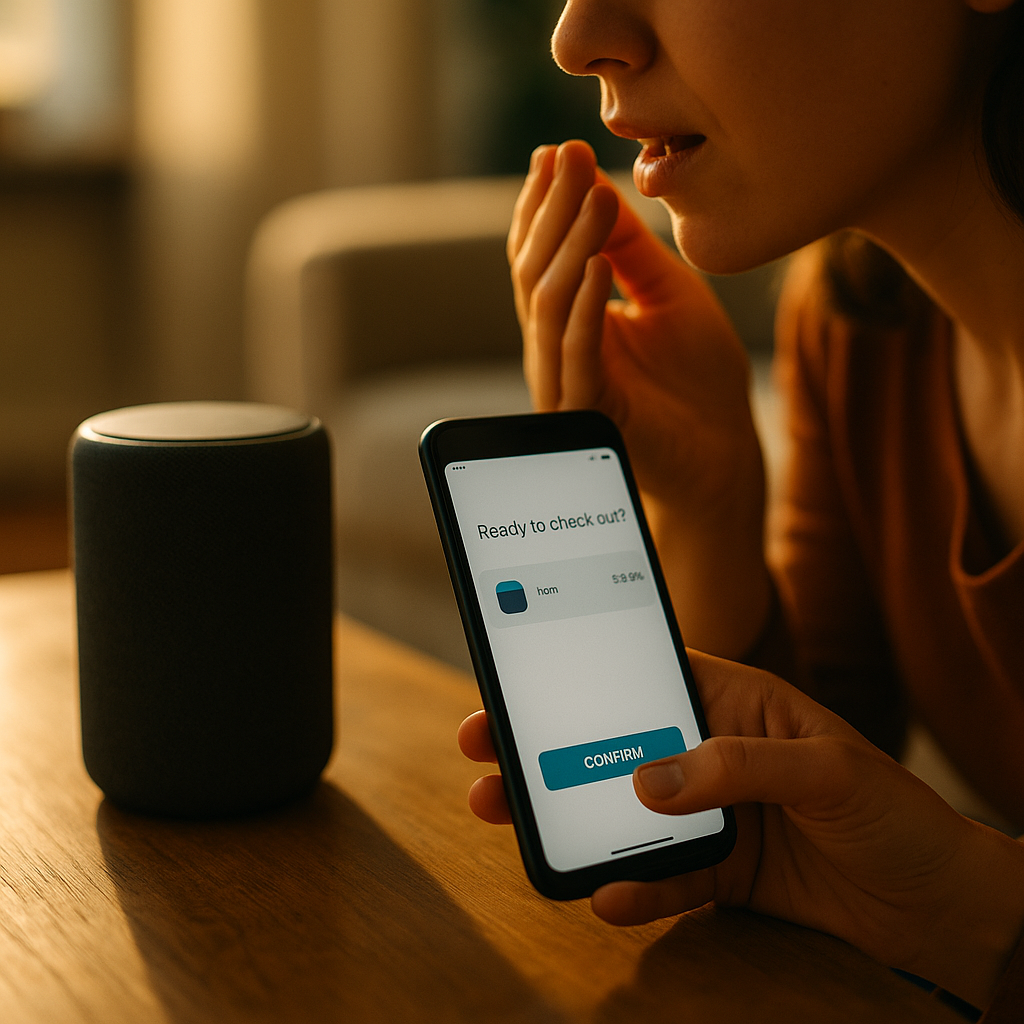
In 2025, voice commerce is moving from novelty to default, and the smallest words now carry the biggest revenue impact. The science of micro copy for AI driven voice checkout interfaces blends linguistics, behavioral psychology, and UX to reduce friction when screens disappear. When customers can’t “see” the flow, every prompt must guide, reassure, and confirm. What separates smooth checkout from abandonment?
Voice checkout microcopy: why words replace screens
In a visual checkout, layout, button labels, and progress indicators do much of the work. In a voice checkout, microcopy becomes the interface. It must do four jobs at once: set expectations, gather information, prevent errors, and build trust—often in under two seconds of audio.
Voice removes the user’s ability to scan. That changes how people process instructions: they rely on short-term memory, immediate confirmation, and predictable turns in conversation. If your prompts are long or ambiguous, users either forget what to say or respond with irrelevant details, increasing recognition errors and retries.
Effective voice microcopy makes the conversation feel inevitable and easy. It anticipates what the user wants to do next and narrows the response space without sounding restrictive. For example, instead of asking, “What would you like to do?” at checkout, you guide action: “Would you like to place the order now, or change something first?”
To keep the flow moving, design microcopy around:
- Turn clarity: make it obvious when the user should speak.
- Response shaping: give examples or constrained choices.
- State visibility: restate what the system understood, briefly.
- Confidence cues: reinforce safety without legal overreach.
Conversational UX principles for AI checkout prompts
AI-driven voice checkout succeeds when microcopy aligns with how humans naturally coordinate tasks in conversation. That means using structure, not verbosity. The best prompts are brief, specific, and recoverable when the model mishears or the user changes their mind.
Use these conversational UX principles to craft checkout prompts that convert:
- One intent per turn: Ask for one thing at a time. Avoid compound prompts like “Confirm your address and payment method.”
- Echo with purpose: Repeat only what reduces risk: item, total, delivery window, payment last four, and any subscription or recurring charges.
- Progress anchoring: Provide short status markers: “Great—address saved. Next, delivery time.” This replaces a visual progress bar.
- Default with consent: Offer safe defaults but request explicit confirmation: “Use your default card ending 4412?”
- Interruption tolerance: Include microcopy that invites corrections: “You can say ‘change address’ at any time.”
Also consider where you place reassurance. If you lead with “This call may be recorded,” you spike anxiety at the exact moment you need cooperation. Instead, put trust statements right before risk moments: payment, address verification, and final confirmation.
Finally, design for low-cognitive-load language: short sentences, concrete nouns, and fewer qualifiers. People are often multitasking during voice checkout (walking, cooking, commuting). Your microcopy must be resilient in imperfect environments.
Behavioral psychology in checkout microcopy: nudges, trust, and clarity
Microcopy works because it influences attention, perceived effort, and perceived risk. In voice checkout, these factors are amplified because users cannot visually verify what’s happening. The goal is not manipulation; it’s decision support—helping customers complete what they already intend to do.
Key psychological levers that translate well to voice include:
- Effort reduction: People abandon when a task feels long. Use microcopy that signals speed: “Two quick checks, then you’re done.”
- Loss aversion (used ethically): Prevent mistakes by framing consequences without fear: “I have ‘Apartment 4B.’ Is that right for delivery?”
- Commitment and consistency: Summarize progress: “You’re set for delivery tomorrow.” This increases follow-through.
- Trust calibration: Avoid overpromising. Say what you do: “I’ll read back the total before placing the order.”
Clarity beats persuasion at checkout. If microcopy sounds like marketing, users worry about hidden charges. Replace hype with transparency:
- Instead of: “Unlock amazing savings with our protection plan!”
- Use: “Add shipping protection for $2.99? It covers loss and damage in transit.”
Trust also depends on predictable confirmations. A simple read-back pattern reduces anxiety: “I heard…” + “Is that correct?” + “You can say change if not.” This mirrors how humans verify details in high-stakes tasks.
Error recovery microcopy for speech recognition and AI uncertainty
AI-driven voice checkout interfaces must assume imperfect inputs: background noise, accents, speech differences, and ambiguous answers. The difference between a failed checkout and a recovered one is often a single line of microcopy.
Design for three common failure types:
- Recognition errors: the system heard the wrong thing.
- Ambiguity: the user gave an answer that could mean multiple things.
- Policy constraints: the user asked for something the system cannot do.
For recognition errors, avoid blame and avoid repeating the same prompt. Use apology + what went wrong + next best action:
- “Sorry, I didn’t catch the street number. Please say just the number, like ‘1205.’”
- “I heard ‘May 15’ for delivery. Did you mean May 5 or May 15?”
For ambiguity, reduce the response space with options:
- “Do you want standard delivery or express?”
- “Should I use the Visa ending 4412 or the Mastercard ending 9070?”
For constraints, be direct and helpful:
- “I can’t change the billing name by voice. I can text you a secure link, or connect you to an agent. Which do you prefer?”
Also include an escape hatch every few turns. Users want control when voice feels uncertain:
- “You can say ‘repeat,’ ‘go back,’ or ‘agent’ anytime.”
When the model is uncertain, do not guess silently. Use calibrated confidence language that doesn’t undermine trust:
- “I might have that wrong. Did you say ‘10 a.m.’?”
This approach aligns with EEAT principles: it is transparent about limitations and prioritizes user safety over forced completion.
Security and privacy microcopy in voice payments and authentication
Voice checkout intersects with sensitive data: addresses, phone numbers, and payment authorization. Microcopy must communicate security steps clearly without creating alarm. In 2025, users expect privacy controls, and regulators increasingly scrutinize dark patterns and unclear consent. Your prompts should sound like a trusted cashier: calm, specific, and procedural.
Key moments that require strong security microcopy include:
- Identity verification (especially for account changes or high-value orders)
- Payment authorization (the “point of no return”)
- Data confirmation (shipping address, phone, email)
Best practices for voice security microcopy:
- Explain the “why” in one clause: “For security, I’ll send a one-time code to your phone.”
- Minimize spoken sensitive data: confirm partials: “Card ending 4412”, not full numbers.
- Offer private-channel alternatives: “If you’re in public, I can send a secure link instead.”
- Use explicit consent for charges: “Say ‘confirm purchase’ to place the order for $48.20.”
Avoid vague final steps like “Should I go ahead?” which can create disputes. Use clear authorization phrases and repeat the total, including shipping and taxes, right before capture. If there is a recurring charge, call it out plainly and ask for explicit acceptance.
Finally, if voice biometrics are used, state it transparently: “If you choose, we can use your voice to verify you next time. Want to set that up?” Never imply enrollment by default.
Testing and measurement: optimizing microcopy for voice conversion rate
Voice microcopy should be treated as a measurable product component, not a finishing touch. Because audio experiences vary by device, environment, and user speech patterns, you need both quantitative and qualitative methods to validate improvements.
Define success with metrics that reflect voice realities:
- Checkout completion rate and time to complete
- Turn count (how many back-and-forths to finish)
- Repair rate (how often users correct the system)
- Fallback rate to agent or web link
- Misrecognition clusters by slot (address, name, promo code)
Microcopy A/B testing in voice requires careful control. If you change both phrasing and dialog flow, you won’t know what caused the lift. Test one variable at a time:
- Prompt length: short vs. shorter (not short vs. long).
- Choice framing: open-ended vs. two options + “something else.”
- Confirmation style: implicit confirmation vs. explicit confirmation for high-risk fields.
Pair analytics with listening studies. Run usability sessions where participants complete checkout in realistic noise conditions. Ask them what they believed happened after each system turn. This reveals hidden confusion that metrics alone may not capture.
Operationally, maintain a microcopy library with approved phrases for confirmations, errors, security, and accessibility. Version it like code, and include rationale, reading level, and do-not-use variants. This supports EEAT by making your content consistent, reviewed, and accountable.
FAQs: microcopy for AI driven voice checkout interfaces
What is microcopy in a voice checkout interface?
Microcopy is the short, functional wording used in prompts, confirmations, errors, and security steps. In voice checkout it replaces visual UI cues, guiding the user through address, delivery, payment, and final authorization.
How long should a voice checkout prompt be?
Aim for one intent per turn and keep most prompts under two short sentences. If you need more detail, split it into two turns with a progress cue, so users don’t forget what you asked.
Should voice checkout use open-ended questions or fixed choices?
Use fixed choices for high-frequency decisions (delivery speed, payment method) and open-ended questions only when necessary (street address). A strong pattern is two options plus an escape: “standard, express, or something else?”
How do you handle speech recognition errors without annoying users?
Don’t repeat the same prompt. Briefly state what failed, ask for a smaller chunk, and provide an example. Also add control phrases like “repeat,” “go back,” and “agent” to reduce frustration.
What should the final purchase confirmation say?
Read back the item count, delivery timing, and total including taxes and shipping, then ask for explicit authorization. For example: “Total is $48.20 for delivery tomorrow. Say ‘confirm purchase’ to place the order.”
How do you build trust in voice payments?
Be transparent about what you’re doing, avoid overpromising, confirm sensitive details using partials, and offer privacy-preserving alternatives like secure links. Trust increases when users can predict the next step and correct mistakes easily.
Microcopy determines whether voice checkout feels effortless or risky. In 2025, the winning approach is scientific: structure prompts around conversational turns, reduce cognitive load, confirm high-stakes details, and design graceful recovery when AI is uncertain. Measure outcomes with completion, repair, and fallback rates, then iterate systematically. Treat every phrase as interface code, because in voice, words are the product.
Top Influencer Marketing Agencies
The leading agencies shaping influencer marketing in 2026
Agencies ranked by campaign performance, client diversity, platform expertise, proven ROI, industry recognition, and client satisfaction. Assessed through verified case studies, reviews, and industry consultations.
Moburst

-
2

The Shelf
Boutique Beauty & Lifestyle Influencer AgencyA data-driven boutique agency specializing exclusively in beauty, wellness, and lifestyle influencer campaigns on Instagram and TikTok. Best for brands already focused on the beauty/personal care space that need curated, aesthetic-driven content.Clients: Pepsi, The Honest Company, Hims, Elf Cosmetics, Pure LeafVisit The Shelf → -
3

Audiencly
Niche Gaming & Esports Influencer AgencyA specialized agency focused exclusively on gaming and esports creators on YouTube, Twitch, and TikTok. Ideal if your campaign is 100% gaming-focused — from game launches to hardware and esports events.Clients: Epic Games, NordVPN, Ubisoft, Wargaming, Tencent GamesVisit Audiencly → -
4

Viral Nation
Global Influencer Marketing & Talent AgencyA dual talent management and marketing agency with proprietary brand safety tools and a global creator network spanning nano-influencers to celebrities across all major platforms.Clients: Meta, Activision Blizzard, Energizer, Aston Martin, WalmartVisit Viral Nation → -
5

The Influencer Marketing Factory
TikTok, Instagram & YouTube CampaignsA full-service agency with strong TikTok expertise, offering end-to-end campaign management from influencer discovery through performance reporting with a focus on platform-native content.Clients: Google, Snapchat, Universal Music, Bumble, YelpVisit TIMF → -
6

NeoReach
Enterprise Analytics & Influencer CampaignsAn enterprise-focused agency combining managed campaigns with a powerful self-service data platform for influencer search, audience analytics, and attribution modeling.Clients: Amazon, Airbnb, Netflix, Honda, The New York TimesVisit NeoReach → -
7

Ubiquitous
Creator-First Marketing PlatformA tech-driven platform combining self-service tools with managed campaign options, emphasizing speed and scalability for brands managing multiple influencer relationships.Clients: Lyft, Disney, Target, American Eagle, NetflixVisit Ubiquitous → -
8

Obviously
Scalable Enterprise Influencer CampaignsA tech-enabled agency built for high-volume campaigns, coordinating hundreds of creators simultaneously with end-to-end logistics, content rights management, and product seeding.Clients: Google, Ulta Beauty, Converse, AmazonVisit Obviously →