


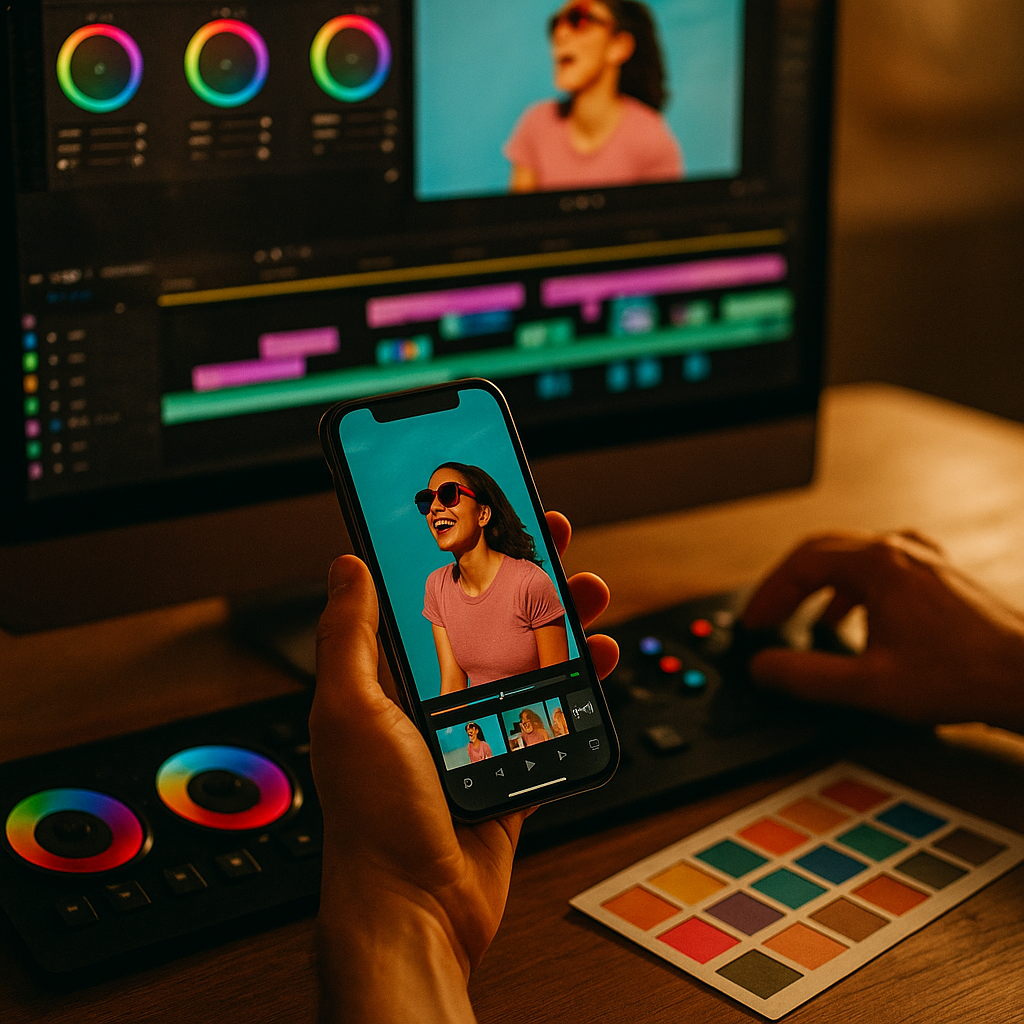
Color is not decoration in short-form content; it is a timing tool that shapes attention, emotion, and memory. The psychology of color pacing in high retention short video editing explains why some clips feel impossible to skip while others lose viewers in seconds. When editors control hue, contrast, and rhythm with intent, retention often rises. So what actually keeps eyes locked in?
Color psychology in video editing: why viewers react before they think
In short video, attention is won emotionally before it is justified logically. Viewers do not pause to analyze a palette; they feel it instantly. That reaction influences whether they keep watching, rewatch, or scroll away. This is where color psychology in video editing becomes a practical retention tool rather than a purely aesthetic choice.
Warm tones such as red, orange, and saturated yellow often create urgency, stimulation, and perceived speed. Cooler blues and greens tend to slow the mood, signal trust, or create a reflective pause. High contrast combinations increase visual alertness. Low contrast, monochromatic scenes often feel calmer or more cinematic, but they can also reduce energy if used too early in a fast-paced clip.
Editors who work on high-retention short videos typically think in micro-emotional beats:
- First 1-2 seconds: immediate visual clarity and emotional signal
- Next 3-7 seconds: strategic change to prevent adaptation
- Middle section: controlled variation to support story and maintain curiosity
- End: color reinforcement tied to payoff, CTA, or memory cue
Human perception adapts quickly to static visual conditions. If the color environment stays flat for too long, the brain predicts what comes next and attention drifts. Pacing color means introducing deliberate shifts in hue, luminance, saturation, or contrast at meaningful moments so the brain keeps updating its expectations.
That does not mean every short video needs aggressive neon grading. It means the color language should match the emotional objective. A financial explainer may benefit from controlled cool tones with warm highlights at key proof points. A fitness transformation clip may use cold, desaturated “before” frames and warm, high-contrast “after” sequences to strengthen the emotional arc.
Visual attention retention: how color pacing affects watch time
Visual attention retention depends on novelty, fluency, and reward. Color pacing supports all three. Novelty comes from change. Fluency comes from clear, readable images. Reward comes from emotional reinforcement when visual shifts align with the narrative beat.
When editors talk about pacing, they usually refer to cuts, motion, and audio. But color pacing can be just as influential because it changes how fast a scene feels, even if the cut rate stays the same. A sequence can contain only three cuts, yet feel highly dynamic because the color progression creates movement in the viewer’s perception.
Here is how color pacing impacts retention in practical terms:
- Brightness spikes pull the eye during key transitions or reveals
- Saturation changes signal emotional escalation or de-escalation
- Temperature shifts help separate context, time, or character perspective
- Accent colors guide focus toward products, faces, captions, or gestures
- Contrast changes reset visual fatigue and renew attention
For example, if a talking-head short stays in one evenly lit, neutral palette for 25 seconds, the viewer receives little perceptual stimulation beyond the script. But if the editor introduces subtle palette shifts at each argument turn, B-roll segment, or statistic reveal, the content feels more alive without becoming chaotic.
This is especially important on platforms where users make split-second decisions. High retention does not come only from loud editing. It often comes from structured variation. The best editors create a pattern the viewer can follow, then break that pattern at precisely the right time. Color is one of the cleanest ways to do that because it works below the level of conscious resistance.
A useful principle is this: pace color changes around meaning, not around random style impulses. If every second introduces a new grade, the viewer feels manipulation rather than momentum. If every color shift marks a beat in the story, the brain interprets it as purposeful progress.
Short-form video engagement: building emotional rhythm with hue and contrast
Short-form video engagement improves when viewers can feel momentum. Emotional rhythm is the rise and fall of tension, clarity, surprise, and payoff across a very short runtime. Color helps establish that rhythm because hue and contrast alter emotional intensity faster than spoken words can.
Think of a 30-second short as a compressed emotional journey. The viewer needs orientation, stimulation, and reward in rapid succession. An effective color pacing strategy may look like this:
- Hook: bold contrast, clean subject separation, immediate focal point
- Context: slightly more neutral tone for readability and trust
- Escalation: richer saturation or warmer temperature as stakes rise
- Reveal: distinct color shift to mark a breakthrough moment
- Resolution: stable palette that lets the message land
This structure works because emotional readability matters. If the visual tone does not support the narrative beat, engagement drops. A celebratory moment graded in flat, cool tones can feel emotionally confusing. A serious point delivered with over-saturated candy colors can feel unserious. Viewers may not verbalize the mismatch, but they respond to it.
Editors should also consider platform-specific behavior in 2026. Many users watch with sound low or off at first, which means visual cues carry even more weight in the opening moments. Color pacing becomes part of the “silent hook.” A well-placed warm accent, punchy luminance contrast, or sudden desaturation can communicate a shift before the caption is even read.
Use restraint. If every frame is intense, none of them are. Sustained maximal saturation creates fatigue. Strong pacing requires contrast between visual states. Calm sections make energetic moments feel energetic. Cooler scenes make warm reveals feel warmer. Desaturated setups make color-rich payoffs more memorable.
Editing for watch time: practical workflows for color pacing decisions
Editing for watch time requires repeatable systems, not guesswork. Color pacing becomes easier when you plan it as part of the edit rather than treating grading as a final cosmetic pass. The strongest retention-focused workflows connect script beats, shot selection, and color decisions from the start.
A practical workflow looks like this:
- Map the retention beats. Identify the hook, first payoff, tension point, main proof, and final reward.
- Assign emotional states. Decide what the viewer should feel at each beat: curiosity, urgency, trust, excitement, relief, desire.
- Translate those states into palette rules. Choose where to use warmth, coolness, saturation, or contrast changes.
- Test readability on mobile. Short videos are often watched on small screens in imperfect lighting conditions.
- Review with sound off. If the emotional progression still reads, the color pacing is likely helping.
For creators and brands, it helps to define a small set of repeatable visual triggers:
- A specific accent color for product benefits or proof moments
- A cooler baseline look for explanation segments
- A warmer, brighter look for transformation or reveal shots
- A contrast boost for CTA moments
This creates consistency without monotony. It also supports brand recognition. Over time, recurring color behaviors can become part of a recognizable editing signature.
One common question is whether color pacing should happen in-camera, in editing, or both. The answer is both whenever possible. Wardrobe, production design, lighting, and background selection give editors stronger source material. Post-production then refines timing and intensity. Trying to create all emotional contrast in the grade alone can look artificial, especially on compressed mobile platforms.
Another frequent question: how often should colors change? There is no universal number. In most high-retention shorts, meaningful visual change tends to occur every few seconds, but not always through full palette swaps. Sometimes a subtle shift in brightness, selective highlight color, or background tone is enough to reset attention.
Audience perception and color theory: common mistakes that lower retention
Audience perception and color theory matter most when editors avoid the mistakes that quietly reduce watch time. Many low-performing shorts are not failing because the idea is weak. They are failing because the visuals create friction, confusion, or fatigue.
Here are the most common color pacing mistakes:
- No visual hierarchy: the viewer cannot tell what matters first
- Overgrading: excessive saturation or contrast makes the clip feel cheap or stressful
- Random palette changes: shifts happen without narrative meaning
- Skin tone neglect: unnatural faces reduce trust immediately
- Low mobile readability: dark mids and muddy contrast collapse on smaller screens
- Style inconsistency: the clip feels stitched together rather than intentionally paced
Skin tone deserves special attention because trust is a retention variable. In testimonial-style, educational, and founder-led content, viewers often assess credibility in milliseconds. If the grade makes the speaker look sickly, too orange, or gray, engagement can fall even if the script is strong. Retention is not only about stimulation; it is also about comfort and perceived authenticity.
Another mistake is confusing color symbolism with universal viewer response. While broad tendencies exist, context changes meaning. Red can signal urgency, danger, romance, appetite, or premium intensity depending on category and framing. That is why editors should test creative against audience behavior rather than relying on abstract theory alone.
Accessibility also matters. Strong color pacing should not depend solely on subtle distinctions that many users may not perceive consistently across devices. Pair color with composition, text emphasis, motion direction, and luminance contrast. Helpful content works for real users in real conditions, not only on a calibrated monitor.
Video editing best practices: measuring whether color pacing actually works
Video editing best practices in 2026 require evidence. If the goal is retention, color pacing decisions should be judged by performance, not personal taste alone. That does not remove creativity; it sharpens it.
Measure these signals after publishing:
- Average view duration: indicates whether the pacing supports sustained attention
- Hook retention: reveals if opening color contrast is helping or hurting
- Rewatch rate: often rises when visual progression feels rewarding
- Drop-off points: may show where the visual energy flattens
- Conversion behavior: useful for branded content where the CTA matters
A simple testing framework can improve results quickly:
- Create two edits with identical scripts and timing.
- Change only the color pacing strategy.
- Version A uses a stable palette with minimal shifts.
- Version B uses intentional emotional progression through hue and contrast changes.
- Compare hook hold, midpoint retention, and completion rate.
This kind of controlled test helps separate visual impact from copy impact. It also helps teams build an internal playbook. Over time, patterns emerge. You may learn that your audience responds best to cooler educational setups with warm proof moments, or that bold saturation boosts work for product demos but reduce trust in expert interviews.
Experience matters here. Editors who consistently improve watch time usually develop judgment about when to intensify, when to simplify, and when to let a single color state hold. That judgment comes from reviewing analytics, studying viewer behavior, and connecting visual choices to outcomes. In other words, strong color pacing is creative, but it is also empirical.
The most reliable approach is to treat color as part of story engineering. Ask: What should the viewer feel now? What visual state best supports that feeling? What change will renew attention without breaking trust? Those three questions lead to better editing decisions than chasing trends.
FAQs about color pacing and short video retention
What is color pacing in video editing?
Color pacing is the deliberate timing of changes in hue, saturation, brightness, and contrast across a video to shape attention, emotion, and viewer momentum. In short-form content, it helps prevent visual fatigue and supports story beats.
Does color pacing really affect retention?
Yes. Color influences emotional response, focus, and perceived speed. When color changes align with meaningful moments, viewers are more likely to keep watching. Poorly paced or random color shifts can lower retention by creating confusion or fatigue.
How often should I change colors in a short video?
Only when the story or message needs a perceptual reset. Some clips benefit from subtle adjustments every few seconds, while others work better with one strong shift at a reveal or payoff. The key is purposeful change, not constant change.
What colors work best for hooks?
There is no single best color, but hooks usually benefit from strong visual hierarchy. High contrast, clean separation between subject and background, and one dominant accent color often perform well because they make the first frame easier to process.
Can I use color pacing without expensive gear?
Yes. Good lighting, intentional backgrounds, simple wardrobe choices, and careful mobile-first grading can create strong color pacing even with basic equipment. Strategy matters more than budget.
Should brand colors always dominate the edit?
No. Brand colors should support recognition, but retention comes first. Use brand colors as anchors or accents while allowing the broader palette to serve the emotional rhythm of the content.
What is the biggest color mistake in short-form video?
Overusing intense saturation and contrast without narrative purpose. It may grab attention briefly, but it often reduces trust and creates fatigue, especially in educational or conversion-focused videos.
How do I know if my color pacing is working?
Check hook retention, average watch time, midpoint drop-offs, rewatch rate, and conversions if applicable. If retention improves when you add structured color progression, your pacing is likely helping.
Color pacing is one of the most underused retention levers in short-form editing. When hue, contrast, and saturation change with narrative intent, viewers feel momentum, clarity, and reward without noticing the technique itself. The takeaway is simple: stop treating color as decoration and start using it as timing. In 2026, editors who pace emotion visually earn more attention and stronger results.