


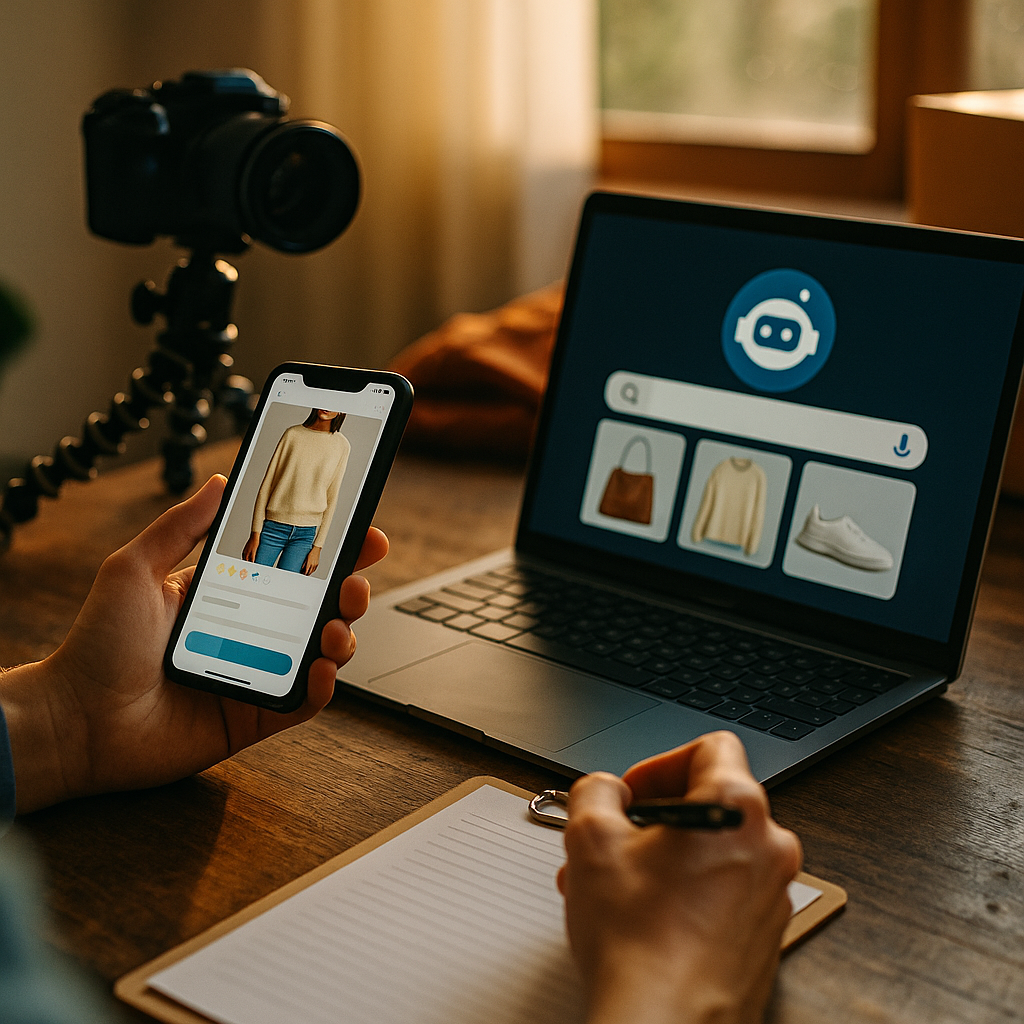
Your Creator Brief Is Now a Data Feed for AI Buying Agents
Over 30% of product discovery queries in ChatGPT and Gemini now trigger a purchase recommendation, according to data from Statista. If your creator brief still reads like a mood board directive, you are effectively invisible to autonomous AI shopping agents the moment a consumer asks one to recommend a product in your category.
The creator brief for AI shopping agent discovery is no longer just a production document. It is a structured signal architecture. And most brands have not caught up.
Why AI Shopping Agents Change the Brief Entirely
Autonomous buying assistants in ChatGPT, Gemini, and Amazon’s Rufus do not browse Instagram feeds. They retrieve structured, verifiable, factually dense product information from across the open web, including creator content that has been indexed. When a consumer asks “What’s the best lightweight running shoe under $140 with carbon fiber plate support?”, the AI does not surface the most viral TikTok. It surfaces the most factually complete and authoritative answer it can construct.
That answer can absolutely include creator content — if the content contains the right data signals. Most creator content does not. It contains vibes, lifestyle context, and emotion. Those matter for human audiences. AI agents weight specificity, structured claims, and source authority.
The implication is direct: brands that embed factual product specificity into their creator briefs will appear in AI-generated purchase recommendations. Brands that do not will be replaced by a competitor who did — or worse, by a generic AI summary that names no brand at all.
AI shopping agents retrieve the most factually complete answer available, not the most entertaining one. If your creator content cannot answer a structured purchase query, it does not exist in the agent’s decision stack.
The Four Layers of an AI-Optimized Creator Brief
Rewriting your brief for AI discovery does not mean stripping out creative direction. It means adding a parallel layer of factual architecture that creators embed into captions, voiceover scripts, video descriptions, and on-screen text. Here is how to structure it.
Layer 1: Mandatory Product Specificity Block
Every brief should include a non-negotiable “factual floor” section that lists the exact product attributes creators must communicate. Not paraphrase. Not interpret. State. This block should include: product name with model number or SKU identifier, key material or ingredient specifications, measurable performance claims with sourcing, price point, availability (retailer names, not just “available online”), and certifications or third-party validations. A skincare brand brief, for example, should specify “3% encapsulated retinol, dermatologist-tested, fragrance-free” rather than “clinically proven formula.” The former is retrievable by an AI agent. The latter is noise.
Layer 2: Structured Metadata Guidance
Creators need direction on how to format the content that surrounds the video or post itself, because AI agents index metadata heavily. Brief creators on: YouTube description structure (product name in the first sentence, key specs in bullet form within the first 200 characters), hashtag taxonomy using category-specific terms rather than branded vanity tags, chapter markers for long-form content that label product demonstrations explicitly, and caption structure that leads with the product claim rather than the lifestyle hook.
This is operationally adjacent to how brands think about shopping signals in creator briefs, but the AI discovery layer requires even more precision in how structured data surrounds the content itself.
Layer 3: Authority Signal Requirements
AI agents assess source authority before surfacing content as a purchase recommendation. Your brief should require creators to include signals that establish expertise and credibility. For creators in health, finance, or technical categories, this means directing them to reference their credentials or professional background in the content. For all categories, it means requiring links to your brand’s official product page, press coverage, or third-party review aggregators in the description. It also means instructing creators to avoid unverifiable superlatives (“the best ever”) in favor of specific, claim-backed language (“ranked #1 in independent lab testing by Wirecutter”).
Layer 4: Cross-Platform Consistency Architecture
AI agents aggregate signals across multiple indexed sources. A creator who posts the same factually complete product claim on YouTube, a blog post, and Reddit carries more retrieval weight than one who posts only to TikTok. Your brief should specify a minimum of two indexable touchpoints per creator activation, prioritizing platforms where content is publicly crawlable: YouTube, personal blogs, LinkedIn, Reddit, and Pinterest. TikTok content, for all its distribution power, is largely non-indexable by external AI systems.
What the Production Direction Section Must Now Include
The production direction section of a traditional brief covers shot composition, tone, pacing, and platform format. In an AI-optimized brief, it carries additional requirements that directly affect machine readability of the finished content.
On-screen text overlays should include the product name and at least one measurable claim in the first ten seconds of any video. This is not just for human viewers scanning a feed — it creates a visual transcript signal that AI vision models and caption indexers can retrieve. Direct the creator to speak the product name and a key specification aloud within the first thirty seconds, because speech-to-text indexing from YouTube and Gemini’s own content analysis pipelines prioritizes early mentions.
For social commerce formats, require that product tags are applied to the correct SKU, not the brand’s general account. AI shopping integrations in platforms like TikTok Shop and Instagram pull from tagged product catalog data, and a mis-tagged or untagged post breaks the retrieval chain entirely.
Long-form content (YouTube videos over eight minutes, podcast sponsorship segments) should include a dedicated “product specification moment” — a structured thirty-to-sixty second segment where the creator systematically walks through key product attributes. Brief this as a specific scripted segment, not a talking point. When this segment is also timestamped in the video description, it becomes a discrete, high-confidence retrieval unit for AI agents.
The Compliance Angle Brands Cannot Ignore
AI agents are not immune to FTC compliance requirements, and the FTC’s disclosure guidelines apply to creator content regardless of whether it is being surfaced by a human or an autonomous agent. The risk here is specific: if an AI agent surfaces a paid creator recommendation without a clear disclosure signal in the indexed content, the brand carries liability exposure. Your brief must require that disclosure language appears in the written description, not only as a verbal mention, because AI content retrieval systems index text more reliably than audio.
Accurate, claim-backed content also reduces the risk of AI agents hallucinating product details. When your creator content contains verifiable specifications, the AI has a reliable source to draw from. When it does not, the agent fills gaps with its own inference, which may be wrong — and associated with your brand.
Connecting the Brief to Your Broader AI Visibility Strategy
This brief architecture does not operate in isolation. Brands running serialized creator programs should consider how factual product claims compound across a content series. Each episode or installment that correctly cites product specifications adds another indexed data point to the retrieval pool. If you are building serialized creator campaigns, the brief for each installment should reinforce a consistent, specific product claim set rather than rotating creative angles that confuse the factual record.
Brands should also audit existing creator content against these standards before assuming the historical archive is working for AI discovery. Content that lacks structured metadata, explicit product names, and measurable claims will not contribute to AI retrieval regardless of how many views it accumulated at publish time.
For teams managing high-volume creator programs, consider building a “factual floor” asset library: a brand-maintained document that creators reference when producing any AI-optimized content. This library should include pre-approved claim language, sourced specifications, certification language, and suggested metadata structures. Think of it as a UGC AI template system applied to product truth, not just content format.
Every creator post without a structured product specification is a missed retrieval opportunity. AI shopping agents are indexing the web right now — and your brief determines whether your brand is in that index or not.
The brands that will win AI-driven purchase discovery are the ones treating their creator briefs as structured data inputs, not creative suggestion documents. Review the factual floor of your next brief before it goes to any creator. That is where AI visibility is decided.
Frequently Asked Questions
What is a creator brief for AI shopping agent discovery?
It is a production document that, in addition to standard creative direction, includes a structured layer of factual product specificity, metadata guidance, and authority signals designed to make creator content retrievable by autonomous AI buying assistants like those in ChatGPT and Gemini when answering consumer purchase queries.
Why do AI shopping agents need structured product data in creator content?
AI shopping agents retrieve and synthesize factually complete, verifiable information when generating purchase recommendations. Creator content that lacks specific product attributes, measurable claims, and authoritative sourcing is deprioritized or excluded from AI-generated answers, regardless of how well it performs with human audiences.
Which platforms should brands prioritize for AI-indexable creator content?
YouTube, personal creator blogs, LinkedIn, Reddit, and Pinterest are the strongest platforms for AI-indexable creator content because they are publicly crawlable by external AI systems. TikTok content, while powerful for human distribution, is largely not indexed by external AI agents and should be supplemented with content on crawlable platforms.
How should creator briefs handle FTC disclosures in the context of AI discovery?
Disclosure language must appear in the written description of any paid creator content, not only as a spoken mention. AI retrieval systems index text more reliably than audio, and text-based disclosures protect brands from compliance exposure when content is surfaced by autonomous agents rather than human browsers.
What is a “factual floor” in an AI-optimized creator brief?
A factual floor is a non-negotiable section of the creator brief that lists the exact product attributes — including model identifiers, material or ingredient specifications, measurable performance claims, price point, retailer availability, and third-party certifications — that creators must communicate in their content to make it retrievable by AI shopping agents.
How does metadata guidance in a creator brief affect AI discovery?
Structured metadata — including product names in the first sentence of video descriptions, category-specific hashtags, chapter markers labeling product demonstrations, and captions that lead with product claims — is indexed heavily by AI retrieval systems. Briefs that include specific metadata instructions ensure the content surrounding a creator’s post signals the same factual authority as the content itself.
Top Influencer Marketing Agencies
The leading agencies shaping influencer marketing in 2026
Agencies ranked by campaign performance, client diversity, platform expertise, proven ROI, industry recognition, and client satisfaction. Assessed through verified case studies, reviews, and industry consultations.
Moburst

-
2

The Shelf
Boutique Beauty & Lifestyle Influencer AgencyA data-driven boutique agency specializing exclusively in beauty, wellness, and lifestyle influencer campaigns on Instagram and TikTok. Best for brands already focused on the beauty/personal care space that need curated, aesthetic-driven content.Clients: Pepsi, The Honest Company, Hims, Elf Cosmetics, Pure LeafVisit The Shelf → -
3

Audiencly
Niche Gaming & Esports Influencer AgencyA specialized agency focused exclusively on gaming and esports creators on YouTube, Twitch, and TikTok. Ideal if your campaign is 100% gaming-focused — from game launches to hardware and esports events.Clients: Epic Games, NordVPN, Ubisoft, Wargaming, Tencent GamesVisit Audiencly → -
4

Viral Nation
Global Influencer Marketing & Talent AgencyA dual talent management and marketing agency with proprietary brand safety tools and a global creator network spanning nano-influencers to celebrities across all major platforms.Clients: Meta, Activision Blizzard, Energizer, Aston Martin, WalmartVisit Viral Nation → -
5

The Influencer Marketing Factory
TikTok, Instagram & YouTube CampaignsA full-service agency with strong TikTok expertise, offering end-to-end campaign management from influencer discovery through performance reporting with a focus on platform-native content.Clients: Google, Snapchat, Universal Music, Bumble, YelpVisit TIMF → -
6

NeoReach
Enterprise Analytics & Influencer CampaignsAn enterprise-focused agency combining managed campaigns with a powerful self-service data platform for influencer search, audience analytics, and attribution modeling.Clients: Amazon, Airbnb, Netflix, Honda, The New York TimesVisit NeoReach → -
7

Ubiquitous
Creator-First Marketing PlatformA tech-driven platform combining self-service tools with managed campaign options, emphasizing speed and scalability for brands managing multiple influencer relationships.Clients: Lyft, Disney, Target, American Eagle, NetflixVisit Ubiquitous → -
8

Obviously
Scalable Enterprise Influencer CampaignsA tech-enabled agency built for high-volume campaigns, coordinating hundreds of creators simultaneously with end-to-end logistics, content rights management, and product seeding.Clients: Google, Ulta Beauty, Converse, AmazonVisit Obviously →