


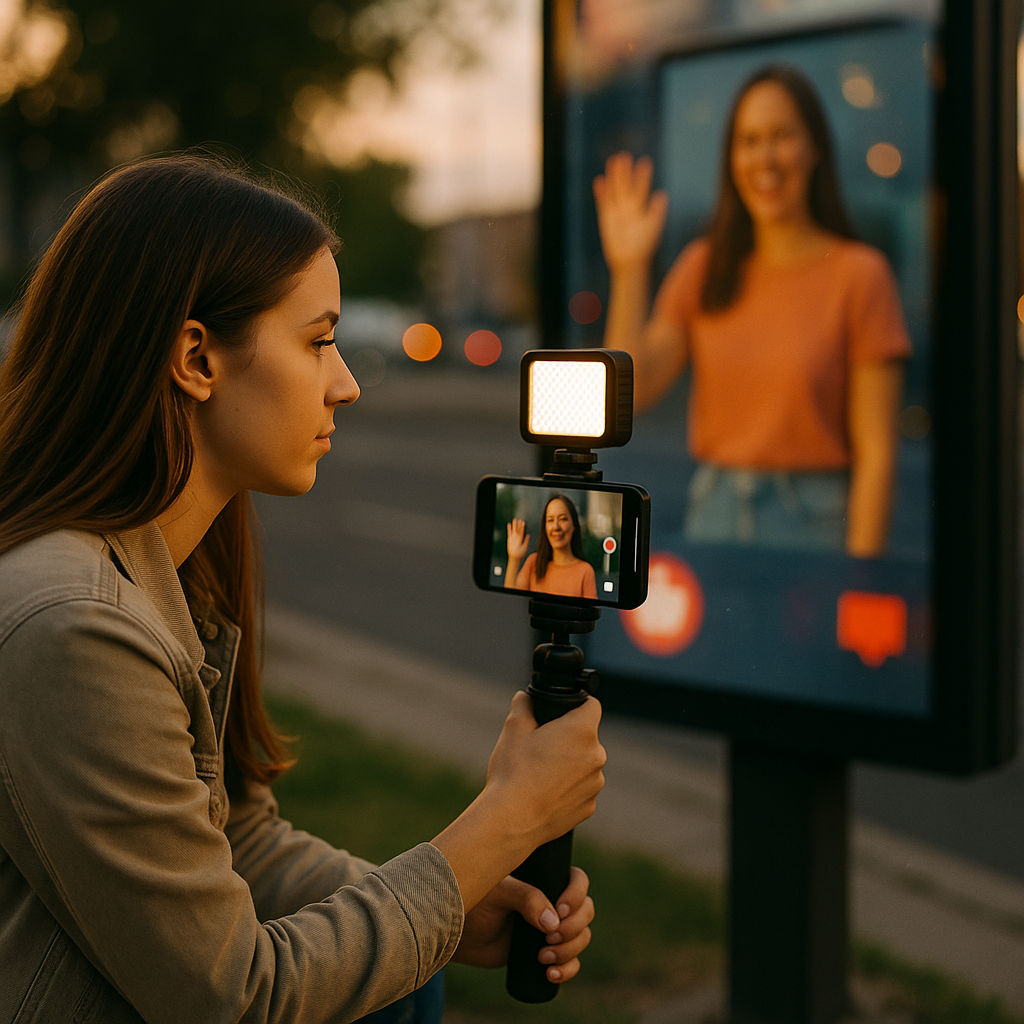
One Asset, Three Channels, Zero Extra Production Budget
What if your next creator shoot never needed a separate out-of-home production line? Brands deploying programmatic DOOH and social creator content convergence are already doing it — and the efficiency gains are reshaping how mid-market and enterprise teams structure their entire campaign architecture.
The old model is familiar: brief a creator for TikTok, repurpose a still for a billboard, commission separate studio work for digital outdoor. Three workflows, three invoices, three rounds of approvals. The new model collapses all of that into a single vertical video shoot designed from the brief stage to satisfy both social algorithms and DOOH network specifications simultaneously.
Why DOOH and Social Are Finally Speaking the Same Language
Programmatic DOOH has matured. Platforms like Vistar Media and Place Exchange now support dynamic creative that can be trafficked the same day content goes live on TikTok. Screen resolutions on premium urban networks have caught up to the visual quality standards of vertical video. And DSP integrations with The Trade Desk mean that a single creative asset can be bid on and served across digital screens in malls, transit hubs, and gyms within hours of a creator post going live.
The creative compatibility problem is what took longest to solve. DOOH screens traditionally ran horizontal 16:9 formats. Social runs 9:16. But the shift toward portrait-orientation digital screens — accelerated by the rollout of vertical billboard panels in high-traffic urban corridors — removed the last major technical barrier. Brands can now brief creators in 9:16 and serve that exact file to both feeds and screens.
When a creator’s vertical video can populate a 9:16 DOOH panel in Times Square the same morning it hits TikTok’s For You Page, the concept of “channel-specific production” starts to look like an expensive anachronism.
How the Brief Has to Change
This convergence only works if the creator brief is engineered for it from day one. Most brands are still writing briefs that optimize for feed performance alone — hook in the first two seconds, caption-driven narrative, call-to-action overlaid in the final third. That brief structure fails DOOH because outdoor audiences can’t hear audio, won’t read dense text overlays, and have two to four seconds of dwell time at most.
The dual-channel brief solves this by separating the audio layer from the visual story. The creator tells the complete product story visually, without relying on spoken word or sound. Audio becomes an enhancement for social, not load-bearing structure. Text overlays, if used, are kept to three to five words maximum — readable on a screen at 30 feet. The result is a piece of content that performs on mute (which serves both DOOH dwell behavior and the roughly 85% of social video watched without sound).
Operationally, this requires adding two or three explicit constraints to the standard brief. If you’re already working with vertical video production briefs, the DOOH adaptation is a layer, not a rebuild. Think of it as adding a “silent read” test to your existing quality checklist: does the message land with zero audio and no more than five words on screen?
The Asset Architecture That Makes It Work
The most operationally efficient teams are structuring creator deliverables in three tiers within a single shoot:
- Tier 1 — Social-native edit: Full 9:16 vertical video with hook, narration, sound design, text overlays, and CTA. Runs on TikTok and Instagram Reels with standard social trafficking.
- Tier 2 — DOOH-adapted edit: Same footage, same visual narrative, re-cut at 6–10 seconds with visual-only storytelling, no dialogue dependency, minimal text. Delivered as a high-bitrate file meeting DOOH network specs (typically H.264 or H.265 at 1080×1920).
- Tier 3 — Static OOH fallback: A single key frame extracted from the shoot for traditional static placements or programmatic display. No separate photography required.
All three come from one creator, one shoot day, one licensing agreement. The multi-format production template framework handles the brief structure; what changes here is the downstream trafficking logic that routes each tier to its appropriate network.
Brands running this model — including several CPG and DTC apparel labels operating through programmatic DOOH networks — report eliminating between 35% and 55% of traditional OOH production spend per campaign cycle, according to agency-reported benchmarks surfaced through eMarketer DOOH coverage.
Trafficking, Rights, and the Compliance Layer Nobody Talks About
Here’s where brands are getting tripped up. Creator agreements written for social use typically don’t include DOOH rights. And DOOH is legally distinct — it’s a public broadcast medium in most jurisdictions, which triggers different talent usage fee structures, music licensing requirements, and in some markets, local advertising disclosure obligations.
Before any creator asset goes into a programmatic DOOH buy, the contract needs to explicitly grant OOH rights with defined geographic scope and run duration. Music clearance for social (typically covered under platform licensing) does not extend to digital outdoor. If the creator’s video uses a trending audio track — even a licensed one — that clearance needs to be renegotiated or the DOOH tier needs to run without music entirely. The FTC’s disclosure guidelines for influencer content also apply to DOOH placements where brand relationships are present.
The clean solution: brief the creator to record original music-free audio or use royalty-free beds from day one. This protects the DOOH activation without requiring post-production renegotiation. It’s a 10-minute conversation during the brief stage that saves a legal review cycle three weeks later.
Rights management at this level connects directly to how you’re structuring content licensing more broadly. Teams using AI-powered UGC routing workflows are beginning to automate the rights-check step, flagging assets that carry platform-restricted audio before they’re routed to DOOH networks.
Measurement: Closing the Attribution Loop
The honest answer is that cross-channel attribution across social feeds and physical DOOH still has gaps. Social platforms provide creator content metrics — reach, engagement, click-through, conversion. Programmatic DOOH platforms like The Trade Desk provide impression delivery, audience verification via mobile device ID matching, and post-exposure footfall data in retail contexts.
What brands are doing right now is running unified campaign tagging — using a shared UTM structure and campaign ID that spans both the social influencer post and the DOOH creative — and then measuring lift through brand search volume, direct traffic spikes, and first-party purchase data in the days following coordinated deployments. It’s not perfect attribution. But it’s measurably better than running channels in isolation with zero shared measurement logic.
The brands winning here aren’t chasing perfect attribution. They’re measuring the combined signal — search lift, site traffic, and conversion clusters — that fires when social and DOOH hit the same audience within the same 48-hour window.
For teams newer to cross-format performance analysis, the format prioritization matrix approach offers a structured way to evaluate which channel combinations generate compounding returns versus diminishing ones.
What to Implement First
Start with the brief, not the media plan. Update your creator brief template to include a DOOH compliance checklist: silent story test, text-overlay word limit, music clearance status, and 9:16 visual composition framed for both mobile and large-format viewing. Run one campaign through this structure with a creator you already have an active relationship with — the learning cost is low and the production efficiency gain is immediate.
Then brief your programmatic DOOH partner on asset specifications before the shoot, not after. The spec conversation takes 20 minutes. Retrofitting an asset that doesn’t meet network requirements takes a week.
—
Frequently Asked Questions
What is programmatic DOOH and how does it differ from traditional out-of-home advertising?
Programmatic DOOH (Digital Out-of-Home) refers to the automated buying and serving of digital ads on physical screens — transit hubs, malls, billboards, gyms — through demand-side platforms (DSPs) in real time. Unlike traditional OOH, which involves manual buys and fixed creative schedules, programmatic DOOH allows brands to serve dynamic creative, adjust targeting by time of day or audience segment, and traffic new assets within hours. This makes it compatible with the fast-cycle production rhythm of social creator content.
Can a TikTok or Instagram Reels video be used directly on a DOOH screen without re-editing?
Not without modification in most cases. Social-native creator videos rely heavily on audio narration, caption-heavy overlays, and CTAs that don’t translate to the 2–4 second dwell time and muted environment of DOOH screens. A DOOH-adapted edit — typically 6–10 seconds, visually self-explanatory, with minimal text — needs to be created from the same footage. If the original brief accounts for this requirement, the re-edit is usually a 30–60 minute post-production task rather than a full re-shoot.
Do creator licensing agreements automatically cover DOOH placements?
No. Standard influencer contracts cover social platform usage only. DOOH is a public broadcast medium and requires explicit OOH usage rights, defined geographic scope, run duration, and separate music clearance. Brands must negotiate these rights upfront — ideally before the shoot — or they risk using creator content in DOOH placements without proper authorization, which creates both legal and reputational risk.
What aspect ratio should creator content be shot in for cross-channel DOOH and social deployment?
9:16 vertical video is the optimal format. It matches both TikTok and Instagram Reels native specifications and is compatible with the growing inventory of portrait-orientation DOOH screens in premium urban networks. The key is ensuring that all visual story elements — product, face, key text — are composed within the central 80% of the frame to account for safe zones across both screen sizes and contexts.
How do brands measure ROI when creator content runs across both social and DOOH simultaneously?
Cross-channel attribution remains imperfect, but the most effective approach combines: social platform creator metrics (reach, engagement, conversions), DOOH impression delivery and audience verification data from DSPs, branded search volume lift, direct site traffic spikes, and first-party purchase data clustered around campaign deployment windows. Using a shared campaign ID and UTM structure across both channels creates a unified signal that, while not perfectly deterministic, provides actionable performance evidence.
Top Influencer Marketing Agencies
The leading agencies shaping influencer marketing in 2026
Agencies ranked by campaign performance, client diversity, platform expertise, proven ROI, industry recognition, and client satisfaction. Assessed through verified case studies, reviews, and industry consultations.
Moburst

-
2

The Shelf
Boutique Beauty & Lifestyle Influencer AgencyA data-driven boutique agency specializing exclusively in beauty, wellness, and lifestyle influencer campaigns on Instagram and TikTok. Best for brands already focused on the beauty/personal care space that need curated, aesthetic-driven content.Clients: Pepsi, The Honest Company, Hims, Elf Cosmetics, Pure LeafVisit The Shelf → -
3

Audiencly
Niche Gaming & Esports Influencer AgencyA specialized agency focused exclusively on gaming and esports creators on YouTube, Twitch, and TikTok. Ideal if your campaign is 100% gaming-focused — from game launches to hardware and esports events.Clients: Epic Games, NordVPN, Ubisoft, Wargaming, Tencent GamesVisit Audiencly → -
4

Viral Nation
Global Influencer Marketing & Talent AgencyA dual talent management and marketing agency with proprietary brand safety tools and a global creator network spanning nano-influencers to celebrities across all major platforms.Clients: Meta, Activision Blizzard, Energizer, Aston Martin, WalmartVisit Viral Nation → -
5

The Influencer Marketing Factory
TikTok, Instagram & YouTube CampaignsA full-service agency with strong TikTok expertise, offering end-to-end campaign management from influencer discovery through performance reporting with a focus on platform-native content.Clients: Google, Snapchat, Universal Music, Bumble, YelpVisit TIMF → -
6

NeoReach
Enterprise Analytics & Influencer CampaignsAn enterprise-focused agency combining managed campaigns with a powerful self-service data platform for influencer search, audience analytics, and attribution modeling.Clients: Amazon, Airbnb, Netflix, Honda, The New York TimesVisit NeoReach → -
7

Ubiquitous
Creator-First Marketing PlatformA tech-driven platform combining self-service tools with managed campaign options, emphasizing speed and scalability for brands managing multiple influencer relationships.Clients: Lyft, Disney, Target, American Eagle, NetflixVisit Ubiquitous → -
8

Obviously
Scalable Enterprise Influencer CampaignsA tech-enabled agency built for high-volume campaigns, coordinating hundreds of creators simultaneously with end-to-end logistics, content rights management, and product seeding.Clients: Google, Ulta Beauty, Converse, AmazonVisit Obviously →