


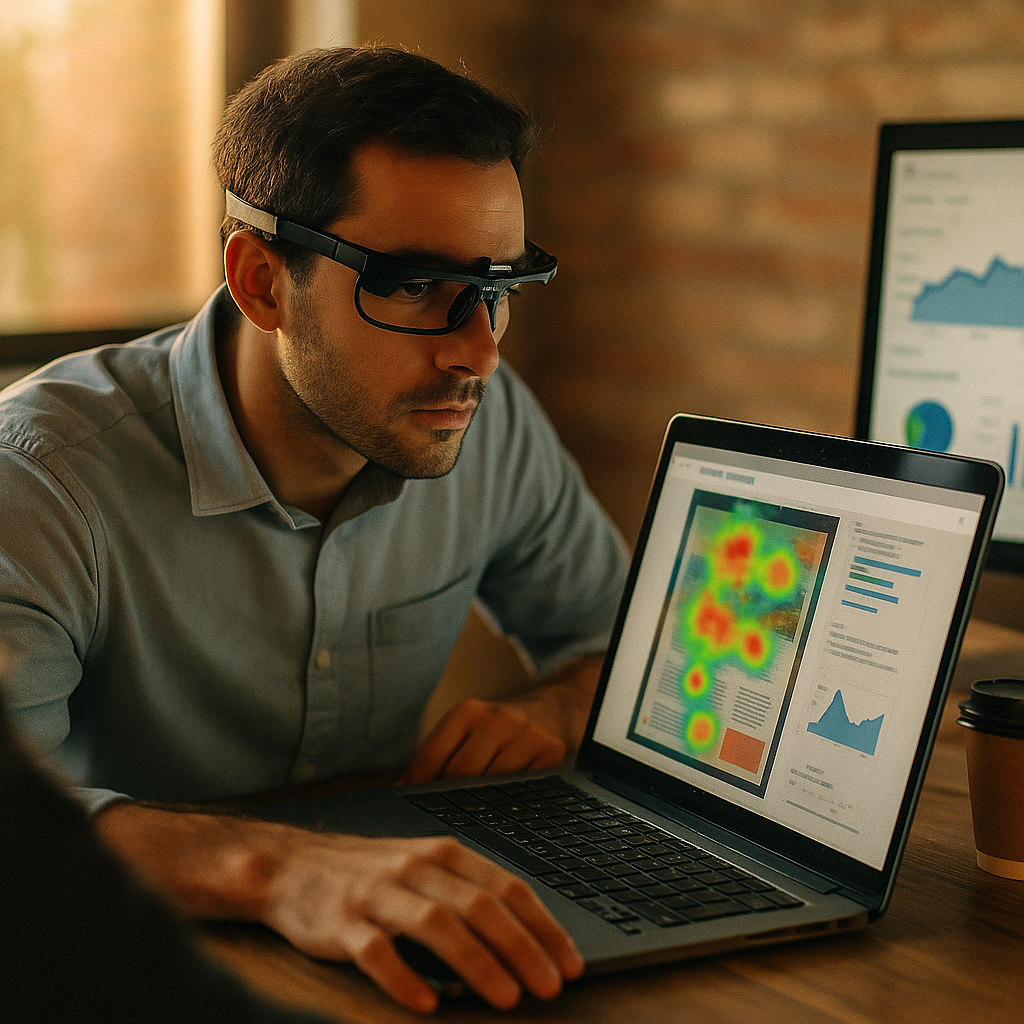
In 2025, attention is the scarcest resource in digital marketing. The science of scroll-stopping visuals: analyzing eye-tracking data shows exactly what people notice, ignore, and misunderstand in milliseconds. When you pair that evidence with smart design, you reduce wasted impressions and increase clarity. This guide translates gaze research into practical creative decisions—so your next visual earns attention instead of hoping for it. Ready?
How eye-tracking data reveals visual attention patterns
Eye tracking measures where and how long people look at elements on a screen. Most systems record gaze points (where the eyes are directed), fixations (moments of focused attention), and saccades (rapid jumps between points). For marketers and designers, the value is simple: you stop guessing what “stands out” and start seeing what actually receives attention.
What eye tracking can and can’t tell you:
- Can: identify which elements are noticed first, how attention flows, whether key messages are read, and where viewers get stuck or drop off.
- Can: reveal distractions (decorative elements stealing attention) and blind spots (critical info not being seen).
- Can’t: directly measure intent, persuasion, or purchase by itself—gaze is attention, not agreement. Pair it with surveys, click data, and conversion metrics.
If you’re designing social ads, landing pages, product pages, or email headers, eye tracking answers the follow-up question everyone asks after performance dips: “Are people even seeing the offer and the brand?” Often, they aren’t—especially on mobile where visual hierarchy collapses under small screens and fast scrolling.
In practice, teams use eye tracking to test variants before scaling spend, validate redesigns, and explain why a “beautiful” creative underperforms. It also reduces internal debate because it replaces opinions with observable attention behavior.
Scroll-stopping visuals and the psychology of attention triggers
People don’t evaluate every post; they filter. A scroll-stopping visual earns a brief “permission window” to communicate. Eye-tracking studies consistently show that early attention is driven by a mix of bottom-up signals (what pops) and top-down goals (what the viewer is trying to do). Your job is to align both.
High-impact attention triggers that typically win early fixations:
- Faces and eyes: Humans orient to faces quickly. If the face looks toward your headline or product, viewers often follow that gaze direction. If it looks off-frame, attention can leak away.
- High-contrast edges and readable typography: Clear contrast between text and background is not just accessibility—it’s attention insurance.
- Novelty with relevance: An unusual shape or composition can pull attention, but if it doesn’t connect to the offer within a second, it becomes decorative friction.
- Single dominant subject: A strong focal point reduces scanning effort, which matters under fast scroll behavior.
- Clear value cue: A concrete benefit (not a vague slogan) often holds attention longer because it resolves uncertainty quickly.
Designers often ask: “Should we use more elements to ‘add interest’?” Eye-tracking results frequently show the opposite. Extra badges, patterns, and competing shapes can create multiple micro-fixations that prevent the viewer from landing on the message. Scroll-stopping is less about visual noise and more about decisive hierarchy.
Another common misconception is that “thumb-stopping” means “bright colors.” Bright can help, but eye tracking routinely exposes bright backgrounds that overpower the product and mute the call-to-action. The most reliable approach is not a specific color—it’s contrast applied with intent and a focal path that matches your story.
Heatmaps, gaze plots, and fixation metrics for creative optimization
Eye-tracking outputs can look intimidating. The key is to connect each visualization to a decision you can actually make.
Heatmaps show aggregated attention density. They answer: “Where did people look most?” Use heatmaps to confirm whether the primary message, product, and brand marks receive meaningful attention. If the hotspot is on a background flourish, your hierarchy is wrong.
Gaze plots (scan paths) show the sequence of fixations. They answer: “In what order did people process the visual?” This helps diagnose why users miss steps. For example, if the call-to-action is seen before the benefit statement, the CTA may feel unearned; if the brand is never reached, recognition and recall suffer.
Fixation metrics help quantify performance:
- Time to first fixation (TTFF): how quickly an element is noticed. Lower is better for the headline, product, and key benefit.
- Total fixation duration: how long attention stays. Longer can mean engagement, but it can also signal confusion—interpret it with comprehension checks.
- Fixation count: repeated returns can indicate importance or uncertainty. If users keep bouncing between price and fine print, clarify the terms.
- Dwell time within an area of interest (AOI): shows whether critical regions get sustained attention.
How to turn metrics into edits:
- If TTFF to the offer is slow, increase prominence: larger type, stronger contrast, fewer competing elements, and place it nearer the natural entry point (often upper-left on LTR layouts, but test on mobile feeds).
- If fixation duration on disclaimers is high, reduce complexity: shorten copy, move details behind a tap, or present terms as simple bullets.
- If brand fixation is near-zero, integrate branding with the focal subject (packaging, watermark near the headline) rather than corner logos that get skipped.
Expect stakeholders to ask: “So do we just chase the hottest heatmap?” No. Optimize for attention to the right elements in the right order. A “successful” heatmap is not the most red—it’s the most aligned with your message sequence.
A/B testing with eye tracking for marketing performance gains
Eye tracking becomes most powerful when it complements A/B testing rather than replacing it. A/B tests tell you which version wins; eye tracking tells you why it wins (or loses), so you can generalize learnings to future creatives.
Practical workflow for A/B testing with eye tracking:
- Define the behavioral goal: e.g., “notice product within 500 ms,” “read benefit line,” “find CTA without searching.”
- Create two to four variants: change one variable at a time where possible (headline placement, subject size, background complexity, face gaze direction, CTA contrast).
- Pre-register success criteria: decide upfront which gaze metrics matter (TTFF to offer, dwell on benefits, path to CTA) and what “good” looks like.
- Run eye tracking under realistic conditions: mobile-first, feed-like pacing, and typical viewing distance. If you only test on a large monitor, you may optimize for the wrong environment.
- Validate with outcome metrics: clicks, add-to-carts, sign-ups, or scroll depth. Eye tracking explains; outcomes decide.
Common A/B scenarios where eye tracking saves time:
- High impressions, low clicks: often the CTA isn’t seen or the value isn’t understood fast enough.
- Good clicks, poor conversion: users may fixate on shipping, price, or trust cues late, revealing unmet expectations.
- Video thumbnails underperform: TTFF often improves when the thumbnail uses a clear subject, fewer words, and a readable benefit cue.
Teams often worry about sample sizes. You don’t need massive numbers to uncover glaring hierarchy issues—especially when you’re diagnosing visibility problems. Still, treat eye-tracking as directional unless you have enough participants and a controlled setup to support stronger inference.
UX research methods and ethical considerations in eye-tracking studies
Google’s helpful content expectations reward pages and products that prioritize user experience. Eye tracking is a UX research method that must be used responsibly, with transparent methodology and participant care.
Choose the right method:
- Lab-based eye tracking: higher precision, better for validating micro-layout decisions, readability, and small UI elements.
- Remote webcam-based eye tracking: faster and cheaper, often good for early creative screening, but typically less precise and sensitive to lighting and device differences.
- Hybrid approach: use remote for breadth (more variants), then lab for depth (finalists).
Make results trustworthy (EEAT in practice):
- Expertise: define AOIs clearly and report the task given to participants. Different tasks produce different gaze behavior.
- Experience: test on the devices and contexts your audience actually uses (mobile feeds, dark mode, accessibility settings).
- Authoritativeness: triangulate: pair eye tracking with usability testing, short comprehension questions, and analytics.
- Trust: document limitations (calibration accuracy, participant environment, and exclusions) so stakeholders don’t over-interpret the visuals.
Ethics and privacy: Eye tracking can feel intimate because it captures behavioral signals. Obtain informed consent, disclose what is recorded, minimize collection of personal data, and store data securely. If you work with regulated industries, ensure your process aligns with applicable privacy and research standards, and avoid using eye tracking to exploit vulnerabilities. Aim for clarity, not manipulation.
Readers often ask: “Is eye tracking only for big budgets?” Not anymore. Costs have dropped, and remote approaches can be accessible. The bigger barrier is not price—it’s using the method correctly, with clear hypotheses and a plan to act on results.
Data-driven design principles for social media creatives
Once you understand attention patterns, you can design systematically. These principles translate eye-tracking insights into repeatable creative standards for social feeds and performance campaigns.
1) Engineer a three-step attention path
Design for: Focal subject → value message → brand/CTA. Use size, contrast, and placement to guide the eye. If gaze plots show viewers jumping randomly, simplify and create a single dominant entry point.
2) Make the value legible in one glance
Short, concrete benefit statements typically outperform abstract taglines because they reduce cognitive load. If fixation duration on the headline is high but comprehension is low, the copy may be wordy or jargon-heavy.
3) Reduce competition inside the frame
Remove or demote elements that steal early fixations: background textures, excessive icons, and low-value badges. If it doesn’t support the message, it shouldn’t compete for attention.
4) Place critical elements where attention naturally lands on mobile
Mobile feed behavior is fast and interrupted. Ensure the product and benefit are visible without requiring precise focusing. Use safe margins so UI overlays don’t cover key text.
5) Use directional cues deliberately
Arrows, gaze direction, and leading lines can guide attention—if they point to the message. If they point away, eye tracking often shows attention exiting the frame.
6) Confirm comprehension, not just visibility
After an eye-tracking session, ask short questions: “What is being offered?” “What’s the price or key condition?” “What brand was it?” If participants looked at the text but can’t answer, your design is readable but not clear.
These principles also answer the practical follow-up question: “What do we change first?” Start with hierarchy (subject size and contrast), then message clarity (copy and layout), then supporting cues (trust marks, CTA, details). Eye tracking helps you prioritize edits that move attention, not just aesthetics.
FAQs
What is eye tracking in marketing?
Eye tracking in marketing measures where viewers look in ads, landing pages, and product experiences. It reveals what gets noticed, how attention flows, and which elements are skipped, helping teams optimize design hierarchy and message clarity.
What makes a visual “scroll-stopping” according to eye-tracking data?
A scroll-stopping visual typically earns a fast first fixation on a clear focal subject, then guides attention to a readable value message. Eye tracking often shows success when the layout minimizes competing elements and keeps the message legible on mobile.
Are heatmaps enough to optimize creatives?
No. Heatmaps show aggregated attention but can hide the order of viewing and moments of confusion. Use heatmaps with gaze plots and fixation metrics, then validate changes with comprehension questions and performance outcomes like CTR and conversion rate.
How many participants do I need for an eye-tracking test?
It depends on the goal. Small studies can uncover major hierarchy problems, while stronger comparisons between variants require more participants and consistent testing conditions. Treat small-sample findings as directional and confirm with A/B testing and analytics.
Does eye tracking work for video and short-form content?
Yes. It can show whether viewers look at captions, faces, products, and on-screen CTAs at the right moments. For short-form, it’s especially useful for evaluating the first second and whether visual cues guide attention as the scene changes.
What are the limitations of webcam-based eye tracking?
Webcam-based eye tracking is typically less precise than lab systems and can be affected by lighting, camera quality, and participant posture. It’s useful for early screening and broad insights, but confirm fine layout decisions with higher-precision methods when needed.
How do I use eye tracking ethically?
Get informed consent, collect only what you need, store data securely, and report limitations. Use insights to improve clarity and usability rather than to manipulate viewers. Responsible research builds trust and supports long-term performance.
Eye tracking turns creative decisions into evidence-based design. When you analyze fixations, gaze order, and attention gaps, you learn exactly why a visual earns attention—or loses it. In 2025, the winning workflow pairs eye-tracking insights with A/B testing and clear messaging. Build a clean focal path, verify comprehension, and remove distractions. Your takeaway: optimize for attention to the right message, fast.