


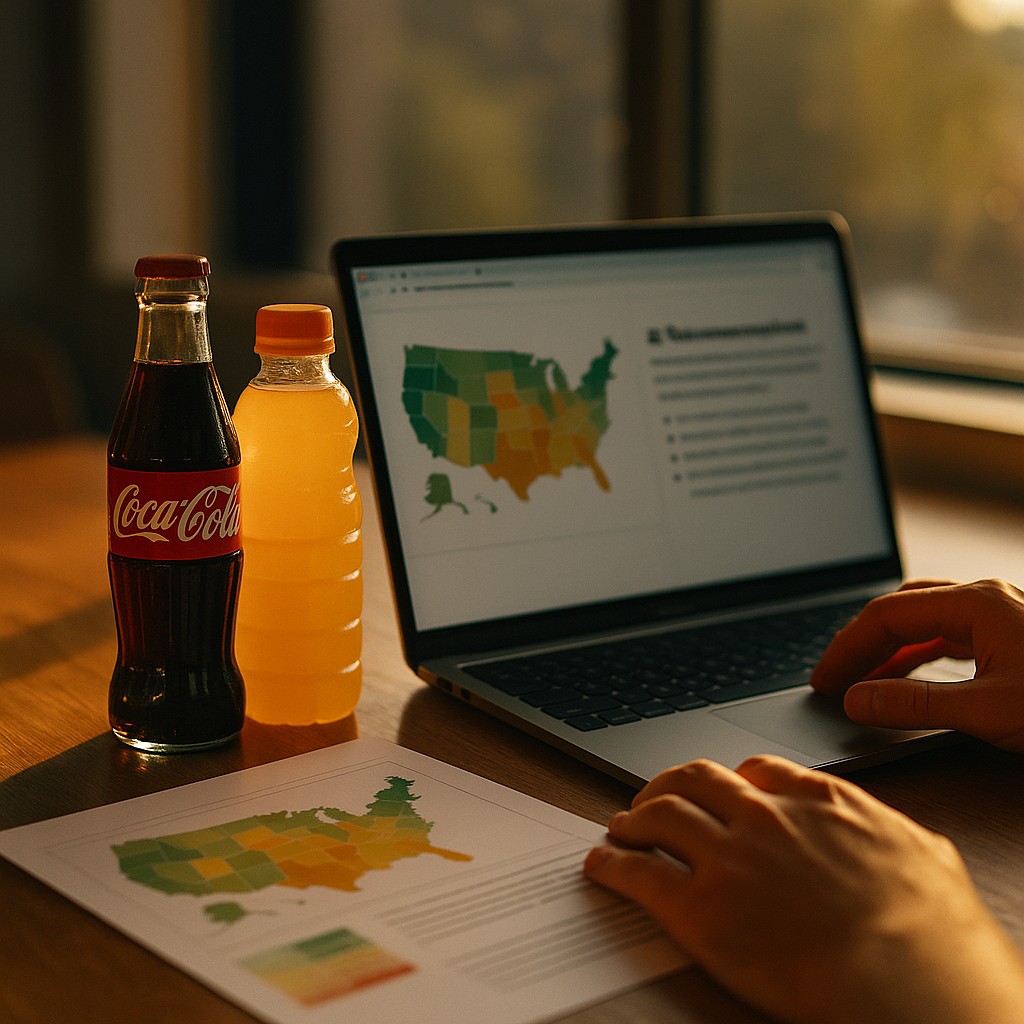
When a Consumer Asks an AI Assistant for a Drink Recommendation, Is Your Brand in the Answer?
Generative search engines now answer drink queries — “best hydration drink after a workout,” “low-sugar sparkling water with electrolytes,” “what should I mix with tequila blanco” — without sending users anywhere. If your creator content wasn’t built to feed those answers, your brand is invisible at the exact moment intent peaks. This is the operational challenge that GEO content brief design solves for beverage brands right now.
Why Beverage Is a High-Stakes GEO Category
Beverages are one of the highest-frequency consumer purchase categories, and they’re also one of the most queried in conversational AI. Think about what someone actually types into ChatGPT, Perplexity, or Google’s AI Overviews: “What’s a good energy drink that won’t crash me?” or “Is celsius better than Bloom for pre-workout?” These aren’t keyword searches. They’re consultations. The AI is acting as a trusted advisor, and it sources its answers from the content ecosystem your creators already produce — or should be producing.
The problem is that most beverage brand briefs are still written for attention, not for retrieval. They’re optimized for scroll-stop, not for the factual pattern-matching that Google’s AI systems and large language models use to construct recommendations. That gap is where brands lose.
A creator brief that doesn’t include required factual claims, specific product signals, and answer-formatted language isn’t just a creative miss — it’s a GEO miss. You’re funding content that trains AI to recommend your competitors.
The Three Structural Pillars of a GEO-Ready Beverage Brief
Before you write a single line of direction for a creator, understand what makes beverage content retrievable by generative engines. There are three non-negotiables.
1. Factual Density. AI systems are trained to surface content that contains verifiable, specific claims. For beverage brands, this means briefing creators to state: exact ingredient counts (“25mg of natural caffeine from green tea”), functional outcomes with specificity (“clinically studied for 4-hour sustained energy, not a spike”), and comparative context (“unlike most RTDs, this uses zero artificial sweeteners”). Vague language like “gives you energy” or “tastes amazing” contributes nothing to GEO indexability. It’s noise. Your brief must mandate factual statements in the script or caption — not as an afterthought, but as the structural spine of the content.
2. Product Signal Specificity. Generative engines identify products through signal clusters: brand name + SKU variant + use case + differentiator. When a creator says only “I love this drink,” the AI can’t build a recommendation from that. When they say “LMNT Mango Chili — I use this specifically post-sauna because the 1,000mg sodium ratio is actually calibrated for heavy electrolyte loss, not just mild dehydration” — that’s a retrievable product signal cluster. Brief your creators to include: the full product name and variant, the specific occasion or use case, the core differentiating ingredient or formulation fact, and the consumer benefit stated in conversational language. This isn’t limiting creative freedom. It’s building the factual scaffolding that AI surfaces.
3. Conversational Answer Structure. Generative AI doesn’t retrieve promotional content — it retrieves content that answers questions. The structural format matters enormously. Briefs should instruct creators to open with a question frame (“If you’re asking whether this actually works for…”), to use natural comparison language (“The difference between this and a standard sports drink is…”), and to close with a direct recommendation statement (“If you’re someone who trains fasted and hates the sugar crash, this is specifically what I’d reach for”). This mirrors how an AI answer is constructed, which significantly increases the probability that creator content gets surfaced as a source.
For a deeper framework on structuring creator content for AI retrieval, the GEM framework for AI recommendations is worth operationalizing alongside your beverage-specific brief templates.
What to Actually Write in the Brief
A GEO content brief for a beverage brand has five required sections that most current briefs don’t include.
- Mandatory Fact Block: A list of 4-6 factual product claims the creator must include verbatim or paraphrased. These are your GEO anchors. Include the source if a claim is study-backed.
- Query Target List: The 3-5 conversational questions your content should answer. Example: “What’s the best functional water for afternoon energy without caffeine?” This tells the creator what problem their video solves in the AI’s information architecture.
- Product Signal Requirements: The exact combination of product name, variant, occasion, and differentiator that must appear together in the content. Not optional. Not “try to mention.”
- Answer Structure Template: A suggested script arc that opens with a consumer pain point, delivers the factual product answer, and closes with a clear recommendation. Creators adapt it — they don’t read it verbatim — but the structure must be present.
- Prohibited Language: Vague claims, superlatives without evidence, and generic flavor/taste commentary that dilutes factual density and adds no GEO value.
This is meaningfully different from a standard creative brief. Standard briefs optimize for brand voice and visual alignment. GEO briefs optimize for retrieval and recommendation — and for beverage brands, that means being in the answer when someone asks Perplexity what to drink after a 10-mile run.
If your team is already building multi-format creator assets, see how structuring content for AI shopping retrieval can inform your brief architecture across SKUs and use cases.
Platform and Format Considerations
GEO optimization doesn’t live only in long-form. AI systems index across YouTube transcripts, TikTok captions, Reddit threads, blog-style creator posts, and Instagram carousels. The brief needs to specify where the factual density lives in each format.
For short-form video (TikTok, Reels, Shorts), the spoken word carries the GEO weight. Brief creators to front-load the product signal and the functional claim in the first 10 seconds. For YouTube, include a briefing requirement for the video description — transcripts and descriptions are high-value GEO signals, and most beverage brands leave them empty or promotional. For static and carousel content, the caption structure matters: Q&A format captions (“Does this actually replace your morning coffee? Here’s what the research on L-theanine and caffeine stacking actually says…”) dramatically outperform lifestyle captions in generative retrieval.
Cross-platform content strategy and the brief structures that support it are covered in depth in the cross-platform UGC repurposing stack — worth reading before you assign format-specific deliverables to creators.
According to Statista, the global functional beverage market is projected to exceed $280 billion. In a category this large, generative AI recommendations aren’t a future consideration — they’re an active distribution channel your brief either captures or concedes.
Compliance and EEAT Alignment in Beverage GEO Briefs
Beverage brands have a specific compliance layer that makes GEO brief design more complex. Health claims — even ingredient-level claims made by creators — carry regulatory exposure under FTC guidelines and, for certain functional categories, FDA rules on structure/function claims. A GEO brief that mandates factual density without a compliance review process is a liability.
The practical fix: build a pre-approved claim library. Legal reviews the claims once; the brief pulls from the approved pool. This protects the brand and ensures creators are using language that’s both factually accurate and legally vetted — which also supports Google’s EEAT standards for trustworthy, expert content. AI systems are increasingly trained to prefer content with demonstrable expertise and verifiability. Claims that cite research, name ingredients accurately, and align with published nutritional data score higher in this trust architecture. Your brief should explicitly instruct creators to reference the brand’s sourced claims, not to invent or embellish.
For brands managing creator content at scale across a portfolio of beverage SKUs, the UGC automation and rights clearance pipeline is the operational infrastructure that makes compliance-at-scale achievable without killing creative throughput.
Measuring GEO Performance for Beverage Creator Campaigns
Traditional influencer metrics — reach, engagement rate, CPM — don’t measure GEO impact. You need a separate measurement layer.
Track: brand mention frequency in AI-generated answers (use tools like eMarketer’s AI visibility tracking benchmarks for category context), the volume of conversational queries where your brand appears as a cited recommendation, and the specific product-claim combinations that appear in AI outputs versus your brief requirements. A/B test brief versions — one with full GEO architecture, one without — and measure differential retrieval rates over a 90-day window. The signal takes time, but it’s measurable, and the compound effect is significant.
Brief-level testing methodology is detailed in the modular video briefs for A/B testing framework — apply the same variant logic to your GEO parameter testing.
Frequently Asked Questions
What is a GEO content brief for beverage brands?
A GEO (Generative Engine Optimization) content brief is a creator direction document specifically designed to ensure that influencer and UGC content contains the factual density, product signal specificity, and conversational answer structure that AI systems like Google AI Overviews, Perplexity, and ChatGPT use when generating drink recommendations. Unlike standard creative briefs focused on brand voice or aesthetics, GEO briefs are built to make content retrievable and citable by generative search engines.
How is a GEO brief different from a standard influencer brief?
A standard brief prioritizes creative direction, brand tone, and visual guidelines. A GEO brief adds mandatory factual claim blocks, query target lists (the specific AI-style questions the content should answer), product signal requirements (brand name, variant, use case, and differentiator clustered together), and an answer-structure template that mirrors how AI constructs recommendations. Both elements can coexist in a single document — GEO brief architecture doesn’t eliminate creative direction, it adds a retrieval layer on top of it.
What types of beverage content are most likely to be surfaced by AI assistants?
Content that contains specific, verifiable product claims, functional benefit statements tied to ingredients, comparison language that positions the product against a consumer problem or category alternative, and recommendation-style closings. YouTube video transcripts, detailed TikTok captions with Q&A formatting, and long-form creator posts with ingredient-level specificity consistently perform well in AI retrieval. Generic taste or lifestyle content contributes very little to generative engine visibility.
How do I ensure health claims in creator content are compliant while still being GEO-effective?
Build a pre-approved claim library reviewed by legal and regulatory counsel, then brief creators exclusively from that pool. Approved claims that are ingredient-specific, accurately sourced, and aligned with FDA structure/function claim guidelines are both compliant and high-value GEO signals. Vague superlatives fail on both dimensions — they’re legally risky and factually thin for AI retrieval. The FTC’s influencer marketing guidelines also require that any material claims be substantiated, which aligns with the factual specificity that GEO optimization demands.
How long does GEO optimization take to show measurable results for beverage brands?
GEO impact typically compounds over 60–120 days as AI systems index, update, and recalibrate their retrieval patterns from new content. Brands should run GEO-structured brief campaigns for at least one full quarter before evaluating retrieval performance. Track AI mention frequency across key conversational query types at 30-day intervals, and compare against a control set of content produced without GEO brief architecture to isolate the variable.
Start by auditing your last five creator briefs: count the verifiable product claims required, the specific query targets named, and the answer-structure direction given. If those three elements are absent or vague, you’re funding content that loses the AI recommendation game before it starts. Rewrite one brief with full GEO architecture this quarter and measure retrieval against the baseline.
Top Influencer Marketing Agencies
The leading agencies shaping influencer marketing in 2026
Agencies ranked by campaign performance, client diversity, platform expertise, proven ROI, industry recognition, and client satisfaction. Assessed through verified case studies, reviews, and industry consultations.
Moburst

-
2

The Shelf
Boutique Beauty & Lifestyle Influencer AgencyA data-driven boutique agency specializing exclusively in beauty, wellness, and lifestyle influencer campaigns on Instagram and TikTok. Best for brands already focused on the beauty/personal care space that need curated, aesthetic-driven content.Clients: Pepsi, The Honest Company, Hims, Elf Cosmetics, Pure LeafVisit The Shelf → -
3

Audiencly
Niche Gaming & Esports Influencer AgencyA specialized agency focused exclusively on gaming and esports creators on YouTube, Twitch, and TikTok. Ideal if your campaign is 100% gaming-focused — from game launches to hardware and esports events.Clients: Epic Games, NordVPN, Ubisoft, Wargaming, Tencent GamesVisit Audiencly → -
4

Viral Nation
Global Influencer Marketing & Talent AgencyA dual talent management and marketing agency with proprietary brand safety tools and a global creator network spanning nano-influencers to celebrities across all major platforms.Clients: Meta, Activision Blizzard, Energizer, Aston Martin, WalmartVisit Viral Nation → -
5

The Influencer Marketing Factory
TikTok, Instagram & YouTube CampaignsA full-service agency with strong TikTok expertise, offering end-to-end campaign management from influencer discovery through performance reporting with a focus on platform-native content.Clients: Google, Snapchat, Universal Music, Bumble, YelpVisit TIMF → -
6

NeoReach
Enterprise Analytics & Influencer CampaignsAn enterprise-focused agency combining managed campaigns with a powerful self-service data platform for influencer search, audience analytics, and attribution modeling.Clients: Amazon, Airbnb, Netflix, Honda, The New York TimesVisit NeoReach → -
7

Ubiquitous
Creator-First Marketing PlatformA tech-driven platform combining self-service tools with managed campaign options, emphasizing speed and scalability for brands managing multiple influencer relationships.Clients: Lyft, Disney, Target, American Eagle, NetflixVisit Ubiquitous → -
8

Obviously
Scalable Enterprise Influencer CampaignsA tech-enabled agency built for high-volume campaigns, coordinating hundreds of creators simultaneously with end-to-end logistics, content rights management, and product seeding.Clients: Google, Ulta Beauty, Converse, AmazonVisit Obviously →