


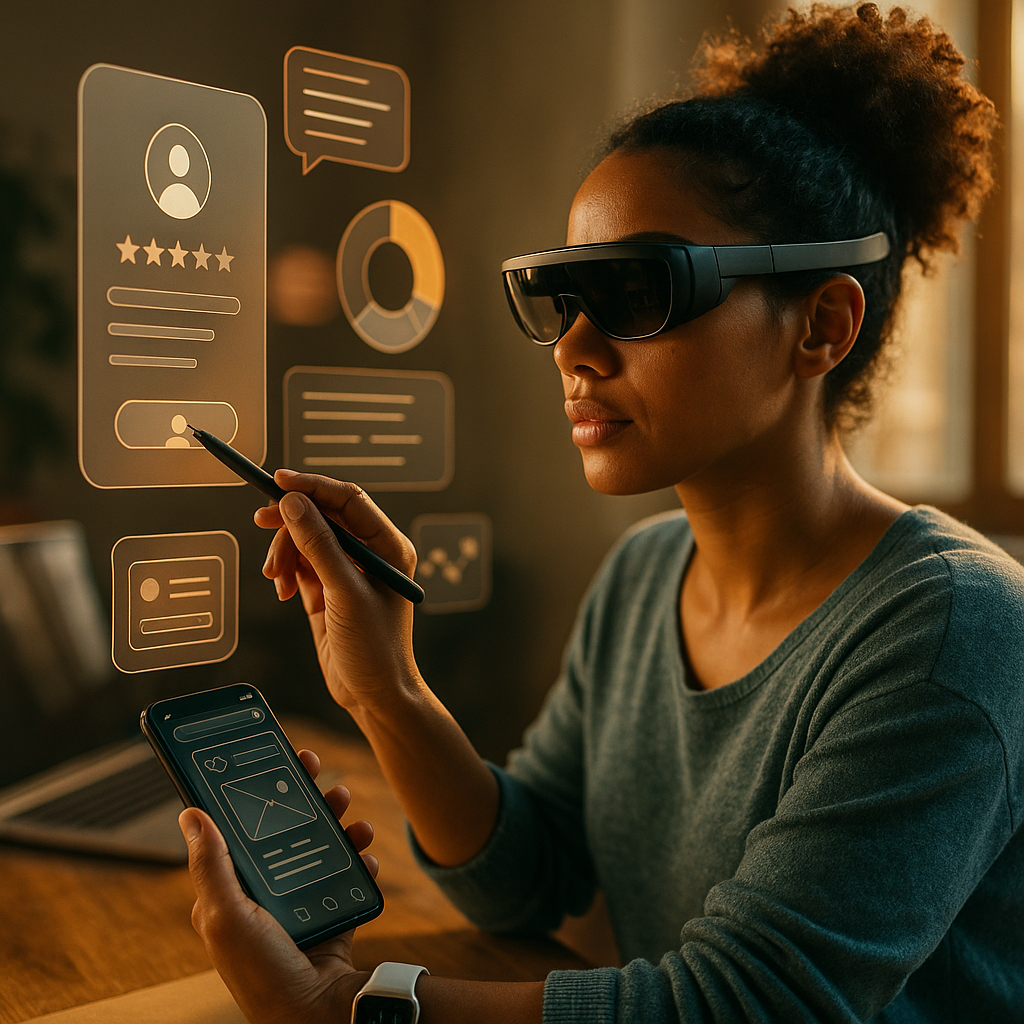
Designing immersive brand experiences for wearables has moved from experimental to essential as smart glasses, rings, hearables, and sensor-rich clothing reshape how people discover, decide, and buy. In 2025, the winning experiences feel personal without feeling invasive, useful without friction, and consistent across devices. This guide shows how to design for trust, context, and attention—so your brand earns repeat engagement. Ready to build what users keep?
Wearable UX design principles for attention, comfort, and speed
Wearables compress interaction into seconds. Screens are smaller (or absent), inputs are constrained, and users are often moving. Your experience must respect attention and body comfort as much as visual hierarchy.
Prioritize “micro-moments” over sessions. A wearable experience succeeds when it delivers value in 1–3 steps: a glance, a tap, a gesture, a voice response, or a haptic confirmation. Design flows that start and finish quickly, then hand off deeper tasks to a phone, tablet, or desktop when needed.
Design around physical context. People use wearables while walking, commuting, exercising, working, or caring for others. Your UI needs high contrast, readable typography, large hit targets, and error-tolerant inputs. For audio wearables, assume environmental noise. For smart glasses, assume partial attention and a preference for heads-up, not heads-down, interaction.
Use multimodal cues intentionally. Wearables can combine visuals, audio, and haptics. Do not duplicate everything in every channel. Instead, assign roles: haptics for confirmation or urgency, visuals for clarity, audio for explanation or accessibility. Calibrate intensity—overuse of haptics and alerts trains users to mute you.
Optimize for battery, heat, and performance. “Immersive” cannot mean resource-heavy by default. Favor lightweight animations, efficient sensor polling, and graceful degradation. If your experience drains battery or heats a device, it will be uninstalled or disabled—regardless of brand equity.
Answer the follow-up question: how immersive can you be on tiny interfaces? Immersion on wearables comes from relevance, timing, and continuity, not from heavy graphics. A perfectly timed, context-aware interaction can feel more “alive” than a complex 3D scene that arrives late or fails in motion.
Spatial computing branding across smart glasses and mixed reality
Smart glasses and mixed-reality devices shift branding from screens to space. The opportunity is not to plaster logos in a user’s view, but to create utility that feels native to the environment and consistent with your brand identity.
Anchor brand value to spatial tasks. Map your brand promise to actions users already want: guided assembly, step-by-step navigation, product visualization at true scale, or real-time translation and captions. Brands win when spatial experiences solve a problem faster than a phone can.
Keep visual language recognizable, not intrusive. In spatial interfaces, subtlety builds trust. Use restrained color, clean iconography, and calm motion. Reserve high-salience elements for safety-critical states or explicit user requests. If your overlays block the world, users will perceive your brand as disruptive.
Design with “environmental etiquette.” Spatial experiences should respect private and shared spaces. Provide quick controls to pause, hide, or reduce overlays. Include “social mode” options that minimize recording indicators and sensitive content when others are nearby.
Plan for cross-device continuity. A smart-glasses moment often starts with a phone: pairing, permissions, personalization, and deeper configuration. Ensure identity, preferences, and saved states carry across. The brand should feel like one system—not a patchwork of apps.
Answer the follow-up question: what does branding look like without a screen? It looks like predictable behavior, consistent voice and tone, and reliable outcomes. In spatial computing, brand memory forms through repeated, frictionless help in the real world.
Haptic and audio brand experiences for hearables and rings
Next-generation wearables include hearables, rings, and other low-display devices. Here, the “interface” is often vibration, sound, and timing. That makes brand expression more like product design than graphic design.
Create a signature haptic vocabulary. Define a small set of vibration patterns for key states: success, caution, failure, and action required. Keep patterns short and distinct. Document them like a design system component so they remain consistent across products and partners.
Use sound as identity, not noise. Earcons (short audio cues) can reinforce brand recognition, but they must be tasteful and accessible. Provide volume controls and mute defaults for public environments. Ensure cues work across hearing abilities: pair audio with haptics and on-screen confirmation when available.
Make voice experiences predictable. If you use voice assistants or branded voice layers, prioritize clarity: short prompts, explicit next steps, and confirmation for high-stakes actions (payments, sharing, unlocking). Avoid anthropomorphic scripts that feel manipulative. In 2025, users expect transparency about what is automated and what is recorded.
Design for interruption. Wearables live in the stream of life. Notifications will be missed. People will be mid-run, mid-meeting, or mid-conversation. Your experience should resume cleanly, summarize what happened, and offer a single best next action.
Answer the follow-up question: how do you express a brand without visuals? Through rhythm, consistency, and restraint. A calm, dependable haptic/audio system communicates confidence more effectively than an aggressive barrage of alerts.
Personalization and context-aware wearable marketing without creepiness
Wearables can infer context from motion, location, biometrics, and routine. That power can unlock exceptional relevance—or break trust instantly. The line between helpful and creepy is defined by user control, clarity, and proportionality.
Start with consent that is specific and revocable. Do not bury permissions. Explain why you need a sensor and what the user gets in return. Offer tiered choices (basic, enhanced, off) rather than an all-or-nothing toggle. Make it easy to change later.
Use “minimum necessary” data. If step count is enough, do not request heart rate. If approximate location is enough, do not request precise location. Collect less, process more on-device, and reduce retention by default. Users increasingly reward brands that treat data as a liability to minimize, not an asset to hoard.
Personalize outcomes, not surveillance. A good wearable experience adapts without exposing what it inferred. For example, instead of “We noticed your stress is high,” use “Want a 60-second breathing reset?” Offer the benefit first, and keep inference details available in a transparent “Why am I seeing this?” panel when the device supports it.
Time messages to intent, not opportunity. Wearable marketing should behave like a concierge, not a billboard. Trigger prompts when a user is already doing a related activity or when your suggestion reduces effort. Avoid sending promotions during sleep windows, workouts, or meetings unless the user explicitly opts in.
Answer the follow-up question: can wearables drive revenue without aggressive ads? Yes—through utilities that naturally lead to purchase: replenishment prompts, fit guidance, service reminders, loyalty benefits delivered at the right moment, and frictionless checkout handoffs to the phone.
Wearable privacy, accessibility, and compliance for brand trust
Trust is the foundation of immersive experiences on the body. Because wearables can touch health-adjacent data, location, and always-on sensors, your brand must prove it deserves that proximity.
Build privacy into the UX, not just the policy. Provide clear indicators when sensors are active. Offer quick “privacy pause” controls. Let users review and delete data from within the experience. Use plain language summaries that match the real behavior of your system.
Secure the entire ecosystem. Wearables often rely on companion apps, cloud services, and third-party SDKs. Vet vendors, minimize trackers, and apply strong authentication for account changes and payments. Plan for lost-device scenarios: quick revoke, remote sign-out, and safe defaults.
Design for accessibility from day one. Wearables can be empowering for people with disabilities, but only if experiences support them. Provide adjustable text size, high contrast, screen reader compatibility where relevant, captions for audio, and haptic alternatives to sound. For gesture controls, offer accessible fallbacks.
Respect health-adjacent boundaries. If you surface wellness metrics, avoid medical claims unless you can substantiate them and your product is positioned appropriately. Provide disclaimers in context, not as fine print. Where sensitive data is involved, ensure the experience encourages informed decisions and avoids pressure tactics.
Answer the follow-up question: how does trust translate into brand outcomes? Trust increases opt-in rates, reduces churn, and improves word-of-mouth—especially in wearables, where users share experiences about comfort, reliability, and how safe the product feels.
Prototyping, testing, and measurement for immersive wearable engagement
Immersive brand experiences are difficult to perfect in a design tool alone. Success depends on real-world testing across environments, bodies, and routines.
Prototype in layers. Start with low-fidelity interaction maps that define triggers, states, and handoffs. Then prototype key moments with device-specific tools: haptics timing, voice prompts, glanceable UI, and battery impact. Treat the wearable and companion app as one journey.
Test in motion and in noise. Lab tests miss the hardest scenarios: bright sunlight, winter gloves, sweaty runs, subway tunnels, open offices, and crowded sidewalks. Run field studies that capture time-to-value, error rates, and abandonment points. Ask users what felt confusing, intrusive, or unsafe.
Measure what matters for wearables. Traditional metrics like session length can mislead. Wearables often aim for quick success. Focus on:
- Time-to-value: how quickly users complete the core task
- Opt-in quality: consent rates and feature enablement without regret
- Notification health: mute rates, dismiss rates, and user-defined quiet hours
- Retention by utility: repeat use of key moments, not total opens
- Cross-device completion: successful handoffs to phone/desktop checkout or support
Operationalize a wearable design system. Document patterns for haptics, glance cards, voice prompts, and spatial overlays. Create guardrails for tone, urgency, and accessibility. This keeps experiences coherent as devices diversify.
Answer the follow-up question: how do you avoid “demo-ware” that doesn’t scale? Tie every immersive feature to a stable operational capability: content pipelines, support workflows, privacy controls, analytics, and performance budgets. If it cannot be maintained, it will not remain immersive for long.
FAQs about immersive brand experiences for wearables
What are the best wearables to design for in 2025?
Prioritize the devices your audience already uses: smartwatches and hearables first, then expand to smart glasses and rings where your brand can provide clear, contextual utility. Choose based on the job-to-be-done and the environment, not novelty.
How do you make a wearable experience feel immersive without using AR?
Focus on relevance and continuity: timely prompts, fast interactions, consistent haptics/audio, and seamless handoffs to a phone for deeper steps. Immersion comes from feeling understood and supported in real moments.
What content works best on smartwatches?
Glanceable, actionable content: status updates, confirmations, reminders, and single-tap decisions. Avoid long reading, complex forms, and dense navigation. Provide escalation to phone when users want details.
How should brands handle biometric or wellness data?
Use minimum necessary data, prioritize on-device processing where possible, and provide clear controls to view, export, and delete. Avoid medical claims unless you can substantiate them and your product is positioned appropriately.
How many notifications are too many on wearables?
Any number that causes muting is too many. Offer granular controls, quiet hours, and priority tiers. Design notifications to be dismissible, informative, and actionable in one step, with a clear benefit each time.
What metrics prove ROI for wearable brand experiences?
Track time-to-value, opt-in rates, feature adoption, retention of key utilities, notification health (mutes/dismissals), and cross-device completion to purchase or support. Combine quantitative analytics with field feedback to understand why users keep or drop features.
Designing immersive brand experiences for wearables in 2025 means treating attention, privacy, and context as core design materials. Build micro-interactions that work in motion, express your brand through haptics, audio, and spatial restraint, and personalize with explicit consent and minimal data. Test in real environments and measure utility, not screen time. The takeaway: earn proximity by being genuinely useful—every time.