


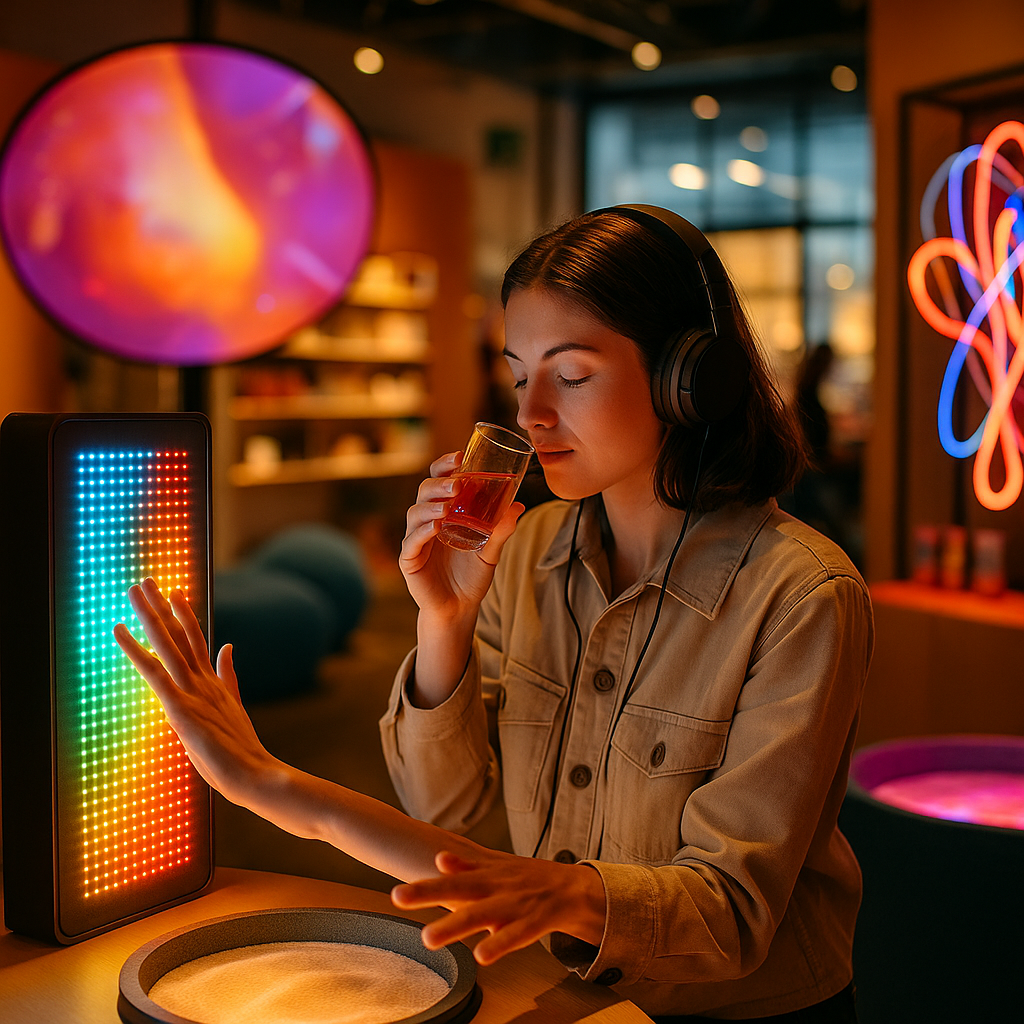
In 2025, shoppers expect more than shelves and signage—they want moments worth sharing and remembering. Designing Immersive Sensory Experiences for Live Retail Activations turns footfall into meaningful engagement by shaping what people see, hear, smell, touch, and taste in real time. This article breaks down practical methods, measurement, and accessibility so your activation performs on-site and online—ready to build something customers feel?
Immersive retail activations: start with a clear sensory strategy
Immersive experiences succeed when they are engineered, not improvised. Before choosing tech, scents, or set builds, define what the activation must achieve: awareness, product trial, lead capture, loyalty sign-ups, or sales. Then connect each goal to a sensory lever that supports it.
Build a “sensory brief” that answers five questions:
- Who is the audience? Map primary segments, motivations, and constraints (families, commuters, enthusiasts, VIP clients).
- What is the brand promise? Turn brand values into sensory cues (e.g., precision = clean sound design and crisp lighting; comfort = warm materials and soft acoustics).
- What is the hero behavior? Decide the one action that matters most (demo, scan QR, register, try-on, purchase).
- What is the story arc? Plan an entry moment, a peak moment, and an exit moment with a memory anchor.
- What are the constraints? Venue rules, power, noise limits, food permits, queue space, and staffing skills.
Practical tip: Use a single-page journey map with columns for Sense, Trigger, Desired emotion, Staff prompt, and Measurement. This keeps creative, operations, and analytics aligned and prevents “cool features” that don’t move outcomes.
To follow EEAT principles, document assumptions, vendors, and safety checks in a shared runbook. If you claim “calming” or “energizing,” tie it to observable design choices (tempo, luminance, scent intensity) and what you’ll measure (dwell time, conversions, sentiment).
Multisensory brand experience: orchestrate sight, sound, scent, touch, and taste
A true multisensory brand experience is not five separate effects—it is one coordinated system. Start with two “lead senses” that carry the concept, then layer supporting senses carefully to avoid overload. In high-traffic retail environments, less, cleaner, and more intentional usually wins.
Sight (visual design): Use lighting to direct attention and manage pace. Bright, high-contrast zones pull shoppers in; softer zones encourage lingering and consultation. Keep a consistent color script aligned with packaging and digital assets so photos and videos instantly read as “your brand.”
Sound (sonic branding): Design audio for intelligibility and comfort. In open retail, prioritize clarity: narrow-band announcements, directional speakers, and a defined “quiet edge” where staff can talk. Create a short sonic signature (2–5 seconds) for key moments like product reveal or checkout confirmation.
Scent (olfactory cues): Scent can powerfully shape memory, but it carries allergy and sensitivity risks. Choose hypoallergenic options, keep diffusion localized, and provide clear opt-out routes. Use scent only when it reinforces the product truth (e.g., ingredients, craftsmanship) rather than as a generic “nice smell.”
Touch (tactile interaction): Make the product (or a material proxy) touchable. Use textures that communicate quality: matte soft-touch coatings for “premium,” knurled grips for “performance,” textiles for “comfort.” Add a hygiene plan that customers can see: cleaning cadence signage, sealed sample swaps, and hand-sanitizing stations placed naturally in the flow.
Taste (sampling): If food or beverage is involved, sampling must be operationally disciplined—portion control, allergen labeling, temperature compliance, and queue design. Tie tasting to education: “Taste this, then feel this texture,” or “Try A vs B and vote.” That turns sampling into data capture and storytelling.
Integration rule: Every sensory element should support one of three outcomes—attention, understanding, or commitment. If it doesn’t, remove it. This keeps the experience immersive without becoming distracting.
Live retail event design: map the journey and manage crowds in real time
Live retail event design is as much about choreography as creativity. Shoppers judge the experience by how it feels to enter, wait, participate, and leave. Poor flow can erase the impact of great content.
Design the physical journey:
- Approach zone: A clear visual beacon plus one simple promise (“Try it in 30 seconds,” “Personalize on the spot”). Avoid multi-line copy that slows scanning.
- Entry trigger: A staff greeting script and a fast first interaction (scan-to-start, tactile sample, or instant photo moment).
- Core interaction: The main demo, consultation, or personalization. Keep it modular so staff can shorten or deepen based on crowd levels.
- Conversion moment: Make the next step obvious: add-to-cart QR, POS lane, appointment booking, or take-home kit.
- Exit + memory anchor: A takeaway that extends recall (digital recap, sample, printed customization card, or shareable media).
Queue strategy matters: People tolerate waiting when they understand the value and feel progress. Use a visible timer, short “micro-interactions” in line (quick quiz, scent strip, ingredient display), and a staff member dedicated to triage (“You can do the 2-minute path or the deep-dive”).
Staffing is part of the sensory design: Train teams on tone of voice, pacing, and nonverbal cues. Provide a decision tree for common scenarios: “If the space is loud, switch to visual prompts; if there’s a crowd surge, move to the short demo; if a customer declines scent, route them to the fragrance-free lane.”
Risk and compliance: Build in emergency egress, trip-hazard checks, and clear signage. If you collect data (email, face capture for AR, or video), disclose clearly and keep consent granular. Trust is part of immersion.
Experiential marketing technology: use AR, spatial audio, and lighting with purpose
Experiential marketing technology should amplify a human story, not replace it. Choose tools that make the product easier to understand, personalize, or imagine in real life.
High-impact tech options (when they fit):
- AR try-on and visualization: Best for beauty, eyewear, accessories, home goods, and apparel. Keep the start friction low: one QR, web-based AR when possible, and clear lighting so tracking works.
- Interactive lighting: Motion-triggered or choice-based lighting can guide shoppers through “chapters.” It also photographs well, extending reach on social platforms.
- Spatial or directional audio: Create localized sound without raising overall noise. This improves comfort and makes staff communication easier.
- Haptics and responsive surfaces: Useful for product education (e.g., vibration patterns that demonstrate features). Keep controls intuitive and sanitize-ready.
- RFID/NFC personalization: Tap-to-save wishlists, receive a recap, or unlock a custom experience. This connects the physical event to CRM without forcing long forms.
Make tech reliable under retail conditions: Plan for unstable connectivity, harsh lighting, and constant handling. Use offline fallbacks, device charging logistics, spare units, and a “degraded mode” script for staff. Reliability is an EEAT signal in practice: shoppers trust brands that run a tight experience.
Privacy-by-design: If you use cameras for AR or analytics, communicate what’s happening in plain language at the point of capture. Offer an equivalent non-camera path. This reduces friction and improves brand credibility.
Content discipline: Keep on-screen steps minimal. The environment should do most of the explaining through cues. Tech should deliver one clear benefit: “See it on you,” “Hear the difference,” “Compare options,” or “Take your customized result home.”
Sensory branding in retail: ensure accessibility, inclusion, and safety
Sensory design must work for people with different needs, sensitivities, and abilities. Accessibility is not only ethical; it protects performance by reducing drop-off and complaints while improving brand trust.
Key considerations for inclusive sensory branding in retail:
- Scent sensitivity: Keep scent localized, low-intensity, and optional. Provide clear fragrance-free routes and signage. Avoid fog effects that can irritate airways.
- Sound comfort: Prevent audio fatigue with measured volume levels and quiet zones. Use captions on screens and printed prompts so customers can follow without relying on hearing.
- Lighting safety: Avoid rapid strobing and high-frequency flashing. Use diffused lighting for comfort and to support camera-based try-on accuracy.
- Physical access: Ensure pathways accommodate mobility aids, with reachable interaction points and seating options for longer demos.
- Cognitive load: Use clear wayfinding, simple steps, and consistent iconography. Offer “fast path” and “guided path” choices.
- Allergens and hygiene: For sampling, label allergens clearly and train staff to answer questions confidently. Visible cleaning builds confidence.
Build trust through expertise: Assign an on-site lead responsible for safety and accessibility checks. Maintain a checklist for opening, mid-day, and closing inspections. When customers ask, “Is this safe?” or “Is there a fragrance-free option?” your staff should answer immediately and consistently.
Answer the unasked question: “What if I don’t want to be filmed?” Provide a no-recording lane for participation and make it equal in value. Inclusion is part of immersion because it reduces anxiety and encourages participation.
Retail activation ROI measurement: track what matters and improve fast
To justify budgets and refine future builds, plan retail activation ROI measurement before you fabricate anything. Decide which metrics define success, how you’ll collect them, and what actions you’ll take based on results.
Use a layered measurement model:
- Operational health: queue time, throughput per hour, dropout rate, staff-to-guest ratio effectiveness.
- Engagement: dwell time, interaction completion rate, repeat interactions, content shares, opt-ins.
- Conversion: add-to-cart scans, on-site sales, appointment bookings, coupon redemption, product trial-to-purchase rate.
- Brand lift signals: post-visit surveys, sentiment notes from staff, UGC volume and quality, social save rates.
Connect physical to digital: Use unique QR codes by zone, tap-to-save via NFC, and receipts or takeaways that drive to a dedicated landing page. Keep attribution clean: each core interaction should have a trackable next step.
On-site testing: Run A/B tests without disrupting the experience: two entry messages, two demo scripts, or two lighting scenes. Make one change at a time and review results daily. If queues spike, shorten the core experience and increase the number of stations rather than adding more messaging.
EEAT in reporting: Be transparent about methodology and limitations. Report what you measured, how you measured it, and what you didn’t measure. Decision-makers trust teams that show their work and turn insights into action.
FAQs
What is a live retail activation?
A live retail activation is a time-bound in-store or pop-up experience designed to drive a specific outcome—such as product trial, sign-ups, or sales—through interactive elements, staff engagement, and measurable calls to action.
How many senses should an activation target?
Start with two lead senses (often sight + touch or sight + sound) and add supporting cues only if they reinforce the story and the goal. Overloading all five senses can reduce comfort and clarity, especially in busy retail environments.
How do you choose a scent safely for retail?
Select hypoallergenic options, keep diffusion localized, avoid heavy concentrations, and provide fragrance-free participation routes. Clearly signpost where scent is present and train staff to route customers who prefer to avoid it.
What technology delivers the best ROI for experiential retail?
Tech that reduces friction and increases confidence tends to perform best: web-based AR try-on, NFC tap-to-save personalization, and directional audio or interactive lighting that guides the journey. The best choice depends on product category and the conversion step you want next.
How do you measure success beyond foot traffic?
Track dwell time, completion rate, lead quality, on-site sales, QR/NFC engagement, and post-visit actions like coupon redemption or bookings. Pair behavioral metrics with short surveys to understand why customers converted—or didn’t.
How long should the core experience take?
Design for a 2–5 minute “fast path” and an optional deeper path for high-intent customers. This protects throughput during peak periods while still serving enthusiasts who want more guidance.
In 2025, immersive live retail activations win when every sensory choice supports a clear customer journey and a measurable business goal. Lead with a tight sensory strategy, design for flow, add technology only when it improves understanding or personalization, and build accessibility into every step. Measure what matters, iterate quickly, and you’ll create experiences people enjoy, remember, and act on.