


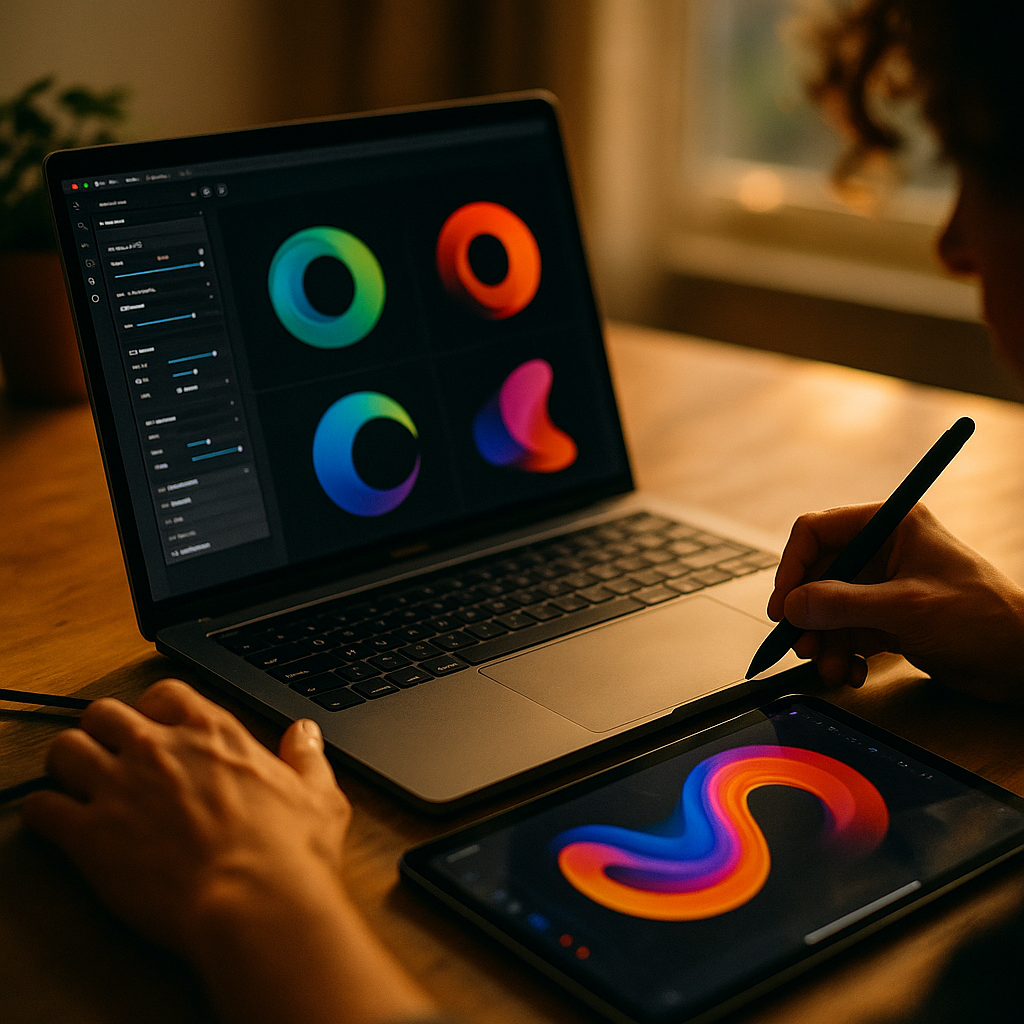
In 2025, brands compete across apps, wearables, signage, and immersive media, where static marks can feel rigid. Living logos and generative design offer a practical way to keep identity consistent while adapting to context, audience, and channel. This approach blends systems thinking, motion principles, and brand governance into one toolkit—if you know how to control it. Ready to build a logo that can breathe?
What Are Living Logos? (secondary keyword: living logos)
Living logos are identity marks designed to change without losing recognizability. Instead of one fixed artwork, a living logo is a controlled family of outputs built from rules. The goal is not novelty; it is adaptation with consistency.
In practice, living logos can shift elements such as color, texture, scale, composition, motion, or data-driven patterns. The most successful systems keep a stable core (often a silhouette, letterform structure, or proportion system) while allowing variation at the edges. This makes them suitable for modern brand touchpoints where space and behavior vary widely:
- Responsive UI icons that must remain legible at tiny sizes
- Motion-first environments such as social video, OTT, and digital out-of-home
- Personalized campaign creative that changes by audience segment
- Experiential installations and product interfaces that react to input
Readers often ask whether a living logo is “just a set of alternates.” The difference is intent and governance: alternates are multiple finished files; a living logo is a system capable of producing many valid instances under clear constraints.
How Generative Design Enables Fluid Branding (secondary keyword: generative design)
Generative design uses algorithms or procedural rules to generate visual outputs. For branding, this can range from simple parametric variations (e.g., pattern density changes by format size) to advanced systems driven by data (e.g., location, time, user behavior, or product telemetry). When used responsibly, it becomes the engine behind fluid branding.
Fluid branding means the identity adapts to context while staying unmistakably “you.” Generative methods support this by producing consistent variations faster than manual production, especially across many formats. That said, automation is not a substitute for art direction. A robust approach combines:
- Aesthetic constraints (grid, proportions, negative space rules)
- Brand constraints (tone, accessibility, cultural sensitivity)
- Technical constraints (file weight, rendering performance, platform limits)
To answer a common follow-up: yes, generative systems can be simple. A living logo does not require complex AI. Many effective systems rely on deterministic rules that make output predictable and brand-safe—critical for legal review and quality assurance.
Designing a Brand System That Stays Recognizable (secondary keyword: brand system)
The core challenge is recognition. If everything changes, nothing is remembered. The strongest living identities define a recognition anchor—the element that never breaks. Anchors typically include:
- Core geometry: a fixed silhouette, monogram skeleton, or iconic container
- Proportion rules: consistent ratios between strokes, counters, and spacing
- Signature behavior: a repeatable motion cue (e.g., “expand-and-settle”)
- Controlled palette logic: a limited set of brand colors with allowed transitions
Next comes variation boundaries: what can change and how far. This is where many teams overpromise. Set explicit ranges (minimum/maximum stroke, contrast thresholds, pattern density caps, motion speed limits). Then document real examples across channels so stakeholders can see what “on-brand variation” looks like.
Build the system around actual use cases. If your logo must work as an app icon, a favicon, and a storefront sign, start there. Establish a “smallest readable version” and a “largest expressive version,” then create rules for everything in between. This reduces rework and prevents the brand from fragmenting in production.
Finally, integrate accessibility and inclusivity early. Ensure adequate contrast, avoid motion that triggers discomfort, and keep alternate static assets for reduced-motion settings. These are not optional in 2025; they are part of brand trust.
Tools, Workflows, and Governance for Generative Logos (secondary keyword: generative logo)
A generative logo becomes sustainable only when the workflow is reliable. That means the design team can produce outputs quickly, and non-design teams can request or generate approved variations without breaking the system.
Effective pipelines usually include:
- Design prototypes: exploratory rules built in motion/creative tooling (to validate behavior)
- Production templates: locked compositions for key formats (social, web headers, OOH)
- Automated export: batch rendering for sizes, languages, and platforms
- Version control: tracked changes to rules, not just final files
- Brand governance: a decision model for approving new parameters and use cases
Governance answers the questions stakeholders will ask the moment the system ships: Who owns the rules? Who approves new variations? What happens when an agency needs assets next week? Define a simple operating model:
- Brand owner: defines strategy and approves expansions to the system
- Design system lead: maintains constraints, templates, accessibility rules
- Engineering/creative tech: ensures performance, integration, and tooling stability
- Legal/compliance: reviews usage where confusion or risk is possible
Teams often worry about “too many outputs.” Solve it by classifying deliverables into tiers: hero expressions (high variability), standard expressions (limited variability), and utility marks (fixed). This keeps the brand lively without sacrificing clarity in everyday contexts.
EEAT: Building Trust With Fluid Brand Identities (secondary keyword: brand trust)
Google’s EEAT principles—Experience, Expertise, Authoritativeness, and Trustworthiness—apply to brand identity content and systems as much as they do to editorial pages. A fluid identity can strengthen trust when it is coherent, transparent, and user-centered.
Experience shows through real usability: the logo stays legible, accessible, and stable across devices. Add proof in your brand documentation: contrast rules, reduced-motion variants, and examples of failure states to avoid.
Expertise comes from well-defined typography, motion, and systems thinking. Instead of vague “anything goes” guidelines, provide measurable constraints, clear do/don’t lists, and tested templates for high-risk placements (app icons, payment flows, legal contexts).
Authoritativeness is supported by consistent application. Publish a single source of truth (brand portal) and ensure partners use it. If you are using data-driven variations, explain the logic internally so teams can defend decisions and avoid random execution.
Trustworthiness hinges on predictability and safety. Avoid manipulative personalization and protect user privacy if data influences outputs. If the logo reacts to user data, document what inputs are used, how they are processed, and how you prevent sensitive inference. This is not just compliance—it is brand reputation.
To address a frequent follow-up: does a living logo confuse SEO or brand recall? Not if the recognition anchor remains stable and the system is applied consistently. Use a fixed primary mark for critical navigation, metadata, and legal contexts, and reserve expressive variations for campaigns and environments designed for motion and storytelling.
Measuring Success: Recognition, Consistency, and Performance (secondary keyword: fluid branding)
Fluid branding succeeds when it improves brand impact without increasing production risk. Measure it like a system, not a poster. Practical metrics include:
- Recognition tests: quick surveys or preference tests comparing fixed vs. variable executions
- Consistency audits: spot-check outputs against constraints (color, spacing, motion timing)
- Accessibility compliance: contrast checks and reduced-motion support across platforms
- Operational efficiency: time-to-asset, approval cycles, number of off-brand incidents
- Performance: load time, render speed, file size for web and app delivery
Plan for edge cases before they become incidents: monochrome printing, embroidery, tiny favicons, extreme aspect ratios, and environments that block animation. A strong living identity includes fallback rules and “minimum viable marks” that remain unmistakable even without the generative layer.
When you evaluate results, separate brand expression from brand utility. Campaign visuals can be bold and variable; interface marks should prioritize clarity and reliability. This distinction prevents teams from forcing expressive behavior into places where users need stability.
FAQs
What is the difference between a living logo and an animated logo?
An animated logo is a fixed design that moves in a predefined way. A living logo is a system that can produce multiple valid versions, sometimes animated, based on rules and constraints.
Do living logos work for small businesses, or only large brands?
They work for small businesses when kept simple: define one recognition anchor, allow limited variation (color, texture, layout), and use templates to avoid production overhead.
Is AI required for generative branding?
No. Many generative identities use deterministic rules (grids, parametric shapes, palette logic). AI can help with exploration, but brand-safe production usually depends on clear constraints and repeatable outputs.
How do you prevent a generative logo from going off-brand?
Set measurable limits (palette, proportions, contrast, motion speed), create tiered usage rules (hero vs. utility), and restrict who can change parameters. Test outputs in the smallest and highest-risk contexts first.
Can a living logo hurt accessibility?
It can if motion is excessive or contrast varies unpredictably. Build in reduced-motion and static alternatives, enforce contrast thresholds, and test in real interfaces and lighting conditions.
How should we document a fluid brand identity?
Create a brand system guide that includes the anchor elements, allowed parameters and ranges, example outputs per channel, export specifications, accessibility requirements, and an approval workflow for new variations.
Living identities thrive when they balance expression with discipline. In 2025, living logos and generative design help brands stay coherent across fast-changing channels by anchoring recognition while allowing controlled variation. Define the anchor, set strict boundaries, operationalize the workflow, and measure consistency, accessibility, and performance. The takeaway: treat the logo as a governed system, and it will adapt without losing trust.