


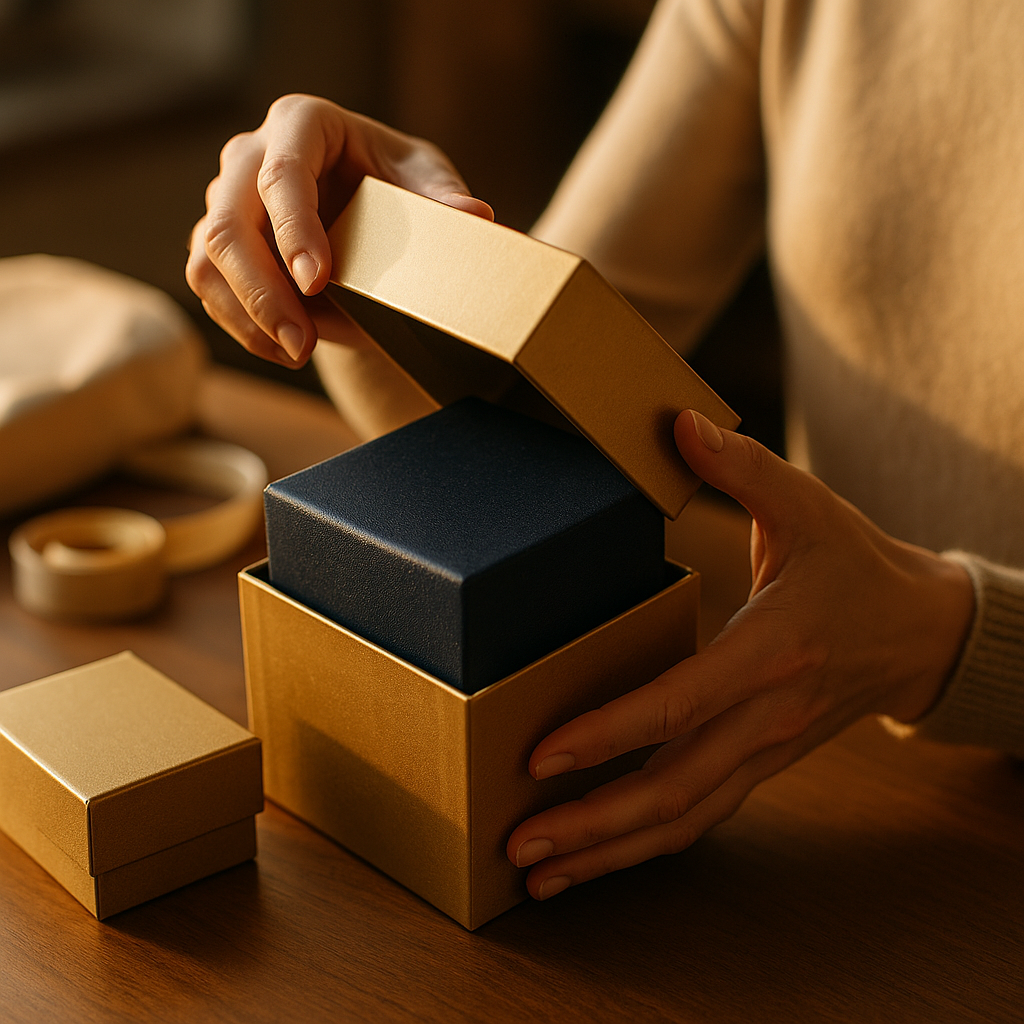
In 2025, premium brands compete on more than looks; they compete on how the product feels to access. The Psychology Of High-End Packaging explains why a little resistance—tight lids, layered wraps, deliberate steps—can increase perceived worth. When used ethically, friction signals care, rarity, and authenticity without saying a word. But where is the line between luxury and annoyance?
Luxury packaging psychology: friction as a signal of quality
Friction is any deliberate effort a customer must make to reach the product: sliding a drawer out, peeling a seal, lifting a dense lid, unfolding tissue, or removing a protective film. In luxury contexts, those micro-efforts act as signals. People infer hidden qualities from visible process, especially when they can’t evaluate the product fully before purchase (think skincare, fragrances, jewelry, or limited drops).
This is not about making packaging difficult for its own sake. It’s about using controlled resistance to communicate that the brand invested in protection, precision, and presentation. A snug magnetic closure suggests engineering; a rigid box suggests durability; tamper evidence suggests integrity. The customer experiences those cues through their hands, which makes the judgment feel self-generated instead of advertised.
Friction also creates temporal distance: the product is not instantly available, which makes it feel more valuable. A two-step opening can feel like a threshold. That’s why many high-end unboxings resemble a ritual: the sequence builds anticipation, then resolves it with a reveal.
Practical takeaway: if your product is premium-priced or gift-oriented, add friction only where it meaningfully supports quality cues—protection, authenticity, or ceremony. Avoid “mystery effort” that doesn’t clearly serve the customer.
Unboxing experience design: anticipation, ritual, and emotional payoff
High-end packaging works best when it creates an emotional arc. Friction can be the pacing mechanism: a pause before the reveal, a layer that frames the product, a texture that slows the hand. This is why unboxing videos continue to influence perception; watching someone else move through the steps primes viewers to expect a premium experience.
To design that arc, start with the customer’s context:
- Self-purchase: The unboxing should reinforce that the buyer made a smart, discerning decision. Clear structure and precision matter more than theatrics.
- Gift: The packaging must “perform” for two people: the giver (status and taste) and the receiver (delight and appreciation). A sequence that feels ceremonial boosts both.
- Repeat purchase: The ritual must stay satisfying without becoming time-consuming. Consider a fast path for refills while keeping the premium moment for the first purchase.
Build friction like a well-edited film: setup, build, reveal, resolution. Setup can be weight and structure; build can be a seal or drawer; reveal is the product presentation; resolution is easy access to instructions, care, or authentication.
Answering the obvious question—how much friction is too much?—comes down to whether the customer feels guided or blocked. Premium friction feels intentional and safe. Annoying friction feels like a puzzle, a trap, or a waste.
Perceived value and effort justification: why “work” can feel worth it
One reason friction builds value is rooted in effort justification: when people invest effort, they tend to value the outcome more because the effort needs to “make sense.” Packaging can create a small investment—opening, unfolding, lifting—that subtly increases the customer’s commitment to the purchase.
This can be especially powerful for products where sensory evaluation happens after purchase. If a fragrance is sealed and nested in protective materials, the customer feels they are accessing something preserved and curated. The effort becomes part of the story: “This was protected because it matters.”
However, effort justification has ethical boundaries. If brands use friction to distract from mediocre product quality, customers feel manipulated and backlash spreads quickly. In 2025, friction must support real value: better protection, better presentation, better authentication, or better sustainability outcomes. Otherwise, the moment a customer thinks “they made this hard just to look expensive,” the signal reverses.
Design guidelines that keep effort helpful:
- Make the next step obvious: Hidden tabs and ambiguous folds create frustration, not premium feelings.
- Reward each step: Each layer should add information or delight (texture, message, reveal), not just delay.
- Respect time: If it takes more than a few seconds to find the opening method, simplify.
When done well, friction doesn’t feel like “work.” It feels like care.
Scarcity cues and exclusivity branding: how packaging creates “limited” feelings
Luxury is partly about controlled access. Friction can simulate that access by making the product feel gated—without being unfriendly. Small signals stack up: numbered inserts, custom seals, precisely fitted components, and packaging that looks engineered for a specific item rather than generic.
These elements reinforce exclusivity branding in three ways:
- Uniqueness: A custom-fit cavity or sculpted insert suggests the product is not mass-handled, even when it is produced at scale.
- Rarity cues: Limited-run markings and short, specific messaging (“crafted for…”, “edition…”) create a sense of constraint.
- Status transfer: The box itself becomes a visible asset—something people keep, display, or reuse—extending brand presence beyond the product.
Where brands go wrong is confusing scarcity with inconvenience. Customers accept barriers that imply protection or authenticity; they reject barriers that feel like cost-cutting, such as flimsy seals that tear poorly or excessive tape used to compensate for weak structure.
If you want exclusivity without negative friction, focus on precision rather than obstruction: tight tolerances, clean openings, premium materials, and clear brand marks placed where the hand naturally rests.
Sensory branding and tactile design: touch, sound, and weight as trust builders
People evaluate packaging faster than they can explain it. Sensory cues—especially tactile and auditory ones—shape judgments about quality and price. Weight suggests substance. A soft-touch coating suggests refinement. A crisp “snap” from a closure suggests mechanical integrity. These cues work because they reduce uncertainty through the senses.
In high-end packaging, friction often shows up as tactile resistance: the slight pull of a drawer, the controlled break of a seal, the gentle suction of a fitted lid. These are moments where the customer’s body receives “evidence” that the brand invested in the experience.
To apply sensory branding responsibly:
- Engineer the opening sound: A quiet, controlled close can feel expensive; a rattly closure can undermine everything.
- Use texture to guide behavior: Raised or matte areas can indicate where to grip, reducing confusion.
- Balance weight with usability: Heavier can feel premium, but it must still be comfortable to handle and ship.
- Prioritize skin-safe finishes: If coatings smell harsh or feel sticky, sensory branding backfires.
Brands often ask whether tactile cues matter for e-commerce. They can matter more online because customers lack in-store reassurance. The first physical contact becomes the “store,” and the packaging is your sales associate.
Premium packaging strategy in 2025: ethical friction, accessibility, and sustainability
In 2025, high-end packaging must meet three realities at once: customers want premium experiences, they expect ease and accessibility, and they scrutinize material impact. The best strategy uses friction selectively and transparently.
Ethical friction means the customer benefits from each layer:
- Protection: Reduce damage and returns with structural integrity instead of excessive filler.
- Authentication: Use tamper evidence and clear brand marks to support trust, especially for resale markets.
- Instruction: Provide a simple, visible opening cue and a quick-start guide where it’s immediately seen.
Accessibility is not optional. Friction should never exclude customers with limited grip strength, disabilities, or sensory sensitivities. Premium can still be easy-open: add pull tabs, leverage points, and intuitive geometry. If you use tight tolerances, ensure there is a clear, comfortable grip zone.
Sustainability is also part of value perception. Customers increasingly interpret “too much packaging” as waste, not luxury. You can keep the ritual while reducing materials by:
- Designing fewer, smarter layers: One rigid structure plus a single protective wrap often beats multiple redundant layers.
- Using mono-material solutions where possible: Easier to recycle than mixed laminates.
- Making the box reusable: A durable box that becomes storage can justify material use better than a disposable one.
How do you test whether friction is building value? Watch real users open it. Time the unboxing. Note where hands hesitate. Ask what each layer “means” to them. If they can’t articulate a benefit, revise.
FAQs
What does “friction” mean in high-end packaging?
It means intentional resistance or steps in the opening process—like tight lids, seals, drawers, or layered wraps—designed to pace the reveal, signal care, and increase perceived value.
Why does difficult-to-open packaging sometimes feel more luxurious?
Because controlled effort can imply protection, precision, and exclusivity. The extra steps slow the moment, build anticipation, and give customers sensory evidence that the brand invested in quality.
How can brands add friction without annoying customers?
Make the opening path obvious, reward each step with a clear benefit (protection, authentication, or presentation), and keep total opening time reasonable. Use tactile cues and pull tabs so the customer feels guided, not blocked.
Does friction improve perceived value for online purchases too?
Yes. For e-commerce, packaging often becomes the first physical brand interaction. A structured, sensory unboxing can compensate for the lack of in-store touch and increase confidence in the purchase.
Is friction in packaging ethical?
It is ethical when it serves the customer—protecting the product, confirming authenticity, improving usability, or supporting sustainability. It becomes unethical when it manipulates perception to mask poor product quality or creates unnecessary waste.
How do you measure whether premium packaging friction is working?
Run user tests and track unboxing time, error rates (wrong opening attempts), customer feedback, returns due to damage, and social sharing sentiment. If users describe the process as “intentional” or “satisfying,” you’re closer to value-building friction.
High-end packaging succeeds when it turns access into meaning. In 2025, the smartest brands use friction as a deliberate signal: protection, authenticity, and a paced reveal that feels confident rather than complicated. The rule is simple—every extra step must earn its place with a clear customer benefit. Design the ritual, remove the obstacles, and value follows.