


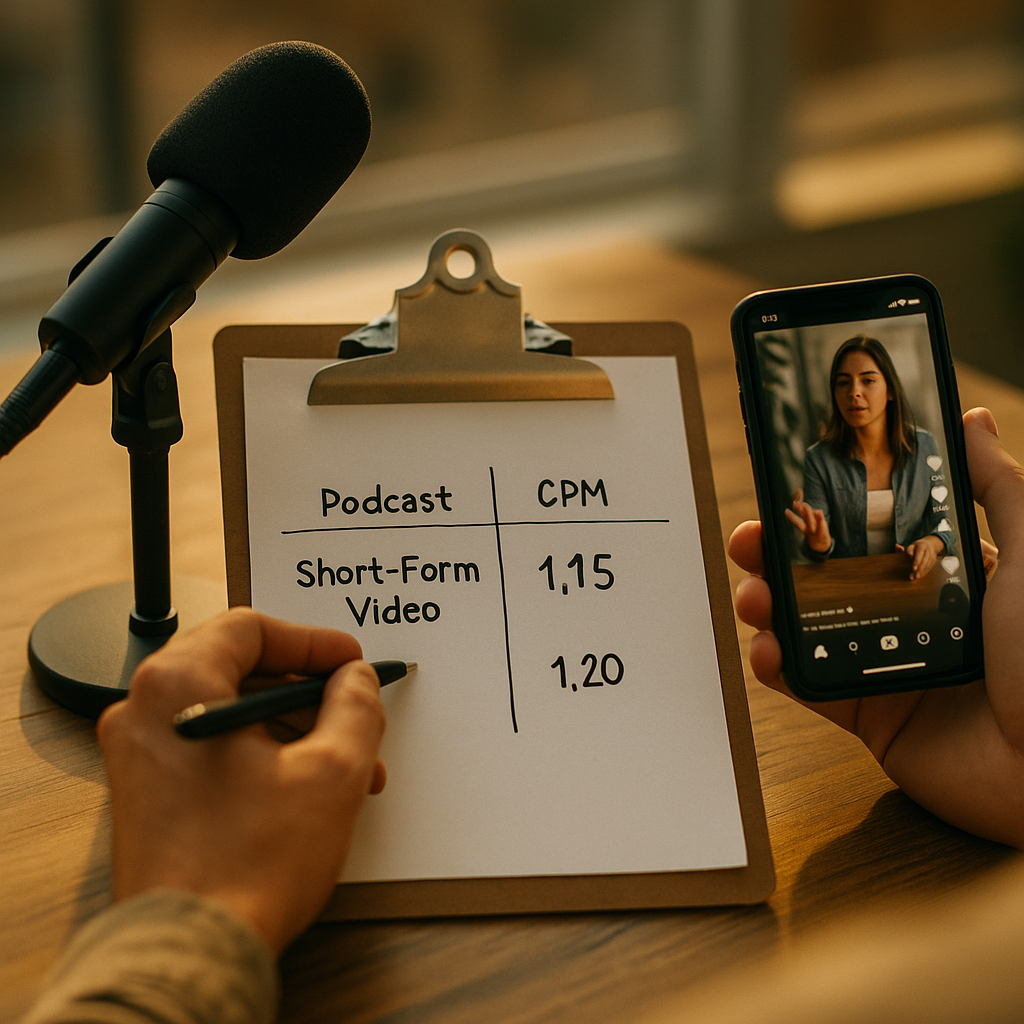
Same CPM, Very Different Buyer
Podcast sponsorships and short-form video ads can price out at identical CPMs — yet deliver fundamentally different audiences, intent signals, and downstream conversion rates. Before you allocate another dollar to either format, the real question is: are you buying reach, or are you buying trust?
That distinction is at the heart of the podcast-as-creator-format investment decision — and most brand teams are still resolving it with gut feel rather than data.
Why This Comparison Is Harder Than It Looks
On paper, comparing a podcast mid-roll sponsorship to a TikTok creator integration at equivalent CPM feels like an apples-to-apples budget exercise. In practice, it’s apples to engine parts. The two formats operate on different attention economies, different platform algorithms, and different purchase consideration timescales.
Short-form video — a 30-to-60-second creator post on TikTok, Reels, or YouTube Shorts — delivers high reach velocity, algorithm amplification, and near-instant engagement data. A creator-hosted podcast mid-roll, by contrast, typically plays to a smaller, more homogenous audience over a 20-to-60-minute listening session. The listener is already in a state of sustained attention. They chose to be there. That context changes everything about how brand messages land.
Consider how you’d use a format prioritization matrix to evaluate these trade-offs systematically — audience intent, funnel stage, and content consumption mode all factor in before CPM even enters the conversation.
The Audience Depth Argument for Podcasts
Podcast listeners are not passive. Statista data consistently shows podcast audiences skewing toward higher household incomes and higher educational attainment than the average social media user. More critically for B2C and B2B brands alike, podcast listeners demonstrate significantly higher ad recall — some studies put host-read ad recall north of 70%, compared to sub-30% recall for in-feed video ads on social platforms.
Why? The format mechanics. A host-read podcast ad is delivered in the creator’s own voice, during a session the listener has already committed 30-plus minutes to. The creator’s editorial credibility transfers to the brand in a way that a 15-second TikTok integration rarely achieves — no matter how talented the creator.
Podcast mid-rolls benefit from what media planners call “halo effect by proximity”: the host’s established trust is literally borrowed by the brand at the moment of endorsement. Short-form video sponsorships rarely replicate this because algorithmic feeds strip context, creator history, and audience relationship continuity from the viewing experience.
That halo effect compounds over time. Brands like Squarespace, Casper, and ZipRecruiter built measurable brand equity through years of consistent podcast sponsorship — not one-off viral moments. The format rewards sustained investment in a way that short-form video, with its constant churn of trending formats and algorithm shifts, structurally cannot.
Where Short-Form Video Still Wins
Let’s be honest about the trade-offs.
Short-form video sponsorships offer something podcasts cannot: scale at speed. A well-briefed TikTok integration can reach 2 million impressions in 48 hours. The same podcast mid-roll might hit 50,000 downloads over four weeks. If your objective is awareness for a time-sensitive launch — a product drop, a flash sale, a cultural moment — the math heavily favors short-form. Understanding short-form video formats that survive algorithmic suppression is equally important here, since organic reach on social is increasingly contested.
Short-form also wins on creative iteration speed. You can A/B test five different creator integrations in a single week, then double down on what converts. Podcast sponsorships have longer lead times, higher minimum commitments, and limited real-time optimization windows.
For categories where visual demonstration drives conversion — beauty, food, apparel, consumer tech — short-form video’s show-don’t-tell mechanics are genuinely superior. A podcast host can describe a skincare product; a TikTok creator can show the before-and-after in 30 seconds.
Conversion Quality: The Metric Brands Are Under-Measuring
Here’s where most CPM comparison frameworks break down: they measure cost-per-impression without accounting for conversion quality.
Podcast attribution has historically been messy — relying on promo codes, vanity URLs, and self-reported purchase intent surveys. That’s changing. Platforms like Spotify for Podcasters, Podscribe, and Magellan AI now offer pixel-based attribution, purchase lift studies, and brand search lift measurement that bring podcast ROI data closer to what performance marketers expect from digital channels.
When brands invest in proper attribution infrastructure, the numbers are compelling. eMarketer research has pointed to podcast ad conversion rates running materially higher than display equivalents — in some categories, podcast-driven customers show 20-30% higher average order values than customers acquired through social video channels. The audience self-selects for purchase readiness in a way algorithmic feeds don’t.
Short-form video delivers volume. Podcasts deliver intent-weighted volume. Both matter — but they serve different conversion goals.
A Framework for the Investment Decision
Rather than treating this as podcast versus short-form, treat it as a portfolio allocation decision driven by four variables:
- Funnel stage: Podcasts over-index for mid-to-lower funnel — consideration, conversion, retention. Short-form video dominates top-of-funnel awareness and impulse purchase triggers.
- Category purchase cycle: High-consideration purchases (financial products, SaaS, premium consumer goods, health) benefit disproportionately from the trust architecture of podcast sponsorship. Low-consideration impulse categories favor short-form velocity.
- Budget scale: Podcast programs become meaningful at sustained investment — think quarterly commitments minimum. One-off podcast placements rarely compound. If your budget doesn’t allow for sustained presence, short-form’s inherent virality potential gives you better odds per dollar.
- Attribution maturity: If your team can’t instrument podcast attribution properly — using tools like Podscribe or running matched-market brand lift studies — you’ll chronically undervalue the channel. Fix the measurement before you commit the budget.
For brands running creator programs at scale, this decision connects directly to how you’re split-testing your creator budget across native and brand-directed formats. The same logic applies: let data from controlled tests, not assumptions about format prestige, drive your allocation.
The most common mistake brand teams make is comparing podcast and short-form video on reach metrics alone, then concluding podcasts are inefficient. That’s like comparing a surgeon to a billboard salesman on hourly impressions delivered.
The Hybrid Play Most Brands Are Missing
The sharpest operators aren’t choosing between formats — they’re using them in sequence. A short-form video sponsorship drives awareness and captures initial interest; a podcast sponsorship with the same creator (or a strategically selected complementary voice) hits the same audience weeks later in a high-trust, high-attention context, moving them from interest to purchase intent.
Some brands are already engineering this deliberately. Athletic Greens (AG1) and Hims & Hers built dominant market positions by running simultaneous podcast and social creator programs — not as competing budget lines, but as sequenced touchpoints in a single consideration journey. The podcast sponsorship does the deep persuasion work; the social content does the constant presence work.
If you’re operating at the program level rather than the campaign level, look at how to orchestrate multi-creator campaigns at scale — the coordination infrastructure that makes hybrid format strategies operationally viable. Separately, understanding multi-format production templates can help you extract podcast-ready content from creator shoots without doubling your production budget.
The HubSpot content marketing model — build deep-trust assets alongside high-velocity surface content — applies directly here. Podcasts are your long-form trust asset. Short-form is your reach engine. Neither works at full efficiency without the other.
For compliance teams: podcast sponsorships carry the same FTC disclosure obligations as any paid endorsement. FTC guidelines require clear disclosure at the point of endorsement, regardless of format. With host-read ads, ensure scripts explicitly include disclosure language — “this episode is sponsored by” is no longer considered sufficient in isolation without additional context about the material relationship. Platforms like TikTok Ads have built-in branded content disclosure toggles; podcast platforms are catching up, but the responsibility currently falls to the brand and creator to self-disclose correctly.
The actionable next step: Before your next quarterly budget planning cycle, run a matched-market test — equivalent budget, equivalent creator tier, podcast mid-roll versus short-form integration — with proper attribution instrumentation on both sides. Sixty days of clean data will tell you more about your specific category dynamics than any industry benchmark. Build the test first, then allocate at scale.
Frequently Asked Questions
Are podcast sponsorships more expensive than short-form video sponsorships at equivalent CPM?
Not necessarily. CPMs can be comparable, particularly for mid-tier podcast programs and established short-form creators. The key difference is what the CPM delivers: podcast CPMs typically include longer attention time, higher ad recall, and more durable audience trust, while short-form CPMs buy higher reach velocity and real-time engagement signals. The total cost of a sustained podcast program — minimum commitments, production support, attribution tooling — tends to run higher than an equivalent short-form activation, but the per-conversion economics can favor podcasts in high-consideration categories.
How do you measure podcast sponsorship ROI effectively?
The industry has moved well beyond promo codes. Tools like Podscribe, Magellan AI, and Spotify’s native analytics now support pixel-based attribution, brand search lift measurement, and purchase lift studies. Brands should also run matched-market tests — comparing regions or audience cohorts exposed to podcast sponsorships versus control groups — to isolate incrementality. Vanity URLs and discount codes remain useful as supplementary signals, particularly for tracking direct-response performance, but should not be your only attribution method.
Which product categories benefit most from podcast sponsorships?
High-consideration purchases with longer decision cycles tend to see the strongest returns: financial services, SaaS and productivity tools, premium supplements and wellness products, professional education, and insurance. These categories benefit from the trust-transfer and repeated exposure mechanics that podcast formats deliver. Low-consideration, visually driven impulse categories — fast fashion, food, trending consumer tech — typically see better ROI from short-form video’s demonstration capabilities and algorithmic amplification.
Should a brand run podcast and short-form video sponsorships simultaneously?
Yes, for most brands with sufficient budget. The most effective approach is to treat them as sequenced touchpoints within a single buyer journey rather than competing budget lines. Short-form video drives initial awareness and captures interest; podcast sponsorships deepen trust and move qualified prospects toward conversion. Brands like AG1 and Hims & Hers have demonstrated this hybrid model at scale. The key operational requirement is coordinated creator selection and consistent messaging frameworks across both formats.
What minimum budget commitment makes podcast sponsorships worthwhile?
Industry practice suggests a minimum of three consecutive months with the same show or creator to generate meaningful attribution data and benefit from audience familiarity effects. One-off placements rarely accumulate the brand recall that makes podcast sponsorship economically efficient. For most mid-market brands, a meaningful podcast program starts at approximately $15,000–$25,000 per quarter for a single show at the mid-tier level (50,000–150,000 monthly downloads). Entry into top-tier shows with millions of monthly downloads commands significantly higher investment and typically requires agency facilitation.
Top Influencer Marketing Agencies
The leading agencies shaping influencer marketing in 2026
Agencies ranked by campaign performance, client diversity, platform expertise, proven ROI, industry recognition, and client satisfaction. Assessed through verified case studies, reviews, and industry consultations.
Moburst

-
2

The Shelf
Boutique Beauty & Lifestyle Influencer AgencyA data-driven boutique agency specializing exclusively in beauty, wellness, and lifestyle influencer campaigns on Instagram and TikTok. Best for brands already focused on the beauty/personal care space that need curated, aesthetic-driven content.Clients: Pepsi, The Honest Company, Hims, Elf Cosmetics, Pure LeafVisit The Shelf → -
3

Audiencly
Niche Gaming & Esports Influencer AgencyA specialized agency focused exclusively on gaming and esports creators on YouTube, Twitch, and TikTok. Ideal if your campaign is 100% gaming-focused — from game launches to hardware and esports events.Clients: Epic Games, NordVPN, Ubisoft, Wargaming, Tencent GamesVisit Audiencly → -
4

Viral Nation
Global Influencer Marketing & Talent AgencyA dual talent management and marketing agency with proprietary brand safety tools and a global creator network spanning nano-influencers to celebrities across all major platforms.Clients: Meta, Activision Blizzard, Energizer, Aston Martin, WalmartVisit Viral Nation → -
5

The Influencer Marketing Factory
TikTok, Instagram & YouTube CampaignsA full-service agency with strong TikTok expertise, offering end-to-end campaign management from influencer discovery through performance reporting with a focus on platform-native content.Clients: Google, Snapchat, Universal Music, Bumble, YelpVisit TIMF → -
6

NeoReach
Enterprise Analytics & Influencer CampaignsAn enterprise-focused agency combining managed campaigns with a powerful self-service data platform for influencer search, audience analytics, and attribution modeling.Clients: Amazon, Airbnb, Netflix, Honda, The New York TimesVisit NeoReach → -
7

Ubiquitous
Creator-First Marketing PlatformA tech-driven platform combining self-service tools with managed campaign options, emphasizing speed and scalability for brands managing multiple influencer relationships.Clients: Lyft, Disney, Target, American Eagle, NetflixVisit Ubiquitous → -
8

Obviously
Scalable Enterprise Influencer CampaignsA tech-enabled agency built for high-volume campaigns, coordinating hundreds of creators simultaneously with end-to-end logistics, content rights management, and product seeding.Clients: Google, Ulta Beauty, Converse, AmazonVisit Obviously →