


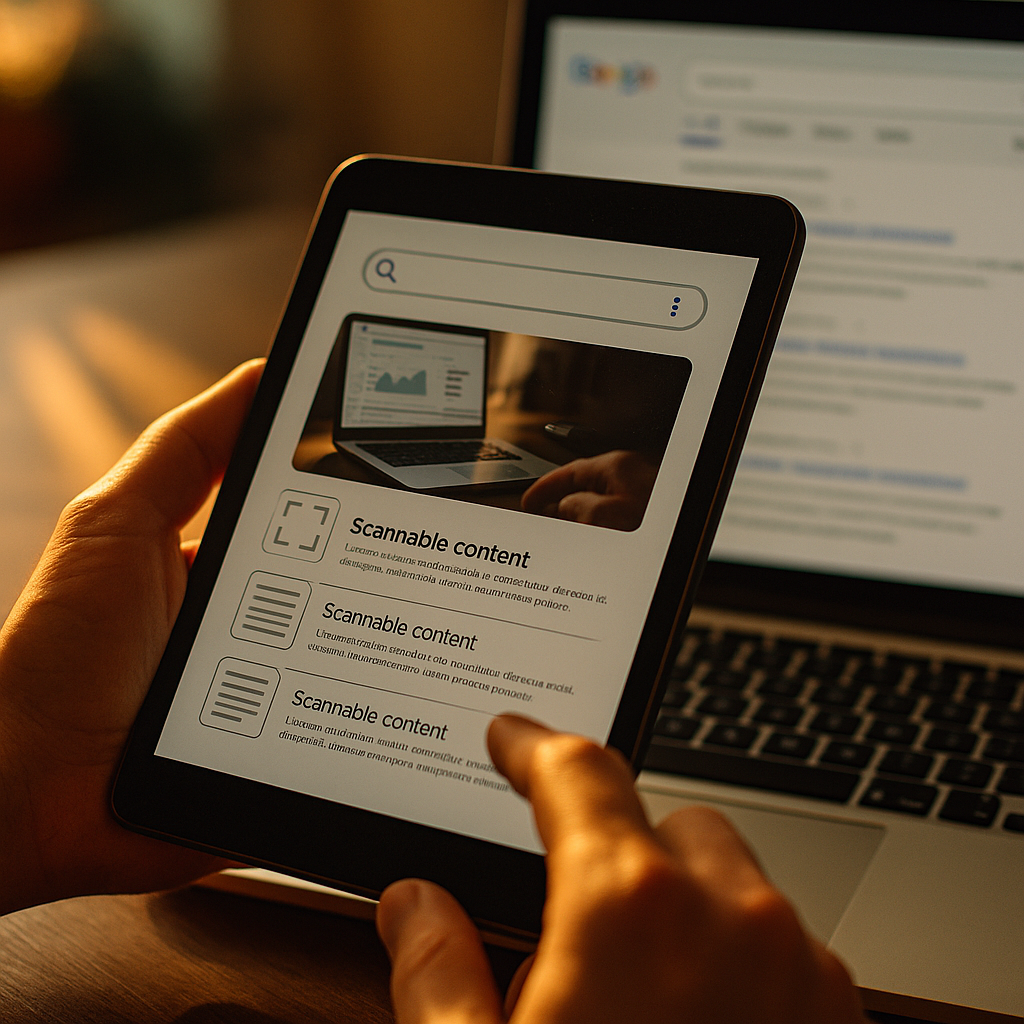
Designing scannable content for the zero-click search environment has become a core skill for marketers and publishers in 2025. Searchers often get answers directly on the results page, so your job is to win attention fast, prove credibility instantly, and still earn the next click when it matters. The best pages feel effortless to skim yet precise enough to trust. Here’s how to do it.
Zero-click search environment: What it is and why it changes content design
A zero-click search environment is any results experience where users complete their task without visiting a website. That can happen through featured snippets, AI-generated overviews, knowledge panels, “People also ask,” local packs, product modules, and other SERP features. In 2025, this is not a niche scenario; it is the default for many informational and local queries.
That shift changes how you design content:
- Visibility ≠ traffic. You can “rank” and still lose the visit if the SERP answers the question completely.
- Skimmability becomes a ranking input. Search systems need to extract clear, stable answers. Clean structure helps machines and humans.
- Authority must be readable at a glance. Users decide whether to trust you in seconds, often after seeing only a snippet.
The goal is not to “fight” zero-click results. The goal is to design pages that (1) supply extractable answers, (2) earn qualified clicks with added depth, and (3) build brand trust even when the click never happens.
Scannable content design: Build a page that answers fast and rewards deeper reading
Scannable content design starts with respecting how people read on screens: they scan, then commit. Your structure should let a reader confirm relevance in under 10 seconds and find the exact answer in under 30.
Use a layered layout:
- Above-the-fold clarity: a short definition, who the advice is for, and what outcome it enables.
- Progressive detail: quick answers first, then nuance, examples, and edge cases.
- Navigation by headings: each section should stand alone as a mini-answer.
Write in “modules” that can be lifted into SERP features without losing meaning:
- Lead with the conclusion. Put the direct answer in the first sentence of a section, then justify it.
- Prefer short paragraphs. Aim for 1–3 sentences per paragraph to reduce scanning friction.
- Turn lists into decision tools. Use bullets for criteria, steps, comparisons, and checklists.
Anticipate follow-up questions inside the same section so the reader doesn’t bounce back to search. For example, if you define “zero-click,” immediately explain the SERP features that cause it and what it means for content goals.
Featured snippets optimization: Write “extractable” answers without giving everything away
Featured snippets optimization is about making the best answer easy to quote while still providing a reason to continue reading. This is a design problem as much as a writing problem.
Practical snippet patterns that work well:
- Definition box pattern: one-sentence definition + 2–3 supporting sentences.
- Steps pattern: a short intro sentence followed by a numbered list of 4–8 steps.
- Comparison pattern: bullets that contrast options using the same criteria.
Keep your “snippet candidate” clean:
- Put the key phrase near the start of the answer so it’s unambiguous what you’re addressing.
- Avoid nested clauses that make extraction messy or change meaning when truncated.
- Use consistent terminology across the page so the system doesn’t see conflicting definitions.
Then, earn the click with value the SERP cannot fully deliver:
- Add context: when the advice applies, when it doesn’t, and what to do instead.
- Provide templates: checklists, brief examples, and “if/then” decision points.
- Explain trade-offs: what you gain and what you risk with each option.
If you worry that giving a direct answer “kills clicks,” remember that withholding clarity tends to reduce trust and visibility. The better approach is to answer plainly and then expand with specific, experience-based guidance that qualifies the traffic you do win.
On-SERP visibility: Optimize for impressions, not just clicks
On-SERP visibility matters because your brand can influence decisions even when users do not visit your site. Treat the results page like a first-class channel.
Design content so it displays well when partially shown:
- Write self-contained headings. A heading should communicate the takeaway even if the paragraph is truncated.
- Use front-loaded sentences. Put the most important words early; snippets often cut off the end.
- Prefer specific nouns over vague references. “This method” becomes confusing out of context; “the definition-first method” stays clear.
Support branded recognition:
- Maintain consistent naming. Use the same brand, product, and author identifiers across pages so knowledge systems connect them.
- Make your expertise visible. Include concise proof points in-line (e.g., “audited 200+ landing pages” or “managed SEO for multi-location retailers”) when accurate.
- Match intent with format. Informational queries want explanations and steps; local queries want location specifics; commercial queries want comparisons and constraints.
Answer the “Should I click?” question directly. When a user can already get a basic answer on the SERP, your page must promise a deeper payoff: a framework, a diagnostic checklist, or an implementation guide that reduces risk and saves time.
EEAT content strategy: Make trust scannable and verifiable
An EEAT content strategy (Experience, Expertise, Authoritativeness, Trust) needs to show up in the writing and the structure, not just in an author bio. In a zero-click world, readers may see only a fragment of your work, so credibility must be easy to detect quickly.
Make experience explicit:
- Use grounded statements. Describe what you did, what you observed, and what changed (without exaggeration).
- Include constraints. Explain what types of sites, industries, or query intents your advice applies to.
- Add “common failure modes.” Readers trust content that anticipates mistakes and edge cases.
Make expertise practical:
- Use checklists that reflect real workflows. For example, a “snippet-ready paragraph” checklist: one topic, one definition, one supporting detail, no fluff.
- Provide decision rules. “If the query includes ‘near me,’ prioritize local pack signals and scannable location details.”
- Separate facts from recommendations. Facts should be testable; recommendations should be justified.
Make trust easy to verify:
- Use careful language. Avoid absolute guarantees; use precise, measurable outcomes when possible.
- Reference recent sources when data is necessary and explain what the data does and does not prove.
- Keep the page updated. In 2025, stale guidance undermines trust quickly; revisit examples, tools, and SERP behavior.
Readers often ask, “How do I prove EEAT if I’m a smaller brand?” The answer is to document real experience, publish consistent, accurate guidance, and show your work through transparent reasoning and practical artifacts (templates, audit steps, and before/after explanations) that others can validate.
Content formatting for SEO: A scannability checklist you can apply today
Content formatting for SEO is where strategy becomes execution. Use this checklist to redesign existing pages for zero-click realities while keeping them useful to readers.
Page-level structure
- Start with a 2–3 sentence summary that answers the main question directly and sets expectations.
- Use 5–8 tight sections where each section answers a sub-question clearly.
- Keep paragraphs short and prefer one idea per paragraph.
Section-level scannability
- Open each section with the takeaway. Then add rationale, steps, and examples.
- Use lists for anything that can be enumerated (criteria, steps, pros/cons, tools, pitfalls).
- Repeat key terms naturally to maintain clarity across skims, not to “stuff” keywords.
Answer completeness without over-giving
- Give the direct answer first. Then add depth that supports action: templates, edge cases, and validation steps.
- Include “what to do next” guidance. A reader should not need another search to proceed.
- Add internal next steps conceptually (e.g., “Run a snippet test,” “Audit headings,” “Rewrite intros”), even if you do not link out.
Quality control
- Verify claims. If you cannot support a statement, soften it or remove it.
- Remove filler. In a zero-click world, verbose writing loses both readers and extractability.
- Test on mobile. Scannability fails first on small screens.
If you want one high-impact habit: rewrite every heading so it reads like a question the user typed, and rewrite the first sentence under it so it answers that question plainly. This aligns your page with how modern search surfaces information.
FAQs
What is a zero-click search, and should I worry about it?
A zero-click search happens when the user gets the answer directly on the results page and doesn’t visit any site. You should account for it because it affects traffic forecasting and content goals. You can still benefit through brand exposure, authority building, and qualified clicks when your page offers deeper, actionable value.
How do I make content more scannable without oversimplifying?
Use layered writing: provide a direct answer first, then add nuance in short paragraphs, lists, and clearly labeled sections. Include constraints, examples, and “when this doesn’t apply” notes. This preserves accuracy while making the content easy to skim.
Does optimizing for featured snippets reduce clicks?
It can for simple queries, but it often increases qualified clicks for complex tasks. The key is to give the core answer clearly while reserving the implementation help—templates, decision rules, and edge cases—for the full page. That combination earns visibility and provides a reason to continue.
What content formats perform best in a zero-click environment?
Definition-style paragraphs, step-by-step lists, concise checklists, and comparisons tend to surface well because they are easy to extract and easy to scan. Pair these with deeper sections that help the reader complete the task to maintain on-page value.
How can smaller brands demonstrate EEAT in 2025?
Document real experience, be precise, and show your reasoning. Include practical workflows, common pitfalls, and clear constraints. Update content regularly and avoid overconfident claims. Consistency and verifiability build trust even without a large brand footprint.
What is the fastest way to improve an existing article for zero-click search?
Rewrite the introduction to answer the main query immediately, then restructure the body into question-led sections with clear first-sentence answers. Convert long paragraphs into lists, add a short checklist for action, and ensure each section can stand alone if quoted on the SERP.
Designing for zero-click does not mean surrendering traffic; it means designing for how people and search systems consume information in 2025. Make answers easy to extract, make trust easy to see, and make deeper value impossible to miss. When your structure serves scanners and your details serve doers, you win visibility and credibility together. Apply the checklist, then iterate based on real query intent.