


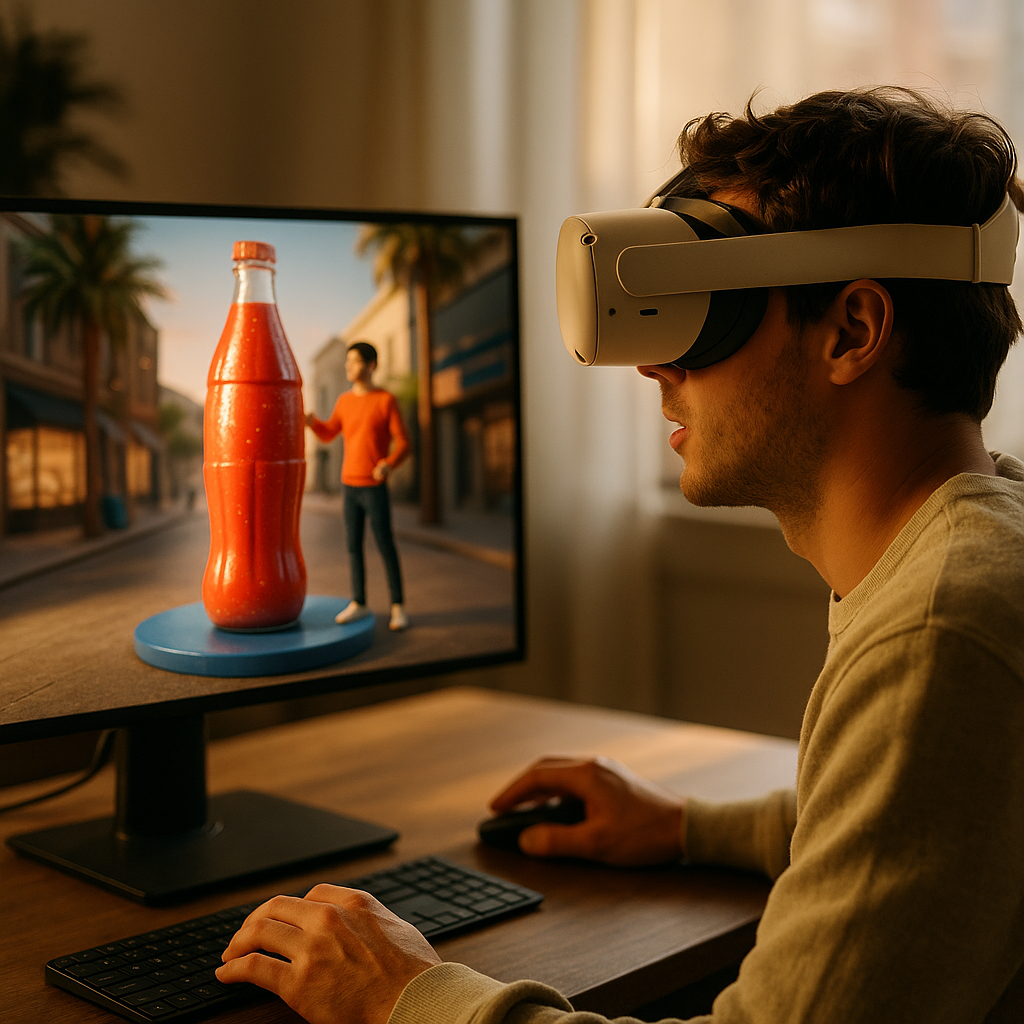
In 2026, brands compete in environments where attention is scarce and perception is shaped in milliseconds. The Science of Visual Anchoring in 3D Immersive Brand Advertisements explains why some spatial campaigns feel instantly memorable while others fade. By aligning perception, motion, and meaning, marketers can guide viewers through immersive scenes with precision. What makes an anchor truly stick?
Visual attention in immersive advertising
Visual anchoring is the practice of placing a dominant perceptual cue inside an ad experience so the viewer immediately knows where to look, what matters, and how to interpret the scene. In 3D immersive brand advertisements, that cue may be an object, a character, a product silhouette, a burst of motion, a color contrast, or a spatial sound source that directs gaze toward a branded focal point.
The science behind this starts with selective attention. Human perception does not process every visual detail equally. Instead, the brain prioritizes stimuli that stand out due to contrast, novelty, motion, scale, emotional relevance, and expected reward. In a 3D environment, these signals become even more powerful because the viewer is not scanning a flat canvas. They are orienting themselves in depth.
That added spatial complexity creates both opportunity and risk. Opportunity, because a brand can stage a full environment that feels discoverable and memorable. Risk, because too many competing elements can dilute the central message. An effective visual anchor solves this problem by reducing cognitive ambiguity. It gives the brain a shortcut: this is the thing to notice first.
Research in attention and eye-tracking continues to show that people form judgments quickly, often before they consciously articulate them. In immersive media, early orientation matters even more because the first few seconds determine whether users explore, engage, or mentally disengage. A strong anchor therefore acts as the entry point to the brand story. It helps audiences understand not only where to look, but why the scene matters.
For marketers, this means visual anchoring is not a decorative tactic. It is a strategic mechanism for directing attention, increasing comprehension, and improving recall in environments where the viewer can look almost anywhere.
Spatial memory and brand recall
Why does visual anchoring improve memory? The answer lies in how the brain encodes spatial experiences. People tend to remember information better when it is connected to place, movement, and distinctive visual structure. This is one reason immersive formats can outperform static placements for certain brand goals: they invite users to build a mental map.
When a 3D advertisement uses a clear anchor, it gives the viewer a stable reference point inside that mental map. The anchor becomes the center of the experience. Supporting details, such as product benefits, animations, or calls to action, are then processed in relation to it. That relationship improves encoding because the information is not floating in isolation. It is organized spatially.
Consider how product launches appear in augmented reality storefronts, virtual showrooms, or interactive out-of-home displays. If the branded product appears immediately as the visual anchor, users connect every later interaction back to that product. If the first thing they notice is an unrelated visual effect, the memory trace becomes weaker or confused. In practice, users may remember the spectacle but not the brand.
Strong anchors improve brand recall in three ways:
- They establish hierarchy. The audience knows what element is primary and what is secondary.
- They reduce memory friction. Fewer competing focal points means easier encoding and retrieval.
- They connect emotion to identity. If the anchor is also the branded asset, emotional response attaches to the brand more directly.
This is especially important for campaigns designed for mixed reality, 3D social ads, gaming environments, and experiential retail. These formats often create high engagement, but engagement alone does not guarantee recall. Without an anchor, the experience can feel impressive yet mentally fragmented.
Marketers should also remember that recall is shaped by consistency. Repeating the same anchored object, color logic, motion pattern, or spatial cue across channels can reinforce familiarity. A viewer who sees the same immersive product form in social AR, retail media, and a 3D web experience is more likely to retain the brand association over time.
3D ad design principles for visual hierarchy
Visual anchoring works best when it is built into the design system from the beginning. It should not be added late as a patch for weak creative. The following principles help create clear hierarchy in 3D ad design.
- Start with one dominant focal point. Every immersive ad should have a single primary element that carries the brand message. This may be the product itself, a logo-bearing object, or a character directly associated with the brand.
- Use contrast deliberately. Contrast can be created through color, brightness, texture, motion, scale, or depth. If everything is vivid and moving, nothing feels important. Reserve the strongest contrast for the anchor.
- Guide approach paths. In spatial environments, users often follow lines, openings, light sources, and implied motion. Arrange the scene so visual pathways lead naturally toward the anchor.
- Control depth cues. Occlusion, perspective, shadow, and parallax influence what feels near, important, and tangible. Anchors often perform better when they occupy a clearly readable foreground or central depth layer.
- Time the reveal. Immediate visibility is usually useful, but not every campaign needs to reveal the anchor at once. A brief setup followed by a decisive branded reveal can increase impact if the sequence remains easy to parse.
- Pair visual cues with interaction cues. If users can tap, rotate, walk around, or trigger events, make the anchor responsive. Interactivity strengthens attention when it confirms that the key object is worth exploring.
Designers should also test for peripheral distraction. Decorative objects, ambient motion, and secondary text can unintentionally compete with the anchor. A practical method is to review the scene in grayscale, at reduced size, and from multiple entry angles. If the anchor still dominates, the hierarchy is probably working.
Another often overlooked factor is logo behavior. In immersive ads, logos do not always need to be large. They need to be integrated. A logo placed on or near the anchored object often performs better than a disconnected logo floating in space. Integration helps the brand feel native to the experience rather than attached after the fact.
Consumer perception psychology in AR and VR marketing
AR and VR marketing succeed when they align with how people interpret presence, realism, and relevance. Visual anchoring sits at the center of that process because it shapes first impressions and emotional orientation.
In AR, the brand competes with the real world. The viewer may be in a noisy retail space, on a street, or at home. The anchor must therefore establish immediate relevance within mixed context. Product scale, realistic lighting, and placement stability matter. If a virtual object drifts, clips, or lacks spatial credibility, trust drops. The anchor stops feeling like a meaningful object and starts feeling like a gimmick.
In VR, the challenge changes. The brand controls the environment, but users expect coherence. If the anchored object does not match the logic of the world, viewers may experience friction. For example, a premium product placed in an overly chaotic or inconsistent environment can weaken perceived quality. The anchor should fit the emotional tone of the experience while still standing apart from surrounding elements.
Several psychological mechanisms explain why this matters:
- Salience: The anchor captures attention because it is perceptually stronger than surrounding stimuli.
- Priming: Early exposure to the anchor shapes how users interpret everything that follows.
- Embodied cognition: Spatial interaction with an anchored object can make the brand feel more concrete and familiar.
- Processing fluency: Easy-to-understand visual structure tends to improve trust and preference.
Brands often ask whether immersive ads should prioritize realism or stylization. The answer depends on category, audience, and objective. For high-consideration products, realistic anchors may support credibility. For entertainment, fashion, and culture-led campaigns, stylized anchors can increase emotional distinctiveness. The key is not realism alone. It is coherence. The anchor should make intuitive sense within the world the brand creates.
Marketers should also consider accessibility and user comfort. Rapid motion, cluttered depth, and low-contrast text can undermine both comprehension and experience quality. Helpful content principles apply here: the ad should be easy to navigate, useful to the intended audience, and respectful of attention. Good immersive advertising does not trap the user in confusion. It guides them clearly.
Eye-tracking metrics and neuromarketing insights
Visual anchoring becomes much more effective when teams validate it with evidence. Eye-tracking, gaze heatmaps, dwell time analysis, biometric response, and interaction data can reveal whether the intended focal point actually works. This is where marketing shifts from intuition to disciplined optimization.
Useful metrics include:
- Time to first fixation: How quickly viewers look at the anchor after the experience begins.
- Fixation duration: How long they maintain attention on the anchor.
- Scan path efficiency: Whether users move through the scene in the intended narrative order.
- Object interaction rate: Whether users engage with the anchor when interaction is available.
- Brand attribution lift: Whether viewers correctly associate the experience with the advertised brand afterward.
- Recall and message retention: Whether users remember the key benefit tied to the anchor.
Eye-tracking often reveals a common problem: teams overestimate how obvious their focal point is. A designer may believe the product is dominant, while actual users spend their first seconds on ambient movement, background characters, or decorative lighting. Without measurement, those blind spots persist.
Neuromarketing methods can add another layer, but they should be used carefully. Physiological arousal alone is not proof of persuasion. A surprising visual can create a spike in attention without strengthening brand understanding. The most useful insight comes from combining behavioral and perceptual data. If users notice the anchor quickly, engage with it meaningfully, and later remember the brand message, the anchor is doing its job.
For EEAT-aligned content and campaign planning, transparency matters. Marketers should avoid overclaiming what biometric tools can prove. Use them as directional evidence, not magic truth machines. The strongest approach pairs measurement with clear hypotheses: Which object should anchor the scene? Which depth position improves fixation? Which motion cue best increases recall without harming comfort?
When teams test these questions iteratively, immersive advertising becomes more accountable and more effective.
Immersive brand storytelling strategy
Visual anchoring should support a larger storytelling strategy, not replace one. A memorable 3D immersive brand advertisement combines focus with narrative progression. The anchor tells the audience where to begin; the story tells them why to care.
Start by defining the campaign objective. Is the goal awareness, product education, emotional affinity, trial, or conversion? The right anchor changes depending on that answer. Awareness campaigns often benefit from a bold, iconic branded object. Education campaigns may anchor around a feature demonstration. Conversion-oriented experiences may anchor around the product plus a frictionless action point.
Then build the narrative in layers:
- Orientation: Introduce the anchor immediately or through a short reveal.
- Meaning: Show what the anchor represents, solves, or promises.
- Interaction: Let the user explore, customize, trigger, or inspect the anchored object.
- Reinforcement: Repeat the brand association through sound, motion, copy, or utility.
- Action: Lead naturally to the next step, whether that is sharing, shopping, visiting, or learning more.
Brands should also adapt anchoring to platform behavior. On a mobile AR ad, the anchor must work on a smaller screen and often within shorter sessions. In a headset-based environment, the anchor can take advantage of stronger spatial presence and longer exploration. In 3D web experiences, load speed and camera control become central. Helpful, high-quality execution is part of the brand signal. If the ad feels slow or confusing, trust can drop before the story begins.
A final best practice is to align creative and measurement teams early. Storytelling choices influence what can be tested, and testing constraints influence what can be built. The most successful immersive campaigns are not just visually advanced. They are planned around how people actually see, interpret, and remember branded spaces.
FAQs about visual anchoring in 3D immersive ads
What is visual anchoring in 3D immersive brand advertisements?
Visual anchoring is the use of a clear focal point that guides attention inside a 3D or spatial ad experience. It helps viewers know where to look first and ties the most important message to a memorable visual element.
Why is visual anchoring important for brand recall?
It improves recall by organizing information around a single dominant cue. When people understand what matters first, they are more likely to remember the product, message, and brand identity after the experience ends.
What makes a good visual anchor?
A good anchor is visually distinctive, relevant to the brand, easy to notice, and integrated into the story. It often uses contrast, scale, motion, or depth to stand out without overwhelming the rest of the scene.
Does visual anchoring work differently in AR and VR?
Yes. In AR, the anchor must compete with real-world distractions and maintain believable placement. In VR, the brand controls the environment more fully, so the anchor must fit the world’s internal logic while still remaining dominant.
How can brands measure whether an anchor is effective?
They can use eye-tracking, fixation data, interaction rates, recall surveys, and brand attribution studies. Useful signals include how quickly users look at the anchor, how long they focus on it, and whether they remember the intended message later.
Should the product always be the anchor?
Not always, but often. If the campaign goal is product understanding or purchase intent, anchoring around the product usually works best. For emotion-led storytelling, a character or branded symbolic object may sometimes be more effective.
Can too many effects weaken visual anchoring?
Absolutely. Excess motion, clutter, and multiple competing focal points can split attention and reduce clarity. Strong immersive ads use restraint so the primary cue remains unmistakable.
How does visual anchoring support EEAT-style helpful content principles?
It makes ads easier to understand, more user-centered, and more trustworthy. When immersive experiences are coherent, useful, and clearly branded, they respect the audience’s attention and improve message comprehension.
Visual anchoring turns immersive advertising from spectacle into strategy. By guiding attention, reinforcing spatial memory, and linking emotion to a clear branded focal point, it helps audiences understand and remember what matters. In 2026, the best 3D campaigns will not rely on novelty alone. They will use evidence-based design to create immersive experiences that feel intuitive, credible, and unmistakably on-brand.