


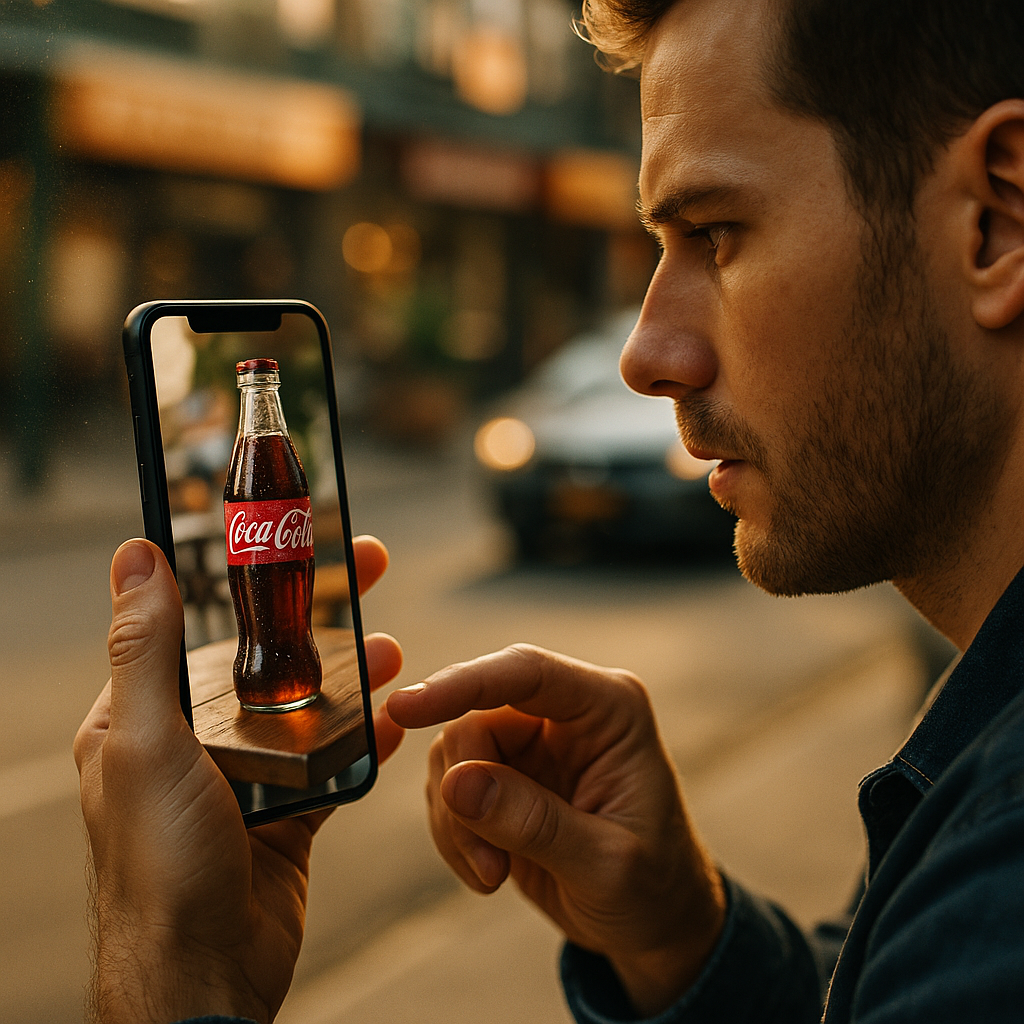
The science of visual anchoring in 3D immersive advertisements explains why some spatial ads feel instantly “placed” in your world while others float, distract, or get ignored. In 2025, brands compete for attention across AR, VR, and mixed reality, where perception rules performance. When you understand how anchors work, you design experiences people trust, remember, and act on—so what actually makes an ad feel real?
Visual anchoring principles: how the brain “locks” to space
Visual anchoring is the perceptual process that makes a virtual object appear stable in a real or simulated environment. In 3D immersive advertising, anchoring is the difference between a product that feels like it belongs on your coffee table and a rendering that jitters, slides, or seems pasted onto the scene.
Anchoring works because the brain constantly predicts what it should see based on sensory inputs and prior experience. Immersive systems succeed when they provide consistent cues that match those predictions. When they fail, the viewer notices “visual drift” or “uncanny placement,” which reduces trust and increases cognitive load.
Key cues the brain uses to judge whether something is truly “there”:
- Depth cues: stereopsis, perspective convergence, relative size, and motion parallax help locate objects in 3D.
- Occlusion: if a virtual object correctly hides behind real geometry (and vice versa), it feels physically present.
- Shadows and contact: contact shadows and subtle ambient occlusion signal weight and a surface connection.
- Temporal stability: consistent position over time, with low latency and minimal jitter, is essential for “locked” placement.
- Scene consistency: lighting direction, color temperature, and material response should match the environment.
For advertisers, the implication is direct: the creative concept can be strong, but if anchoring cues conflict, attention shifts from the message to the artifact. Strong anchoring protects comprehension and gives the brand a credibility advantage.
Spatial cognition in AR/VR ads: attention, memory, and trust
Immersive ads don’t just add depth; they change how users allocate attention and encode memory. Spatial cognition research shows that humans remember information better when it is tied to a location and integrated into a coherent scene. In practice, this means anchored elements can become “memory handles” that improve recall—if they do not overload the user.
How anchoring affects key advertising outcomes:
- Attention: stable, well-placed objects attract attention without forcing the viewer to re-verify their position. Poor anchoring triggers repeated visual checking, which feels like friction.
- Comprehension: when the brain accepts an object as part of the scene, it processes it more fluently, leaving more capacity for the message.
- Trust: visual instability can feel like manipulation or technical incompetence. Consistency signals quality and safety—especially in commerce flows.
- Memory: placing brand elements at meaningful scene landmarks (edges, surfaces, entry points, or task locations) improves retrieval later.
Readers often ask whether “more realism” always wins. It doesn’t. Realism supports trust, but advertising still benefits from clarity. The best-performing immersive ads usually prioritize legibility and interaction reliability over photorealism that risks mismatch with the user’s environment.
Depth cues and occlusion: the backbone of 3D placement
Depth cues and occlusion are foundational because they define what the viewer believes about distance and physical relationships. If you want a product to feel like it sits on a counter, the ad must convince the eye at both global and local levels: global depth (overall scale and perspective) and local contact (where it touches surfaces).
Practical depth-cue tactics that consistently improve anchoring:
- Use correct scale: calibrate to real-world units and avoid “hero scaling” that breaks expectations unless the concept is intentionally surreal.
- Exploit motion parallax: ensure the object shifts correctly as the viewer moves. Parallax errors are noticed quickly.
- Add contact shadows: a soft shadow under the object often does more than complex reflections for believability.
- Implement occlusion reliably: depth-based occlusion with scene meshes (or plane detection where meshes aren’t available) makes the object feel embedded.
- Respect surface normals: align objects to the plane orientation. A can that leans slightly into a tabletop looks wrong instantly.
Common failure pattern: many ads render the product beautifully but skip robust occlusion because it’s “hard.” The result is a floating object that users interpret as an overlay rather than a presence. If your platform supports scene reconstruction, prioritize occlusion early in production and budget time for testing across varied environments (dark rooms, glossy surfaces, cluttered backgrounds).
Another frequent question: should you anchor to detected planes only (floors/tables) or to full meshes? Planes are faster and often adequate for simple placements. Mesh anchoring is better for complex scenes (sofas, shelves, uneven terrain) and for interactions where the object must convincingly pass behind real geometry.
Eye tracking and saliency: guiding gaze without breaking presence
Eye tracking and saliency design let you steer attention while maintaining immersion. In 3D, the “banner ad” approach fails because users can look anywhere; the ad must earn attention through relevance, timing, and spatial logic. If your placement interrupts the user’s task or violates expected gaze behavior, it can feel intrusive.
How to guide gaze in immersive ad experiences:
- Place content in the comfort zone: keep primary elements near the natural forward field of view and avoid forcing extreme neck rotation for key information.
- Use contrast with restraint: brightness and color contrast should highlight the message, but not so much that it appears detached from the scene lighting.
- Animate with purpose: subtle micro-motions (slow rotations, gentle pulsing) can attract gaze; abrupt motion can cause annoyance and reduce perceived quality.
- Sequence information: reveal details after initial anchoring is established. Users accept text and UI overlays more readily once the object feels stable.
- Respect saccades: viewers make rapid eye movements to scan. Keep critical copy short, and design for quick reacquisition of the focal point.
EEAT note for marketers: if you use eye tracking, explain it in plain language and offer clear controls. In 2025, users expect transparency about data collection. Build trust by default: minimize what you collect, document why you collect it, and make opt-out straightforward without degrading the experience.
Saliency also interacts with memory: a single, well-anchored “hero” object usually outperforms multiple competing objects. If you must include several items (for example, a product family), anchor them to a shared surface and use hierarchy—one focal product, secondary products in peripheral positions, and minimal text until the user chooses to explore.
Presence and realism: latency, lighting, and haptics that sell
Presence is the feeling of “being there.” For 3D immersive advertisements, presence is not a vanity metric; it directly influences persuasion because it affects how credible and actionable the experience feels. Presence depends on perceptual coherence: the ad must behave like a thing in the world.
Three technical factors that most strongly influence anchoring and presence:
- Latency and tracking stability: high motion-to-photon latency or unstable tracking creates jitter. Even small instability makes products feel intangible. Prioritize performance budgets: simplify shaders, limit heavy particle systems, and test on mid-range devices.
- Lighting consistency: match directionality, intensity, and color temperature. If the room lighting is warm and your object is lit cold, it will “pop” in the wrong way. Use environment probes when possible, and provide graceful fallbacks.
- Material plausibility: glossy materials reveal errors through incorrect reflections. If you cannot match reflections reliably, choose materials or finishes that are forgiving while staying brand-accurate.
Haptics and audio can reinforce anchoring even when visuals are limited. A subtle spatial sound aligned to the object, or a gentle haptic response when the user “taps” it, strengthens the brain’s belief that the object is interactive and located in space. Keep these cues consistent: mismatched audio direction or delayed haptics can harm presence as much as visual jitter.
Brand safety and user comfort: strong presence must not cause discomfort. Avoid rapid camera motion, forced locomotion, or aggressive depth effects. If an ad causes eye strain or motion sickness, the negative association sticks to the brand.
Measurement and ethics: proving impact while protecting users
Immersive ads are measurable, but metrics must reflect what anchoring is supposed to achieve: stable attention, comprehension, and confident action. Standard 2D metrics (like clicks) only tell part of the story. In 3D, you also care about how long the user inspected the product, whether they approached it, and whether they interacted intentionally.
Measurement approaches that map to visual anchoring quality:
- Stability scores: quantify jitter, drift, and re-localization frequency across sessions and environments.
- View and dwell metrics: track whether users looked at the object long enough to process the message (and whether gaze was interrupted by instability).
- Interaction quality: measure successful grabs, rotations, or taps without misfires. Mis-taps often indicate poor alignment or unclear affordances.
- Task completion: for commerce, track add-to-cart, configuration completion, or store-locator actions after interaction—not just “time in experience.”
- Qualitative validation: short post-experience questions can reveal whether users felt the object was “really there” and whether it increased confidence.
Ethics and EEAT in 2025: immersive formats can feel persuasive because they feel real. Use that power responsibly. Clearly label advertising, avoid deceptive scale tricks in commerce contexts, and keep claims verifiable. If the ad visualizes performance (for example, “stain resistance”), include a brief explanation of what is simulated versus what is demonstrated. This protects users and reduces regulatory risk.
Finally, plan for accessibility. Provide readable text sizing, high-contrast UI options, captions for audio, and interaction alternatives for users who cannot perform fine hand gestures. Accessibility improvements often improve conversion because they reduce friction for everyone.
FAQs: Visual anchoring in 3D immersive advertisements
What is visual anchoring in immersive advertising?
Visual anchoring is the set of perceptual and technical cues that make a virtual ad object appear stable and physically located in a real or virtual environment. It relies on depth cues, occlusion, lighting consistency, and low-latency tracking.
How do I know if my 3D ad is well anchored?
Users should perceive the object as stable when they move, with minimal jitter or drift. The object should align with surfaces, show believable contact shadows, occlude correctly, and remain readable without forcing repeated visual “double-checking.”
Do I need photorealism for strong anchoring?
No. You need perceptual coherence. A stylized object with correct scale, shadows, occlusion, and stable tracking often feels more “real” than a photoreal asset that mismatches lighting or jitters.
What causes floating or sliding products in AR ads?
Common causes include weak tracking, insufficient feature points in the environment (blank walls, low light), missing occlusion, incorrect plane alignment, and latency spikes from heavy rendering. Optimizing performance and improving scene understanding typically fixes it.
Which matters more: occlusion or shadows?
Both matter, but occlusion usually has the bigger impact when objects interact with real geometry. Shadows are often the fastest win for “weight” and surface contact. In many campaigns, adding contact shadows first and then implementing robust occlusion provides the best return.
Is eye tracking necessary for effective immersive ads?
No, but it can improve iteration speed and personalization when used transparently. Many successful experiences rely on strong spatial design, interaction metrics, and qualitative feedback without collecting gaze data.
How can immersive ads stay privacy-safe in 2025?
Collect only the data you need, explain it clearly, avoid capturing raw scene imagery unless essential, anonymize or aggregate metrics, and offer opt-out controls. Prioritize on-device processing where possible.
Visual anchoring is the hidden mechanism that makes 3D immersive ads feel believable, comfortable, and persuasive. When depth cues, occlusion, lighting, and low-latency tracking work together, users stop noticing the tech and start engaging with the message. In 2025, the best strategy is simple: design for stability first, then add interactivity and polish—because presence drives trust and trust drives action.