


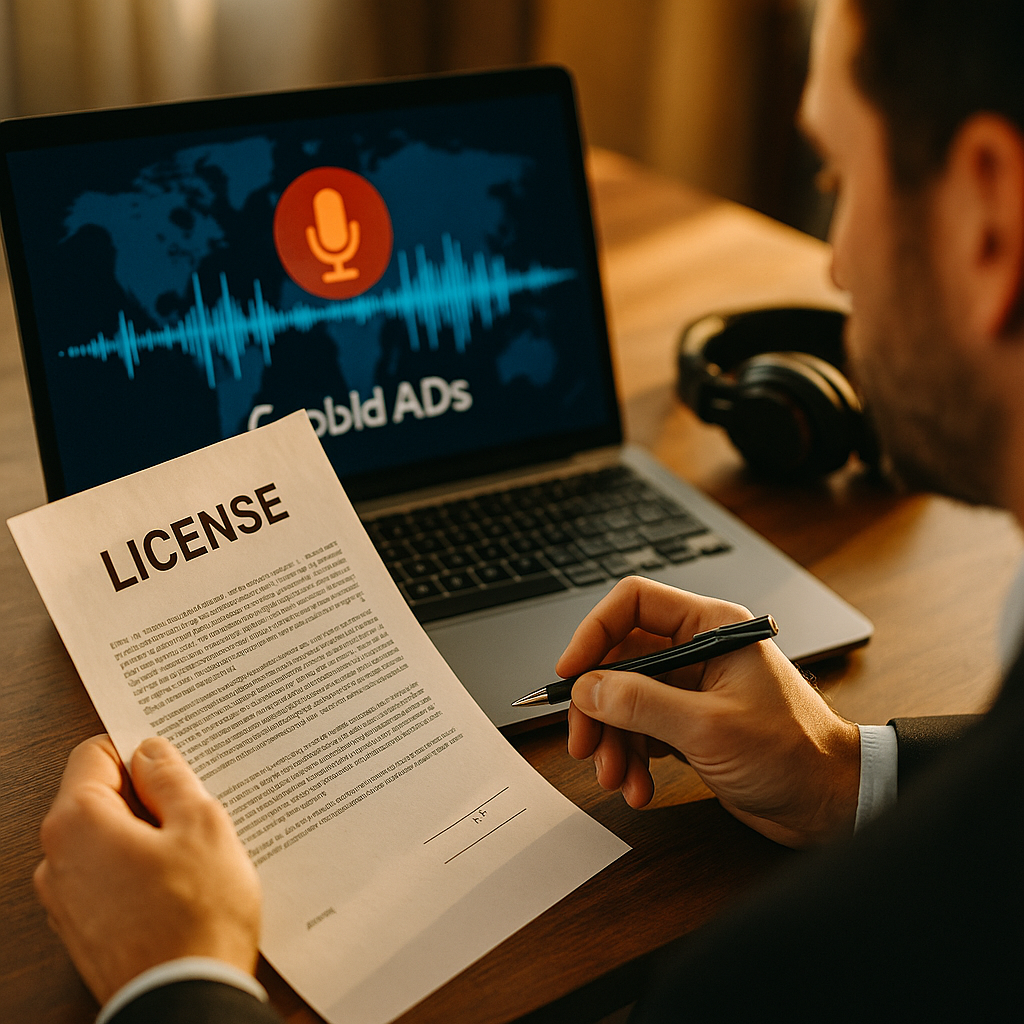
In 2025, brands need scalable, compliant voiceovers that travel across markets without slowing production. This review of synthetic voice licensing platforms for global ads compares how leading providers handle usage rights, talent consent, language coverage, and brand safety. You will learn what to check before you license, which features matter most, and how to avoid costly missteps—because the fine print can make or break a campaign.
Global advertising compliance
Global ad teams adopt synthetic voice for speed, versioning, and localization. The risk is that voice is identity-adjacent: consumers can interpret it as a real person, and regulators may treat it as sensitive. A platform is only “good” for global ads if it supports compliant use across territories, channels, and timelines.
When evaluating licensing for global advertising compliance, focus on four non-negotiables:
- Clear usage rights: Does the license explicitly cover paid ads, including social, CTV, radio, in-app, and programmatic placements? “Commercial use” language is not enough if it excludes paid promotion or certain platforms.
- Talent consent and provenance: Platforms should state how voices are created, whether voice actors opted in for commercial usage, and how ongoing consent is managed. Look for explicit documentation rather than marketing claims.
- Geography and language scope: Global ads often require many localized versions. Licensing terms should not restrict specific regions or languages unless clearly noted, and you should understand whether certain markets require additional disclosures.
- Misuse controls: Strong providers include safeguards against impersonation, political content restrictions (where applicable), and abuse reporting. These controls reduce brand risk when teams scale output.
Also plan for procurement and legal review. The best platforms provide a readable license summary plus a full contract, and they make it easy to export proof of rights for agencies, publishers, and internal audit.
AI voiceover licensing models
Most platforms fall into a few licensing patterns. Knowing them helps you compare offers that look similar on pricing pages.
- Per-character or per-minute + commercial add-on: Common among self-serve TTS products. You pay for generation volume, and commercial rights may be included only on higher tiers. Confirm whether “commercial” includes paid advertising.
- Seat-based subscriptions: Designed for teams. Useful if many stakeholders need access, approvals, and version control. Check if seats include unlimited exports and whether there are fair-use constraints.
- Campaign or usage-based licensing: More common for enterprise voice licensing. You may pay based on media spend, regions, or term length. This can align cost with business value but requires tight contract definitions.
- Custom voice licensing: A brand voice model trained from a contracted voice actor or internal talent. The contract should address exclusivity, model ownership, re-record obligations, revocation terms, and what happens if the relationship ends.
For global ads, prioritize licenses that answer these follow-ups clearly:
- Term: Is it perpetual, annual, or tied to a campaign window? If time-limited, what is the renewal cost and process?
- Channels: Are broadcast, paid social, and out-of-home explicitly included? Some licenses quietly exclude broadcast or require separate clearance.
- Derivatives: Can you edit, remix, and combine the voice with music and sound design? Can you re-cut for different aspect ratios and ad lengths?
- Sub-licensing: Can your agency and regional partners use the files? If not, you will run into operational friction.
Enterprise voice licensing
Enterprise platforms stand out less on “naturalness” and more on governance, contract clarity, and risk controls. For global campaigns, enterprise readiness usually means:
- Audit trails for who generated what, when, and from which script version.
- Role-based access control to prevent accidental use of restricted voices or markets.
- Centralized brand voice governance so teams use approved pronunciations and style guides.
- Vendor security documentation such as data handling policies and enterprise support SLAs.
In procurement terms, the strongest offerings provide:
- Explicit advertising rights language and straightforward addenda for global territories.
- Indemnity and limitation of liability terms that match enterprise expectations (or at least a clear path to negotiate them).
- Model provenance statements explaining training sources, consent, and restrictions.
Practical advice: if your campaigns include recognizable celebrity-like voices, or you operate in regulated categories, treat synthetic voice selection like you treat music licensing—centralize approvals and keep proof of rights attached to every asset.
Multilingual text-to-speech platforms
For global ads, language coverage is only the start. Multilingual performance depends on accent control, phoneme-level pronunciation tools, code-switching, and consistency across markets. The best multilingual text-to-speech platforms combine strong generation with licensing terms that allow you to deploy at scale.
Here is a practical, licensing-focused review of major platform types and what they tend to do well for global advertising.
1) Enterprise-grade voice model platforms (strong governance + custom voice options)
- Best for: Global brands that need a consistent brand voice across many markets and long-term usage.
- Typical strengths: Custom voice programs with documented consent, team workflows, and support for approvals. More negotiable enterprise contracts.
- Typical watch-outs: Higher cost and longer onboarding. Some voices may be restricted by region or content category.
What to ask: Can you license a brand-exclusive voice for paid ads globally? What happens if you need to pause usage in one market? How quickly can you generate new localized variants with the same voice identity?
2) Self-serve TTS platforms (speed + breadth, licensing varies)
- Best for: Rapid iteration, A/B testing, performance marketing teams, and agencies producing many versions.
- Typical strengths: Fast generation, simple APIs, broad language lists, and competitive pricing.
- Typical watch-outs: Licensing language can be vague for ads, and some subscriptions limit redistribution or paid promotions. Consent and provenance details may be less visible.
What to ask: Does your plan include paid advertising rights on social platforms? Are you allowed to share generated audio with broadcasters, publishers, and DSPs? Can your agency export on your behalf?
3) Localization-first dubbing suites (workflow + translation integration)
- Best for: Brands running multi-language video campaigns that require dubbing, timing alignment, and collaboration with localization teams.
- Typical strengths: End-to-end workflows: translation, timing, voice selection, and version management. Often includes tools for lip-sync or timing constraints.
- Typical watch-outs: Voice licensing terms may differ by language pack or by distribution type. Some tools focus on post-production more than ad rights clarity.
What to ask: Is the synthetic voice licensed for advertising globally, or only for “localization projects”? Do you provide rights documentation per language deliverable?
4) Marketplaces for licensed voices (choice + consent-forward licensing)
- Best for: Teams that want a wide selection and transparent talent participation models, including revenue share or opt-in commercial usage.
- Typical strengths: Voice actor participation is often clearer, and rights may be packaged per voice with specific usage terms.
- Typical watch-outs: Inconsistent terms across voices can create operational complexity. Some voices may be unavailable for certain categories.
What to ask: Are ad rights consistent across the voices you plan to use? Can you lock a voice for continuity, so it does not change or disappear mid-campaign?
Across all categories, multilingual success in ads depends on local QA. Even the best models can mispronounce brand names or culturally sensitive terms. Ensure the platform lets you adjust pronunciations and store them in a shared glossary.
Brand safety and voice rights
Synthetic voice introduces brand safety issues that are different from stock footage or music. A platform’s policies should reduce the chance of reputational harm, while still letting you move quickly.
Evaluate brand safety and voice rights with these checks:
- Impersonation and restricted content controls: Providers should prohibit cloning real individuals without authorization and have enforcement mechanisms. For ads, this reduces the risk of a campaign being associated with misuse elsewhere.
- Voice stability: Some providers update models frequently. Ask whether the voice can change in tone or pronunciation over time and whether you can “freeze” a voice version for campaign consistency.
- Disclosure guidance: Some markets and platforms may require disclosure when audio is AI-generated. Strong vendors provide practical guidance, but your legal team should decide policy.
- Data retention and script privacy: Ad scripts can include embargoed product details. Confirm whether prompts and generated audio are retained, used for training, or shared with third parties.
Answer a key operational follow-up early: Who owns the output? Many platforms grant you broad rights to use generated audio, but they may retain platform IP. That is normal; what matters is that your license clearly permits advertising use, edits, distribution, and partner sharing for the term you need.
How to choose a platform for global campaigns
Selection becomes simpler when you score platforms against the same global ad requirements. Use this short checklist to drive demos and contract reviews.
Step 1: Define your ad usage profile
- Markets and languages needed now and in the next 12 months
- Channels: paid social, CTV, broadcast, audio streaming, in-store, OOH, digital
- Term: campaign window vs always-on
- Whether you need one consistent brand voice across all markets
Step 2: Confirm licensing in writing
- Advertising rights explicitly include paid placements and your target channels
- Territories are global or match your media plan
- Agency and vendor sharing is permitted
- Indemnity, takedown processes, and dispute handling are clear
Step 3: Validate voice quality with localization QA
- Run a pilot in 3–5 representative languages, including one non-Latin script if relevant
- Test brand name pronunciation, legal disclaimers, and fast-read performance copy
- Check consistency between 6-second, 15-second, and 30-second edits
Step 4: Ensure governance and repeatability
- Approved-voice libraries, pronunciation dictionaries, and version control
- Access controls and approval workflows
- Exportable documentation proving rights for each asset
If two platforms sound similar, choose the one that makes licensing easiest to explain to a media partner. In global ads, speed comes from clarity.
FAQs about synthetic voice licensing for global ads
-
Do synthetic voice licenses usually allow paid advertising?
Some do, some do not. Many plans say “commercial use” but exclude paid promotions or specific channels. Always confirm that paid advertising is explicitly included for your channels (social, CTV, broadcast, DSP audio) and territories.
-
Can my agency generate and export voiceovers on our behalf?
Only if the license allows sub-licensing or partner use. If not, the safest approach is to provision agency seats under your account or sign an enterprise agreement that names agencies and production vendors as authorized users.
-
What is the difference between a stock synthetic voice and a custom brand voice?
A stock voice is a prebuilt model available to all customers under the platform’s license. A custom brand voice is trained for your organization from a contracted talent source (or approved recordings) and typically includes additional terms for exclusivity, governance, and long-term usage.
-
What documentation should we keep for compliance?
Keep the contract, plan details, proof of subscription tier at the time of export, voice ID/name, export date, and a record of the script used. For enterprise deals, ask the vendor for a rights letter or a downloadable certificate of usage rights per asset batch.
-
Are we required to disclose that an ad uses AI voice?
Requirements vary by market, platform policies, and category. Treat disclosure as a legal and policy decision. Choose a vendor that provides guidance and tooling, but rely on your legal team for final rules and localization-specific phrasing.
-
What happens if a vendor removes a voice or changes a model?
Ask whether you can lock a voice version for continuity and whether your existing exported audio remains licensed. Strong contracts clarify that previously created assets stay usable for the licensed term, even if a voice is later discontinued.
Global ads move faster when synthetic voice is licensed as carefully as music or footage. Choose platforms that document talent consent, spell out paid advertising rights, and support multilingual QA and governance at scale. In 2025, the winning workflow combines fast generation with contracts you can audit, share with partners, and trust across markets—so you can launch confidently without last-minute legal surprises.