


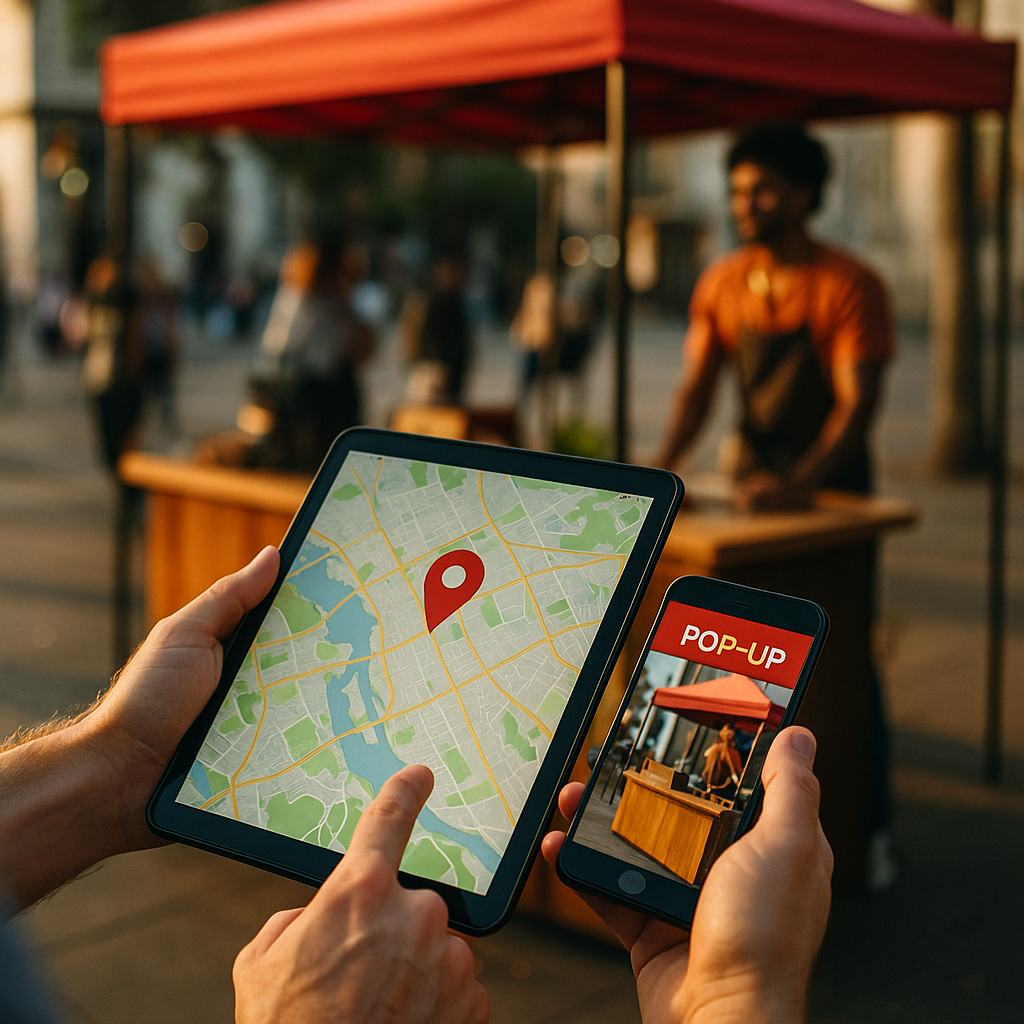
In 2025, pop-ups win when they show up in the right place and moment. Location-based marketing lets you target nearby audiences, tailor messages to local intent, and measure real-world foot traffic without guesswork. This guide breaks down the tactics, tools, and compliance steps that turn geodata into sold-out time slots and higher basket sizes—ready to outsmart your next venue?
Location targeting strategy for pop-up events
Pop-up success starts with a clear, measurable location targeting strategy—not a vague “we’ll boost a post near the venue.” Before you pick tactics, define the job your pop-up must do: launch a new product, collect leads, clear seasonal inventory, or build community. Each goal changes who you target and how close to the venue you should concentrate spend.
Start with three practical location layers:
- Core radius (0–0.5 miles / 0–800m): High intent, high urgency. Use for “open now,” limited drops, timed demos, and walk-in incentives.
- Consideration ring (0.5–3 miles / 800m–5km): People who can plan a visit today or this weekend. Use for appointment booking, RSVP prompts, and “how to get here” messages.
- Expansion zone (3–15 miles / 5–25km): Best for weekend events, unique experiences, or brands with strong pull. Use for storytelling creatives and value-led offers.
Translate goals into KPIs you can actually track: footfall lift vs. baseline, visit rate from exposed audiences, cost per store visit, RSVP-to-attendance rate, redemption rate of a location-only offer, and email/SMS capture per 100 visitors. If you’re staffing with brand ambassadors, add “demos per hour” and “conversion per demo” to align marketing with on-site operations.
Answer the questions customers will ask before they ask them: parking and public transport, accessibility, peak times, queue expectations, payment methods, and whether items are limited. Put those answers into your ads, local landing page, and map listings. Fewer uncertainties mean more visits.
Geo-fencing and proximity marketing tactics
Geo-fencing works best when you treat it like a sequenced conversation rather than a single blast. A geo-fence is a virtual perimeter (around a venue, neighborhood, or competitor location) that triggers ad eligibility or messaging when devices enter. Proximity marketing covers tactics that react to closeness—often in real time—without crossing into intrusive behavior.
High-performing geo-fencing plays for pop-ups:
- Venue fence + time gating: Run “now open” messages only during operating hours and 60–90 minutes before close to avoid wasted impressions.
- Event adjacency fence: Surround arenas, markets, or conferences that share your audience. Creative should connect to that context (e.g., “Show your ticket for a bonus”).
- Competitor conquesting (use with care): Fence competitor retailers and offer a differentiated promise (limited edition, faster service, personalization). Keep messaging factual and brand-safe.
- Transit corridor fence: Target stations and commuting paths with “stop by on your way” offers and a one-tap directions button.
Make it feel helpful, not creepy: avoid messaging that implies you know exactly where someone is (“We saw you at…”). Use neutral phrasing like “Nearby today?” and focus on utility: directions, hours, wait time updates, or a quick incentive.
Set frequency and creative rotation: Pop-up campaigns often burn out fast. Cap frequency to prevent annoyance (for example, 2–3 impressions per user per day in the core radius) and rotate creatives by daypart: morning discovery, lunch break convenience, evening urgency.
Link online to offline without overpromising: Use trackable QR codes and short URLs on-site, plus unique “this location only” offer codes. That lets you measure lift while keeping the customer experience simple.
Local SEO for pop-up shops and temporary locations
Local SEO is the fastest way to capture high-intent searches like “pop-up near me,” “brand + city,” and “open now.” Temporary doesn’t mean unsearchable—if anything, urgency makes local discovery more valuable. The key is setting up accurate, consistent information that search engines and map apps can trust.
Build a pop-up local presence that matches how people search:
- Create a dedicated location landing page: include address, dates, hours, parking, accessibility notes, what’s exclusive, and a prominent directions link. Add FAQs like “Is this the only location?” and “Do I need an appointment?”
- Optimize your map listing: if you can claim a listing for the pop-up, ensure the category matches intent (e.g., “Clothing store,” “Cosmetics store,” “Event venue” as appropriate). If you can’t, optimize your main brand listing with an “Event” update and link to the pop-up page.
- Use on-page location signals: neighborhood names, nearby landmarks, and transit stops (naturally written) help match local queries.
- Keep NAP consistency: name, address, phone (or contact method) should match everywhere: website, ticketing platform, partners, and social profiles.
Publish “helpful updates” that earn trust: post a short weekly update with what’s new, expected busy times, and whether popular items are still available. This supports EEAT because it demonstrates real operational knowledge, not generic hype.
Turn reviews into a pop-up asset: Encourage visitors to leave reviews specifically about the pop-up experience (service speed, quality, vibe). Reply with specifics: what you improved and what to expect next. Reviews act as social proof and influence map rankings.
Mobile ad campaigns with hyperlocal personalization
Hyperlocal personalization means adjusting creative and offers based on where someone is, how far they are from the pop-up, and what they’re likely doing right now. Mobile is the natural channel because it connects discovery, navigation, and purchase in one device.
Personalize with variables that matter:
- Distance-based messaging: “5 minutes away” or “Around the corner” can outperform generic copy—only use it when your location data and map routing are reliable.
- Daypart offers: morning coffee collab, lunchtime quick pickup, evening gift-ready bundles. Keep terms simple.
- Weather and context triggers: promote umbrellas, warm drinks, or indoor experiences when conditions make them relevant.
- Local culture fit: adapt imagery and language to the neighborhood without stereotyping. Feature recognizable landmarks and real staff when possible.
Design for fast decisions: Pop-up ads should answer four questions immediately: where, when, why now, and how to get there. Use a single primary action: directions, RSVP, or “claim offer.” If you use RSVP, confirm with an SMS or email that includes a map link and calendar add.
Bring on-site and online into one funnel: Use a scannable on-site sign offering a small value exchange (exclusive drop access, raffle entry, or a personalized recommendation) in return for SMS/email opt-in. Then use geo-based follow-ups: a reminder when they’re near again, a thank-you message after a visit, and a “last chance” note on the final day.
Reduce friction with a pop-up-ready landing page: lightweight, mobile-first, and built to load quickly on cellular. Include: hours, directions, parking, accessibility, expected wait time, payment methods, and what’s unique today. If you sell tickets, show remaining slots in real time when possible.
Foot traffic analytics and offline conversion measurement
You can’t optimize what you can’t measure. For pop-ups, measurement should connect three realities: ad exposure, actual visits, and on-site outcomes (sales, leads, demos). Modern foot traffic analytics can estimate visit lift by comparing exposed vs. control audiences, but you still need operational data to understand quality.
Use a measurement stack that balances rigor and practicality:
- Platform store-visit reporting: useful directional signal when available, especially for short campaigns.
- UTM-tagged links + map clicks: measure intent actions like “Get directions” and “Call.”
- QR codes tied to zones: place different QR codes at entrance, checkout, and demo stations to map visitor flow.
- Offer code redemption: a “pop-up only” code reveals true conversion without complex tooling.
- POS and lead capture data: track average order value, top SKUs, and opt-in rate by daypart.
Answer the likely follow-up: “What if we don’t have baseline foot traffic?” Create a baseline using a short pre-launch period with no paid media (if time allows) or compare against nearby similar locations/days. At minimum, record hourly counts for a few days and note external factors (weather, local events, staffing changes). This context prevents false conclusions.
Optimize with a weekly (or daily) learning loop: shift budget toward radius segments that deliver higher visit rate, adjust creative based on daypart performance, and coordinate staffing with expected demand. If your ads succeed but checkout lines slow down, conversion drops—your marketing and operations must move together.
Privacy compliance and trust in location data
Location campaigns can drive strong results, but only when they respect privacy and user choice. In 2025, consumers expect transparency, and regulators expect documented compliance. Strong privacy practices also improve performance because they protect brand trust and reduce opt-outs.
Keep your program compliant and credible:
- Use consent-based location signals: rely on platforms and partners that collect and process location data with appropriate permissions.
- Minimize data collection: collect only what you need to run the campaign and measure outcomes. Avoid storing precise location histories unless absolutely necessary.
- Disclose clearly: if you use SMS/email capture on-site, state what messages you’ll send and how often, and make opt-out simple.
- Separate personalization from surveillance: don’t imply you know sensitive places someone visited. Keep targeting categories broad and respectful.
- Document your approach: maintain a simple record of vendors, data sources, retention periods, and user rights handling.
Build EEAT into every touchpoint: show real business details (address, dates, staff presence), publish accurate policies, and provide reliable customer support. If a customer asks, “How did you know I was nearby?” your answer should be straightforward: you used general location-based ad targeting within the app they’re using, not personal tracking.
FAQs about location-based marketing for pop-up events
-
What is the best radius for a pop-up event campaign?
Start with a core radius of 0–0.5 miles for immediate foot traffic, then add a 0.5–3 mile ring for planned visits. Use a wider 3–15 mile zone only if the experience is destination-worthy or you’re running weekend-only activations.
-
How soon should I start promoting a pop-up using location targeting?
Begin 2–4 weeks out to build awareness and capture RSVPs, then shift budget toward proximity and “open now” messaging during the final 7–10 days. For one-day pop-ups, compress the plan: awareness early in the week, proximity pushes 24–48 hours before.
-
Do geo-fenced ads guarantee foot traffic measurement accuracy?
No. Foot traffic reporting is typically modeled and may have eligibility thresholds. Treat it as directional and validate with on-site signals like QR scans, offer redemptions, and POS trends by daypart.
-
Can small brands run effective location-based campaigns on a limited budget?
Yes. Concentrate spend in the smallest viable radius, limit ad formats to one or two, and use a single compelling offer. Pair paid media with strong local SEO and partner cross-promotion to multiply reach without multiplying cost.
-
What content should be on a pop-up landing page to improve conversions?
Include dates, hours, address, directions link, parking/transit guidance, accessibility details, what’s exclusive, expected wait times, and one primary action (RSVP, directions, or claim offer). Keep it mobile-first and fast-loading.
-
How do I stay privacy-compliant with location-based marketing?
Use consent-based platforms, avoid collecting unnecessary precise data, provide clear notices for opt-ins, and keep messaging general rather than personally revealing. Maintain documentation of vendors and retention practices to support audits and customer questions.
Pop-ups thrive when you match message, moment, and proximity. Use location layers to focus spend, geo-fencing to create timely nudges, local SEO to capture high-intent searches, and hyperlocal mobile creatives that remove friction. Measure visits with multiple signals, then optimize daily with operational realities in mind. In 2025, trust and privacy complete the strategy—execute cleanly, and your next pop-up becomes predictable growth.