


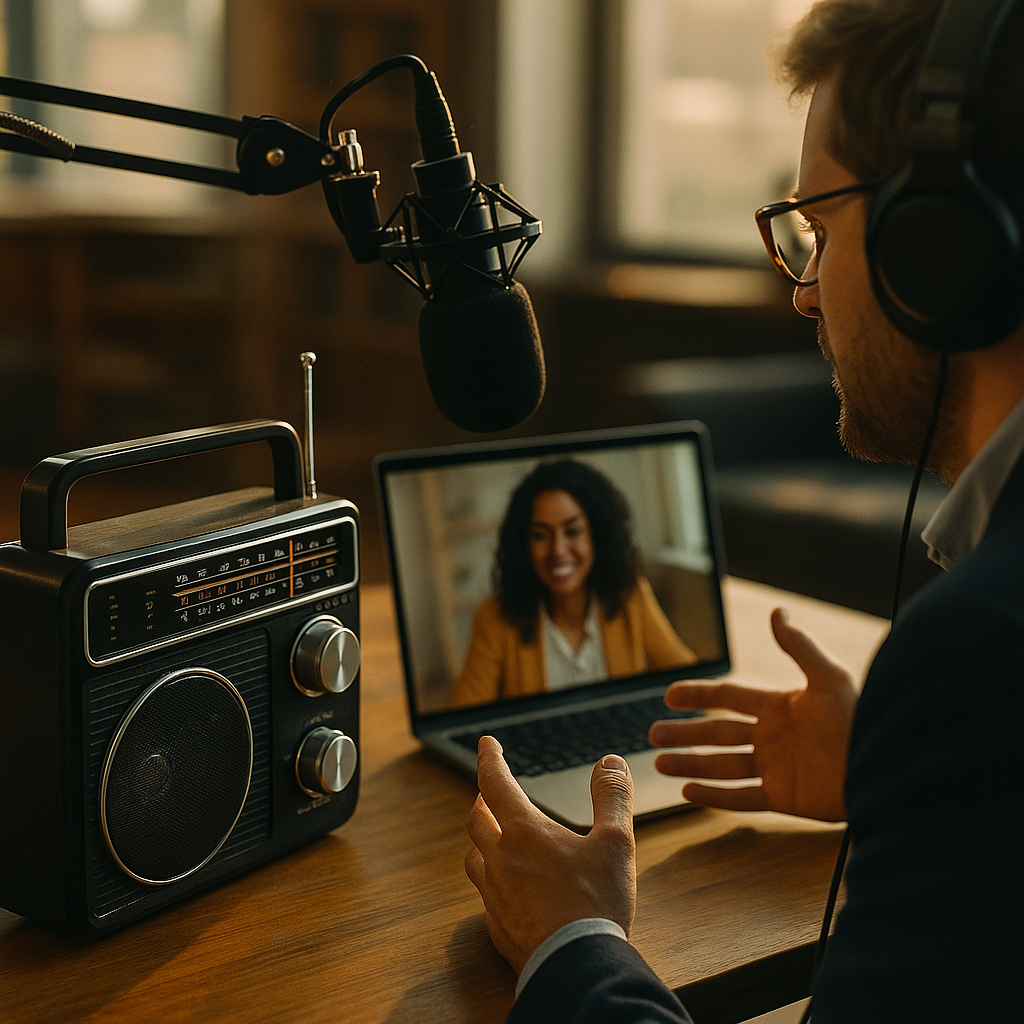
In 2025, SaaS growth teams face a noisy, expensive ad market and tougher attribution standards. This case study shows how a B2B software company used micro local radio to create measurable demand, earn trust, and take market share without relying on hyper-competitive digital auctions. The playbook blends targeted audio, disciplined testing, and airtight measurement—keep reading to see what made it work.
Market context: micro local radio advertising as a contrarian growth channel
The SaaS firm in this case study—we’ll call it ClearDesk—sells workflow automation software to service businesses (10–150 employees). By early 2025, ClearDesk’s growth team faced three constraints that will feel familiar:
- Rising digital costs: Paid search and paid social CPMs and CPCs increased while lead quality became inconsistent.
- Lower tracking reliability: Stricter privacy expectations reduced deterministic attribution and made optimization slower.
- Slower sales cycles: More stakeholders wanted proof, references, and credibility signals before booking demos.
ClearDesk tested webinars, partners, and outbound. Results were fine, but not enough to outpace two well-funded competitors. The team needed a channel that could do two things at once: build trust quickly in local markets and produce trackable pipeline.
They chose micro local radio advertising: short runs on specific local stations and shows, aligned with where their ideal customers lived and worked. It looked old-fashioned on paper, but it had three advantages:
- High attention in local contexts: Commute and “in-between” time listening creates repetition without scrolling fatigue.
- Trust transfer: Local hosts and familiar stations can lend credibility faster than unknown online ads.
- Clear geo focus: You can concentrate spend in a handful of ZIP codes and match it to local sales coverage.
The goal wasn’t broad awareness. It was to win specific pockets of demand—market by market—until competitors felt pressure.
Strategy design: local market penetration strategy for SaaS
ClearDesk built a plan around market selection, message-market fit, and sales readiness. They avoided the common mistake of “running radio” without a go-to-market structure behind it.
1) Picking winnable markets
They scored 28 metro areas and chose four initial “beachheads” using criteria their RevOps team could defend:
- Existing customer density: At least 20 paying customers within 45 miles (for referenceability and lookalike targeting).
- Sales capacity: An assigned AE/AM pod and a local-friendly onboarding schedule.
- Competitive pressure: Competitors were present but not dominant (measured by share of search and win/loss notes).
- Vertical fit: Strong concentration of service firms: HVAC, plumbing, landscaping, commercial cleaning, and local IT services.
2) Tight positioning for local relevance
Instead of generic “all-in-one workflow automation,” ClearDesk anchored to one outcome: fewer dropped jobs and faster invoicing. They used language that sounded like a local operator, not a software vendor:
- “Stop losing jobs between dispatch and billing.”
- “Get paid faster without adding office staff.”
- “One dashboard for scheduling, approvals, and invoices.”
3) A revenue plan that could catch demand
Radio can create demand spikes. ClearDesk ensured they could capture them by:
- Setting a 15-minute SLA for inbound calls and demo requests during business hours.
- Creating a local demo calendar (time slots reserved for each metro).
- Training reps to reference local proof: “We work with teams like yours in this area.”
This set the foundation for a test that wouldn’t collapse under its own success.
Campaign execution: geo-targeted radio ads with host-read credibility
ClearDesk didn’t buy broad-market, high-frequency placements. They bought specific shows with listener profiles that matched owners and operations managers: morning drive business news, local sports talk, and “community” segments that attract small-business audiences.
Media mix and creative
- 60% host-read spots: Short, conversational reads that sounded like advice, not a jingle.
- 30% produced 30-second ads: Clear structure: problem → outcome → proof → offer → call-to-action.
- 10% sponsorships: “Traffic/powered by” placements to reinforce frequency at low cognitive load.
Why host-read mattered
ClearDesk’s team interviewed station reps and listened to recorded segments before committing. They found that host-read spots delivered two benefits:
- Trust: Owners recognized the voice and stayed tuned in.
- Message retention: Natural phrasing improved recall of the offer and URL.
Offer and landing experience
Radio only works when response friction is low. ClearDesk used:
- A market-specific URL per metro (example structure: /city) and an easy-to-say vanity URL that redirected.
- A call tracking number per station and, when possible, per show.
- A “10-minute workflow assessment” offer for owners who weren’t ready for a full demo.
Each landing page included:
- Three outcomes (time saved, fewer errors, faster cash collection)
- Two local-ish proof points (customer logos common in-region or anonymized “service team in your metro” quotes)
- A short form (name, company, phone/email, team size) plus a direct “call now” option
Flighting and frequency
They ran 6-week flights with a consistent cadence. They avoided “one and done” bursts because SaaS buying decisions require repetition. Week 1–2 focused on awareness and the assessment offer; Week 3–6 added stronger conversion prompts (“Book a demo this week”).
Measurement framework: radio attribution for SaaS pipeline in 2025
ClearDesk treated measurement as a product requirement, not a reporting afterthought. Because radio doesn’t provide click-level data like paid social, they designed multiple corroborating signals to decide what was working.
1) Direct response tracking
- Vanity URLs → unique landing pages: Captured sessions, form fills, demo bookings, and assessment bookings by market.
- Unique phone numbers: Call tracking recorded volume, duration, and outcomes (qualified vs unqualified).
2) Incrementality checks
To avoid crediting radio for demand that would have occurred anyway, ClearDesk ran two simple incrementality tactics that a mid-sized team can execute:
- Geo holdouts: Two similar metros kept as “no-radio” controls while maintaining baseline digital spend.
- Share-of-search monitoring: They tracked branded search lift in active markets versus holdouts to see whether awareness truly moved.
3) CRM discipline and closed-loop reporting
ClearDesk enforced a process: every inbound lead had to be tagged with a self-reported source question (“How did you hear about us?”) with “radio” and station options. Reps often resist this, so leadership made it a required field before moving stages.
They built a dashboard that answered executive questions directly:
- Cost per assessment booked
- Assessment-to-demo conversion rate
- Demo-to-opportunity rate by market
- Pipeline and revenue influenced by market, station, and flight
What they learned about attribution
Radio’s biggest impact showed up as assisted demand: more branded search, more direct traffic, and higher close rates in the metros where ClearDesk sounded “everywhere.” ClearDesk avoided over-optimizing to only last-touch conversions, because it would have undervalued the channel.
Results: SaaS market share growth driven by local audio marketing
ClearDesk measured outcomes at three layers: response, pipeline, and competitive impact. While exact numbers vary by market, their internal post-mortem highlighted consistent patterns that drove expansion decisions.
Response and pipeline outcomes
- Higher intent inbound: Radio-origin leads booked more “talk-to-sales” meetings and fewer “just browsing” demos.
- Shorter time to first meeting: Calls increased, especially during morning and lunch hours, aligning with commute listening and mid-day admin time.
- Improved show rates: Prospects who mentioned a host or station were more likely to attend and less price-sensitive early on.
Market share signals
ClearDesk tracked competitive momentum using methods that avoid guesswork:
- Win/loss notes: Fewer deals cited “never heard of you” in radio metros.
- Inbound competitor comparisons: More prospects asked, “How are you different from X?”—a sign ClearDesk entered the consideration set.
- Partner pull-through: Local accounting and IT partners were more willing to co-market once ClearDesk had visible local presence.
The unexpected upside: sales enablement
Radio gave reps a warm opener that didn’t feel scripted: “You may have heard us on [station].” That line reduced friction and created immediate context. In a mid-market SaaS motion, that context can be the difference between a polite brush-off and a booked discovery call.
What did not work
- Overly clever creative: Jokes and character skits reduced clarity. ClearDesk returned to plain language and outcomes.
- Sending radio traffic to the generic homepage: Conversion rates improved after they built market pages with one offer and one primary CTA.
- Buying “big reach” without fit: Stations with broad audiences delivered volume but weaker qualification.
After the initial flights, ClearDesk expanded to six more metros, keeping the same measurement rules and only scaling what proved incremental.
Playbook: local audio marketing tactics you can replicate
If you want to use micro local radio to win share, ClearDesk’s playbook boils down to repeatable execution, not magic.
1) Start with one vertical, one outcome, one offer
Pick a narrow wedge (e.g., service businesses) and a tangible outcome (e.g., faster invoicing). Offer a low-friction next step (assessment) alongside the demo.
2) Use “proof you can say out loud”
- Short customer quote with a measurable benefit
- Number of local teams served (if true and defensible)
- Specific process improvement (“from paper work orders to same-day invoicing”)
3) Build attribution before you buy media
- Unique URL and call tracking per market
- Required CRM source capture
- Holdout markets to test incrementality
4) Coordinate with sales and customer success
Plan for follow-up capacity and local references. If radio works, demand rises quickly and punishes slow response.
5) Optimize like a performance channel, not a branding exercise
Keep creative simple, run weekly checks, rotate offers cautiously, and kill underperforming placements. ClearDesk treated stations and shows like ad sets: each needed to earn its keep.
FAQs: micro local radio for SaaS growth
Is radio still effective for B2B SaaS in 2025?
Yes, when you use micro local radio with tight market selection, a clear offer, and closed-loop measurement. It tends to work best for SaaS products that benefit from trust, repetition, and local relevance (operations, field service, finance workflows).
How much budget do you need to test micro local radio?
You can run a meaningful test with a focused 4–6 week flight in one or two metros, as long as you can afford enough frequency for recall. The exact spend varies by market and station, but the key is concentrating budget rather than spreading it thin.
What’s better: host-read spots or produced ads?
Host-read often wins on trust and attention, especially in local markets. Produced ads help with consistency and compliance. Many teams get the best results with a mix: lead with host-read for credibility and add produced spots for message discipline.
How do you attribute revenue to radio without perfect tracking?
Use multiple signals: market-specific URLs, unique phone numbers, self-reported source in your CRM, branded search lift, and geo holdouts. You won’t get perfect certainty, but you can get strong directional confidence and improve over time.
What should the landing page include for radio traffic?
One clear promise, one primary CTA, fast load speed, a short form, and a call option. Include concise proof and remove distractions. Radio listeners respond to clarity, not complex navigation.
Which SaaS categories are the best fit for micro local radio?
Products with clear operational ROI and local buyer density: field service management, scheduling and dispatch, invoicing/payments, compliance workflows, call tracking, and IT services automation. Niche enterprise platforms with long procurement cycles can work, but require stronger account-based coordination.
ClearDesk proved that micro local radio can be a disciplined, measurable growth lever in 2025 when it’s run like performance marketing and supported by sales execution. They chose winnable metros, built credible host-read creative, and measured incrementality with holdouts, tracked URLs, and CRM rigor. The takeaway is simple: local audio wins share when you earn trust fast and capture demand faster.