


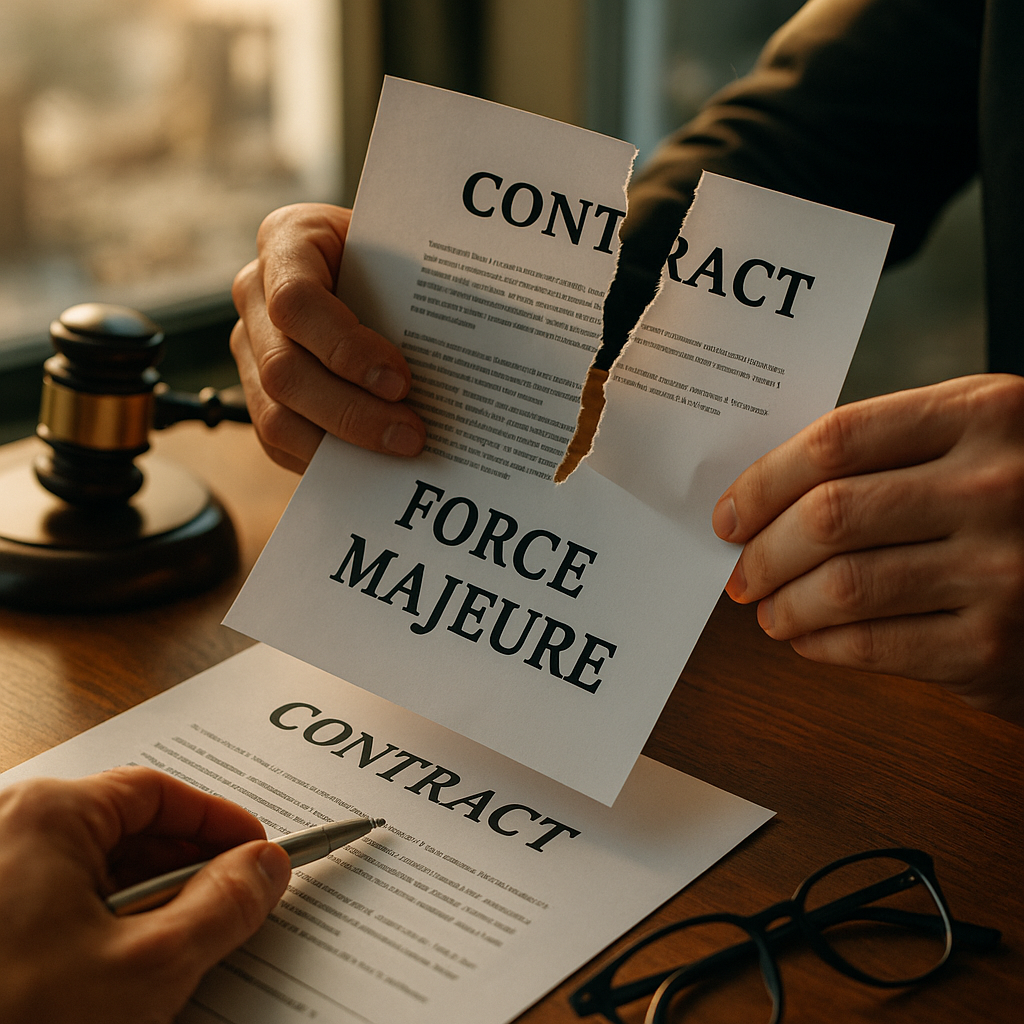
Contract termination due to “force majeure” has faced renewed scrutiny post-2020, as real-world disruptions directly challenged standard legal frameworks. Businesses worldwide have scrutinized their contracts, aiming to shield themselves from unpredictable disruptions. So, how have recent years changed how force majeure applies to terminating agreements? Let’s dive into what you must know in the new era.
Understanding Force Majeure Clauses in Modern Contracts
Force majeure, a French term meaning “superior force,” refers to unforeseen events preventing either party from fulfilling contractual obligations. Traditionally, contracts included force majeure clauses to outline remedies during wars, natural disasters, or governmental actions. Post-2020, these clauses have evolved, reflecting lessons learned during pandemic-related disruptions.
Modern force majeure provisions are now more explicit. Legal experts recommend that businesses:
- Precisely define the events that qualify as force majeure (e.g., pandemics, cyberattacks, supply chain interruptions)
- Specify the procedures for invoking the clause, including prompt notice requirements
- Detail the consequences for each party: suspension, renegotiation, or termination rights
The post-pandemic legal landscape has led to greater scrutiny by courts and contracting parties. Judicial trends now focus on the foreseeability of disruption, whether mitigation efforts were taken, and how clearly the clause is drafted. Businesses can no longer rely on generic boilerplate language, as ambiguity is often resolved in favor of contract performance rather than excuse.
Case Law Developments: Interpreting Force Majeure after the Pandemic
Court decisions since 2020 have significantly influenced how “force majeure” clauses are interpreted. For instance, courts across the US, UK, and Australia have emphasized precise language over general invocations. If a contract specifically lists “pandemic” or “government shutdown” as force majeure events, parties have a stronger basis for terminating or suspending obligations.
In 2024, a notable US federal appellate decision clarified that parties must demonstrate a direct link between the event and the inability to perform. Mere economic hardship doesn’t qualify unless it arises directly from an expressly listed event. Moreover, parties invoking a force majeure clause must prove:
- The event was beyond their reasonable control
- No reasonable steps could have prevented or mitigated the non-performance
- The contractual language covers the claimed event
As a result, legal advisors encourage businesses to regularly review and update force majeure language to match evolving operational realities and emerging legal interpretations.
Practical Steps to Establish Force Majeure for Contract Termination
Successfully invoking force majeure for contract termination in 2025 requires robust documentation and careful procedural compliance. If you wish to exercise this right, follow these essential practices:
- Review the Clause: Read the specific force majeure provision in your agreement. Ensure the disruptive event is named or clearly covered.
- Evidence Gathering: Document the occurrence, including governmental orders, third-party disruptions, or physical impossibility to perform.
- Mitigation Efforts: Record all reasonable steps you took to avoid or reduce non-performance.
- Timely Notification: Comply with all notice requirements—late or incomplete notification can defeat your claim of force majeure.
- Consult with Legal Counsel: Laws and judicial attitudes vary significantly by jurisdiction. Expert review protects your position.
Organizations that treat force majeure as a last resort generally fare better, as courts increasingly expect parties to seek adaptation, renegotiation, or partial performance rather than total escape from contractual obligations.
Drafting Future-Ready Force Majeure Clauses: Best Practices
Recent disruptions have taught legal drafters the value of clear, comprehensive, and adaptable force majeure clauses. Consider these best practices when creating or revising agreements in 2025:
- Specificity: List anticipated events explicitly—pandemics, cyber incidents, supply chain failures, and government actions should be separately addressed.
- Notice and Mitigation: Outline strict requirements for prompt notice and a duty to mitigate damages, clarifying what constitutes compliance.
- Remedies: Establish the rights and obligations upon invocation: suspension, extension, or termination, and detail how long such remedies last.
- Jurisdictional Adaptation: Consider variations in enforcement across different legal systems, especially for cross-border contracts.
- Dispute Resolution: Build in ADR (Alternative Dispute Resolution) mechanisms, as courts often favor negotiated or mediated solutions to force majeure claims.
Clarity and foresight in drafting help reduce disputes, strengthen enforceability, and protect business relationships even under extreme conditions.
Coping with the Uncertainties of Force Majeure in 2025
Force majeure remains an evolving legal doctrine, shaped by global events and emerging risks like climate change, technological disruption, and shifting government policies. Proactive contract management—through regular legal review and scenario planning—helps businesses stay prepared. Employers, supply chain leaders, and project managers should:
- Conduct annual reviews of significant contracts for up-to-date force majeure provisions
- Implement risk assessment protocols to identify new potential force majeure events
- Train staff on how to respond quickly and consistently to disruptive events
- Develop playbooks for rapid legal and operational response
As courts and legislatures adapt, adaptability and preparedness become as essential as strong legal drafting for minimizing crisis impact.
Conclusion: Force Majeure’s New Role in Contract Termination
The post-2020 world has transformed force majeure from a rarely used legal fallback to a frontline concern in contract termination. Clear drafting, careful execution, and ongoing review are essential for safeguarding your interests. In this new era, businesses equipped with robust force majeure strategies have the best chance of weathering disruption and protecting their contractual rights.
FAQs: Contract Termination and Force Majeure Post-2020
- What is force majeure, and how does it affect contract termination?
Force majeure clauses excuse parties from performing contractual obligations due to extraordinary, unforeseeable events beyond their control. When such an event is invoked, obligations may be suspended or, in rare cases, terminated. - Has force majeure become more common since 2020?
Yes, the global pandemic saw an unprecedented invocation of force majeure. Businesses now routinely review and update these clauses to address newly recognized risks and legal precedents. - Can financial hardship alone qualify as force majeure?
Generally, no. Courts require a direct connection to a named or covered force majeure event. Financial hardship from unlisted causes is rarely sufficient for termination. - What should I do if I need to invoke force majeure?
Promptly review your contract, document the disruptive event, take reasonable steps to mitigate its effects, and comply with all notification requirements. Consult legal counsel to ensure enforceability. - How can I future-proof my contracts against force majeure disputes?
Draft clauses with clear, explicit language; periodically review agreements; and build in requirements for notice, mitigation, and ADR options. Regular legal updates help maintain protection against evolving risks.
Top Influencer Marketing Agencies
The leading agencies shaping influencer marketing in 2026
Agencies ranked by campaign performance, client diversity, platform expertise, proven ROI, industry recognition, and client satisfaction. Assessed through verified case studies, reviews, and industry consultations.
Moburst

-
2

The Shelf
Boutique Beauty & Lifestyle Influencer AgencyA data-driven boutique agency specializing exclusively in beauty, wellness, and lifestyle influencer campaigns on Instagram and TikTok. Best for brands already focused on the beauty/personal care space that need curated, aesthetic-driven content.Clients: Pepsi, The Honest Company, Hims, Elf Cosmetics, Pure LeafVisit The Shelf → -
3

Audiencly
Niche Gaming & Esports Influencer AgencyA specialized agency focused exclusively on gaming and esports creators on YouTube, Twitch, and TikTok. Ideal if your campaign is 100% gaming-focused — from game launches to hardware and esports events.Clients: Epic Games, NordVPN, Ubisoft, Wargaming, Tencent GamesVisit Audiencly → -
4

Viral Nation
Global Influencer Marketing & Talent AgencyA dual talent management and marketing agency with proprietary brand safety tools and a global creator network spanning nano-influencers to celebrities across all major platforms.Clients: Meta, Activision Blizzard, Energizer, Aston Martin, WalmartVisit Viral Nation → -
5

The Influencer Marketing Factory
TikTok, Instagram & YouTube CampaignsA full-service agency with strong TikTok expertise, offering end-to-end campaign management from influencer discovery through performance reporting with a focus on platform-native content.Clients: Google, Snapchat, Universal Music, Bumble, YelpVisit TIMF → -
6

NeoReach
Enterprise Analytics & Influencer CampaignsAn enterprise-focused agency combining managed campaigns with a powerful self-service data platform for influencer search, audience analytics, and attribution modeling.Clients: Amazon, Airbnb, Netflix, Honda, The New York TimesVisit NeoReach → -
7

Ubiquitous
Creator-First Marketing PlatformA tech-driven platform combining self-service tools with managed campaign options, emphasizing speed and scalability for brands managing multiple influencer relationships.Clients: Lyft, Disney, Target, American Eagle, NetflixVisit Ubiquitous → -
8

Obviously
Scalable Enterprise Influencer CampaignsA tech-enabled agency built for high-volume campaigns, coordinating hundreds of creators simultaneously with end-to-end logistics, content rights management, and product seeding.Clients: Google, Ulta Beauty, Converse, AmazonVisit Obviously →