


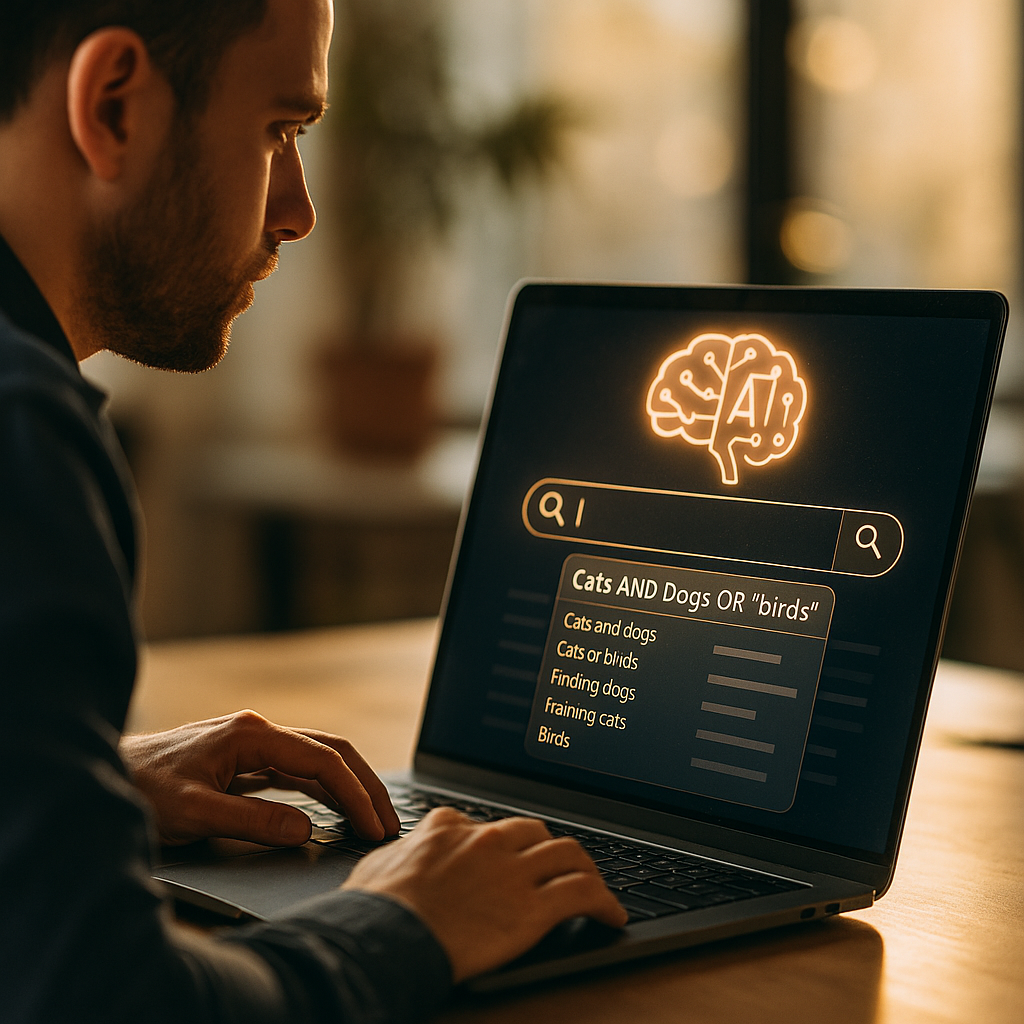
Using AI to generate Boolean search strings for discovery is rapidly transforming how professionals locate information online. Leveraging artificial intelligence streamlines complex research tasks and helps uncover precise results in record time. Are you ready to see how AI is upgrading one of the most critical tools in information discovery workflows?
How Boolean Search Strings Power Discovery Processes
Boolean search strings use logical connectors like AND, OR, and NOT to combine keywords and refine search results. In disciplines like legal research, recruitment, and academia, Boolean operators help users filter millions of documents to find the most relevant content quickly. But crafting complex Boolean queries by hand is time-consuming and error-prone, requiring deep domain knowledge.
Getting a Boolean string “just right” can be the difference between finding a hidden gem or missing crucial data. Despite their value, Boolean strings often intimidate even seasoned professionals due to syntax complexity and ever-evolving vocabulary, especially when researching emerging fields. This challenge underscores the importance of leveraging artificial intelligence for Boolean query generation today.
Benefits of AI Boolean Search String Generation
AI-powered Boolean string generation offers numerous advantages for modern discovery:
- Accuracy: AI tools understand context and intent, avoiding oversights from manual query-building.
- Speed: Automated query construction cuts down hours of manual effort to mere seconds.
- Consistency: AI enforces best practices, minimizing human error in complex logical patterns.
- Coverage: Advanced models capture synonyms, related concepts, and spelling variations to ensure comprehensive results.
For example, legal researchers rely on AI-generated Boolean searches to identify precedence, while employers extract highly targeted candidate pools. According to 2024 Gartner insights, organizations using AI-automated discovery reported up to 45% increases in research efficiency, underscoring the real-world impact of these tools.
How AI Tools Generate Optimized Boolean Queries
Modern AI discovery tools combine large language models with databases of vocabulary and logic rules. Here’s how these systems typically operate:
- Context Analysis: The AI reviews the user’s objective, topic, and any seed keywords.
- Synonym Expansion: Advanced models pull in synonyms, related terminology, and common misspellings.
- Logic Structuring: Using learned best practices, the AI arranges operators like AND, OR, and NOT for clear and effective filtering.
- Validation and Refinement: Tools may offer suggestions based on initial query tests, refining the Boolean logic for optimal precision.
This automated workflow is flexible, handling industry-specific jargon or adapting to updates in search platform rules. With up-to-date training data, today’s AI Boolean generators support nuanced and evolving use cases, from scientific research to patent discovery.
Best Practices for Implementing AI Boolean String Generation
To ensure effective adoption and maximize the value of AI-generated Boolean queries, organizations should follow proven strategies:
- Start with clear discovery objectives. AI excels when given precise topical direction.
- Regularly review and edit suggestions. Human review ensures contextual nuances are not missed, combining machine efficiency with expert oversight.
- Integrate with trusted data sources. Ensuring high-quality, up-to-date content for AI to draw upon improves results in discovery workflows.
- Invest in user training. Empower teams to understand both Boolean basics and AI interface options for continual improvement.
Combining AI and subject matter expertise delivers superior outcomes over either in isolation. By iterating on AI-generated queries, teams stay agile and competitive in today’s fast-evolving information landscape.
Limitations and Considerations in AI Boolean Generation
While AI offers powerful advantages, it’s essential to recognize limitations:
- Over-inclusion or exclusion: Overly broad queries may flood users with irrelevant data, while overly narrow queries risk missing key results.
- Algorithmic transparency: Users should understand how and why AI made certain query choices to ensure reliability and trust.
- Domain-specific nuances: No AI replaces sector expertise altogether; collaboration between AI and human reviewers is vital.
- Changing data landscapes: As language and databases evolve, continuous AI retraining and query review keep outputs relevant.
Staying aware of these factors helps organizations balance efficiency and accuracy, ensuring discovery workflows remain robust, responsible, and transparent in 2025’s data-driven environment.
The Future of AI in Information Discovery
AI-driven Boolean string generation is only the beginning. Leading platforms now combine Boolean logic with semantic search, natural language understanding, and real-time feedback loops. This hybrid approach enables even richer discovery, connecting dots between concepts and surfacing insights previously hidden from traditional search.
As AI models become more adept at understanding context and intent, professionals across legal, academic, and business domains will increasingly rely on these tools to navigate an ever-expanding digital world. Adoption will further accelerate as AI systems provide more explainability, compliance assurance, and integration with trusted data lakes.
Conclusion
AI-generated Boolean search strings have revolutionized discovery workflows, empowering users to find the most relevant information with unprecedented speed and precision. By combining artificial intelligence and subject expertise, organizations ensure reliable results that keep them ahead in the information race. Embrace these technologies to transform how you discover and connect with knowledge in 2025 and beyond.
FAQs: Using AI to Generate Boolean Search Strings for Discovery
-
What is a Boolean search string?
A Boolean search string is a combination of keywords and logical operators (AND, OR, NOT) used to filter and refine search results for more precise information discovery.
-
How does AI generate Boolean queries?
AI analyzes your research intent, expands keywords with synonyms and related terms, organizes logic with Boolean operators, and validates the query for accuracy and completeness.
-
Why is AI-automated Boolean searching useful?
AI-driven Boolean searches increase speed, accuracy, and consistency, reducing manual effort and minimizing user error when building complex queries.
-
What industries benefit most from AI Boolean generation?
Key sectors include legal research, recruitment, academic research, business intelligence, and patent discovery, all of which require fast, targeted information retrieval.
-
Are AI-generated Boolean queries always accurate?
While highly accurate, AI queries benefit from human review to account for domain-specific subtleties and ensure maximum relevance for unique tasks.
Top Influencer Marketing Agencies
The leading agencies shaping influencer marketing in 2026
Agencies ranked by campaign performance, client diversity, platform expertise, proven ROI, industry recognition, and client satisfaction. Assessed through verified case studies, reviews, and industry consultations.
Moburst

-
2

The Shelf
Boutique Beauty & Lifestyle Influencer AgencyA data-driven boutique agency specializing exclusively in beauty, wellness, and lifestyle influencer campaigns on Instagram and TikTok. Best for brands already focused on the beauty/personal care space that need curated, aesthetic-driven content.Clients: Pepsi, The Honest Company, Hims, Elf Cosmetics, Pure LeafVisit The Shelf → -
3

Audiencly
Niche Gaming & Esports Influencer AgencyA specialized agency focused exclusively on gaming and esports creators on YouTube, Twitch, and TikTok. Ideal if your campaign is 100% gaming-focused — from game launches to hardware and esports events.Clients: Epic Games, NordVPN, Ubisoft, Wargaming, Tencent GamesVisit Audiencly → -
4

Viral Nation
Global Influencer Marketing & Talent AgencyA dual talent management and marketing agency with proprietary brand safety tools and a global creator network spanning nano-influencers to celebrities across all major platforms.Clients: Meta, Activision Blizzard, Energizer, Aston Martin, WalmartVisit Viral Nation → -
5

The Influencer Marketing Factory
TikTok, Instagram & YouTube CampaignsA full-service agency with strong TikTok expertise, offering end-to-end campaign management from influencer discovery through performance reporting with a focus on platform-native content.Clients: Google, Snapchat, Universal Music, Bumble, YelpVisit TIMF → -
6

NeoReach
Enterprise Analytics & Influencer CampaignsAn enterprise-focused agency combining managed campaigns with a powerful self-service data platform for influencer search, audience analytics, and attribution modeling.Clients: Amazon, Airbnb, Netflix, Honda, The New York TimesVisit NeoReach → -
7

Ubiquitous
Creator-First Marketing PlatformA tech-driven platform combining self-service tools with managed campaign options, emphasizing speed and scalability for brands managing multiple influencer relationships.Clients: Lyft, Disney, Target, American Eagle, NetflixVisit Ubiquitous → -
8

Obviously
Scalable Enterprise Influencer CampaignsA tech-enabled agency built for high-volume campaigns, coordinating hundreds of creators simultaneously with end-to-end logistics, content rights management, and product seeding.Clients: Google, Ulta Beauty, Converse, AmazonVisit Obviously →