


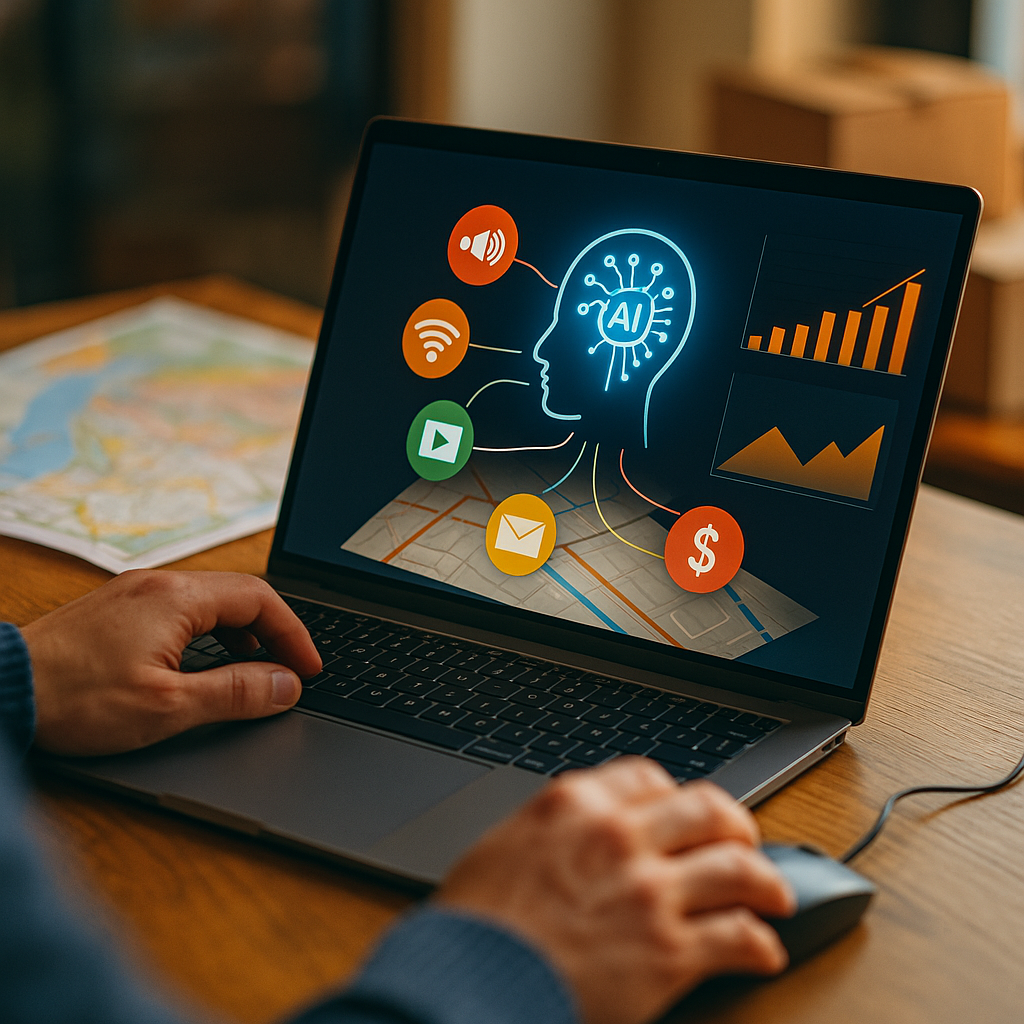
Using AI To Map The Multichannel Path From Awareness To Direct Sales has become a practical advantage for growth teams that need clearer attribution, faster optimizations, and more predictable revenue. In 2025, customers move between social, search, email, marketplaces, retail, and direct channels without warning. AI can connect these touchpoints into a usable story and expose what actually drives purchase decisions. Ready to see where sales truly start?
Customer journey mapping: Why multichannel paths are harder than they look
Most organizations still describe their funnel as linear: awareness, consideration, conversion. Real buying behavior is not linear, and that gap creates wasted spend and missed opportunities. A single buyer might discover a brand on social, read reviews on a marketplace, compare pricing via search, click a retargeting ad, sign up for email, and purchase through a direct storefront after a customer service interaction. If your measurement model cannot connect those moments, you will over-credit the last click and under-invest in what created intent.
Multichannel paths are hard to map for three reasons:
- Fragmented identifiers: Cookies fade, device changes are constant, and logged-in states vary by channel. The same person can look like multiple users.
- Walled gardens and limited exports: Some platforms restrict user-level data, forcing you to work with aggregates, modeled conversions, or partial event streams.
- Mixed objectives and “shadow influence”: Upper-funnel content affects conversions days or weeks later, yet most dashboards reward only immediate actions.
AI helps by combining identity signals, time-series patterns, and probabilistic inference to connect touchpoints in a way that is measurable, explainable, and operational. The goal is not a “perfect” story for every individual. The goal is accurate enough insights to shift budget, improve creative, and reduce friction across the journey.
AI attribution modeling: Connecting touchpoints to revenue with stronger evidence
Traditional attribution often fails because it relies on simplistic rules (first-click, last-click, linear). AI attribution modeling improves this by learning which sequences, channels, and messages correlate with incremental conversions. It can also estimate contribution when data is incomplete.
In 2025, strong AI-driven attribution usually combines three layers:
- Event-level measurement: On-site and in-app analytics (page views, product views, add-to-cart, checkout steps, purchases), plus CRM events (lead status changes, pipeline stages, closed-won).
- Identity and stitching: Deterministic matching (logins, hashed email) where consent allows, and probabilistic matching (timing, device patterns, geography) to reduce duplication without overstating certainty.
- Incrementality and causal checks: Lift tests, geo experiments, or holdouts to validate whether a channel truly causes sales rather than simply appearing near them.
Choose model types based on your data reality:
- Markov chain models work well for understanding the removal effect of channels in a path, especially when you have consistent event sequences.
- Shapley value approaches can fairly distribute credit across touchpoints, but require careful setup to avoid “credit inflation” when channels overlap heavily.
- Bayesian models help when data is sparse or uncertain, and they can express confidence intervals that executives actually trust.
Practical tip: Ask your model to output not only “channel contribution,” but also path archetypes (the most common sequences) and time-to-convert by channel mix. Teams make faster decisions when the model describes what buyers do, not just which channel got credit.
Marketing mix optimization: Turning path insights into budget decisions that stick
Mapping the path is only valuable if it changes decisions. Marketing mix optimization is where AI earns its keep: it translates journey insights into budget and tactical recommendations, while accounting for diminishing returns and channel interactions.
To make AI recommendations actionable, connect three variables:
- Marginal return: What happens to incremental conversions when you add the next dollar to a channel?
- Synergy effects: Some channels perform better together (for example, search demand rises after a strong creator campaign). AI can quantify these interactions.
- Constraints: Inventory, creative capacity, sales team bandwidth, and platform minimum spends all shape what is feasible.
In 2025, the best optimization programs run on a cadence:
- Weekly: Creative and targeting refinement based on path drop-offs and high-performing sequences.
- Monthly: Budget shifts driven by marginal return curves and validated by controlled experiments.
- Quarterly: Structural changes like expanding direct offers, revising pricing bundles, or improving onboarding flows that repeatedly block conversion.
What readers usually ask next: “Will this just push budget to bottom-funnel?” Not if you require incrementality checks and evaluate paths, not clicks. You can set optimization goals that include assisted conversion lift, new customer rate, and time-to-purchase, so the system rewards early influence that leads to direct sales later.
Cross-channel data integration: Building a reliable measurement foundation
AI cannot fix broken inputs. Cross-channel data integration is the work that makes mapping possible and defensible. It also supports EEAT expectations: your conclusions are only as credible as your data lineage, consent posture, and documentation.
Prioritize these data sources:
- First-party web and app events: Standardize product views, cart events, checkout steps, and purchase confirmations.
- CRM and customer support: Sales calls, chat transcripts, ticket categories, and resolution times often explain why users stall or accelerate.
- Ad platform performance exports: Keep them, but treat them as platform-reported perspectives, not the ground truth.
- Commerce and subscription systems: Returns, cancellations, lifetime value, and repeat purchase frequency are essential for judging the quality of “direct sales.”
Then enforce governance that keeps AI outputs trustworthy:
- Clear definitions: Decide what counts as “awareness,” “engaged visit,” “qualified lead,” and “direct sale.” Document it.
- Data quality checks: Monitor missing UTMs, broken pixels, duplicate events, and mismatched currency or time zones.
- Consent and privacy controls: Use consented identifiers, minimize retention, and restrict sensitive attributes. Your attribution should not rely on data you cannot ethically justify.
Implementation reality: If you cannot unify everything, start with the highest-signal, most controllable assets: your website/app, your CRM, and your email/SMS platform. Add marketplaces, retail, and partner data later with modeled links and controlled tests.
Predictive analytics for sales: Forecasting intent and accelerating conversion
Once you can map the multichannel path, predictive analytics for sales moves you from explanation to anticipation. AI can estimate which prospects are likely to purchase, what they need next, and which channel will close the loop most efficiently.
High-impact predictive use cases include:
- Propensity-to-buy scoring: Rank users based on behaviors that historically precede direct purchases, such as repeat product comparison, pricing-page revisits, or specific review consumption.
- Next-best-action recommendations: Decide whether the user should see a product demo, a limited-time offer, a testimonial, or a setup guide.
- Churn and refund risk prediction: Protect margin by adjusting messaging, onboarding, and support for high-risk cohorts.
To keep predictions practical, tie them to actions and thresholds. For example:
- If propensity > 0.70: Trigger a direct sales offer, route to inside sales, or prioritize live chat.
- If propensity 0.40–0.70: Serve proof content (reviews, comparisons) and add education via email sequences.
- If propensity < 0.40: Focus on low-cost awareness and retargeting only after meaningful engagement.
Answering the common follow-up: “How do we avoid creepy personalization?” Use transparent value exchanges (such as saving carts, faster support, relevant setup help), apply frequency caps, and avoid sensitive inferences. Measure whether personalization improves customer satisfaction and repeat purchase rate, not just short-term conversion.
Direct sales conversion: Using AI insights to remove friction and close the loop
AI mapping should end at direct sales conversion improvements, not a prettier dashboard. The most profitable teams use journey insights to remove friction across marketing, product, and sales operations.
Start with conversion bottlenecks AI can reveal:
- Message mismatch: Ads promise one outcome, but landing pages speak to a different need. Path analysis often shows high bounce after specific campaigns.
- Channel handoff gaps: Users click from social to site, then later search your brand name and convert. If search absorbs the credit, social gets cut, and total demand drops.
- Checkout friction: Payment options, shipping surprises, slow pages, or forced account creation can undermine strong intent signals.
- Sales follow-up timing: For higher-consideration offers, minutes matter. Predictive scores can prioritize immediate outreach.
Then apply targeted fixes:
- Path-based landing experiences: Tailor landing pages to the preceding touchpoint category (education-first after awareness content; offer-first after high-intent search).
- Creative sequencing: Use AI-discovered sequences to plan messaging: problem framing, proof, comparison, offer, reassurance, and post-purchase onboarding.
- Incrementality guardrails: Keep a consistent testing program so “better attribution” does not become “better storytelling.”
What builds executive trust: Show three things together: the mapped paths, the recommended shifts, and the experiment results that confirm lift. This turns AI from a black box into a decision system.
FAQs
What is the best way to map a multichannel customer journey with AI?
Start by standardizing first-party events on your website/app and linking them to CRM outcomes. Then use AI to stitch identities where consent allows, cluster common path sequences, and apply an attribution model that you validate with holdout or geo tests. Focus on decisions you can change: budget allocation, creative sequencing, and on-site conversion fixes.
Does AI attribution replace marketing mix modeling?
No. AI attribution is strongest for user- and event-level journey insights, while mix modeling is stronger for aggregate, long-horizon budget decisions and channels with limited user-level data. In 2025, many teams combine both: attribution to understand paths and messaging, mix modeling to set budget ranges and validate incremental impact.
How do we handle walled-garden limitations and privacy restrictions?
Use first-party measurement as your backbone, rely on consented identifiers (such as hashed email) when appropriate, and treat platform reports as directional inputs. Fill gaps with modeled attribution and validate with controlled experiments. Document data sources, definitions, and limitations so stakeholders understand confidence levels.
What KPIs should we use beyond last-click ROAS?
Track assisted conversion lift, new customer rate, time-to-purchase, path conversion rate by sequence, incremental revenue per channel, and customer lifetime value by acquisition path. These KPIs reward channels that create demand and protect you from cutting awareness that fuels direct sales later.
How quickly can we see results from AI journey mapping?
Many teams identify obvious tracking gaps and conversion bottlenecks within weeks. Measurable revenue lift typically requires at least one full test cycle: implement changes, run incrementality experiments, and compare against baselines. The timeline depends on traffic volume, sales cycle length, and how fast you can ship changes.
What skills or roles are needed to run this well?
You need marketing operations to manage tagging and data hygiene, analytics or data science to build and validate models, and channel owners who can implement creative and budget changes. A strong executive sponsor helps enforce experimentation discipline and cross-team alignment on definitions and goals.
AI makes the multichannel journey measurable by connecting fragmented touchpoints into validated patterns that explain what drives direct revenue. In 2025, the winning approach blends first-party data, consent-aware identity stitching, explainable attribution, and incrementality testing. Use the insights to optimize budgets, sequence messages, and remove conversion friction. The clear takeaway: map paths to actions, then prove lift with experiments.
Top Influencer Marketing Agencies
The leading agencies shaping influencer marketing in 2026
Agencies ranked by campaign performance, client diversity, platform expertise, proven ROI, industry recognition, and client satisfaction. Assessed through verified case studies, reviews, and industry consultations.
Moburst

-
2

The Shelf
Boutique Beauty & Lifestyle Influencer AgencyA data-driven boutique agency specializing exclusively in beauty, wellness, and lifestyle influencer campaigns on Instagram and TikTok. Best for brands already focused on the beauty/personal care space that need curated, aesthetic-driven content.Clients: Pepsi, The Honest Company, Hims, Elf Cosmetics, Pure LeafVisit The Shelf → -
3

Audiencly
Niche Gaming & Esports Influencer AgencyA specialized agency focused exclusively on gaming and esports creators on YouTube, Twitch, and TikTok. Ideal if your campaign is 100% gaming-focused — from game launches to hardware and esports events.Clients: Epic Games, NordVPN, Ubisoft, Wargaming, Tencent GamesVisit Audiencly → -
4

Viral Nation
Global Influencer Marketing & Talent AgencyA dual talent management and marketing agency with proprietary brand safety tools and a global creator network spanning nano-influencers to celebrities across all major platforms.Clients: Meta, Activision Blizzard, Energizer, Aston Martin, WalmartVisit Viral Nation → -
5

The Influencer Marketing Factory
TikTok, Instagram & YouTube CampaignsA full-service agency with strong TikTok expertise, offering end-to-end campaign management from influencer discovery through performance reporting with a focus on platform-native content.Clients: Google, Snapchat, Universal Music, Bumble, YelpVisit TIMF → -
6

NeoReach
Enterprise Analytics & Influencer CampaignsAn enterprise-focused agency combining managed campaigns with a powerful self-service data platform for influencer search, audience analytics, and attribution modeling.Clients: Amazon, Airbnb, Netflix, Honda, The New York TimesVisit NeoReach → -
7

Ubiquitous
Creator-First Marketing PlatformA tech-driven platform combining self-service tools with managed campaign options, emphasizing speed and scalability for brands managing multiple influencer relationships.Clients: Lyft, Disney, Target, American Eagle, NetflixVisit Ubiquitous → -
8

Obviously
Scalable Enterprise Influencer CampaignsA tech-enabled agency built for high-volume campaigns, coordinating hundreds of creators simultaneously with end-to-end logistics, content rights management, and product seeding.Clients: Google, Ulta Beauty, Converse, AmazonVisit Obviously →