


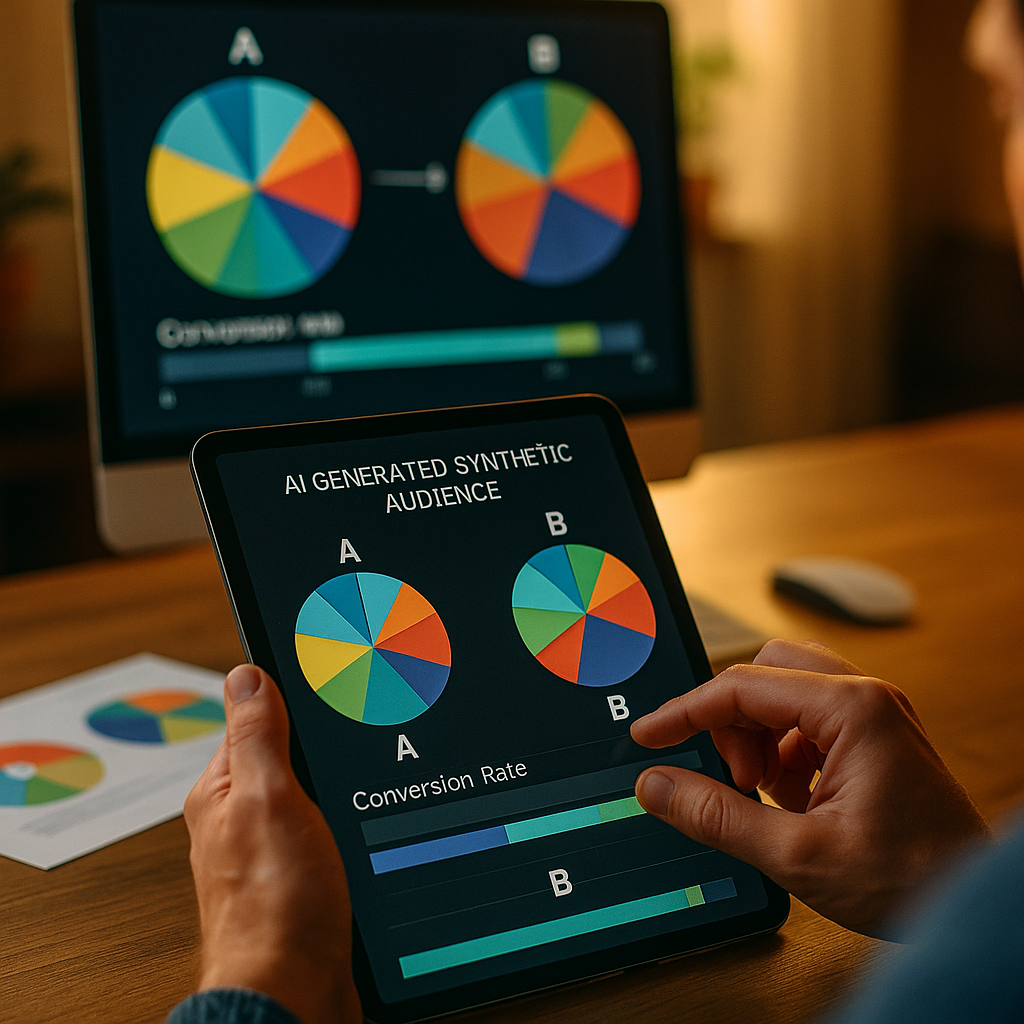
In 2025, marketers face a simple reality: budgets demand proof before spend, and creative testing must move faster than audience behavior. Using AI to generate synthetic audience segments for campaign pre-testing offers a practical way to simulate how distinct customer groups might respond before you launch. Done well, it reduces risk, improves targeting, and speeds iteration without compromising privacy. The bigger question is: how do you do it responsibly and accurately?
AI synthetic audience segments: what they are and what they are not
Synthetic audience segments are AI-generated representations of groups of people that mirror key attributes and behaviors of real audiences. They are built from patterns in existing data (first-party, research, aggregated insights) and generated as “lookalike” cohorts or simulated individuals with probabilities, not identities.
What they are: statistically plausible segments used to pre-test messaging, offers, channels, and sequencing; a way to explore “what-if” scenarios when real-world testing is expensive or slow; a method to reduce dependence on third-party identifiers by leaning on first-party signals and modeled behavior.
What they are not: a replacement for real customers; a loophole to recreate identifiable individuals; a justification to ignore consent, governance, or bias controls. If your synthetic segment allows re-identification or reliably reconstructs real people, it fails privacy expectations and can break policy or law.
Marketers often ask whether synthetic equals “fake.” A better framing is simulated: a controlled approximation that can predict relative performance, uncover weak creative assumptions, and prioritize which hypotheses deserve live spend.
Campaign pre-testing with AI: where it fits in a modern workflow
Campaign pre-testing with AI works best as a decision layer before expensive activation. It helps you answer: Which message resonates with which segment? Which channel mix is likely to be efficient? What objections should creative address? Where might conversion drop off?
A practical workflow in 2025 usually follows this sequence:
- Define the campaign decision: pick a single decision you want to de-risk (e.g., messaging angle, value proposition, offer, landing page structure, or channel sequencing).
- Inventory usable inputs: first-party CRM and web analytics (consented), product usage, customer support themes, brand lift research, and aggregated market insights.
- Generate synthetic segments aligned to business reality (e.g., “price-sensitive switchers,” “feature-driven power users,” “time-poor convenience buyers”).
- Run simulated exposure: feed creative variants, channel contexts, and constraints into a model to predict outcomes (attention, intent, likelihood to click, propensity to convert, churn risk).
- Prioritize live tests: take only the top hypotheses into small-scale real-world experiments, then scale what validates.
This approach answers a common follow-up: “Will this replace A/B testing?” No. It makes A/B testing smarter by narrowing your test matrix and avoiding spend on losing ideas. It also supports faster creative iteration by highlighting which claims are misaligned with segment motivations.
Privacy-safe marketing research: data inputs, governance, and compliance
In 2025, synthetic audiences can strengthen privacy-safe marketing research, but only if you treat governance as a product requirement, not a legal afterthought. The main goal is to gain insight without exposing personal data or enabling re-identification.
Recommended data practices:
- Prefer first-party, consented data with clear purpose limitation (e.g., “marketing optimization” or “research and measurement” as defined in your consent language).
- Minimize and aggregate: use feature engineering that reduces sensitivity (e.g., bucket ages, generalized geo, high-level interests) unless you have a documented need for granularity.
- Use privacy-preserving generation: apply techniques such as differential privacy noise, k-anonymity thresholds on outputs, and strict suppression rules for small cohorts.
- Block “memorization” risk: evaluate whether the generator can reproduce rare records; set controls that prevent outputting exact matches to real individuals.
- Separate duties: limit who can access raw inputs; allow most teams to work with synthetic outputs only.
Governance checklist you can operationalize:
- Document purpose and scope (why you model, what decisions it informs, what it must not be used for).
- Define unacceptable outputs (e.g., sensitive inference around health, ethnicity, or financial distress unless explicitly permitted and ethically justified).
- Maintain audit trails for training data sources, model versions, segment definitions, and who approved release.
- Validate with legal and security before activation, especially if synthetic outputs influence targeting decisions.
Readers often worry that synthetic data automatically “solves” privacy. It does not. It can reduce risk, but you still need consent, security controls, and proof that outputs are non-identifying.
Marketing measurement and lift modeling: how to validate synthetic segment accuracy
Synthetic segments are only useful if they predict real behavior well enough to improve decisions. Strong marketing measurement and lift modeling turns synthetic work into measurable value rather than “interesting analysis.” Validation should focus on both fidelity (how well it matches reality) and utility (how well it improves outcomes).
Key validation methods:
- Holdout comparisons: compare synthetic predictions against a withheld slice of real outcomes (e.g., conversion rate by channel, average order value, time-to-purchase).
- Back-testing: run the model on past campaigns where results are known; check whether it would have ranked winners correctly.
- Calibration checks: if the model predicts a 20% conversion likelihood for a segment, observed conversion in similar conditions should cluster near that number (after adjusting for reach and noise).
- Sensitivity analysis: test whether small changes in assumptions (price, offer, frequency) create reasonable changes in predicted response.
- Bias and fairness tests: measure whether predictions systematically under- or over-estimate performance for protected or vulnerable groups, especially when proxies exist.
What to measure in pre-testing depends on your funnel:
- Upper funnel: predicted attention, message comprehension, brand recall, and intent proxies.
- Mid funnel: click propensity, landing page engagement, lead quality likelihood.
- Lower funnel: purchase propensity, predicted incremental lift, churn risk impact, customer lifetime value direction.
A likely follow-up is: “How accurate is accurate enough?” Use a decision threshold: if synthetic pre-testing consistently identifies the top two creative options and avoids the bottom two, it can materially reduce waste even if it is not perfect. The goal is better prioritization, not omniscience.
Creative testing at scale: segment scenarios that reveal why ideas win or lose
Creative testing at scale is where synthetic segments can deliver immediate operational impact. Instead of testing one “general audience,” you pressure-test multiple motivations and objections before committing to production and media spend.
High-value synthetic scenarios include:
- Motivation splits: “status-driven” vs. “value-driven” vs. “simplicity-driven” buyers, each reacting to different proof points.
- Objection handling: simulate responses for “skeptical about claims,” “concerned about switching costs,” or “worried about support.”
- Channel context: a message that works in search may fail in social; synthetic pre-testing can model attention and intent differences by environment.
- Offer elasticity: compare “free trial,” “annual discount,” “bundle,” or “guarantee” for each segment to find the least costly incentive.
- Frequency and fatigue: estimate where incremental exposure stops adding value and starts increasing annoyance or churn risk.
To make outputs actionable, force the model to explain outcomes in marketing terms. Instead of “Variant B scores 0.72,” require “Variant B wins for this segment because it reduces perceived complexity and increases trust through concrete proof.” Then translate those insights into creative edits: swap vague claims for measurable proof, tighten the call to action, and align imagery with the segment’s decision drivers.
Also address the operational follow-up: “Will this slow my team down?” Not if you standardize inputs. Use a consistent creative brief format (promise, proof, price, friction reducers, CTA) and a consistent segment template (needs, triggers, barriers, preferred channels). That structure makes synthetic testing repeatable and fast.
Responsible AI in advertising: risks, limitations, and best practices for trust
Responsible AI in advertising matters because synthetic segments can amplify problems if misused: discrimination, manipulation, inaccurate targeting, and false confidence. You protect performance and brand trust by adopting guardrails.
Main risks and how to mitigate them:
- Bias amplification: if training data reflects historical inequities, synthetic segments may replicate them. Mitigate with bias testing, balanced sampling, and explicit exclusion of sensitive attributes unless clearly justified.
- Overfitting to the past: the model may favor yesterday’s winners. Mitigate by incorporating recent signals, adding exploration, and validating on new campaign contexts.
- Spurious precision: synthetic outputs can look exact even when uncertainty is high. Mitigate by reporting confidence intervals and using ranges rather than single-number certainty.
- Misleading persona narratives: overly humanized personas can push teams to stereotype. Mitigate by grounding segments in measurable behaviors and decision triggers.
- Policy violations: sensitive targeting or inferred traits can breach platform rules. Mitigate by aligning segment definitions with platform policies and internal ethical standards.
EEAT-aligned best practices to build confidence in your approach:
- Experience: tie synthetic pre-testing to real campaign outcomes; maintain a playbook of what it predicted and what happened.
- Expertise: involve marketing science, analytics, and privacy experts in model design and validation, not only creative teams.
- Authoritativeness: document methodology, data sources, and evaluation metrics so stakeholders can review and challenge assumptions.
- Trust: publish internal guidelines, keep audit logs, and establish escalation paths when a segment or use case feels questionable.
The practical takeaway: synthetic segments are a decision-support tool. Treat them like forecasting. You would not run a business on a forecast without checks, and you should not run a campaign on a synthetic segment without validation.
FAQs
How do synthetic audience segments differ from lookalike audiences?
Lookalike audiences are typically created inside ad platforms from seed lists and optimized for reach within that platform. Synthetic segments are generated outside or alongside platforms to simulate behavior, motivations, and likely responses for pre-testing. You can use synthetic insights to choose which lookalikes to build and what message each should receive.
What data do I need to start generating synthetic segments?
Start with consented first-party data: CRM attributes, purchase history, product usage, site behavior, and survey findings. If you lack volume, use aggregated research and qualitative inputs (support tickets, sales call themes) to define segment hypotheses, then validate with small live tests.
Can synthetic segments replace customer surveys or focus groups?
They can reduce how often you need them, but they should not fully replace direct customer feedback. Use synthetic segments to narrow questions, prioritize concepts, and design better research. Then use surveys or interviews to validate motivations and language before scaling spend.
How do I know whether synthetic outputs are privacy-safe?
Require a formal privacy review: confirm no direct identifiers are used, apply minimum cohort sizes, test for re-identification risk, and ensure the generator cannot reproduce rare records. Keep raw data access restricted and distribute only synthetic outputs for analysis.
What KPIs are best for synthetic campaign pre-testing?
Use KPIs tied to your decision: predicted relative lift between creative variants, click propensity by channel context, conversion propensity under different offers, and expected incremental outcomes (not just raw conversions). Always validate with real-world holdout tests before scaling.
How long does it take to implement this approach?
A focused pilot can run in weeks if you have clean first-party inputs and a clear decision to de-risk. Full operationalization takes longer because you need governance, templates, validation routines, and stakeholder alignment across marketing, analytics, and privacy.
AI-driven synthetic segments can make campaign decisions more evidence-based, especially when timelines and budgets limit real-world experimentation. Use them to simulate reactions, rank creative and offer options, and design smaller, smarter live tests. Treat privacy and validation as non-negotiable requirements, not optional add-ons. When you combine governance with measurement, you gain faster learning and more confident launches.
Top Influencer Marketing Agencies
The leading agencies shaping influencer marketing in 2026
Agencies ranked by campaign performance, client diversity, platform expertise, proven ROI, industry recognition, and client satisfaction. Assessed through verified case studies, reviews, and industry consultations.
Moburst

-
2

The Shelf
Boutique Beauty & Lifestyle Influencer AgencyA data-driven boutique agency specializing exclusively in beauty, wellness, and lifestyle influencer campaigns on Instagram and TikTok. Best for brands already focused on the beauty/personal care space that need curated, aesthetic-driven content.Clients: Pepsi, The Honest Company, Hims, Elf Cosmetics, Pure LeafVisit The Shelf → -
3

Audiencly
Niche Gaming & Esports Influencer AgencyA specialized agency focused exclusively on gaming and esports creators on YouTube, Twitch, and TikTok. Ideal if your campaign is 100% gaming-focused — from game launches to hardware and esports events.Clients: Epic Games, NordVPN, Ubisoft, Wargaming, Tencent GamesVisit Audiencly → -
4

Viral Nation
Global Influencer Marketing & Talent AgencyA dual talent management and marketing agency with proprietary brand safety tools and a global creator network spanning nano-influencers to celebrities across all major platforms.Clients: Meta, Activision Blizzard, Energizer, Aston Martin, WalmartVisit Viral Nation → -
5

The Influencer Marketing Factory
TikTok, Instagram & YouTube CampaignsA full-service agency with strong TikTok expertise, offering end-to-end campaign management from influencer discovery through performance reporting with a focus on platform-native content.Clients: Google, Snapchat, Universal Music, Bumble, YelpVisit TIMF → -
6

NeoReach
Enterprise Analytics & Influencer CampaignsAn enterprise-focused agency combining managed campaigns with a powerful self-service data platform for influencer search, audience analytics, and attribution modeling.Clients: Amazon, Airbnb, Netflix, Honda, The New York TimesVisit NeoReach → -
7

Ubiquitous
Creator-First Marketing PlatformA tech-driven platform combining self-service tools with managed campaign options, emphasizing speed and scalability for brands managing multiple influencer relationships.Clients: Lyft, Disney, Target, American Eagle, NetflixVisit Ubiquitous → -
8

Obviously
Scalable Enterprise Influencer CampaignsA tech-enabled agency built for high-volume campaigns, coordinating hundreds of creators simultaneously with end-to-end logistics, content rights management, and product seeding.Clients: Google, Ulta Beauty, Converse, AmazonVisit Obviously →