


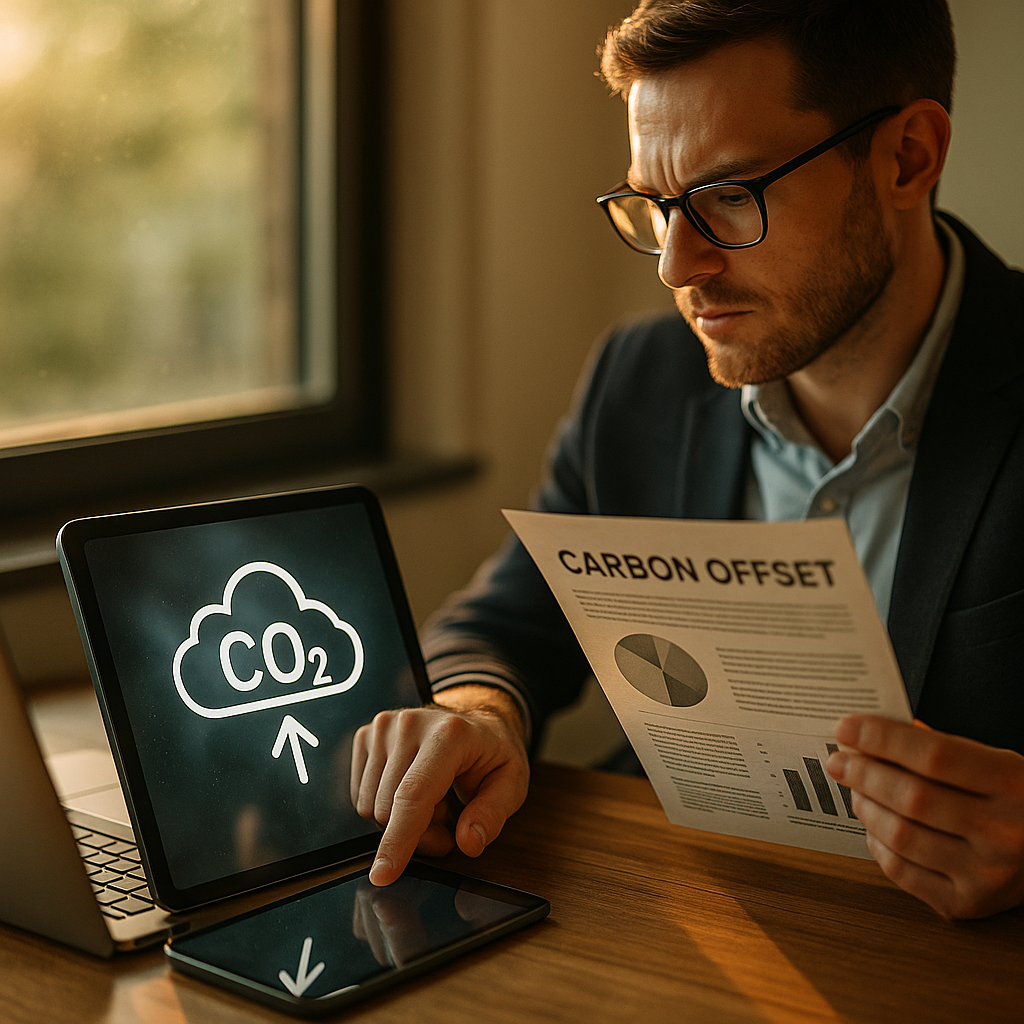
In 2025, brands face growing scrutiny over carbon offset messaging as regulators, platforms, and customers demand proof—not promises. Navigating Transparency Requirements For Carbon Offset Marketing Claims requires clear language, traceable data, and defensible evidence from purchase to impact. This guide explains what “transparent” actually means, how to avoid common claim pitfalls, and how to build trust without overstating results—starting now.
Carbon offset marketing compliance: what transparency means in practice
Transparency is not a slogan; it is a documentation and communication standard. In carbon offset marketing, “transparent” means a reasonable consumer—and a regulator—can understand exactly what you did, what the offset represents, and what it does not guarantee.
In practice, carbon offset marketing compliance typically requires you to disclose:
- What was offset: the emissions source and boundary (product, shipment, business unit, or company-wide).
- How emissions were calculated: method used, data quality, assumptions, and whether the numbers are estimates.
- What type of offset was used: avoidance vs. removal, project type (forestry, cookstoves, methane capture, direct air capture, etc.), and relevant limitations.
- Where offsets came from: program/registry, project name, location, vintage, and serial numbers where available.
- When the climate benefit occurs: immediate vs. over time, especially for nature-based projects and long-duration storage claims.
- Who verified the credits: validation/verification body, standard used, and any third-party assurance on your internal calculations.
Many marketing problems happen when brands compress complex details into a short phrase such as “carbon neutral.” If you use that phrase, you must be prepared to explain (in accessible language) the pathway: measurement → reduction → residual emissions → offsets. Consumers increasingly expect that offsets complement reductions, not replace them; your transparency should reflect that hierarchy.
Follow-up question readers often ask: “Do we need to publish everything on the ad itself?” Typically, no. But you should provide clear, prominent access to substantiation through landing pages, QR codes, or product detail pages—without burying critical qualifiers in hard-to-find PDFs.
Carbon neutrality claims: how to avoid misleading language
“Carbon neutral,” “net zero,” and “climate positive” have become high-risk terms because they can imply absolute outcomes. The safest approach is to make specific, bounded claims and support them with disclosures that prevent reasonable misunderstanding.
To reduce claim risk, structure your statement with three parts:
- Scope: what is covered (e.g., “cradle-to-gate emissions for Product X” or “Scope 1 and 2 for Facility Y”).
- Action: what you did (reduced emissions by specific measures; purchased and retired credits for residual emissions).
- Evidence link: where details are available (public claim support page with methodology and credit data).
Use language that reflects the underlying mechanism. For example:
- Prefer: “We measured the emissions from shipping this order and retired verified carbon credits to compensate for those emissions.”
- Use with care: “Carbon neutral shipping” (only if you define boundaries, explain that it is compensation, and show retirement evidence).
- Avoid unless fully substantiated: “Zero emissions,” “no climate impact,” or “100% climate friendly.”
Another common issue is confusing avoidance credits (preventing future emissions) with removal credits (taking CO2 out of the atmosphere). If your marketing implies removal—words like “remove,” “draw down,” “take carbon out,” or imagery suggesting permanent elimination—ensure the credits are removals and disclose storage durability. If they are avoidance credits, say so plainly.
Follow-up question: “Can we say ‘net zero’ if we buy offsets?” “Net zero” is widely treated as a long-term, science-aligned pathway rather than an annual offsetting statement. If you use it, anchor it to a credible plan and milestones, and separate near-term offsetting from long-term decarbonization progress.
Carbon offset disclosure: what to publish and where to publish it
Effective carbon offset disclosure balances accessibility for consumers with detail for auditors and NGOs. A practical approach is a two-layer disclosure model:
- Layer 1 (consumer-facing): plain-language summary on a landing page reachable from the claim in one step.
- Layer 2 (technical support): downloadable documentation with calculations, standards, and project/credit evidence.
Layer 1 should include:
- Claim boundary: what’s included and excluded.
- Emissions figure: total emissions addressed and how it was estimated.
- Reduction actions: what you did before offsetting.
- Offset approach: removal vs. avoidance and why you chose it.
- Credit proof: registry, project, vintage, and retirement confirmation.
Layer 2 should include:
- Methodology: calculation approach for each emissions category, emission factors, key assumptions, and uncertainty notes.
- Governance: internal review, roles, and approval process for claims.
- Credit documentation: certificates, serial numbers, and retirement records, ideally linkable on registry platforms.
- Quality assessment: criteria used to select credits (additionality, permanence, leakage, social safeguards).
Where to publish depends on the claim channel:
- Packaging: QR code or short URL that goes directly to the Layer 1 page for that specific product or batch.
- E-commerce: product detail section with a “Climate claim details” accordion plus a link to technical files.
- Ads and social: brief claim plus a prominent link; avoid tiny footnotes that are unreadable on mobile.
- B2B sales collateral: include boundaries, standards, and retirement evidence; buyers often require procurement-ready documentation.
Follow-up question: “Should we disclose credit costs?” Not usually required for claim transparency, but be cautious if pricing creates a misleading impression (e.g., “for just $0.01 we neutralize your footprint”). Focus on quality, retirement, and boundaries rather than implying cheap offsets solve complex impacts.
Verified carbon credits: how to substantiate quality and retirement
“Verified” must mean something concrete. Substantiation should show the credits were issued under a recognized standard, independently verified, and retired (not merely purchased or “allocated”). If the credit is not retired, the climate claim is typically premature because the credit can still be sold or claimed by someone else.
To support verified carbon credits in marketing, document:
- Registry and standard: name of the program and the methodology used by the project.
- Project details: location, type, co-benefits (only if documented), and known limitations.
- Vintage and volume: the issuance/crediting period and number of tonnes claimed.
- Serial numbers: unique identifiers where available.
- Retirement evidence: retirement certificate or registry link showing who retired the credits and when.
Quality questions you should anticipate from regulators and sophisticated customers:
- Additionality: would the project likely happen without carbon finance?
- Permanence: how durable is storage or avoidance, and what buffers exist for reversals?
- Leakage: does the activity shift emissions elsewhere?
- Double counting: can another entity claim the same reduction or removal?
Be careful with co-benefit claims such as “protects biodiversity” or “supports local communities.” These can be accurate but require their own substantiation. Tie such statements to project documentation, third-party reports, or certification that explicitly covers those outcomes. Avoid implying guaranteed social outcomes if the project only includes them as intended benefits.
Follow-up question: “Is third-party assurance worth it?” If you make prominent climate claims, limited-scope assurance for your emissions inventory and claim controls can materially reduce risk and improve credibility. It also supports EEAT by showing independent scrutiny.
Greenwashing risk: aligning with regulators, platforms, and consumer expectations
Greenwashing risk increases when marketing outpaces measurement, or when claims hide tradeoffs. In 2025, enforcement and reputational pressure often focus on the same patterns:
- Overbroad claims: implying a whole company is “carbon neutral” when only a product line is covered.
- Unclear boundaries: failing to specify whether Scope 3 emissions are included.
- Offset-first messaging: celebrating offsets without describing reductions.
- Vague labels: “eco,” “planet friendly,” or “net zero” without clear meaning.
- Missing retirement proof: credits purchased but not retired, or retirement not tied to the claim period.
Mitigation strategy: build a claims control system similar to financial marketing review. That system should include:
- Claim taxonomy: approved phrases and prohibited phrases, with required disclosures for each.
- Evidence checklist: what must be on file before a claim can launch (inventory, boundary, credit proof, approvals).
- Review workflow: sustainability + legal + marketing sign-off, with version control.
- Ongoing monitoring: re-check project status, credit retirements, and public challenges to project integrity.
Also consider platform policies. Ad platforms and marketplaces increasingly restrict environmental claims and can demand substantiation. If your campaign might be paused pending proof, you need documentation ready before launch.
Follow-up question: “What if a project later becomes controversial?” Prepare a response plan. Transparency means acknowledging uncertainty and updating disclosures when new facts arise. If integrity concerns become credible, consider replacing credits, correcting claims, and explaining the action publicly.
EEAT for sustainability messaging: building trust with documentation and governance
EEAT—experience, expertise, authoritativeness, and trust—matters for sustainability content because audiences and evaluators look for signals that your claims are grounded in real practice, not copywriting. You can strengthen EEAT without overloading readers by designing your disclosures to answer the “how do you know?” question.
Practical EEAT actions for carbon offset messaging:
- Show operational experience: summarize your measurement process, internal roles, and how frequently you update calculations.
- Demonstrate expertise: cite the standards or protocols you follow in plain language, and explain key assumptions.
- Establish authority: publish who is accountable for the claim program (team or officer), and provide contact routes for questions.
- Increase trust: disclose limitations, uncertainty, and what the claim does not cover.
Include a “Claim support” section that is easy to navigate:
- Claim statement: exact wording used in marketing.
- Boundary and period: what emissions and what time frame the claim applies to.
- Calculation summary: major categories and methods.
- Offset details: project, registry, vintage, retirement.
- Updates: change log when you revise methods or replace credits.
Follow-up question: “How detailed should our public page be?” Detailed enough that an informed reader can reproduce the reasoning at a high level and verify credit retirement independently. If you require trust without giving verification paths, the claim is fragile.
FAQs: transparency requirements for carbon offset claims
What is the minimum disclosure needed to make an offset-based claim?
At minimum, disclose the claim boundary (what’s covered), how emissions were calculated (high-level method), the type and source of credits (registry/project/vintage), and proof of retirement. Also state that offsets compensate for emissions rather than eliminate them, unless you are making a clearly defined removal claim.
Can we say “carbon neutral” if we only offset Scope 1 and 2?
You can, but only if you clearly state the boundary (Scope 1 and 2 only) and avoid implying the whole value chain is covered. Many brands instead say “carbon neutral for Scope 1 and 2 operations” or “we offset our operational emissions,” with a link to details.
Do we need to use removal credits to make a credible claim?
Not always, but you must match credit type to the claim. If your language implies removing CO2 from the atmosphere, you need removals and should disclose durability. If you use avoidance credits, describe them accurately and avoid “remove” phrasing.
What does “retired” mean for carbon credits, and why does it matter?
Retirement means the credit is permanently taken out of circulation in a registry so it cannot be sold or claimed again. For marketing claims, retirement is critical evidence that the credit is uniquely applied to your stated purpose.
How should we handle uncertainty in emissions calculations?
Acknowledge estimates and key assumptions in your disclosures. Use ranges internally where possible, choose conservative factors when data quality is low, and update calculations as better activity data becomes available. Avoid absolute phrasing like “exactly zero impact.”
What’s the biggest red flag that triggers greenwashing allegations?
Overbroad claims without boundaries or proof—especially company-wide “carbon neutral” statements that rely heavily on offsets while providing little evidence of reductions, limited credit information, or no retirement documentation.
Should we disclose our reduction actions even if the claim is about offsets?
Yes. Consumers and regulators often expect offsets to cover residual emissions after reductions. Briefly list the main reduction actions and clarify what remains and why offsets were used for that portion.
How often should we update our claim support pages?
Update at least when you refresh emissions data, change calculation methods, buy or retire new credits, or adjust claim wording. If you make ongoing claims (e.g., “carbon neutral shipping”), maintain a predictable update cadence and keep an accessible change log.
Transparency requirements for carbon offset marketing are now a core part of brand risk management in 2025. Treat every climate claim as a testable statement supported by clear boundaries, credible calculations, and verifiable credit retirement. When you communicate reductions first and offsets second—and publish evidence where customers can find it—you earn trust and reduce compliance exposure. Build the system now, before scrutiny forces it.
Top Influencer Marketing Agencies
The leading agencies shaping influencer marketing in 2026
Agencies ranked by campaign performance, client diversity, platform expertise, proven ROI, industry recognition, and client satisfaction. Assessed through verified case studies, reviews, and industry consultations.
Moburst

-
2

The Shelf
Boutique Beauty & Lifestyle Influencer AgencyA data-driven boutique agency specializing exclusively in beauty, wellness, and lifestyle influencer campaigns on Instagram and TikTok. Best for brands already focused on the beauty/personal care space that need curated, aesthetic-driven content.Clients: Pepsi, The Honest Company, Hims, Elf Cosmetics, Pure LeafVisit The Shelf → -
3

Audiencly
Niche Gaming & Esports Influencer AgencyA specialized agency focused exclusively on gaming and esports creators on YouTube, Twitch, and TikTok. Ideal if your campaign is 100% gaming-focused — from game launches to hardware and esports events.Clients: Epic Games, NordVPN, Ubisoft, Wargaming, Tencent GamesVisit Audiencly → -
4

Viral Nation
Global Influencer Marketing & Talent AgencyA dual talent management and marketing agency with proprietary brand safety tools and a global creator network spanning nano-influencers to celebrities across all major platforms.Clients: Meta, Activision Blizzard, Energizer, Aston Martin, WalmartVisit Viral Nation → -
5

The Influencer Marketing Factory
TikTok, Instagram & YouTube CampaignsA full-service agency with strong TikTok expertise, offering end-to-end campaign management from influencer discovery through performance reporting with a focus on platform-native content.Clients: Google, Snapchat, Universal Music, Bumble, YelpVisit TIMF → -
6

NeoReach
Enterprise Analytics & Influencer CampaignsAn enterprise-focused agency combining managed campaigns with a powerful self-service data platform for influencer search, audience analytics, and attribution modeling.Clients: Amazon, Airbnb, Netflix, Honda, The New York TimesVisit NeoReach → -
7

Ubiquitous
Creator-First Marketing PlatformA tech-driven platform combining self-service tools with managed campaign options, emphasizing speed and scalability for brands managing multiple influencer relationships.Clients: Lyft, Disney, Target, American Eagle, NetflixVisit Ubiquitous → -
8

Obviously
Scalable Enterprise Influencer CampaignsA tech-enabled agency built for high-volume campaigns, coordinating hundreds of creators simultaneously with end-to-end logistics, content rights management, and product seeding.Clients: Google, Ulta Beauty, Converse, AmazonVisit Obviously →