


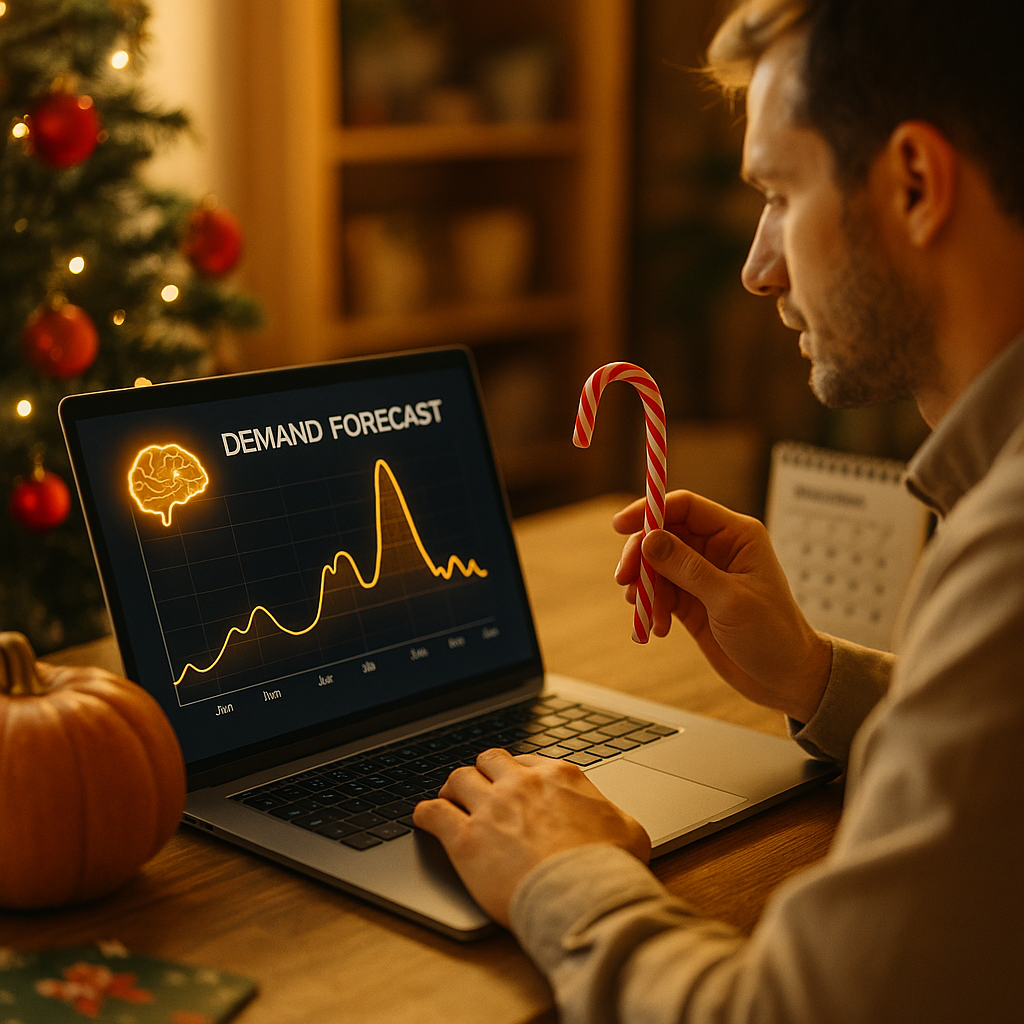
Using AI to forecast seasonal demand for niche physical products is now practical for small brands, makers, and specialized retailers in 2025. Better predictions reduce stockouts, overbuying, and cash tied up in slow movers. The challenge is that niche items behave differently from mass-market goods, with sharper spikes and more noise. This guide shows what to do, what to avoid, and how to act on forecasts—starting today.
AI demand forecasting for seasonal products: what makes niche items different
Niche physical products rarely follow smooth, predictable patterns. They often depend on micro-seasons (a short festival window, a hobby event calendar, a local climate shift), community trends, and limited-run supply. That means traditional forecasting methods—like simple moving averages—often miss the real drivers.
AI-based forecasting works well here because it can combine multiple signals and learn non-linear relationships. Instead of asking “what happened last December?” you can ask “what happens when a winter storm hits, influencer mentions rise, and paid search costs change?”
Common niche-seasonality patterns AI handles well:
- Short, sharp peaks (e.g., cosplay accessories around conventions)
- Regional seasonality (e.g., outdoor gear tied to local weather)
- Event-driven cycles (e.g., tournament weekends, school term starts)
- Launch-and-drop effects for limited editions and collector items
Practical takeaway: the goal is not a perfect number; it’s a forecast good enough to make better inventory, purchasing, and marketing decisions with clear uncertainty ranges.
Seasonal sales data preparation: building a trustworthy dataset
Forecast quality depends on data quality. For niche products, the biggest risk is thin data: fewer orders, more randomness, and frequent assortment changes. You can still forecast accurately if you build a consistent, explainable dataset and document assumptions.
Start with these data sources:
- Order lines (SKU, quantity, price, discount, channel, date/time, region)
- Inventory signals (on-hand, on-order, stockouts, backorders, lead times)
- Marketing drivers (ad spend by channel, email sends, influencer posts, affiliate pushes)
- External signals (weather, local events, Google Trends topics, marketplace rankings)
- Operational constraints (supplier MOQs, production capacity, shipping cutoffs)
Clean-up steps that matter in practice:
- Separate demand from sales: stockouts mask true demand. Tag days with inventory constraints and treat them differently in training.
- Normalize promotions: label promo periods, discount depth, and placements so AI doesn’t “learn” a seasonal spike that was actually a sale.
- Handle SKU changes: map replacements and bundles to a product family so your model keeps learning even when SKUs rotate.
- Create a calendar layer: holidays, paydays, school schedules, sports calendars, industry events, shipping deadlines.
EEAT note: keep a simple “data dictionary” that defines each field and how it’s collected. When you later question a forecast, this documentation is what makes your process auditable and repeatable.
Machine learning seasonality models: choosing the right approach
In 2025, you don’t need to invent a model from scratch. You do need to choose a method aligned with your data volume, SKU count, and operational goals. The best teams run a small model “bench” and keep the simplest model that meets accuracy and usability targets.
Three practical model options:
- Baseline statistical models (seasonal naïve, ETS, ARIMA): fast, explainable, strong when patterns are stable and data is limited.
- Gradient-boosted trees (e.g., XGBoost/LightGBM): excellent for adding external drivers (weather, ads, events) and handling non-linear effects.
- Deep learning time-series models (e.g., Temporal Fusion Transformer): useful when you have many SKUs, longer history, and lots of signals—especially for hierarchical forecasting.
What “good” looks like for niche products:
- Probabilistic forecasts (prediction intervals), not just a single point estimate.
- Hierarchical consistency: SKU forecasts should roll up to category and channel totals without contradictions.
- Fast retraining: seasonal demand shifts; your model must adapt as new weeks of data arrive.
Answering a common follow-up: “Should I use generative AI for forecasting?” Use generative AI to help design features, document assumptions, and explain outputs. Use time-series and ML models for the actual forecast math.
Demand signals for niche SKUs: features that actually improve accuracy
Niche demand often moves because of signals outside your storefront. AI performs best when you provide these drivers as structured inputs (“features”). The key is to select signals you can access consistently and that you can act on.
High-impact demand signals to test:
- Search interest: Google Trends indices for product topics, ingredient names, fandom keywords, or hobby terms.
- Social velocity: post counts, engagement rate, and creator mentions for a specific keyword cluster.
- Weather and climate: temperature swings, precipitation, storm alerts, pollen counts (category-dependent).
- Marketplace indicators: category rank changes, review velocity, competitor pricing snapshots.
- Paid media pressure: CPM/CPC shifts that change your ability to buy demand profitably.
- Lead-time risk: supplier fill rate, shipping delays, and production bottlenecks as constraints.
Make features decision-oriented: If you can’t respond to a signal (for example, you don’t control paid media or cannot expedite production), it may still help accuracy, but it won’t help operations. Prioritize signals that link to actions: reorder timing, safety stock, and campaign scheduling.
Prevent “false intelligence”: avoid using future-leaking variables (like next week’s ad budget if it’s decided after the forecast). Only include what is known at forecast time or what you can realistically plan.
Inventory optimization with AI forecasts: turning predictions into purchase decisions
A forecast is only valuable when it changes what you do: how much to buy, when to produce, and where to place inventory. For seasonal niche products, the operational target is usually a service level (avoid stockouts during a short window) while limiting markdowns after the window closes.
Convert forecasts into inventory actions:
- Set forecast horizons by lead time: if manufacturing takes 8 weeks, you need at least an 8–12 week forecast for purchase orders.
- Use prediction intervals for safety stock: base safety stock on uncertainty and desired service level, not a fixed “weeks of cover.”
- Plan scenarios: base, optimistic, and conservative demand curves that tie to clear triggers (e.g., “If search index stays above X for 10 days, switch to optimistic.”)
- Allocate by channel: e-commerce vs. retail vs. marketplaces often peak at different times; treat them separately, then reconcile totals.
- Time-box the season: define “in-season” and “out-of-season” rules for replenishment, markdowns, and bundling.
Answering another follow-up: “What if I sell limited runs?” AI still helps—forecast the sell-through curve (rate of depletion) and use it to set batch size, release timing, and waitlist thresholds. You can also forecast substitution: when one variant sells out, which variant captures that demand?
Operational tip: pair forecasting with a simple constraint sheet: MOQs, cash budget, warehouse capacity, and supplier cutoffs. The best forecast is useless if it recommends an order you cannot place.
Forecast accuracy and AI governance: measuring results and building trust
Trust comes from consistent evaluation and clear ownership. In 2025, “AI governance” for a small business doesn’t mean bureaucracy—it means you can explain how forecasts are produced, monitored, and corrected.
How to evaluate forecasts for seasonal niche demand:
- Use multiple metrics: MAPE can break on low-volume items; add MAE or WAPE and a bias metric (over/under tendency).
- Backtest by season: compare performance on the last comparable seasonal windows, not only on random weeks.
- Track stockout-adjusted demand: measure forecast vs. estimated true demand, not just shipped units.
- Monitor bias: consistent over-forecasting causes markdowns; consistent under-forecasting causes lost peak revenue.
Governance checklist aligned with EEAT:
- Ownership: name an accountable operator (merchandiser, buyer, or ops lead) who approves decisions.
- Change log: document major input changes (new supplier, new pricing, new channel) so you can explain shifts.
- Human review rules: define when humans override the model (e.g., once-in-a-decade event, sudden recall, viral spike).
- Model monitoring: watch for drift when a niche trend fades or competitors enter.
Answering the trust question directly: you don’t need AI to be “right” every week; you need it to be directionally reliable and transparent about uncertainty, so your inventory and marketing decisions improve over time.
FAQs
What is the best way to forecast seasonal demand for a niche product with limited history?
Start with a simple baseline (seasonal naïve or ETS) and add external signals like search interest and event calendars. Group SKUs into product families to increase data volume, and treat stockout periods as censored demand rather than true zeros.
How far ahead should I forecast for seasonal inventory planning?
Forecast at least as far as your total lead time (production + shipping + receiving) plus a buffer for uncertainty. If lead time is 6–10 weeks, a 12-week forecast is typically more actionable for purchase orders and capacity planning.
Can AI forecast demand when promotions or influencer posts cause spikes?
Yes, if you label promotions and include structured marketing features (discount depth, email sends, creator mentions). Without these features, AI may misinterpret a campaign spike as recurring seasonality and over-forecast later.
How do I handle stockouts in my training data?
Flag stockout days and either exclude them from training targets or estimate lost sales using page views, add-to-cart rates, or historical conversion. This prevents the model from learning that demand drops when inventory hits zero.
What tools can small businesses use for AI demand forecasting?
Many teams use a mix of spreadsheets for constraints, a database or BI tool for clean historical data, and an ML stack (or a forecasting platform) for training and backtesting. Prioritize tools that support prediction intervals, retraining, and clear explainability.
How do I know if my forecasts are “good enough” to act on?
Use decision-based tests: did service level improve during peak weeks, did markdowns decrease after the season, and did cash tied in inventory drop? If those outcomes improve while forecast bias stays controlled, the forecasts are operationally good.
AI forecasting works best when you treat it as a decision system, not a magic number generator. In 2025, niche sellers can combine clean sales history, stockout-aware targets, and external demand signals to predict short seasonal peaks with usable confidence ranges. The clear takeaway: connect forecasts to actions—reorders, safety stock, and campaign timing—then measure outcomes and iterate every season.
Top Influencer Marketing Agencies
The leading agencies shaping influencer marketing in 2026
Agencies ranked by campaign performance, client diversity, platform expertise, proven ROI, industry recognition, and client satisfaction. Assessed through verified case studies, reviews, and industry consultations.
Moburst

-
2

The Shelf
Boutique Beauty & Lifestyle Influencer AgencyA data-driven boutique agency specializing exclusively in beauty, wellness, and lifestyle influencer campaigns on Instagram and TikTok. Best for brands already focused on the beauty/personal care space that need curated, aesthetic-driven content.Clients: Pepsi, The Honest Company, Hims, Elf Cosmetics, Pure LeafVisit The Shelf → -
3

Audiencly
Niche Gaming & Esports Influencer AgencyA specialized agency focused exclusively on gaming and esports creators on YouTube, Twitch, and TikTok. Ideal if your campaign is 100% gaming-focused — from game launches to hardware and esports events.Clients: Epic Games, NordVPN, Ubisoft, Wargaming, Tencent GamesVisit Audiencly → -
4

Viral Nation
Global Influencer Marketing & Talent AgencyA dual talent management and marketing agency with proprietary brand safety tools and a global creator network spanning nano-influencers to celebrities across all major platforms.Clients: Meta, Activision Blizzard, Energizer, Aston Martin, WalmartVisit Viral Nation → -
5

The Influencer Marketing Factory
TikTok, Instagram & YouTube CampaignsA full-service agency with strong TikTok expertise, offering end-to-end campaign management from influencer discovery through performance reporting with a focus on platform-native content.Clients: Google, Snapchat, Universal Music, Bumble, YelpVisit TIMF → -
6

NeoReach
Enterprise Analytics & Influencer CampaignsAn enterprise-focused agency combining managed campaigns with a powerful self-service data platform for influencer search, audience analytics, and attribution modeling.Clients: Amazon, Airbnb, Netflix, Honda, The New York TimesVisit NeoReach → -
7

Ubiquitous
Creator-First Marketing PlatformA tech-driven platform combining self-service tools with managed campaign options, emphasizing speed and scalability for brands managing multiple influencer relationships.Clients: Lyft, Disney, Target, American Eagle, NetflixVisit Ubiquitous → -
8

Obviously
Scalable Enterprise Influencer CampaignsA tech-enabled agency built for high-volume campaigns, coordinating hundreds of creators simultaneously with end-to-end logistics, content rights management, and product seeding.Clients: Google, Ulta Beauty, Converse, AmazonVisit Obviously →