


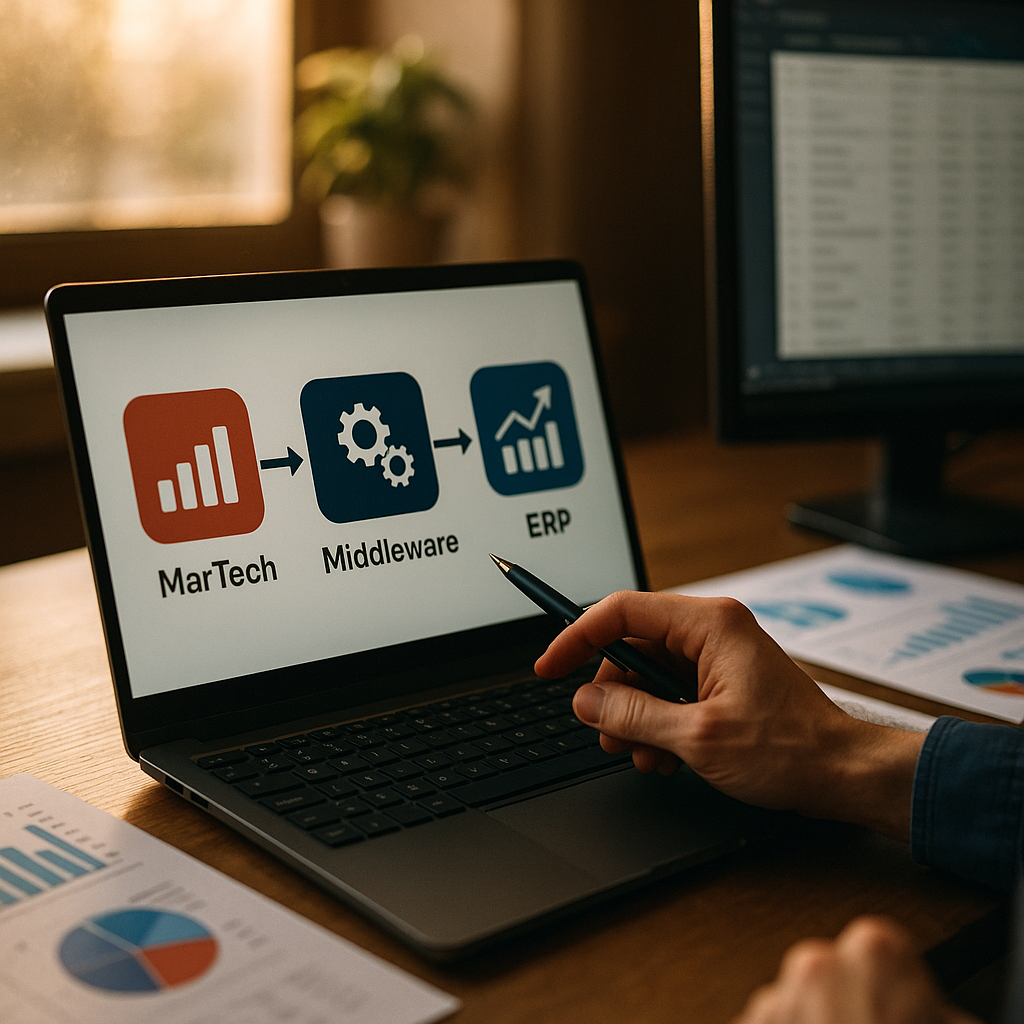
Comparing middleware for connecting MarTech to ERP systems has moved from an IT concern to a revenue-critical decision in 2025. Marketing teams need clean customer and product data, while finance and operations demand accuracy, control, and auditability. The right integration layer keeps both sides aligned without slowing delivery. Choose poorly and you’ll get fragile syncs, data drift, and unhappy stakeholders—so what should you compare?
Integration strategy for MarTech-ERP middleware
Before you compare vendors, define the integration outcomes that matter to both marketing and ERP owners. This prevents “tool-first” selection and surfaces constraints early (data governance, latency, budgets, and security).
Start with the business flows, not the endpoints. Typical MarTech↔ERP flows include:
- Lead-to-cash alignment: syncing account, contact, and opportunity context into marketing automation and CRM, then pushing qualified demand and attribution back to finance.
- Product and pricing consistency: ERP as the source of truth for SKUs, price lists, availability, and bundles; MarTech uses this data for personalization and campaign accuracy.
- Consent and customer preferences: centralizing consent signals and distributing them to email, ads, and web personalization tools.
- Invoice, renewal, and lifecycle triggers: ERP events (invoice posted, payment received, contract renewal window) triggering journeys in MarTech platforms.
Answer these selection questions upfront:
- Real-time vs batch: Do you need near-real-time personalization and stock visibility, or is nightly batch sufficient?
- System of record: Which system owns customer master data, product master data, and financial truth?
- Data model complexity: Are you dealing with multiple ERPs, multiple business units, or multi-currency pricing?
- Change frequency: How often do APIs and schemas change across your MarTech stack?
- Operating model: Will marketing ops build and maintain integrations, or will IT/engineering own them?
This strategy becomes your evaluation rubric: it defines required connectors, transformation rules, SLAs, and governance. It also clarifies what “success” looks like—fewer manual uploads, faster campaign launches, stronger attribution, and fewer reconciliation issues.
iPaaS vs ESB vs API management for ERP integration
Most middleware options for MarTech-to-ERP connectivity fall into three categories. Many vendors combine more than one, but the differences still matter for how you design, secure, and operate integrations.
iPaaS (Integration Platform as a Service) is typically the fastest path to production for common MarTech apps. It offers cloud-based connectors, low-code flows, mapping tools, and orchestration features.
- Best for: rapid deployment, broad SaaS connectors, marketing ops/IT collaboration.
- Trade-offs: complex transformations and advanced CI/CD can be harder; costs can scale with volume.
ESB (Enterprise Service Bus) is more traditional middleware, often used in complex enterprise landscapes with heavy on-prem requirements and strict governance.
- Best for: deep enterprise integration patterns, legacy systems, sophisticated routing and mediation.
- Trade-offs: longer time-to-value, heavier development and operations footprint.
API management focuses on publishing, securing, monitoring, and governing APIs. It is less about building the entire integration and more about controlling access and lifecycle for services you expose (including ERP-backed services).
- Best for: standardizing access to ERP data/services, partner access, security and governance at scale.
- Trade-offs: you still need integration/orchestration tools for complex workflows and data movement.
Practical guidance: If your goal is connecting multiple MarTech tools to ERP with repeatable patterns, an iPaaS-led approach often wins on speed. If you must support significant on-prem ERP connectivity with heavy enterprise policy enforcement, an ESB or hybrid approach may fit better. If your organization is building a “productized integration layer” for many teams, pair integration with API management to create stable contracts and reduce brittle point-to-point dependencies.
Data synchronization and master data management
Most failures in MarTech↔ERP integration are data issues, not connector issues. Comparing middleware should include a deep look at how each option handles data synchronization, identity resolution, and data quality.
Key data capabilities to compare:
- Canonical data modeling: Can you define a common model for customer, account, product, and order events, then map systems to it?
- Bidirectional sync controls: Can you prevent feedback loops and accidental overwrites (for example, ERP “wins” for pricing, CRM “wins” for contacts)?
- Deduplication and matching: Support for deterministic and probabilistic matching (email, ERP customer ID, domain, tax ID) and survivorship rules.
- Schema evolution: How does it handle new fields and deprecations without breaking flows?
- Data validation: Required fields, acceptable value ranges, and quarantine/exception handling.
Decide where master data lives. For many organizations, ERP is the source of truth for products, pricing, invoicing, and legal entities, while CRM (and sometimes a CDP) is the source of truth for engagement identity and segmentation attributes. Middleware should enforce these boundaries with clear ownership rules, not just “last write wins.”
Event-driven vs scheduled sync: Event-driven integration (for example, order created, payment posted) supports timely journeys and better customer experience. But scheduled sync may be safer for complex reconciliations or when ERP APIs have strict throughput limits. The best middleware gives you both patterns with idempotency support, so reprocessing doesn’t create duplicates.
Answer the follow-up question: “Do we need a CDP or MDM tool too?” If you require advanced identity resolution across channels, real-time audience building, and governance for customer profiles, a CDP can complement middleware. If you need enterprise-grade golden records across many operational systems, MDM may be necessary. Middleware still matters because it moves, transforms, and operationalizes the data those platforms manage.
Security, compliance, and governance for marketing data
ERP data is sensitive, and marketing data can be regulated. Middleware must protect both. In 2025, security and governance are core selection criteria—not optional add-ons.
Security requirements to compare:
- Authentication and authorization: Support for modern standards (OAuth, SAML/SSO), service accounts, and fine-grained role-based access control.
- Encryption: Encryption in transit and at rest, plus secret management and key rotation options.
- Network controls: Private connectivity options, IP allowlisting, VPC/VNet integration, and secure on-prem agents when needed.
- Data minimization: Ability to filter and mask fields so marketing tools only receive what they require.
- Auditability: Immutable logs for who changed what, when, and why; exportable audit trails for internal reviews.
Compliance and privacy: Your middleware should help operationalize consent signals and retention policies. For example, when a user withdraws consent, you need reliable downstream deletion or suppression workflows across email platforms, ad audiences, and analytics tools—while preserving required financial records in the ERP.
Governance model: Strong middleware supports environment separation (dev/test/prod), approvals for deployment, and policy enforcement (rate limits, data access policies). This reduces the “shadow integration” problem where quick fixes quietly create ongoing risk.
Follow-up question: “Can marketing have access without risking ERP integrity?” Yes—if you expose controlled, read-optimized ERP views (or APIs) rather than broad table-level access, and if you enforce field-level security and throttling at the middleware layer.
Scalability, performance, and reliability in integration platforms
MarTech usage can spike with campaigns, product launches, and seasonal demand, while ERP systems often have strict performance constraints. Middleware should absorb variability without degrading critical operations.
Performance factors to compare:
- Throughput and concurrency: Maximum events per minute and parallel job execution without hitting ERP API limits.
- Latency: Support for near-real-time paths where it matters (price updates, transactional triggers) and efficient batch for bulk loads.
- Backpressure and queuing: Built-in queuing to protect ERP and smooth traffic bursts.
- Retry and idempotency: Configurable retries with dead-letter queues and replay tools to recover cleanly from failures.
- High availability: Resilience across zones/regions, plus clear SLAs and transparent status reporting.
Reliability is operational, not just architectural. Compare how each platform handles:
- Observability: end-to-end tracing, per-record error visibility, and actionable alerts (not just “job failed”).
- Runbooks and support: documented incident response, support responsiveness, and escalation paths aligned with your business hours.
- Change management: safe deployments, versioning, rollback, and test automation support.
Follow-up question: “How do we prevent integrations from breaking when MarTech apps change?” Favor middleware with connector versioning, contract testing options, and monitoring that detects schema drift. Also, build stable internal contracts (canonical fields and events) so downstream tools can change without forcing redesign of upstream ERP logic.
Total cost of ownership and vendor selection criteria
Middleware costs are rarely limited to license fees. In 2025, the best comparison looks at total cost of ownership (TCO) across build, run, and change.
TCO components to evaluate:
- Licensing model: per connector, per task/flow, per event, per runtime, or per environment. Ask how costs change as you add channels and increase volume.
- Implementation effort: time to build core flows (product sync, order triggers, consent propagation), plus testing and documentation requirements.
- Operational overhead: monitoring, incident response, and support needs. Platforms with strong observability reduce hidden labor costs.
- Skills and staffing: do you need specialized developers, or can a well-governed low-code approach work?
- Lock-in risk: ability to export configurations, reuse mapping logic, and adopt open standards for events and APIs.
Selection criteria checklist (use in demos and trials):
- Connector depth: ERP connector supports required objects and operations (not just basic read). MarTech connectors support webhooks, custom objects, and bulk APIs.
- Transformation strength: mappings, lookups, enrichment, and complex conditional logic without fragile workarounds.
- Governance: approvals, environments, RBAC, audit logs, and policy enforcement.
- Testing and CI/CD: deployment automation, environment promotion, and regression testing capabilities.
- Proof of value: run a pilot with real data and failure scenarios (rate limits, duplicate records, partial outages).
Follow-up question: “What’s a realistic pilot?” Choose one high-impact use case (for example, ERP invoice events triggering lifecycle journeys) and one foundational sync (product and pricing). Validate error handling, replay, monitoring, and governance—not just the happy path.
FAQs about middleware for connecting MarTech to ERP systems
What is the best middleware for connecting MarTech to ERP systems?
The best choice depends on your operating model and requirements. If you need fast deployment across many SaaS marketing tools, an iPaaS is often the strongest fit. If you have heavy on-prem integration and complex enterprise routing needs, an ESB or hybrid approach can be better. If governance and reusable services are priorities, pair integration capabilities with API management.
Should ERP data be pushed into a CDP or pulled on demand?
Push ERP data into a CDP when you need frequent segmentation, identity resolution, and consistent profiles across channels. Pull on demand (via APIs) when you only need small, controlled subsets like real-time price or availability checks. Many organizations use both: a pushed dataset for analytics and segmentation, and API calls for real-time experiences.
How do we avoid duplicates and mismatched customer records?
Define a canonical identifier strategy (ERP customer ID, CRM account ID, and email/domain rules), then enforce survivorship and matching rules in middleware. Require idempotent writes, add validation, and route uncertain matches to a review queue instead of auto-creating new records.
Is real-time integration always necessary for marketing?
No. Use real-time for triggers that affect customer experience or revenue accuracy (renewal reminders, payment failures, price changes). Use batch for high-volume enrichment and reporting where delays are acceptable. A good platform supports both while protecting ERP performance through queuing and rate limiting.
What security features are non-negotiable?
At minimum: SSO/RBAC, encryption in transit and at rest, secret management, comprehensive audit logs, and the ability to restrict and mask sensitive fields. Also confirm private connectivity options if your ERP environment requires it, plus strong monitoring and alerting for abnormal access patterns.
How long does a MarTech-to-ERP middleware implementation typically take?
A focused pilot can be delivered quickly if requirements are clear and data quality is reasonable. Full rollout timing depends on the number of systems, the complexity of data models, governance requirements, and how much change management is needed. Expect more time when you must standardize identifiers, clean data, and align ownership across teams.
Comparing middleware for connecting MarTech to ERP systems comes down to fit: the right tool matches your integration strategy, data ownership rules, and governance needs while delivering reliable performance. In 2025, prioritize platforms that handle identity, security, observability, and change management—not just connectors. Run a pilot on real workflows, test failure scenarios, and validate TCO. The takeaway: choose middleware that protects ERP integrity while accelerating marketing execution.
Top Influencer Marketing Agencies
The leading agencies shaping influencer marketing in 2026
Agencies ranked by campaign performance, client diversity, platform expertise, proven ROI, industry recognition, and client satisfaction. Assessed through verified case studies, reviews, and industry consultations.
Moburst

-
2

The Shelf
Boutique Beauty & Lifestyle Influencer AgencyA data-driven boutique agency specializing exclusively in beauty, wellness, and lifestyle influencer campaigns on Instagram and TikTok. Best for brands already focused on the beauty/personal care space that need curated, aesthetic-driven content.Clients: Pepsi, The Honest Company, Hims, Elf Cosmetics, Pure LeafVisit The Shelf → -
3

Audiencly
Niche Gaming & Esports Influencer AgencyA specialized agency focused exclusively on gaming and esports creators on YouTube, Twitch, and TikTok. Ideal if your campaign is 100% gaming-focused — from game launches to hardware and esports events.Clients: Epic Games, NordVPN, Ubisoft, Wargaming, Tencent GamesVisit Audiencly → -
4

Viral Nation
Global Influencer Marketing & Talent AgencyA dual talent management and marketing agency with proprietary brand safety tools and a global creator network spanning nano-influencers to celebrities across all major platforms.Clients: Meta, Activision Blizzard, Energizer, Aston Martin, WalmartVisit Viral Nation → -
5

The Influencer Marketing Factory
TikTok, Instagram & YouTube CampaignsA full-service agency with strong TikTok expertise, offering end-to-end campaign management from influencer discovery through performance reporting with a focus on platform-native content.Clients: Google, Snapchat, Universal Music, Bumble, YelpVisit TIMF → -
6

NeoReach
Enterprise Analytics & Influencer CampaignsAn enterprise-focused agency combining managed campaigns with a powerful self-service data platform for influencer search, audience analytics, and attribution modeling.Clients: Amazon, Airbnb, Netflix, Honda, The New York TimesVisit NeoReach → -
7

Ubiquitous
Creator-First Marketing PlatformA tech-driven platform combining self-service tools with managed campaign options, emphasizing speed and scalability for brands managing multiple influencer relationships.Clients: Lyft, Disney, Target, American Eagle, NetflixVisit Ubiquitous → -
8

Obviously
Scalable Enterprise Influencer CampaignsA tech-enabled agency built for high-volume campaigns, coordinating hundreds of creators simultaneously with end-to-end logistics, content rights management, and product seeding.Clients: Google, Ulta Beauty, Converse, AmazonVisit Obviously →