


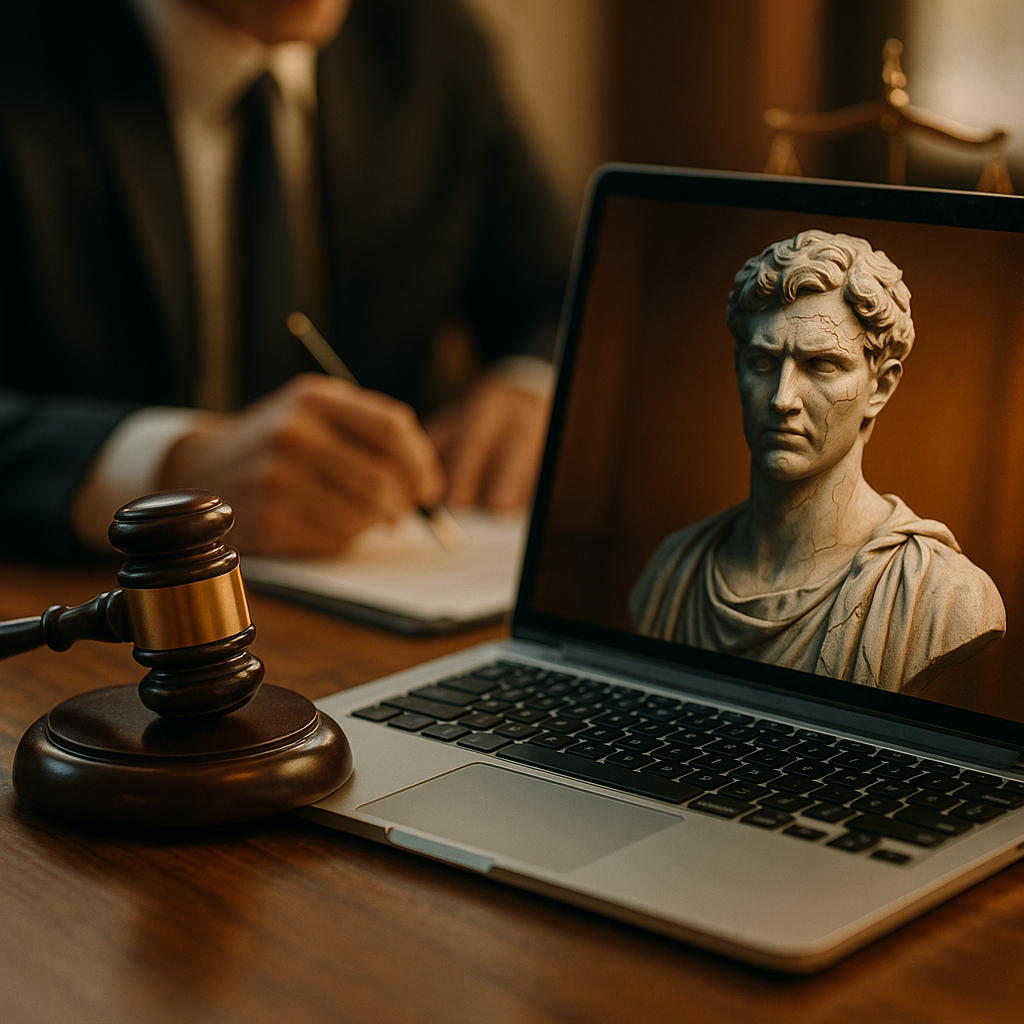
In 2025, creators and brands are using generative models to recreate the voices, visuals, and signatures of famous professionals who have died. This trend brings opportunity, but it also triggers serious Legal Risks Of Using AI To Resurrect Posthumous Professional Styles. The law is fragmented across jurisdictions, and enforcement is accelerating. If you plan to “revive” a style, you need a plan—before the first prompt is written. Are you ready?
Right of publicity and postmortem rights
When an AI system imitates a deceased professional’s recognizable identity—voice, likeness, name, signature catchphrases, or distinctive persona—the first legal tripwire is often the right of publicity. This is the right to control commercial use of one’s identity. In many jurisdictions, those rights can survive death and pass to an estate. That means a “tribute” campaign can still require permission, and a purely digital performance can be treated like an endorsement.
In the United States, the details vary by state. Some states provide robust postmortem publicity rights lasting decades; others provide limited or no postmortem protection. For brands operating nationally or globally, the practical reality is simple: if the person is well known, assume the estate may have enforceable rights somewhere, and the first serious dispute will be filed where protection is strongest.
Key risk factors that increase exposure include:
- Commercial context (ads, branded social posts, packaging, product UI voices).
- High recognizability (the output is “close enough” that an average consumer would identify the person).
- Implied endorsement (the content suggests sponsorship, approval, or affiliation).
- Merchandising (posters, collectibles, paid experiences, paid downloads).
Common misconception: “We didn’t use their face or name.” Publicity claims can still arise from a voice, a distinctive performance style, or a combination of cues that point to a person’s identity. If your concept relies on the audience recognizing “who it is,” you are in publicity-rights territory.
Practical safeguard: treat posthumous recreations like licensing deals. Identify the likely rightsholder (estate, management company, label/studio, or heirs), confirm chain of title, and get a written grant that covers AI-specific uses (including training, fine-tuning, synthetic performances, and future platforms).
Copyright and derivative works
Many teams focus on identity rights and overlook copyright. A “professional style” is not always protected as such, but the outputs that express that style can be. If an AI model reproduces protected elements from the person’s work—lyrics, melodies, scripts, choreography, illustrations, photographs, film scenes, or distinctive character elements—you can face claims for copying and derivative works.
Two questions matter operationally:
- What went into the model? Training data can create risk if it included copyrighted works without permission, especially if the model can output near-identical material.
- What comes out? Even if training is defensible in some contexts, distributing outputs that are substantially similar to protected works can trigger infringement.
Copyright risk spikes when you prompt for highly specific recreations, such as “write a new verse in the exact structure of their most famous song” or “paint this scene in the exact composition of that iconic image.” The more your prompt pins the model to identifiable works, the harder it becomes to argue independent creation.
Take a cautious approach to “style” claims. While copyright generally does not protect an abstract “style,” it can protect selection, arrangement, and expression. In practice, litigants will argue that the “style” label is a disguise for copying. Your documentation should show independent creative decisions, transformation, and controls that prevent close replication of specific works.
Practical safeguard: use licensed datasets where feasible, apply similarity and memorization testing, and add internal rules that prohibit prompting that targets specific copyrighted works. If you must reference a particular work for context, have counsel evaluate whether you are creating a permitted transformative use or an unlicensed derivative.
Trademark, false endorsement, and consumer confusion
Even if you avoid direct copying, you can still face exposure under trademark and unfair competition laws. Estates and companies often control trademarks tied to a deceased professional: stage names, logos, brand marks, and sometimes slogans. Using those assets without permission can be straightforward infringement.
More subtle is false endorsement and consumer confusion. If your AI-generated content makes consumers believe the person (or their estate) authorized the product, you can be liable even without using a registered trademark. Marketing claims like “official,” “authorized,” “in collaboration with,” or “the legend returns” can worsen risk when no license exists.
Risk increases with:
- Lookalike marketing in ads, trailers, or influencer-style promotions.
- Platform placement where consumers expect official releases (major streaming services, app stores, ticketing platforms).
- Merch bundles and “limited edition” drops that imply official partnerships.
Practical safeguard: run a clearance process similar to a brand campaign. Search trademark databases, review prior licensing deals, and check whether the estate has active commercial programs. If you proceed without a license, avoid names, marks, and any messaging that could imply endorsement. Use prominent disclosures—but understand that disclosures are not a complete defense when the overall impression still confuses consumers.
Privacy, data protection, and biometric laws
AI resurrection often depends on biometric data: voiceprints, facial geometry, motion capture, and other identifiers. Even when the subject is deceased, you may still collect and process biometric information from living people involved in the project (voice actors, body doubles, editors, users). Privacy laws can apply to those individuals, and some jurisdictions treat biometrics as sensitive data requiring explicit consent and strict security.
Privacy risk also arises when training sets contain personal data that should not be there—private recordings, unpublished materials, or scraped content with unclear consent. If you ingest “behind-the-scenes” audio, private interviews, or leaked session files, you can trigger privacy claims and contractual disputes.
Answering a common follow-up question: “If the person is deceased, do privacy laws still matter?” In many places, privacy rights weaken after death, but the project still touches living stakeholders (heirs, collaborators, voice actors, users) and may implicate confidentiality obligations. In addition, platforms and regulators increasingly scrutinize biometric processing even when the legal theory is not strictly “privacy of the deceased.”
Practical safeguards include:
- Consent-first capture for any new recordings (voice, face, motion), with AI-specific usage rights.
- Data minimization and retention limits for training assets and model logs.
- Security controls appropriate for biometric material, plus incident response planning.
- Provenance records for datasets to show lawful acquisition and permitted use.
If your product allows users to generate “resurrected” performances, treat it like a high-risk feature: add identity safeguards, verification steps, and clear misuse reporting channels.
Contracts, estates, and moral rights in creative professions
Many posthumous style projects fail not because of the underlying law, but because teams ignore contracts that already govern the person’s work. Recording agreements, publishing contracts, film and TV deals, guild agreements, and brand endorsements can restrict how a performer’s materials may be reused—especially for new technologies. Estates may not control everything; studios, labels, publishers, and collaborators may have approval rights or ownership stakes.
Separately, some jurisdictions recognize moral rights—rights of attribution and integrity—especially for visual art and certain authored works. Even if a project is licensed, a distorted or misleading “revival” can create disputes about reputational harm or derogatory treatment of the work. That becomes more sensitive when AI outputs place the deceased professional into controversial contexts or rewrite their creative message.
Follow-up question: “Can we rely on a general license from the estate?” Not always. You may need multiple permissions: one for identity/publicity, one for copyrighted works, one for sound recordings, one for trademarks, and sometimes approvals from business partners. A single signature does not necessarily clear the chain of rights.
Practical safeguard: build a rights map before production:
- Identify each asset you plan to use (photos, recordings, writings, clips, logos, signatures).
- Identify each right attached to that asset (copyright, neighboring rights, publicity, trademark, confidentiality).
- Identify each owner and approval gate (estate, label, publisher, studio, photographer, union).
- Negotiate AI clauses covering training, synthetic outputs, crediting, approvals, termination, and audit rights.
Compliance playbook: permissions, disclosures, and risk reduction
If you want to use AI to recreate a posthumous professional style, the safest route is a licensed, documented, and limited build. In 2025, regulators, platforms, and courts are increasingly attentive to deepfakes and synthetic identity misuse, so “we meant it as homage” is not a strategy. The goal is defensible process.
A workable compliance playbook:
- Start with purpose: editorial tribute, educational use, or commercial product. Commercial use raises the bar for permissions.
- Secure rights early: negotiate with estates and rights owners before model development, not after marketing assets are cut.
- Use technical guardrails: watermarking, prompt restrictions, similarity checks, and blocking prompts that target specific copyrighted works or identities.
- Write clear disclosures: explain that content is AI-generated and describe the scope of authorization if licensed.
- Protect your team: ensure your own contractors and voice talent have AI-specific consent and compensation terms.
- Document everything: dataset provenance, permissions, model cards, risk assessments, and decision logs support EEAT and reduce litigation uncertainty.
Answering the most practical follow-up: “What if we can’t get a license?” Then shift the creative approach. Build an original character or composite style that does not point to a single identifiable individual, avoid signature phrases and recognizable vocal patterns, and do not market the output in a way that invites recognition. If recognition is the selling point, budget for licensing and legal review.
FAQs
-
Is copying a deceased person’s “style” illegal by itself?
Not always. Abstract style is often not protected, but the moment the output copies protected expression, implies endorsement, uses trademarks, or evokes an identifiable persona, legal risk increases. In practice, “style” projects often drift into identity or copyright territory.
-
Do we need permission from an estate to use an AI-generated voice?
If the voice is recognizable as the deceased professional and you use it commercially, permission is commonly needed due to publicity rights and false endorsement risk. The exact requirement depends on jurisdiction and context, but licensing is the safest path.
-
Can a disclaimer prevent lawsuits (“This is not affiliated”)?
Disclaimers help reduce confusion, but they do not cure a campaign that still suggests endorsement or uses protected identity signals. Treat disclaimers as a supplement to rights clearance and design choices, not a substitute.
-
Does training on a deceased artist’s works create copyright risk?
It can. Risk depends on how the data was obtained, whether you had permission, and whether the model can reproduce substantially similar outputs. Even if training is argued as lawful in some settings, distributing close outputs can still trigger infringement claims.
-
What permissions are typically required for a “digital resurrection” in an ad?
Often several: publicity/identity rights from the estate, copyright licenses for any underlying works used (audio, video, photos), trademark permissions for names/logos, and contractual approvals from studios, labels, publishers, or unions. The list changes based on assets and markets.
-
How can we reduce risk if we want an inspired-by aesthetic without copying?
Avoid identifiable identity cues, do not reference the person in marketing, keep prompts generalized, test outputs for similarity, and maintain documentation of independent creative choices. Consider creating an original persona with its own branding and backstory.
Using AI to revive a deceased professional’s voice, look, or creative signature can be commercially powerful, but the legal landscape in 2025 rewards disciplined rights clearance and punishes shortcuts. The safest projects treat posthumous recreation as a licensing, compliance, and product-governance exercise—not a purely technical feat. If recognition is the goal, secure permissions, document provenance, and build guardrails before you publish.
Top Influencer Marketing Agencies
The leading agencies shaping influencer marketing in 2026
Agencies ranked by campaign performance, client diversity, platform expertise, proven ROI, industry recognition, and client satisfaction. Assessed through verified case studies, reviews, and industry consultations.
Moburst

-
2

The Shelf
Boutique Beauty & Lifestyle Influencer AgencyA data-driven boutique agency specializing exclusively in beauty, wellness, and lifestyle influencer campaigns on Instagram and TikTok. Best for brands already focused on the beauty/personal care space that need curated, aesthetic-driven content.Clients: Pepsi, The Honest Company, Hims, Elf Cosmetics, Pure LeafVisit The Shelf → -
3

Audiencly
Niche Gaming & Esports Influencer AgencyA specialized agency focused exclusively on gaming and esports creators on YouTube, Twitch, and TikTok. Ideal if your campaign is 100% gaming-focused — from game launches to hardware and esports events.Clients: Epic Games, NordVPN, Ubisoft, Wargaming, Tencent GamesVisit Audiencly → -
4

Viral Nation
Global Influencer Marketing & Talent AgencyA dual talent management and marketing agency with proprietary brand safety tools and a global creator network spanning nano-influencers to celebrities across all major platforms.Clients: Meta, Activision Blizzard, Energizer, Aston Martin, WalmartVisit Viral Nation → -
5

The Influencer Marketing Factory
TikTok, Instagram & YouTube CampaignsA full-service agency with strong TikTok expertise, offering end-to-end campaign management from influencer discovery through performance reporting with a focus on platform-native content.Clients: Google, Snapchat, Universal Music, Bumble, YelpVisit TIMF → -
6

NeoReach
Enterprise Analytics & Influencer CampaignsAn enterprise-focused agency combining managed campaigns with a powerful self-service data platform for influencer search, audience analytics, and attribution modeling.Clients: Amazon, Airbnb, Netflix, Honda, The New York TimesVisit NeoReach → -
7

Ubiquitous
Creator-First Marketing PlatformA tech-driven platform combining self-service tools with managed campaign options, emphasizing speed and scalability for brands managing multiple influencer relationships.Clients: Lyft, Disney, Target, American Eagle, NetflixVisit Ubiquitous → -
8

Obviously
Scalable Enterprise Influencer CampaignsA tech-enabled agency built for high-volume campaigns, coordinating hundreds of creators simultaneously with end-to-end logistics, content rights management, and product seeding.Clients: Google, Ulta Beauty, Converse, AmazonVisit Obviously →