


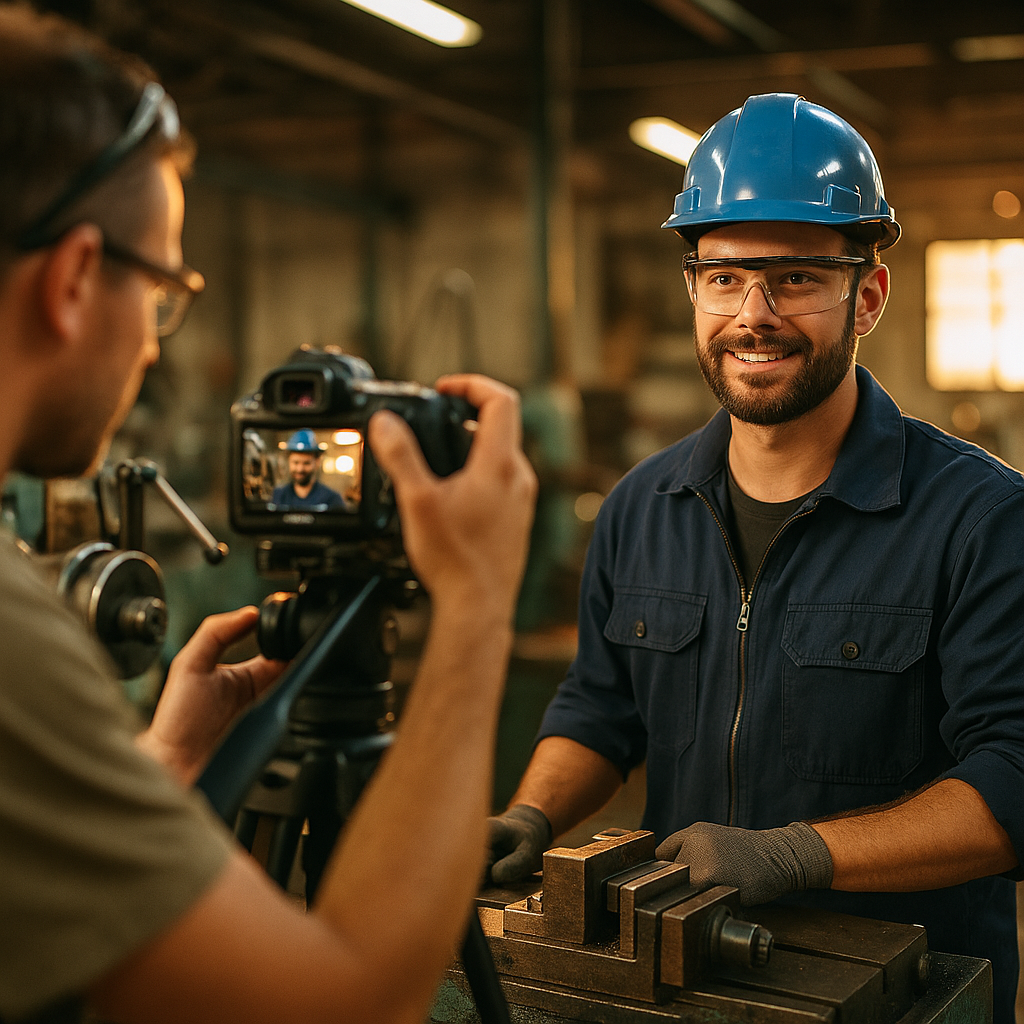
In 2025, manufacturers face a trust gap: buyers and job candidates want proof of people, not just process. This case study shows how one traditional plant used video marketing for manufacturers to reveal the humans behind the machines—without compromising safety, quality, or professionalism. You’ll see what they filmed, how they earned buy-in, and the exact results they tracked. Ready to meet the team?
Why video storytelling in manufacturing matters now
Stonebrook Components (a 40-year-old mid-sized manufacturer of precision metal parts for industrial OEMs) had a familiar problem: their reputation was strong in engineering circles, but their brand felt faceless online. Procurement teams knew their tolerances and lead times. Few people knew their culture, their craftsmanship, or why long-tenured employees stayed.
The leadership team identified three business goals tied to one insight: trust is built faster when audiences can see and hear real people. They wanted to:
- Increase inbound RFQs from new OEM accounts that weren’t already in their network.
- Improve recruiting for hard-to-fill roles (CNC operators, quality techs, maintenance).
- Reduce sales friction by answering common “who are you?” questions before calls.
They already had written case studies and a capabilities deck. Engagement was modest, and the content didn’t translate well to social platforms where candidates spend time. The marketing lead proposed a focused video program: not glossy brand films, but short, credible, repeatable stories featuring employees doing real work.
To align with helpful-content expectations and EEAT, Stonebrook treated the project like a quality initiative: documented processes, clear approvals, and measurable outcomes. The goal wasn’t to “go viral.” It was to communicate competence and character consistently.
Humanizing industrial brands with employee-led videos
Stonebrook built the content around the people buyers and candidates rarely meet: machinists, inspectors, planners, and maintenance leads. They used a simple editorial principle: every video must teach something useful or reveal a decision-making standard. That kept the content from feeling like forced “culture” messaging.
They launched three employee-led series:
- “Meet the Makers”: 60–90 second profiles showing an employee’s role, what quality means to them, and one personal detail (how they got into the trade, a mentor, a skill they’re proud of).
- “Quality in Action”: 45–75 second explainers featuring inspectors and engineers demonstrating how parts are verified (without revealing proprietary specs).
- “A Day on the Line”: 30–45 second vertical clips that follow one task from setup to sign-off, emphasizing safety and process discipline.
Each video followed a consistent structure:
- Hook: a plainspoken statement (“If this gauge fails, the whole batch stops.”).
- Proof: show the work, the tools, and the standards used.
- Human moment: why the person cares, what they’ve learned, or what they wish customers understood.
- Next step: link to a capability page, an open role, or a “request a tour” form.
To address a common follow-up question—“Won’t employees feel awkward on camera?”—Stonebrook avoided scripts. They used bullet prompts and coached for clarity. The on-camera subjects approved final cuts before publishing, which improved participation and reduced rework.
B2B manufacturing video strategy: planning, safety, and approvals
Traditional manufacturers often stall on video because of safety, compliance, and IP concerns. Stonebrook solved this with a lightweight governance workflow that mirrored how they manage production changes:
- Risk review: the safety manager reviewed shot lists to prevent unsafe behaviors from being filmed (PPE, lockout/tagout areas, forklift aisles).
- IP screen: engineering flagged visuals that might reveal proprietary processes, customer part numbers, or sensitive drawings.
- Brand and HR check: HR verified permissions, and marketing ensured claims were accurate and specific.
They created a “film-safe zone map” of the plant: green areas for open filming, yellow areas requiring escort, and red areas not filmed. That single document reduced delays and helped supervisors feel in control.
On the production side, they chose a practical setup:
- Two-person crew: one shooter/editor and one producer handling interviews and releases.
- Simple gear: mirrorless camera, lav mic, compact lights, and a phone for vertical clips.
- Batch filming: one half-day per month captured 8–12 assets (long cut, short cut, stills, and quotes).
They also set rules that supported credibility:
- No exaggeration: avoid sweeping claims like “best in the industry.” Replace with verifiable statements (certifications, inspection steps, response times).
- Show real constraints: when talking lead times, explain what drives them and how the team reduces risk.
- Use real titles: name the employee’s role and tenure when relevant, which builds trust without oversharing.
This planning answered another frequent follow-up—“How do we prevent video from disrupting production?”—by making filming predictable, limited, and coordinated with supervisors.
Authentic behind-the-scenes manufacturing content: what they filmed
Stonebrook’s highest-performing videos were not the ones with the most cinematic shots. They were the ones that clarified how the company thinks. The team leaned into “behind-the-scenes,” but always with a purpose: demonstrate standards, not just scenery.
Key content themes included:
- Quality checkpoints: first-article inspection, gauge calibration, and what triggers a stop-and-fix decision.
- Problem-solving: a maintenance lead explaining how they prevent unplanned downtime and why preventive work matters to customers.
- Craft skills: a machinist describing how they confirm setup, interpret a drawing, and avoid scrap.
- Customer impact: an engineer explaining how a tolerance issue affects assembly downstream, framed in plain language.
To humanize the team without becoming performative, Stonebrook used three authenticity tactics:
- Natural audio: they kept a little ambient shop sound under the voiceover to maintain realism, while ensuring speech remained clear.
- Real questions: interview prompts came from sales calls and recruiting screens (“What would you tell a new customer?” “What surprises new hires?”).
- On-screen proof points: where appropriate, they displayed non-sensitive artifacts like a checklist, a generic gauge reading, or a training sign-in board.
They also avoided a common trap: filming only leadership. Leaders appeared in a limited set of videos focused on decision-making (investment in training, safety philosophy, quality expectations). The main characters remained the people doing the work, which matched the goal of humanizing the brand.
Recruiting and sales results from manufacturing video marketing
Stonebrook measured outcomes like an operations team would: a few metrics tied to each goal, tracked monthly, and reviewed in a short meeting with sales and HR. They did not attribute every win to video; they looked for contribution and patterns.
Top-of-funnel impact (brand and inbound)
- Website time-on-page increased on pages with embedded video, and the sales team reported fewer “tell me about your shop” questions on first calls.
- RFQ submissions improved from new accounts after prospects watched the “Quality in Action” series during the evaluation stage.
Sales enablement impact
- Sales reps added a short “Meet the Makers” playlist to follow-up emails after introductory calls.
- Prospects arrived at plant tours with more specific questions, which made tours shorter and more productive.
Recruiting impact
- HR used role-specific clips in job postings and in outreach messages to candidates.
- Interview drop-off decreased because candidates had a clearer picture of the environment and expectations before scheduling.
Stonebrook also tracked internal effects, which many teams overlook:
- Employee pride: featured employees shared the videos with family and friends, expanding reach organically.
- Manager alignment: supervisors appreciated having a consistent way to explain standards to new hires.
To keep the program accountable, they defined a “good video” operationally: it must be published on schedule, meet safety/IP requirements, and move at least one key metric (applications, RFQs, email replies, or tour requests) in the right direction over a quarter. Anything else was considered a creative experiment, not core output.
EEAT best practices for industrial video content in 2025
Stonebrook’s approach worked because it aligned with how people evaluate expertise and trust online. In 2025, audiences expect evidence. They also expect clarity, accessibility, and responsible publishing.
Here are the EEAT practices they built into the workflow:
- Experience: on-camera employees described what they do daily and showed it. Viewers could see hands-on competence, not abstract claims.
- Expertise: technical statements were reviewed by engineering or quality, and videos included context (“why this check matters”) rather than jargon alone.
- Authoritativeness: Stonebrook connected videos to supporting pages that included certifications, equipment lists, and documented processes, creating a consistent proof trail.
- Trust: they avoided hidden edits that could mislead; they didn’t show unsafe actions; they obtained releases; they respected customer confidentiality.
They also improved accessibility and search value:
- Transcripts and captions for every video to support comprehension and indexing.
- Clear titles and descriptions using the same terms prospects use (inspection, CNC setup, preventive maintenance), not internal acronyms.
- Dedicated landing pages that answered follow-up questions: tolerances handled, materials, typical volumes, quality steps, and how to start an RFQ.
If you’re considering a similar initiative, Stonebrook’s most practical lesson is this: treat video like a repeatable production line. Make it safe, measurable, and easy for employees to participate. That’s how you publish enough to earn trust over time.
FAQs: Video to humanize a manufacturing team
- How do we get shop-floor employees comfortable on camera?
Use short formats, avoid scripts, and film in familiar settings with minimal crew. Ask practical questions they can answer confidently, and let them approve the final edit. Start with volunteers, then expand as others see respectful results.
- What should we avoid filming in a traditional manufacturing plant?
Avoid unsafe behaviors, restricted areas, proprietary processes, customer-identifying details, and sensitive documents (work orders, drawings, part numbers). Create a film-safe zone map and require a quick safety and IP review before each shoot.
- Do we need expensive production to build trust?
No. Trust comes from clarity and proof. Clean audio, steady shots, and good lighting matter more than cinematic effects. Viewers respond to real explanations of standards, checks, and problem-solving.
- Which video topics help sales the most?
Topics that reduce uncertainty: quality checkpoints, lead-time drivers, how you handle nonconformances, capacity planning, and how you communicate during disruptions. Short “how we ensure X” videos often outperform generic brand reels.
- How do we measure ROI from manufacturing videos?
Tie metrics to goals: RFQ submissions, tour requests, email reply rates, time-on-page, conversion rate on job postings, and interview-to-offer rates. Track usage in sales sequences and HR outreach to see which videos influence real actions.
- Where should a manufacturer publish these videos?
Publish on your website (embedded on relevant pages), on your primary social channel where candidates engage, and in sales/recruiting emails. Organize content into playlists by topic (quality, capabilities, careers) so viewers can self-educate.
Stonebrook didn’t humanize its brand by chasing trends; it did it by showing standards through people. In 2025, that approach builds trust with buyers and clarity for candidates. The takeaway is simple: pick employee-led formats, protect safety and IP with a clear workflow, and publish consistently. When customers can see how your team thinks, decisions get easier.
Top Influencer Marketing Agencies
The leading agencies shaping influencer marketing in 2026
Agencies ranked by campaign performance, client diversity, platform expertise, proven ROI, industry recognition, and client satisfaction. Assessed through verified case studies, reviews, and industry consultations.
Moburst

-
2

The Shelf
Boutique Beauty & Lifestyle Influencer AgencyA data-driven boutique agency specializing exclusively in beauty, wellness, and lifestyle influencer campaigns on Instagram and TikTok. Best for brands already focused on the beauty/personal care space that need curated, aesthetic-driven content.Clients: Pepsi, The Honest Company, Hims, Elf Cosmetics, Pure LeafVisit The Shelf → -
3

Audiencly
Niche Gaming & Esports Influencer AgencyA specialized agency focused exclusively on gaming and esports creators on YouTube, Twitch, and TikTok. Ideal if your campaign is 100% gaming-focused — from game launches to hardware and esports events.Clients: Epic Games, NordVPN, Ubisoft, Wargaming, Tencent GamesVisit Audiencly → -
4

Viral Nation
Global Influencer Marketing & Talent AgencyA dual talent management and marketing agency with proprietary brand safety tools and a global creator network spanning nano-influencers to celebrities across all major platforms.Clients: Meta, Activision Blizzard, Energizer, Aston Martin, WalmartVisit Viral Nation → -
5

The Influencer Marketing Factory
TikTok, Instagram & YouTube CampaignsA full-service agency with strong TikTok expertise, offering end-to-end campaign management from influencer discovery through performance reporting with a focus on platform-native content.Clients: Google, Snapchat, Universal Music, Bumble, YelpVisit TIMF → -
6

NeoReach
Enterprise Analytics & Influencer CampaignsAn enterprise-focused agency combining managed campaigns with a powerful self-service data platform for influencer search, audience analytics, and attribution modeling.Clients: Amazon, Airbnb, Netflix, Honda, The New York TimesVisit NeoReach → -
7

Ubiquitous
Creator-First Marketing PlatformA tech-driven platform combining self-service tools with managed campaign options, emphasizing speed and scalability for brands managing multiple influencer relationships.Clients: Lyft, Disney, Target, American Eagle, NetflixVisit Ubiquitous → -
8

Obviously
Scalable Enterprise Influencer CampaignsA tech-enabled agency built for high-volume campaigns, coordinating hundreds of creators simultaneously with end-to-end logistics, content rights management, and product seeding.Clients: Google, Ulta Beauty, Converse, AmazonVisit Obviously →