


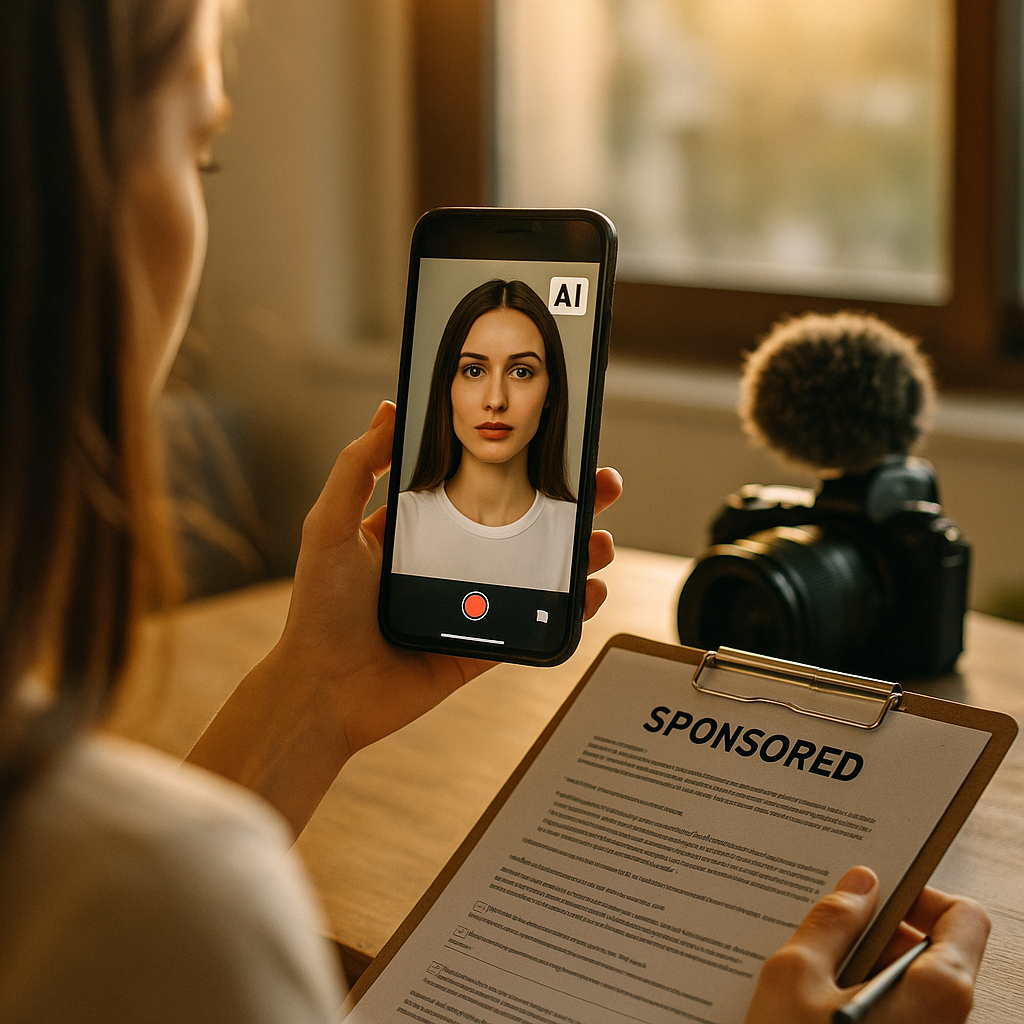
Branded AI influencers can scale storytelling, but they also raise hard questions about transparency and trust. In 2025, Navigating Legal Disclosure Requirements For Branded AI Influencers means aligning marketing goals with fast-moving ad rules, platform policies, and consumer protection standards. This guide explains what to disclose, where to disclose it, and how to operationalize compliance without killing creativity—because one unclear post can trigger outsized risk.
Advertising disclosure rules for AI influencers
Most disclosure obligations do not turn on whether the endorser is human or synthetic. Regulators focus on what the audience experiences: a marketing message that could mislead if the material relationship or persuasive intent is unclear. If your branded AI influencer promotes a product, appears to recommend it, or “reviews” it in a way that could affect purchasing decisions, treat it like an endorsement and disclose accordingly.
Core principles that drive enforcement:
- Clear and conspicuous: Disclosures must be easy to notice and understand on the first viewing, not buried in a profile link or a long caption.
- Proximity: Place the disclosure near the claim or endorsement, not separated by “more” truncation or multiple swipes without repeating the disclosure.
- Plain language: Use simple terms like “Ad,” “Paid partnership,” or “Sponsored”—avoid vague tags like #sp if the platform/audience may not understand it.
- Format-matched: If the message is audio/video, include verbal and on-screen disclosures; if it’s a short-form video, disclose early and keep it on-screen long enough to read.
What counts as a “material connection” for an AI influencer? Any relationship that could affect the credibility of the endorsement: payment, free product, commissions, equity, affiliate links, gifts, travel, or even a brand’s control over the AI character’s script and distribution. When the brand owns the AI influencer, the connection is usually direct and should be disclosed prominently.
Practical takeaway: Assume disclosure is required whenever the branded AI influencer’s content is promotional or could reasonably be perceived as impartial advice. If you’re debating whether it’s “really an ad,” disclose.
Sponsored content compliance across platforms
Platform tools help but rarely solve everything. Using a “Paid partnership” label is a strong start, yet you still need readable disclosures in the content itself when required by local rules and to prevent viewers from missing the label.
Placement guidance that holds up under scrutiny:
- Short-form video: Put “Ad” or “Paid partnership with [Brand]” in the first seconds on-screen, and repeat in the caption. If the AI influencer speaks, include a short verbal disclosure at the start.
- Stories/Reels with multiple frames: Repeat disclosures on each frame where the product is featured or claims are made.
- Livestreams: Disclose at the beginning and periodically, especially after new viewers join. Pin a disclosure comment when possible.
- Affiliate content: Use explicit language like “I earn a commission if you buy” near the link or call-to-action.
- Product claims: Keep disclosures separate from substantiation. A disclosure doesn’t cure an untrue claim; you still need evidence for performance, health, or comparative statements.
Answering the common follow-up: “Can we put the disclosure only in the profile bio?” No. Bios are not proximate to individual posts and are easy to miss. Treat each piece of sponsored content as needing its own disclosure.
Workflow tip: Build a pre-publish checklist into your content pipeline: (1) Is this promotional? (2) Is there any material connection? (3) Does the disclosure appear in the first screen/seconds? (4) Is it readable on mobile? (5) Is it repeated where necessary?
FTC endorsement guidelines and material connections
If you market to U.S. audiences, expect enforcement to follow the principle that endorsements must not mislead and must disclose material connections. The fact that the speaker is an AI character doesn’t reduce obligations; it can increase scrutiny if consumers might assume a neutral persona.
Where teams get exposed:
- “Character reviews” that look independent: If a branded AI influencer “tests” competing products but is owned by or paid by one brand, the relationship must be obvious, and claims must be substantiated.
- Employee-like control: When the brand scripts, edits, or approves content, the AI influencer is effectively a brand channel. Disclose that the content is an ad when it promotes products.
- UGC-style ads: If you run AI influencer content as paid media, disclosures still matter. Viewers should not be tricked into thinking it’s organic, independent commentary.
- Influencer networks and agencies: If an agency supplies an AI character and you pay for posts, both parties may share responsibility for compliance. Align contract terms and approvals.
Practical language that tends to be understood:
- “Ad: I’m a virtual brand ambassador for [Brand].”
- “Paid partnership with [Brand].”
- “Sponsored: [Brand] provided this product (and paid me) to feature it.”
Substantiation reminder: If the AI influencer claims “clinically proven,” “fastest,” “burns fat,” or “works in 24 hours,” you need competent and reliable evidence. Disclosures do not replace proof.
AI transparency and synthetic media labeling
Disclosure isn’t only about sponsorship. Audiences, platforms, and some jurisdictions increasingly expect transparency that content is AI-generated or that the presenter is not a real human. Even when not strictly required everywhere, synthetic media labeling supports trust, reduces deception risk, and aligns with platform integrity policies.
What to label:
- The identity: State that the influencer is virtual or AI-generated when a reasonable viewer might assume they are human.
- The media: If images, voice, or video are AI-generated or materially edited, use platform labels (when available) and a plain-language note where appropriate.
- The intent: If the content is advertising, say so clearly in addition to any AI label.
How to combine labels without confusing people: Use a two-part disclosure: one for sponsorship and one for synthetic identity. Example: “Ad • Virtual AI character • Paid partnership with [Brand].” Keep it short, front-loaded, and consistent.
Follow-up question readers ask: “Do we need to disclose the model or tools used?” Typically, regulators focus more on consumer deception than toolchain details. Disclose what matters to audience understanding: that the persona is virtual and that the message is sponsored. If you operate in highly regulated sectors (health, finance, political), your risk analysis may justify additional detail.
Deepfake risk boundary: Never design an AI influencer to mimic a real person without clear authorization, and avoid voice or likeness similarities that could confuse viewers. This is both a legal and reputational hazard.
Brand risk management and documentation
Strong compliance programs are operational, not aspirational. Regulators and platforms often look for whether you had reasonable procedures, trained staff, and corrected issues quickly. In 2025, the most defensible posture is documented diligence.
Build a disclosure governance system:
- Policy: A short internal policy defining when disclosures are required, approved disclosure language, and placement rules by format.
- Roles: Assign accountable owners (marketing lead, legal/compliance reviewer, creative lead) and define escalation triggers (health claims, minors, regulated products, comparative claims).
- Templates: Pre-approved caption blocks, on-screen disclosure cards, and audio disclosure scripts.
- Version control: Archive source files, captions, and approval records for each post, including disclosure placement screenshots.
- Monitoring: Spot-check published posts, paid ads, and reposts by partners. Fix quickly and document corrections.
Contract clauses to reduce chaos:
- Disclosure obligations: Require compliant disclosures in specified formats and placements.
- Approval rights: Give the brand the right to review and require edits for compliance.
- Substantiation cooperation: Prevent unsupported claims; require claim review for regulated categories.
- Indemnities and remedies: Clarify responsibility if a partner posts noncompliant content.
Special caution areas: Marketing to minors, health/wellness, financial products, and any content that looks like professional advice. If your AI influencer provides “tips,” add guardrails: avoid individualized guidance, avoid guarantees, and add clear context and disclaimers where appropriate.
Global legal considerations for influencer marketing
Branded AI influencers routinely reach cross-border audiences, so “one-size” disclosures can fall short. While principles are similar globally—don’t mislead, disclose material connections, label ads—local expectations differ in wording, placement, and enforcement intensity.
How to stay compliant without tailoring every post to every country:
- Use the strictest reasonable standard: Prominent “Ad” labeling, early placement, and repetition in multi-part content generally satisfies most regimes.
- Geo-target when possible: If you run paid campaigns, segment by region and apply local language disclosures where required.
- Maintain a jurisdiction matrix: Track your key markets, platform rules, and required terminology. Update it quarterly or after platform policy changes.
- Local counsel for regulated launches: For high-risk categories (supplements, medical, alcohol, gambling, finance), get local review before scaling.
Answering a frequent operational question: “Can we rely on platform disclosure tools worldwide?” Treat platform tools as additive. Many regulators expect disclosures inside the content, and tools may not display consistently across devices or reposts.
FAQs
Do branded AI influencers need to disclose that they are AI?
Often, yes as a best practice, and sometimes due to platform rules or local synthetic media expectations. If viewers could reasonably think the persona is human, labeling the influencer as virtual/AI helps avoid deception and supports trust.
Is “#ad” enough for sponsored AI influencer posts?
It can be sufficient when it is clear, prominent, and placed where viewers will see it immediately (not after truncation). For video, add on-screen and, when feasible, verbal disclosure. Combine with platform “Paid partnership” tools when available.
What if the brand owns the AI influencer—do we still need a disclosure?
Yes, when the content promotes the brand’s products or includes endorsements that could influence buying decisions. Ownership is a material connection, and viewers should not be left to infer it.
How should we disclose affiliate links used by an AI influencer?
Use plain language near the link or call-to-action: “Affiliate link—I may earn a commission if you buy.” Also label the post as an ad if the overall content is sponsored or promotional.
Can an AI influencer make product performance or health claims?
Yes, but only if the brand has appropriate substantiation. High-risk claims (health, weight loss, financial outcomes) require especially strong evidence and careful wording. Disclosures do not fix unsupported claims.
What are the biggest compliance mistakes brands make with AI influencers?
Burying disclosures, relying only on a bio or hashtag pile, failing to repeat disclosures in multi-frame content, mixing AI identity labels with sponsorship in a confusing way, and approving bold claims without substantiation or documentation.
Branded AI influencers can deliver efficient, consistent campaigns, but compliance must be built into every post. Disclose sponsorship clearly, disclose material connections consistently, and label synthetic identity when viewers could be misled. Pair those disclosures with claim substantiation, platform-appropriate placement, and documented approvals. In 2025, the safest strategy is simple: make the commercial nature and the virtual nature obvious—before the audience has to guess.
Top Influencer Marketing Agencies
The leading agencies shaping influencer marketing in 2026
Agencies ranked by campaign performance, client diversity, platform expertise, proven ROI, industry recognition, and client satisfaction. Assessed through verified case studies, reviews, and industry consultations.
Moburst

-
2

The Shelf
Boutique Beauty & Lifestyle Influencer AgencyA data-driven boutique agency specializing exclusively in beauty, wellness, and lifestyle influencer campaigns on Instagram and TikTok. Best for brands already focused on the beauty/personal care space that need curated, aesthetic-driven content.Clients: Pepsi, The Honest Company, Hims, Elf Cosmetics, Pure LeafVisit The Shelf → -
3

Audiencly
Niche Gaming & Esports Influencer AgencyA specialized agency focused exclusively on gaming and esports creators on YouTube, Twitch, and TikTok. Ideal if your campaign is 100% gaming-focused — from game launches to hardware and esports events.Clients: Epic Games, NordVPN, Ubisoft, Wargaming, Tencent GamesVisit Audiencly → -
4

Viral Nation
Global Influencer Marketing & Talent AgencyA dual talent management and marketing agency with proprietary brand safety tools and a global creator network spanning nano-influencers to celebrities across all major platforms.Clients: Meta, Activision Blizzard, Energizer, Aston Martin, WalmartVisit Viral Nation → -
5

The Influencer Marketing Factory
TikTok, Instagram & YouTube CampaignsA full-service agency with strong TikTok expertise, offering end-to-end campaign management from influencer discovery through performance reporting with a focus on platform-native content.Clients: Google, Snapchat, Universal Music, Bumble, YelpVisit TIMF → -
6

NeoReach
Enterprise Analytics & Influencer CampaignsAn enterprise-focused agency combining managed campaigns with a powerful self-service data platform for influencer search, audience analytics, and attribution modeling.Clients: Amazon, Airbnb, Netflix, Honda, The New York TimesVisit NeoReach → -
7

Ubiquitous
Creator-First Marketing PlatformA tech-driven platform combining self-service tools with managed campaign options, emphasizing speed and scalability for brands managing multiple influencer relationships.Clients: Lyft, Disney, Target, American Eagle, NetflixVisit Ubiquitous → -
8

Obviously
Scalable Enterprise Influencer CampaignsA tech-enabled agency built for high-volume campaigns, coordinating hundreds of creators simultaneously with end-to-end logistics, content rights management, and product seeding.Clients: Google, Ulta Beauty, Converse, AmazonVisit Obviously →