


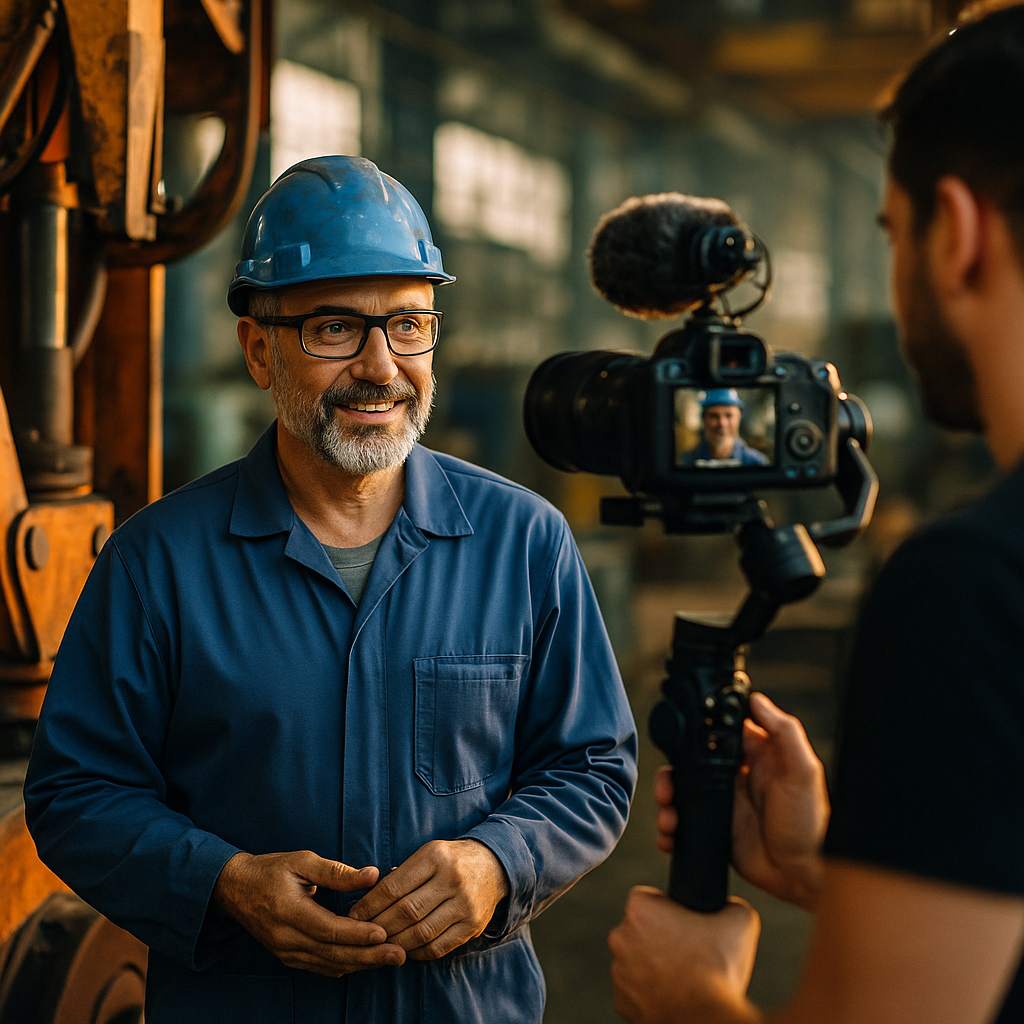
In 2025, buyers of industrial equipment still buy from people they trust. This case study shows how a traditional manufacturer using video to humanize industrial brands can shorten sales cycles, improve lead quality, and strengthen recruitment by revealing the expertise behind the machines. You will see the strategy, production approach, and governance that made it work—plus what to copy without copying mistakes.
Video marketing case study overview: the manufacturer, market, and baseline
Company profile (anonymized but representative): A 70+ year-old, privately owned manufacturer of precision components used in packaging lines, food processing machinery, and material handling. It sells through a mix of direct sales and distributors across North America and Europe. Average deal size is mid-five figures, with complex specifications and a long evaluation process.
What “humanize” meant in their context: Not soft storytelling for its own sake, but making technical decisions feel safe by showing the engineers, machinists, quality leads, and service technicians who stand behind the product. The brand wanted to replace “cold catalog” perception with credibility, responsiveness, and pride in workmanship.
Baseline challenges:
- Low trust at first touch: Prospects treated the firm like a commodity supplier, even when tolerances and uptime performance justified premium pricing.
- High friction in pre-sales: Sales spent hours repeating the same explanations about materials, certifications, lead times, and installation constraints.
- Distributor inconsistency: Channel partners varied widely in how they described the product and capabilities.
- Recruiting headwinds: Skilled applicants did not understand the work environment or growth path, and many never applied.
Target audience: Plant managers, maintenance leaders, procurement, and OEM design engineers. Each group cared about different proof points: reliability, serviceability, compliance, and manufacturability.
Success definition: The team did not start with vanity metrics. They set clear business outcomes: increase qualified inquiries, reduce time-to-quote, improve close rates on complex assemblies, and strengthen hiring pipeline quality.
Industrial brand storytelling: turning expertise into watchable proof
The manufacturer treated storytelling as structured evidence. Every video needed to answer a buyer’s real question: “Can you solve my problem reliably, and will it be easy to work with you?” That framing kept content practical and prevented “feel-good” videos that did not move revenue.
Core narrative pillars (used across the channel):
- Precision you can see: Tight tolerance work, metrology, and repeatability shown visually with measurement tools and QC routines.
- People who own outcomes: Engineers explaining design tradeoffs; machinists describing process controls; service techs demonstrating preventative maintenance.
- Reliability under constraints: How parts behave under washdown, temperature swings, vibration, and continuous duty cycles.
- Partnership culture: How the firm handles changes, expedites, root-cause analysis, and documentation.
Video formats that performed best:
- “Engineer-to-engineer” explainers (3–6 minutes): A design engineer walks through a common application, specifying what matters and why.
- Manufacturing process spotlights (2–4 minutes): Short, tightly edited tours of one process step (e.g., CNC, heat treatment, passivation, inspection).
- Service walkthroughs (4–8 minutes): Maintenance tips that reduce downtime and position the brand as helpful before the purchase.
- Customer problem-solution stories (2–5 minutes): Focused on constraints, decision criteria, and measurable outcomes, with approvals and compliance review.
How they kept it credible: They avoided over-claiming. When a result depended on application conditions, the on-camera expert said so. That honesty increased trust with engineers and procurement teams who are trained to question marketing language.
Follow-up question buyers usually ask: “Do you have experience in my industry?” The team answered inside the videos by including quick context cues (materials, standards, environment) and linking to a relevant spec sheet or application note on the same page.
B2B video strategy: content mapping to the industrial buyer journey
Instead of publishing randomly, the manufacturer mapped video to the buyer journey and to internal sales motions. This prevented the common failure where marketing produces content that never gets used by sales.
Awareness (first touch):
- Goal: Establish competence and relevance in under 60 seconds.
- Content: Short “what we make and who we help” clips, plus application snippets (e.g., “Designed for washdown packaging lines”).
- Distribution: Website homepage, product category pages, LinkedIn, and distributor portals.
Consideration (evaluation and comparison):
- Goal: Reduce uncertainty, help spec decisions, and demonstrate process control.
- Content: Engineer explainers, process spotlights, and “common mistakes” videos that show practical know-how.
- Sales enablement: A small library of “send-after-call” videos aligned to the top 20 objections and questions.
Decision (quote and sign-off):
- Goal: Make approval easier for procurement and leadership.
- Content: Quality system overview, compliance documentation walkthrough, packaging and shipping standards, and “what happens after you place an order.”
- Website integration: Embedded videos on quote-request and product pages, paired with clear next steps.
Post-sale (retention and expansion):
- Goal: Reduce support load and increase repeat purchases.
- Content: Installation guides, PM routines, troubleshooting checklists, and training for distributor service teams.
Recruiting (parallel journey): The company added “day-in-the-life” videos and supervisor interviews. These were not polished commercials; they were clear, respectful previews of the work, safety culture, and growth path.
Measurement discipline: Each stage had a primary metric tied to business value: qualified form fills, meetings booked, quote requests, sales cycle time, and fewer repetitive support tickets. View counts were tracked, but not treated as success by default.
Manufacturing video production: practical workflow, compliance, and cost control
The manufacturer assumed it needed an agency and a large budget. It did not. The winning approach combined a small internal “video pod” with occasional specialist support.
Team structure:
- Internal owner (marketing lead): Manages the editorial calendar, stakeholder approvals, and distribution.
- On-camera experts: Engineers, quality managers, and service technicians trained to present clearly and safely.
- Production partner (as needed): A local videographer for multi-camera shoots, lighting, and audio in loud environments.
Safety, IP, and compliance guardrails (non-negotiable):
- Safety-first filming rules: PPE compliance, no filming near restricted zones, and a production safety checklist signed by operations.
- IP and customer privacy: No customer drawings, proprietary fixtures, or confidential assemblies on camera unless cleared in writing.
- Claims substantiation: Any performance claim required documented test evidence or a clearly stated scope and conditions.
- Accessibility: Captions for all videos and transcript text for on-page SEO and usability.
Repeatable production workflow:
- Question-first scripting: Each video starts from a buyer question and ends with a next step (download spec sheet, request a sample, schedule a call).
- Shot list built around proof: Close-ups of inspection, measurement, and assembly steps that signal quality without saying “high quality.”
- Fast review loop: Quality and legal review only on the sections that needed it, not the entire edit, to reduce bottlenecks.
- Repurposing: One long video became multiple short clips, still images for product pages, and a written Q&A article.
Cost control insight: The biggest waste came from trying to film too many topics in one day. They shifted to “one topic per shoot” with a clear outline and achieved better clarity, fewer retakes, and faster edits.
Follow-up question leaders ask: “Will our people be comfortable on camera?” The answer was yes, once they removed pressure. They used interviews instead of memorized scripts, allowed retakes, and kept technical experts speaking in their own words.
EEAT and trust signals: building authority for industrial buyers in 2025
Industrial buyers evaluate risk. Video helped because it provided real-world signals of competence, but only when paired with strong EEAT fundamentals: experience, expertise, authoritativeness, and trustworthiness.
What they changed to strengthen EEAT across video and site:
- Named experts and roles: Every video page listed the on-camera expert’s name, title, and domain responsibilities (e.g., “Quality Manager, ISO documentation and inspection processes”).
- Evidence links: When discussing materials, compliance, or test methods, the page linked to relevant documents (certifications, standards summary, inspection capabilities).
- Editorial ownership: Videos had an internal reviewer assigned (engineering or quality) and a “last reviewed” note on the page without overstating freshness.
- Transparent limitations: The company clarified what it does not do (capacity limits, excluded materials, environmental constraints). This reduced unqualified leads and increased close rates.
- Consistent terminology: Product names, tolerances, and processes matched datasheets and quote documents, reducing confusion for procurement.
Trust signal that moved the needle: A “What happens after you request a quote?” video showing the quoting workflow, engineering review, quality checks, and typical timeline ranges. Procurement teams shared it internally because it reduced perceived risk.
How they avoided “thin content” video pages: Each embedded video sat above a concise written summary, key specs, common questions, and a clear call to action. This served users who prefer scanning and improved on-page relevance.
Results and learnings: KPIs, sales alignment, and what to replicate
The manufacturer treated results as operational learning rather than a victory lap. They reviewed performance monthly with sales, marketing, and operations to keep the program grounded in business outcomes.
Key outcomes observed after rollout:
- Higher-quality inquiries: Forms included more complete specifications because prospects watched a “how to specify” video before submitting.
- More productive sales calls: Reps sent a short playlist after first contact; discovery calls shifted from basic explanations to application fit and constraints.
- Shorter time-to-quote: Fewer back-and-forth emails on standard questions (materials, finishes, compliance, lead times), because answers lived in video and on-page text.
- Distributor consistency: Partners used the same “process proof” clips, aligning messaging across regions.
- Recruiting lift: Applicants referenced specific videos in interviews, indicating better self-selection and clearer expectations.
What did not work (and what they changed):
- Over-produced brand film: A cinematic factory montage looked impressive but did not answer buyer questions. They replaced it with a short, structured overview led by the engineering director.
- Too much jargon: Early videos assumed deep familiarity. They added quick definitions on-screen and included a short “Who this is for” line at the start.
- Missing next step: Some videos ended without direction. They standardized a closing: “If you’re dealing with X, here’s how to request a tolerance review.”
Replicable playbook (for other traditional manufacturers):
- Start with 10 buyer questions: Pull them from sales call notes and support tickets.
- Pick 3 proof-heavy formats: Engineer explainer, process proof, and service walkthrough.
- Embed on money pages: Product pages, quote pages, and the “industries served” pages, not just a news feed.
- Build a sales playlist system: One playlist per persona or application, so reps can send “the right five” videos.
- Govern claims and privacy: A simple checklist prevents costly mistakes and keeps trust intact.
Bottom-line insight: Video worked because it reduced perceived risk and made expertise visible. The technology was secondary; the operational discipline made the difference.
FAQs: video to humanize industrial brands
-
What types of industrial videos build trust fastest?
Videos that show measurable proof: inspection routines, process controls, maintenance steps, and engineers explaining design tradeoffs. Buyers trust what they can verify, so pair visuals with clear specs, constraints, and documentation links.
-
How long should B2B manufacturing videos be in 2025?
Match length to intent. Keep awareness clips under 60 seconds, explainers around 3–6 minutes, and service or troubleshooting content up to 8 minutes when it saves real downtime. Clarity matters more than strict duration.
-
Do we need professional actors or a spokesperson?
No. Industrial audiences respond best to real engineers and technicians. Provide basic media coaching, use interview-style prompts, and focus on accuracy. Authentic delivery beats polished performance in technical buying situations.
-
How do we measure ROI beyond views?
Track outcomes tied to the funnel: qualified quote requests, meeting bookings, time-to-quote, sales cycle duration, close rates on complex deals, and reductions in repetitive support questions. Also track which videos are used in sales sequences and their impact on reply rates.
-
Where should we publish manufacturing videos for the best business impact?
Start on your website pages that drive revenue: product categories, application pages, and quote-request pages. Then distribute through LinkedIn, email follow-ups, and distributor portals. Keep YouTube as a searchable library, but prioritize placement where decisions happen.
-
How do we avoid revealing proprietary information?
Create filming rules: no customer drawings on camera, blur sensitive screens, avoid unique fixtures, and require written approval for any customer site footage. Use a pre-shoot walkthrough with operations and quality to flag risks before recording.
Video worked for this traditional manufacturer because it made competence visible and reduced uncertainty at every step of the buying process. In 2025, industrial customers expect proof, not slogans, so the best content shows people, process, and constraints with clarity. Build a small, governed library tied to buyer questions, embed it on revenue pages, and let sales use it daily.
Top Influencer Marketing Agencies
The leading agencies shaping influencer marketing in 2026
Agencies ranked by campaign performance, client diversity, platform expertise, proven ROI, industry recognition, and client satisfaction. Assessed through verified case studies, reviews, and industry consultations.
Moburst

-
2

The Shelf
Boutique Beauty & Lifestyle Influencer AgencyA data-driven boutique agency specializing exclusively in beauty, wellness, and lifestyle influencer campaigns on Instagram and TikTok. Best for brands already focused on the beauty/personal care space that need curated, aesthetic-driven content.Clients: Pepsi, The Honest Company, Hims, Elf Cosmetics, Pure LeafVisit The Shelf → -
3

Audiencly
Niche Gaming & Esports Influencer AgencyA specialized agency focused exclusively on gaming and esports creators on YouTube, Twitch, and TikTok. Ideal if your campaign is 100% gaming-focused — from game launches to hardware and esports events.Clients: Epic Games, NordVPN, Ubisoft, Wargaming, Tencent GamesVisit Audiencly → -
4

Viral Nation
Global Influencer Marketing & Talent AgencyA dual talent management and marketing agency with proprietary brand safety tools and a global creator network spanning nano-influencers to celebrities across all major platforms.Clients: Meta, Activision Blizzard, Energizer, Aston Martin, WalmartVisit Viral Nation → -
5

The Influencer Marketing Factory
TikTok, Instagram & YouTube CampaignsA full-service agency with strong TikTok expertise, offering end-to-end campaign management from influencer discovery through performance reporting with a focus on platform-native content.Clients: Google, Snapchat, Universal Music, Bumble, YelpVisit TIMF → -
6

NeoReach
Enterprise Analytics & Influencer CampaignsAn enterprise-focused agency combining managed campaigns with a powerful self-service data platform for influencer search, audience analytics, and attribution modeling.Clients: Amazon, Airbnb, Netflix, Honda, The New York TimesVisit NeoReach → -
7

Ubiquitous
Creator-First Marketing PlatformA tech-driven platform combining self-service tools with managed campaign options, emphasizing speed and scalability for brands managing multiple influencer relationships.Clients: Lyft, Disney, Target, American Eagle, NetflixVisit Ubiquitous → -
8

Obviously
Scalable Enterprise Influencer CampaignsA tech-enabled agency built for high-volume campaigns, coordinating hundreds of creators simultaneously with end-to-end logistics, content rights management, and product seeding.Clients: Google, Ulta Beauty, Converse, AmazonVisit Obviously →