


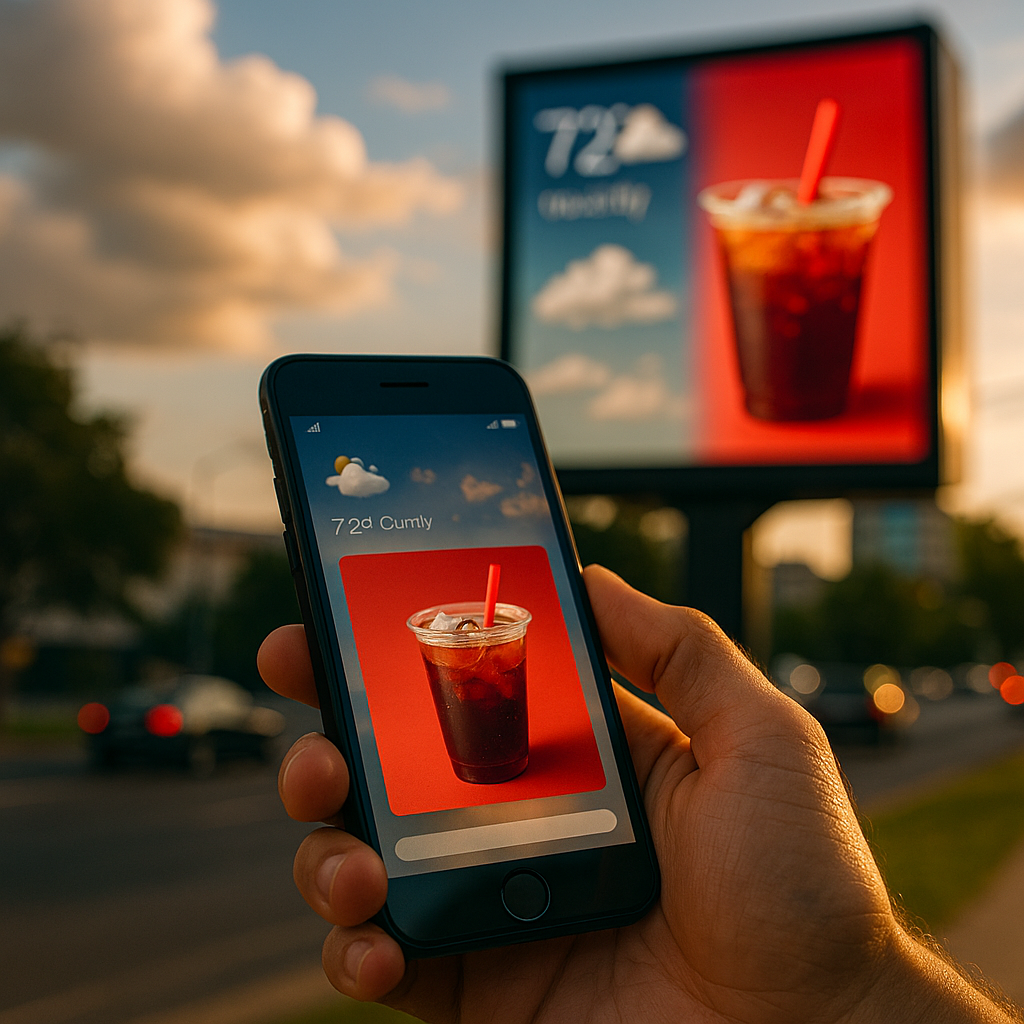
Using AI To Personalize Dynamic Creative Based On Weather And Location is quickly becoming the practical standard for performance-minded advertisers in 2025. Instead of showing one generic message to everyone, brands can adapt copy, imagery, and offers to real-world context in seconds. When the forecast shifts or a user travels, your ads can stay relevant and measurable. Want to see what that looks like in practice?
Why weather-based advertising matters for relevance and ROI
Weather influences what people need, when they need it, and how urgently they act. That makes it a high-signal context trigger for many categories: apparel, grocery, QSR, travel, home services, OTC health, mobility, and entertainment. A sudden cold front can accelerate demand for outerwear; heatwaves can spike delivery and hydration purchases; rain can increase ride-hail usage and indoor activities.
Weather-based advertising turns those shifts into timely creative decisions. Instead of relying on broad seasonal assumptions, you respond to conditions that are true now. In practice, this typically improves:
- Message relevance (the offer matches immediate needs, reducing wasted impressions)
- Conversion efficiency (fewer clicks from low-intent users, more from high-intent users)
- Customer experience (ads feel helpful rather than random)
AI makes the approach scalable. Without AI, you might build a handful of “rainy day” and “sunny day” ads and manually switch them. With AI-driven decisioning, you can create a structured library of assets and let models assemble, select, and prioritize the best combination by forecast, temperature range, precipitation probability, UV index, air quality, and local time.
To keep this helpful and credible, tie weather triggers to a clear business hypothesis. For example: “When precipitation probability exceeds 60% within 3 hours of lunch, promote delivery and hot items.” That specificity sets you up for measurement and prevents “weather gimmicks” that don’t move outcomes.
AI dynamic creative optimization (DCO): what it is and how it works
AI dynamic creative optimization (DCO) is a system that assembles and serves ad variations by combining modular creative elements—headlines, images, CTAs, product tiles, prices, and disclaimers—based on signals like weather, location, device, time, and audience intent. AI helps in two distinct ways:
- Generation and variation: creating on-brand text and layout variations that comply with your rules.
- Decisioning and learning: choosing which variation to show to maximize a defined goal (CTR, conversion, ROAS, or incremental lift).
A modern DCO workflow usually looks like this:
- Define inputs: weather fields (temperature bands, precipitation, wind, humidity), location granularity (DMA/city/ZIP radius), and business constraints (stock, store hours, delivery coverage).
- Build a creative system: templates with interchangeable modules and strict brand rules (fonts, color tokens, legal text blocks).
- Set policies: guardrails that prevent inappropriate combinations (e.g., “don’t show ‘same-day delivery’ where it’s not available”).
- Deploy and learn: model selects variants; performance data feeds continuous improvement.
Readers often ask whether AI “writes the ad.” In most high-performing setups, AI supports copy generation and ranking, but humans control the message strategy and brand safety. You get speed without sacrificing governance.
Another common question: “Is this only for big budgets?” Not necessarily. Start with a limited number of weather states and a few locations, then expand as you prove incremental value. The key is designing modules that can scale, not producing endless one-off ads.
Location-based personalization: data sources, targeting, and privacy
Location-based personalization goes beyond “city name insertion.” It means using geography to deliver creative that reflects what a customer can actually do: visit a nearby store, book a local service, attend an event, or receive delivery within a promised window.
In 2025, the most practical location signals for advertising and onsite experiences typically include:
- Approximate device location (when permissioned)
- IP-derived region (coarser, less precise, often used for basic localization)
- Declared location (user-selected store, shipping ZIP, profile preferences)
- Platform location segments (aggregated and privacy-preserving, where available)
Location is powerful, but it must be handled carefully. Apply EEAT-aligned practices:
- Be transparent: disclose in your privacy notice and in-context prompts how location improves relevance.
- Collect the minimum: use coarse location when it meets the need; avoid precise GPS if city-level works.
- Honor consent: ensure opt-in/opt-out choices are respected across ad tech and onsite personalization.
- Prevent sensitive inferences: avoid creative that implies knowledge of a person’s health status, visits, or other sensitive attributes based on location.
From a performance standpoint, location personalization works best when it changes the decision, not just the wording. Examples include showing the nearest store with hours, surfacing local inventory, highlighting region-specific offers, or adapting pricing and delivery promises based on serviceable areas.
If you can’t reliably resolve accurate location, don’t force it. Instead, design fallbacks: generic creative, region-level messaging, or prompts that let users choose their nearest location. A robust fallback plan prevents broken experiences and keeps measurement clean.
Real-time weather triggers: rules, APIs, and creative mapping
Real-time weather triggers are the bridge between raw meteorological data and customer-facing creative. Success depends on two things: choosing the right weather variables for your category and mapping them to meaningful creative actions.
Common weather inputs include:
- Temperature (absolute and “feels like”)
- Precipitation type and probability (rain, snow, sleet)
- Wind speed (useful for outdoor activities and safety messaging)
- Humidity (relevant for skincare, HVAC, and comfort products)
- UV index (suncare, outdoor recreation)
- Air quality (masks/filters where appropriate, with careful policy review)
Most teams implement weather using a third-party weather API integrated into their ad decisioning layer or personalization platform. To keep the system stable and trustworthy:
- Use time windows: trigger on forecast for the next 1–6 hours for immediacy, and next 24 hours for planning behaviors.
- Debounce changes: avoid flipping creative every few minutes; set thresholds and minimum durations.
- Map weather to outcomes: connect each trigger to a user benefit (comfort, convenience, safety, availability).
- Build fallbacks: if the API fails or returns uncertain data, serve default creative.
Creative mapping is where many programs stumble. Avoid overly granular segmentation that produces tiny sample sizes and weak learning. A practical starting framework uses 6–10 weather states such as: hot, warm, mild, cool, cold, rainy, snowy, windy, high-UV, poor air quality. Then layer location and time-of-day only where it changes the offer or product set.
To answer the inevitable follow-up question—“Should we mention the weather in the ad?”—often yes, but only when it adds value. “Rainy day deal” can work, but “Free delivery before the storm hits” is clearer. In some categories, subtle creative shifts (imagery, product selection) outperform explicit weather callouts because they feel less intrusive.
Measuring incremental lift with creative testing and attribution
Incremental lift measurement is essential because weather and location can correlate with demand. If conversions rise during a heatwave, was it your creative or the heat itself? You need testing that isolates impact.
Use these measurement practices to strengthen credibility and decision-making:
- Holdouts: keep a control group that receives standard creative while the test group receives weather/location-personalized creative.
- Geo experiments: compare matched markets where only some locations run the program, controlling for baseline demand.
- Pre/post with controls: if experimentation is limited, use time-series methods with control variables, but treat results cautiously.
- Creative-level reporting: track performance by weather state and location segment to learn what actually works.
Define success metrics that match your funnel:
- Upper funnel: view-through engagement, video completion, qualified site visits
- Mid funnel: add-to-cart, store locator usage, menu views, quote starts
- Lower funnel: conversion rate, CPA, ROAS, offline sales matched to exposure
Also set “quality” metrics to avoid optimizing into bad outcomes:
- Refund/return rate by creative state
- Customer support contacts related to misleading availability
- Frequency and fatigue (especially when weather changes cause repeated messaging)
Finally, document what the model is allowed to learn. If you optimize purely on CTR, AI may choose sensational weather callouts that attract clicks but reduce conversion. Set optimization goals around business outcomes, and use creative review to ensure claims remain accurate across locations and conditions.
Operational best practices: brand safety, accessibility, and governance
Brand-safe AI personalization requires governance, not just technology. The best programs run like a product: clear owners, documented rules, and continuous QA.
Use these operational controls:
- Creative guardrails: approved vocabulary, prohibited claims, required disclaimers, and category-specific compliance rules.
- Human review loops: review new modules and AI-generated copy before production, with periodic audits after launch.
- Inventory and serviceability checks: suppress products that are out of stock locally; don’t advertise services not available in that area.
- Accessibility standards: readable contrast, legible type at small sizes, alt-text equivalents where relevant, and avoid weather imagery that reduces clarity.
- Localization QA: verify place names, store hours, and local regulations for offers.
Governance also covers data stewardship. Keep a clear data lineage: which weather provider you use, which fields feed decisioning, how often data refreshes, and what happens during outages. This documentation supports EEAT by making your system explainable to stakeholders, auditors, and partners.
If you use generative AI for copy or image variations, separate “idea generation” from “serving.” Generate drafts, then lock approved variants into a controlled library. That approach reduces brand risk while still accelerating production.
FAQs
What industries benefit most from weather and location-based dynamic creative?
Retail (apparel, grocery), food delivery and QSR, travel and hospitality, home services (HVAC, roofing), pharmacy/health retail, mobility, and events see strong gains because weather changes immediate needs and location determines availability.
How granular should location targeting be for personalized creative?
Start at a level that matches your operational reality: city or metro for most brands, store-radius for retailers with reliable store data, and ZIP/postal where delivery zones are strict. Always include fallbacks when location is unknown or coarse.
Do I need real-time data, or is a daily forecast enough?
Use real-time or near-real-time updates when timing affects intent (delivery, commuting, last-minute apparel). For planning behaviors (weekend travel, seasonal prep), daily or twice-daily forecasts can be sufficient and simpler to manage.
How do I prevent “creepy” personalization when referencing weather and location?
Keep messaging utility-driven and non-invasive. Prefer “Rainy day essentials delivered fast” over “It’s raining near you right now.” Use coarse location, avoid sensitive inferences, and ensure consent and disclosures are clear.
What creative elements should be dynamic first?
Start with product selection, headline, and CTA because they typically drive the biggest performance change. Then expand to imagery, offer logic, and landing page modules once you can measure lift reliably.
How long does it take to launch a first version?
A focused pilot can go live in a few weeks if you already have templates and product feeds. The timeline mostly depends on data integration (weather and location), approval workflows, and measurement setup (holdouts or geo tests).
AI-powered personalization tied to weather and location works when it stays grounded in real customer benefit, accurate availability, and clean measurement. Build a modular creative system, use sensible triggers, and protect privacy with clear consent and minimal data collection. In 2025, the advantage goes to teams that treat dynamic creative as an always-on product, not a one-off campaign—ready to adapt the moment conditions change.
Top Influencer Marketing Agencies
The leading agencies shaping influencer marketing in 2026
Agencies ranked by campaign performance, client diversity, platform expertise, proven ROI, industry recognition, and client satisfaction. Assessed through verified case studies, reviews, and industry consultations.
Moburst

-
2

The Shelf
Boutique Beauty & Lifestyle Influencer AgencyA data-driven boutique agency specializing exclusively in beauty, wellness, and lifestyle influencer campaigns on Instagram and TikTok. Best for brands already focused on the beauty/personal care space that need curated, aesthetic-driven content.Clients: Pepsi, The Honest Company, Hims, Elf Cosmetics, Pure LeafVisit The Shelf → -
3

Audiencly
Niche Gaming & Esports Influencer AgencyA specialized agency focused exclusively on gaming and esports creators on YouTube, Twitch, and TikTok. Ideal if your campaign is 100% gaming-focused — from game launches to hardware and esports events.Clients: Epic Games, NordVPN, Ubisoft, Wargaming, Tencent GamesVisit Audiencly → -
4

Viral Nation
Global Influencer Marketing & Talent AgencyA dual talent management and marketing agency with proprietary brand safety tools and a global creator network spanning nano-influencers to celebrities across all major platforms.Clients: Meta, Activision Blizzard, Energizer, Aston Martin, WalmartVisit Viral Nation → -
5

The Influencer Marketing Factory
TikTok, Instagram & YouTube CampaignsA full-service agency with strong TikTok expertise, offering end-to-end campaign management from influencer discovery through performance reporting with a focus on platform-native content.Clients: Google, Snapchat, Universal Music, Bumble, YelpVisit TIMF → -
6

NeoReach
Enterprise Analytics & Influencer CampaignsAn enterprise-focused agency combining managed campaigns with a powerful self-service data platform for influencer search, audience analytics, and attribution modeling.Clients: Amazon, Airbnb, Netflix, Honda, The New York TimesVisit NeoReach → -
7

Ubiquitous
Creator-First Marketing PlatformA tech-driven platform combining self-service tools with managed campaign options, emphasizing speed and scalability for brands managing multiple influencer relationships.Clients: Lyft, Disney, Target, American Eagle, NetflixVisit Ubiquitous → -
8

Obviously
Scalable Enterprise Influencer CampaignsA tech-enabled agency built for high-volume campaigns, coordinating hundreds of creators simultaneously with end-to-end logistics, content rights management, and product seeding.Clients: Google, Ulta Beauty, Converse, AmazonVisit Obviously →