


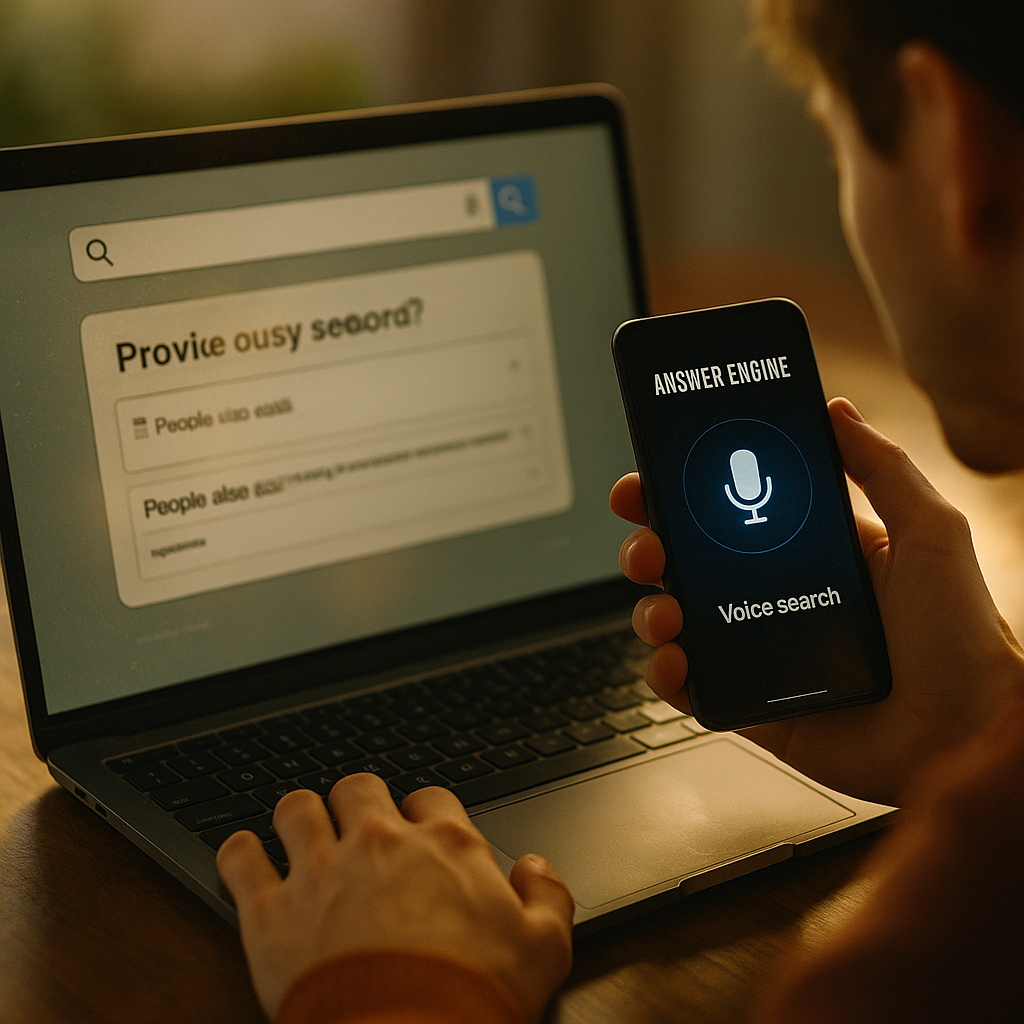
Answer Engine Optimization (AEO) is reshaping how brands win visibility as users increasingly expect instant, direct answers instead of ten blue links. In 2025, AI-driven search and voice assistants compress discovery into a single response, raising the stakes for accuracy, credibility, and structure. Marketers who adapt now can earn “the answer” placement, not just a ranking—are you ready to compete there?
What is Answer Engine Optimization (AEO) and why it’s accelerating
Answer engines (AI assistants, AI Overviews-style experiences, voice assistants, and chat-based search) aim to deliver a complete response inside the interface. That changes the core job of optimization: instead of only attracting clicks, you also need to be selectable as a trusted source for a synthesized answer.
AEO focuses on making your content easy for machines to interpret and safe to cite. It blends traditional SEO fundamentals (crawlability, relevance, authority) with answer-first formatting and stronger evidence signals. The acceleration comes from three shifts in user behavior:
- Intent compression: Users phrase queries as questions and expect a single best response.
- Interface consolidation: Results pages increasingly summarize rather than list.
- Trust sensitivity: Users scrutinize sources more when answers are generated, not merely retrieved.
If your page can’t be parsed quickly or doesn’t clearly demonstrate expertise, it’s less likely to be referenced. AEO is not a replacement for SEO; it is a new layer that optimizes for citations, summaries, and spoken responses—often without a click.
Traditional SEO vs AEO strategy: how the playbook changes
Traditional SEO has centered on rankings, clicks, and on-page engagement. AEO expands the success criteria to include: “Was my brand used to build the answer?” and “Did the assistant attribute the information correctly?” This changes priorities across content, technical structure, and measurement.
Key differences that matter in practice:
- From keywords to questions: You still map keywords, but you organize content around problem statements, decision criteria, and common follow-ups.
- From long intros to immediate value: Answer engines favor content that gets to the point, then supports it with proof.
- From page authority to source credibility: Backlinks still help, but so do author credentials, citations, and consistent brand reputation across the web.
- From “optimize for SERP features” to “optimize for synthesis”: Featured snippets were a preview; now the engine may merge multiple sources.
Readers often ask whether AEO reduces the need for SEO. It doesn’t. If your site is slow, blocked, thin, or inconsistent, it won’t be eligible for inclusion. The difference is that AEO forces you to think about retrieval + interpretation + attribution, not only ranking signals.
AI search and zero-click answers: what changes for traffic and attribution
As answer engines provide more complete responses, more searches end without a click. That can feel like lost opportunity, but it can also be a new form of brand visibility—if you earn attribution and if the answer positions you as the next step.
What to expect in 2025:
- More “good enough” answers: Basic definitions, comparisons, and how-to steps may be satisfied on the results screen.
- Fewer but higher-intent clicks: When users do click, they often want depth, confirmation, pricing, or next-step actions.
- Messier attribution: AI answers may cite multiple sources, cite none, or cite inconsistently across sessions.
To respond, build content that serves two layers of intent:
- Layer 1: the direct answer. A concise, unambiguous response near the top of the page.
- Layer 2: the decision support. Evidence, edge cases, examples, and actionable next steps that motivate a click or conversion.
Also plan for measurement that goes beyond “organic sessions.” Track branded search lift, assisted conversions, and mentions in AI-cited environments where possible. If your analytics only values last-click traffic, you may underinvest in the channels that influence decisions earlier.
EEAT signals for AEO: building trust that answer engines can cite
Answer engines are more cautious about what they repeat, especially in areas where inaccuracies create risk. That’s why EEAT—Experience, Expertise, Authoritativeness, and Trustworthiness—moves from “nice to have” to “citation insurance.”
Practical EEAT upgrades that support AEO:
- Show real experience: Include first-hand steps, screenshots, process notes, constraints, and what you observed. Avoid vague summaries.
- Use qualified authors: Provide author names and roles, and ensure the author has visible credentials or demonstrated expertise relevant to the topic.
- Support claims with verifiable sources: Cite primary sources, standards bodies, peer-reviewed research, or official documentation when you make factual claims.
- Maintain editorial integrity: Date and maintain updates, correct errors publicly, and separate opinion from fact.
- Be consistent off-site: Align what your site says with your profiles, reviews, and third-party references.
One likely follow-up: “Do I need to be a famous brand to win AEO?” No—but you do need to be verifiable. Clear authorship, transparent sourcing, and accurate, specific explanations can outperform generic content from larger sites, particularly for niche queries.
Structured content and schema markup: making answers machine-readable
Answer engines prefer content that’s easy to extract and recombine. Structure reduces ambiguity. Your goal is to make the “answer units” on your page obvious, while keeping the page useful for humans.
High-impact structuring tactics:
- Lead with a direct answer paragraph: Put the definition or recommendation first, then expand.
- Use scannable lists for steps and criteria: Clear ordered steps for processes, and bullet criteria for comparisons.
- Define terms consistently: Use the same phrase for the same concept across your site to improve retrieval and reduce confusion.
- Cover follow-up questions on the same page: Add “what to do next,” “common mistakes,” and “how to choose” sections to satisfy conversational flows.
Schema markup supports AEO by clarifying entities and relationships. Use only schema types that reflect the page truthfully. Common, relevant options include:
- FAQPage for genuine FAQs (not sales copy).
- HowTo for step-by-step instructions (when appropriate for your content and policies).
- Article with author and publisher details.
- Organization and Person to strengthen entity understanding.
AEO doesn’t mean stuffing pages with markup. It means aligning structure, semantics, and evidence so the engine can quote you confidently without misrepresenting your point.
How to implement an AEO content strategy: workflows, audits, and KPIs
AEO succeeds when it becomes a repeatable system, not a one-off rewrite. Start with your highest-value topics where being “the answer” influences revenue or trust.
Step-by-step implementation:
- Identify “answer-worthy” queries: Collect customer questions from sales calls, support tickets, on-site search, and community forums. Prioritize by business impact and frequency.
- Map intent to content types: Decide whether the user needs a definition, a comparison, a troubleshooting guide, or a decision framework.
- Rewrite intros and headings for clarity: Ensure each section answers a specific question and avoids vague framing.
- Add proof and boundaries: Include who the advice is for, prerequisites, limitations, and when to consult a professional if relevant.
- Strengthen EEAT: Add author bios, editorial review, citations, and update logs where appropriate.
- Implement structured data carefully: Validate markup, keep it consistent with visible content, and avoid spammy patterns.
- Test in real answer engines: Run your priority queries and note which sources are cited, what format wins, and what follow-up questions appear.
KPIs that make sense for AEO in 2025:
- Share of answers: How often your brand appears in cited sources for target questions.
- Branded demand: Lift in branded queries and direct traffic as users seek you out after seeing you cited.
- Qualified organic conversions: Fewer clicks can still produce more leads if the clicks are more intentional.
- Content accuracy metrics: Reduction in support contacts caused by misunderstandings; fewer “bounce-backs” from unclear guidance.
If you’re wondering what to do first: audit your top pages for question clarity, proof, and structure. Then update the pages that already earn impressions—those are closest to becoming the cited source.
FAQs about Answer Engine Optimization
-
Is AEO replacing SEO?
No. AEO builds on SEO. You still need crawlable pages, strong internal linking, fast performance, and relevant content. AEO adds optimization for how answer engines extract, summarize, and attribute information.
-
How do I choose keywords for AEO?
Prioritize question-based queries and high-intent follow-ups: “what is,” “how to,” “best way to,” “vs,” “cost,” “examples,” and “common mistakes.” Use customer language from support and sales conversations to capture real phrasing.
-
What content format performs best for answer engines?
Pages that provide a direct answer early, then support it with structured sections, lists, and clear definitions tend to be easier to cite. Add boundaries, examples, and next steps to satisfy follow-up questions.
-
Do I need schema markup to win AEO?
Not always, but it helps. Schema can clarify entities, authorship, and page purpose, improving machine readability. Only use markup that matches visible content and keep it maintained.
-
How do I measure AEO if clicks decline?
Track citations/mentions in answer experiences for target queries, branded search growth, assisted conversions, and lead quality. Pair analytics with manual checks and reporting from tools that monitor AI citations where available.
-
What are the biggest mistakes to avoid with AEO?
Buried answers, vague claims without sources, thin content that restates common knowledge, inconsistent terminology, and misleading markup. Another common mistake is ignoring editorial review, which undermines trust signals.
Answer engines reward pages that are clear, structured, and trustworthy enough to quote. In 2025, the winning approach combines traditional SEO hygiene with answer-first writing, strong EEAT signals, and machine-readable formatting. Optimize for being cited, not just visited, and you’ll protect visibility as interfaces change. The takeaway: build content that answers fast, proves it, and guides next steps.
Top Influencer Marketing Agencies
The leading agencies shaping influencer marketing in 2026
Agencies ranked by campaign performance, client diversity, platform expertise, proven ROI, industry recognition, and client satisfaction. Assessed through verified case studies, reviews, and industry consultations.
Moburst

-
2

The Shelf
Boutique Beauty & Lifestyle Influencer AgencyA data-driven boutique agency specializing exclusively in beauty, wellness, and lifestyle influencer campaigns on Instagram and TikTok. Best for brands already focused on the beauty/personal care space that need curated, aesthetic-driven content.Clients: Pepsi, The Honest Company, Hims, Elf Cosmetics, Pure LeafVisit The Shelf → -
3

Audiencly
Niche Gaming & Esports Influencer AgencyA specialized agency focused exclusively on gaming and esports creators on YouTube, Twitch, and TikTok. Ideal if your campaign is 100% gaming-focused — from game launches to hardware and esports events.Clients: Epic Games, NordVPN, Ubisoft, Wargaming, Tencent GamesVisit Audiencly → -
4

Viral Nation
Global Influencer Marketing & Talent AgencyA dual talent management and marketing agency with proprietary brand safety tools and a global creator network spanning nano-influencers to celebrities across all major platforms.Clients: Meta, Activision Blizzard, Energizer, Aston Martin, WalmartVisit Viral Nation → -
5

The Influencer Marketing Factory
TikTok, Instagram & YouTube CampaignsA full-service agency with strong TikTok expertise, offering end-to-end campaign management from influencer discovery through performance reporting with a focus on platform-native content.Clients: Google, Snapchat, Universal Music, Bumble, YelpVisit TIMF → -
6

NeoReach
Enterprise Analytics & Influencer CampaignsAn enterprise-focused agency combining managed campaigns with a powerful self-service data platform for influencer search, audience analytics, and attribution modeling.Clients: Amazon, Airbnb, Netflix, Honda, The New York TimesVisit NeoReach → -
7

Ubiquitous
Creator-First Marketing PlatformA tech-driven platform combining self-service tools with managed campaign options, emphasizing speed and scalability for brands managing multiple influencer relationships.Clients: Lyft, Disney, Target, American Eagle, NetflixVisit Ubiquitous → -
8

Obviously
Scalable Enterprise Influencer CampaignsA tech-enabled agency built for high-volume campaigns, coordinating hundreds of creators simultaneously with end-to-end logistics, content rights management, and product seeding.Clients: Google, Ulta Beauty, Converse, AmazonVisit Obviously →