


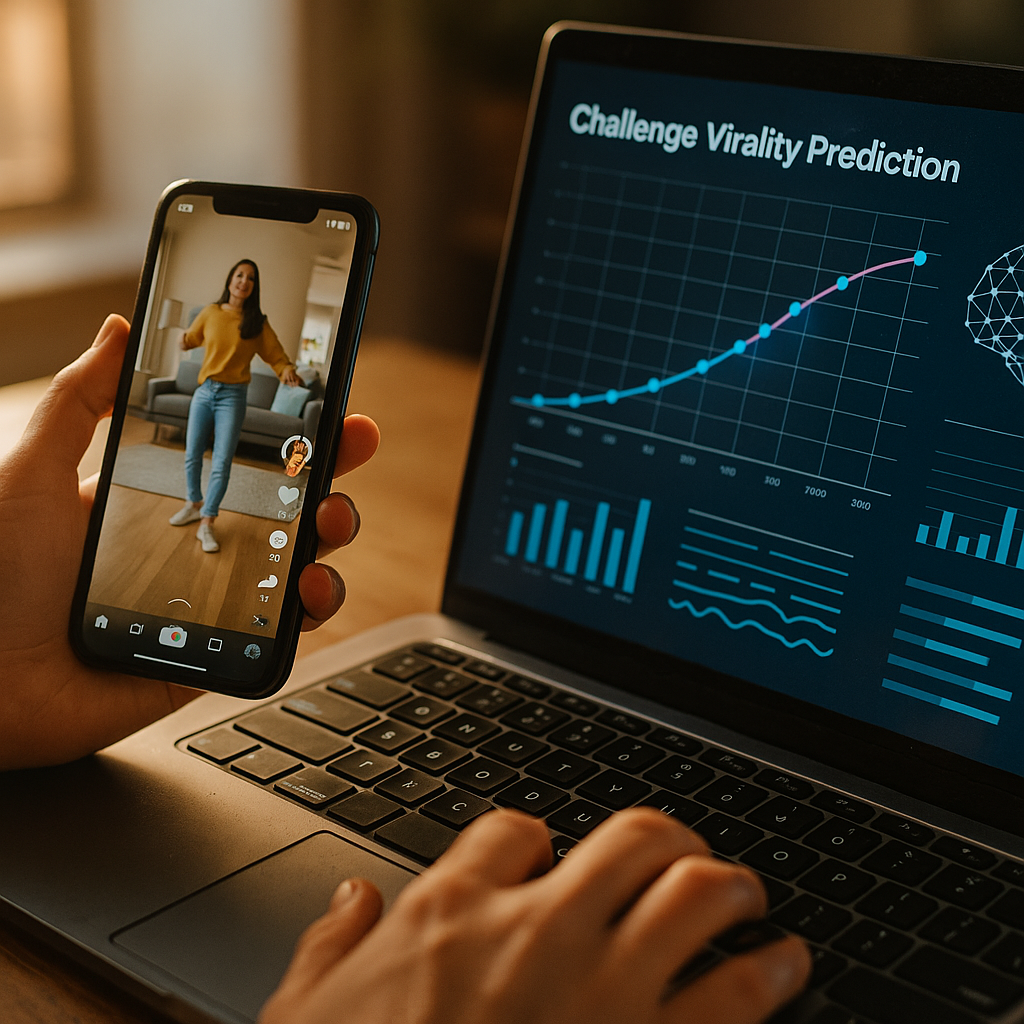
Using AI To Predict The Virality Of Brand-Led Community Challenges has shifted from gut instinct to measurable science in 2025. Brands now test concepts, forecast participation curves, and spot friction points before a challenge goes live. With the right data and governance, AI can surface what truly moves a community to act, share, and return. The question is: will your next challenge be engineered to travel?
AI virality prediction: what “viral” means for community challenges
Virality in brand-led community challenges is not just “views” or a trending hashtag. It is a compounding pattern of participation and sharing that sustains itself across days, platforms, and social clusters. For most brands, the practical definition is: a challenge grows faster than you can buy it with paid media, while maintaining participation quality (not just low-effort spam).
AI virality prediction uses signals from content, audience behavior, network effects, and timing to estimate the probability that a challenge will reach a target threshold, such as:
- Participation velocity: how quickly new participants join after launch.
- Share-to-participation ratio: whether participants recruit others.
- Retention across steps: drop-off between “view,” “join,” “post,” and “invite.”
- Cross-community lift: spread from core fans to adjacent audiences.
- Brand safety and sentiment stability: growth without reputational risk.
Helpful framing: predictability improves when you treat a challenge like a product funnel with a social multiplier. AI does not “guarantee” virality; it estimates outcomes under specific conditions and highlights levers you can change—creative format, incentives, rules, creators, timing, or community mechanics—to improve the odds.
Brand-led community challenges strategy: aligning the challenge with purpose and audience
AI works best when the strategic inputs are clear. A brand-led challenge needs a precise audience promise: what participants gain (identity, recognition, learning, fun, belonging) and what the brand gains (UGC, trials, referrals, insights, loyalty). If those are vague, models will still output predictions, but they won’t be actionable.
Start with a challenge brief that can be translated into measurable variables:
- Behavior to elicit: create a post, complete a task, submit proof, invite a friend, attend a live event.
- Effort level: seconds, minutes, or multi-day; higher effort often needs higher social reward.
- Social proof mechanism: leaderboards, duets/remixes, shout-outs, badges, spotlight features.
- Participation constraints: geography, age gating, platform rules, brand safety requirements.
- Community moderators and escalation paths: how you respond to confusion, negativity, or misuse.
Then specify the “non-negotiables” to protect trust. For example: no misleading claims, clear eligibility, transparent prizes, and respectful community guidelines. In 2025, trust is a growth factor; challenges that confuse users or hide conditions often spike briefly and then collapse due to backlash or platform enforcement.
Practical follow-up question: Should you design for maximum reach or maximum conversion? Decide early. AI can help you forecast both, but the mechanics differ. Reach-optimized challenges typically reduce friction and amplify remixability; conversion-optimized challenges often add qualification steps (email, trial, purchase) that reduce reach but increase business impact.
Predictive analytics for social challenges: the data signals that matter most
Reliable prediction depends on using the right signals at the right level of granularity. In community challenges, three classes of data drive most performance forecasts:
1) Creative and format features
- Prompt clarity (can a user understand the task in under 3 seconds?)
- Template-ability (can people copy the format without feeling like an ad?)
- Audio, caption structure, visual pacing, and “first-frame” readability
- Emotional tone (playful, aspirational, competitive, altruistic)
2) Audience and community signals
- Historical participation rates for similar prompts
- Creator-community overlap (do seed creators share followers with your target?)
- Community norms (are challenges common, or do users prefer discussion and advice?)
- Sentiment baseline and sensitivity topics to avoid
3) Network and distribution mechanics
- Share paths (DMs, duets, stitches, reposts, group shares)
- Time-of-day and day-of-week performance for your audience clusters
- Platform-specific ranking signals you can infer from prior posts (watch time, saves, completion rate)
- Cross-platform lift patterns (e.g., short-form video to community forum sign-ups)
Brands often ask: “Can AI predict virality from a concept alone?” It can estimate based on prior patterns, but concept-only forecasting is weaker than forecasting with concrete assets (draft scripts, thumbnails, captions, landing pages, and the exact rules). The more you can provide artifacts that resemble the final experience, the more the model can learn from comparable historical outcomes.
Another common question: “Do we need massive datasets?” Not always. If you have limited first-party challenge history, you can combine:
- First-party data: prior campaigns, community activity, CRM segments, site analytics.
- Platform analytics exports: performance of your posts and creator partners.
- Third-party benchmarks: category-level engagement norms (used carefully and transparently).
Keep governance tight: only collect what you can justify, store it securely, and document data provenance. This improves both performance and credibility.
Machine learning models for content virality: approaches that actually work
In practice, predicting challenge virality is a mix of forecasting and classification. The goal is not to build a “magic score,” but a system that explains why a challenge is likely to grow and which changes will improve outcomes.
Common model types used in 2025
- Gradient-boosted trees: strong for tabular features (creator stats, past performance, timing, format variables) and interpretable via feature importance.
- Time-series forecasting: predicts participation curves, peak timing, and decay; useful for staffing moderation and scaling infrastructure.
- Graph-based models: estimate spread through communities using creator-audience overlap and interaction networks.
- Multimodal models: analyze video, audio, and text jointly to detect patterns in hooks, pacing, and prompt clarity.
- Causal inference layers: separate correlation from likely impact (e.g., “Did adding a prize increase participation, or did you also change the format?”).
What to predict (and what not to)
Strong targets include: probability of hitting a participation threshold, expected cost per participant under a seeding plan, and predicted drop-off points in the funnel. Avoid overpromising on “exact view counts.” Platform dynamics are noisy, and forecasting should focus on decision-grade ranges and confidence intervals.
Evaluation that respects reality
- Backtesting on past challenges: would the model have correctly prioritized winners and flagged losers?
- Holdout sets by time: prevent leakage by testing on later campaigns.
- Calibration: if the model says “70% chance,” it should be right about 70% of the time across many launches.
- Human review loops: community managers validate whether recommendations fit community context.
Follow-up question: “Will AI push us toward generic, copycat challenges?” It can if you only optimize for historical engagement. Counter that by adding novelty metrics (distance from past formats), brand-fit constraints, and qualitative review. The best systems balance proven mechanics with differentiated creative.
Social media challenge optimization: testing, seeding, and iteration before launch
The biggest advantage of AI is not predicting after you launch; it is improving the challenge before you spend budget or risk community fatigue. Treat virality as a set of controllable variables and run structured experiments.
Pre-launch simulation and creative testing
- Variant testing: generate 5–10 prompt versions, then score them on clarity, remixability, and predicted completion.
- Hook and thumbnail experiments: test first-frame options and captions with small paid or organic samples.
- Friction audits: AI-assisted review of rules and landing pages to reduce confusion and drop-off.
Seeding strategy with creators and community leaders
Virality typically starts with a “starter set” of participants whose audiences overlap just enough to create momentum without saturating the same cluster. AI can help select a balanced seed set by modeling:
- Audience overlap and incremental reach
- Historical participation quality (not just followers)
- Brand safety risk and sentiment patterns
- Creator reliability (delivery, responsiveness, compliance)
Real-time iteration in the first 48 hours
Most challenges reveal their trajectory early. Build a monitoring dashboard that tracks:
- Participation velocity vs. predicted range
- Comment sentiment and confusion signals
- Share paths (where invites are coming from)
- Moderator workload and recurring questions
If participation is below forecast, the fix is often mechanical: simplify the prompt, showcase better examples, adjust the call-to-action, or add a social reward (features, badges, spotlight). If participation is high but sentiment is unstable, prioritize community guidelines, clarification posts, and moderation escalation.
EEAT and responsible AI marketing: trust, transparency, and measurement
In 2025, predictive systems only create value if they also protect users and the brand. Google’s EEAT principles map well to community challenges: demonstrate expertise in experimentation, show real experience in community management, cite credible sources when using external benchmarks, and maintain trust through transparent policies.
How to operationalize EEAT for AI-driven virality prediction
- Experience: document what your team learned from prior challenges, including failures and adjustments.
- Expertise: involve data scientists and community leads in joint reviews; avoid “black box” recommendations without rationale.
- Authoritativeness: align with platform policies, and keep a clear record of approvals, disclosures, and creator agreements.
- Trustworthiness: disclose material incentives, protect user data, and provide clear rules and eligibility.
Responsible data use and privacy
Use aggregated and anonymized analytics wherever possible. Minimize personally identifiable information, set retention limits, and maintain a clear consent story for any first-party data collection. If you use AI to analyze comments or submissions, define how you handle sensitive content and how users can report issues.
Measurement that ties to business outcomes
Virality is a means, not the end. Connect challenge performance to outcomes such as sign-ups, trials, repeat purchases, referral rates, and community growth quality. Use incrementality thinking: compare against a control period or a holdout audience to estimate what the challenge actually caused, not just what happened alongside it.
FAQs about predicting challenge virality with AI
Can AI accurately predict whether a community challenge will go viral?
AI can estimate the probability of hitting defined growth thresholds and identify the levers that improve odds. It cannot guarantee virality because platform distribution, cultural moments, and competitor activity add uncertainty. The best use is decision support: choose better concepts, creators, and mechanics before launch.
What inputs do we need to get useful predictions?
You’ll get the most value from draft creative assets (scripts, thumbnails, captions), a clear prompt and rules, historical performance data from your channels, and a proposed seeding plan. Even with limited history, you can build workable models using platform analytics plus structured experimentation.
How early should we start modeling a challenge?
Start as soon as you have a few concept directions. Early scoring helps narrow options, but accuracy improves once you have near-final assets and a distribution plan. Many teams run two passes: concept screening, then pre-launch forecasting with finalized creatives.
Which metrics best indicate “viral momentum” in the first 48 hours?
Track participation velocity, share-to-participation ratio, completion rate (watch time and task completion proxies), and sentiment stability. Also monitor repeated questions in comments; confusion is a leading indicator of drop-off and negative amplification.
How do we avoid bias or unsafe outcomes when optimizing for virality?
Set guardrails: brand-safety topic exclusions, fairness checks in creator selection, and human review of model recommendations. Optimize for participation quality and sentiment, not just reach. Keep transparent rules and disclose incentives to maintain trust.
Do we need to use generative AI to run these predictions?
No. Many strong systems rely on predictive analytics and machine learning on structured data. Generative AI is helpful for creating test variants, summarizing feedback at scale, and diagnosing friction, but it should sit inside a measured experimentation process.
AI makes virality more predictable when you treat a community challenge as a measurable system: clear prompt, low friction, smart seeding, and fast iteration. Build models around participation velocity, share paths, and sentiment stability, then test variants before committing spend. In 2025, the winners combine rigorous analytics with community-first governance, turning “viral” into repeatable growth rather than luck.
Top Influencer Marketing Agencies
The leading agencies shaping influencer marketing in 2026
Agencies ranked by campaign performance, client diversity, platform expertise, proven ROI, industry recognition, and client satisfaction. Assessed through verified case studies, reviews, and industry consultations.
Moburst

-
2

The Shelf
Boutique Beauty & Lifestyle Influencer AgencyA data-driven boutique agency specializing exclusively in beauty, wellness, and lifestyle influencer campaigns on Instagram and TikTok. Best for brands already focused on the beauty/personal care space that need curated, aesthetic-driven content.Clients: Pepsi, The Honest Company, Hims, Elf Cosmetics, Pure LeafVisit The Shelf → -
3

Audiencly
Niche Gaming & Esports Influencer AgencyA specialized agency focused exclusively on gaming and esports creators on YouTube, Twitch, and TikTok. Ideal if your campaign is 100% gaming-focused — from game launches to hardware and esports events.Clients: Epic Games, NordVPN, Ubisoft, Wargaming, Tencent GamesVisit Audiencly → -
4

Viral Nation
Global Influencer Marketing & Talent AgencyA dual talent management and marketing agency with proprietary brand safety tools and a global creator network spanning nano-influencers to celebrities across all major platforms.Clients: Meta, Activision Blizzard, Energizer, Aston Martin, WalmartVisit Viral Nation → -
5

The Influencer Marketing Factory
TikTok, Instagram & YouTube CampaignsA full-service agency with strong TikTok expertise, offering end-to-end campaign management from influencer discovery through performance reporting with a focus on platform-native content.Clients: Google, Snapchat, Universal Music, Bumble, YelpVisit TIMF → -
6

NeoReach
Enterprise Analytics & Influencer CampaignsAn enterprise-focused agency combining managed campaigns with a powerful self-service data platform for influencer search, audience analytics, and attribution modeling.Clients: Amazon, Airbnb, Netflix, Honda, The New York TimesVisit NeoReach → -
7

Ubiquitous
Creator-First Marketing PlatformA tech-driven platform combining self-service tools with managed campaign options, emphasizing speed and scalability for brands managing multiple influencer relationships.Clients: Lyft, Disney, Target, American Eagle, NetflixVisit Ubiquitous → -
8

Obviously
Scalable Enterprise Influencer CampaignsA tech-enabled agency built for high-volume campaigns, coordinating hundreds of creators simultaneously with end-to-end logistics, content rights management, and product seeding.Clients: Google, Ulta Beauty, Converse, AmazonVisit Obviously →