


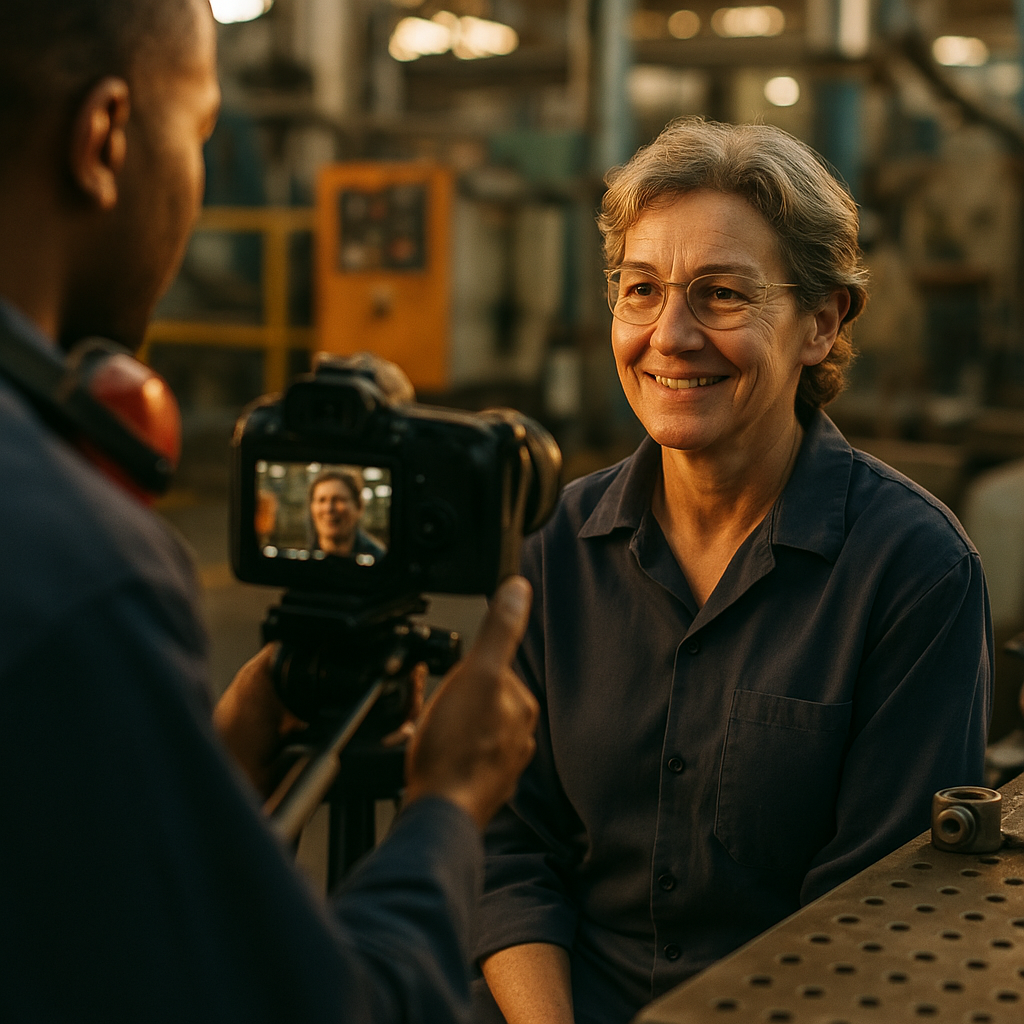
In 2025, manufacturers face a trust gap: buyers want proof, employees want pride, and communities want transparency. This case study shows how a traditional plant turned its people into the story—without compromising safety, quality, or brand standards. Using employee video storytelling, the company increased engagement, shortened sales cycles, and boosted hiring interest. Want the exact playbook?
Video marketing case study: The problem a traditional manufacturer needed to solve
Northforge Components (a mid-sized, family-owned industrial parts manufacturer) had a familiar challenge. The company made high-precision components used in infrastructure and heavy equipment—essential products that rarely feel “shareable.” Its reputation in the field was strong, but its digital presence and employer brand lagged behind competitors.
Leadership identified three problems that all traced back to a single issue: outsiders couldn’t “see” the company.
- Sales friction: Buyers understood specs and certifications but struggled to differentiate Northforge from similar suppliers. Account managers repeatedly answered the same trust questions: “Who will run our work?” “How stable is your team?” “How do you prevent defects?”
- Recruiting headwinds: Applicants assumed the environment was outdated or overly rigid. Exit interviews showed candidates wanted to understand day-to-day culture before committing.
- Internal morale: Employees felt proud of craftsmanship, yet believed corporate messaging didn’t reflect the reality of their work. That disconnect quietly reduced advocacy.
Northforge didn’t need hype. It needed evidence—delivered in a way that felt human and credible. Video became the most efficient tool to show what leadership couldn’t easily explain in text: care, competence, teamwork, and pride in process.
Humanize staff with video: The strategy that made real people the brand
The company set one non-negotiable goal: feature employees as the experts, not as background scenery. Marketing partnered with HR, operations, and safety to build a program that could scale without disrupting production.
The strategy relied on four content pillars designed to answer the questions prospects and candidates ask most:
- Meet the team: 60–90 second “day-in-the-life” profiles of machinists, quality technicians, maintenance leads, and customer service reps. Each video emphasized problem-solving, not personal trivia.
- Quality in action: Short explainers showing how inspection works, how nonconformances are handled, and what “right the first time” means on the floor.
- Process transparency: Visual walkthroughs of key steps—material receiving, setup, first-article inspection, packaging—shot to protect proprietary details while still demonstrating rigor.
- Leadership listening: Quarterly “ask me anything” clips where plant leaders answered top employee questions gathered anonymously.
To keep the tone authentic, Northforge avoided scripts. Instead, the producer prepared three question prompts per person, such as:
- “What’s a problem you solved this month?”
- “What do you check before you sign off a part?”
- “What would you tell a new hire on day one?”
This approach supported Google’s helpful content expectations by prioritizing first-hand experience and practical detail. It also reduced risk: employees spoke about what they actually do, within approved boundaries.
Industrial video content: The production workflow that respected the factory floor
Traditional manufacturers often avoid video because they fear downtime, safety issues, or “marketing getting in the way.” Northforge solved these concerns with a disciplined workflow built with operations and EHS (environment, health, and safety).
1) Pre-production (one week, minimal meetings)
- Safety and compliance checklist: PPE rules, filming zones, forklift lanes, lockout/tagout boundaries, and “no filming” areas were documented.
- Shot plan by cell: The team planned shots around natural changeovers, breaks, and scheduled maintenance windows.
- Consent and training: Employees opted in, reviewed how footage would be used, and received simple guidance: no customer names, no proprietary dimensions, no unapproved claims.
2) Filming (two half-days per month)
- One compact crew: producer + camera operator (sometimes the same person) and a safety escort.
- Short interviews (10 minutes) captured near the work area, then b-roll gathered quickly without interrupting critical tasks.
- Audio was treated seriously: a small mic kit prevented “noisy factory” frustration and improved perceived professionalism.
3) Post-production (fast and repeatable)
- Templates for lower-thirds (name/title), on-screen captions, and brand-safe music ensured consistent quality.
- Every video was delivered in multiple formats: website embed, LinkedIn-friendly cutdown, vertical version for recruiting, and a silent-captioned version for internal screens.
- Review was limited to two stakeholders: one for brand/legal, one for operations/safety—preventing endless revisions.
This workflow aligned with EEAT because it protected accuracy and safety while making the experts—the staff—clearly identifiable. Viewers saw real roles, real environments, and real standards, not generic stock footage.
Employer branding video: Distribution that reached buyers and candidates where they already are
Northforge did not treat video as “a campaign.” It treated video as sales enablement + recruiting infrastructure. Distribution followed intent, not vanity metrics.
On the website (high-intent trust building)
- Employee profile videos were placed on role-relevant pages: quality videos on quality/certification pages, maintenance stories on reliability/uptime pages, and customer service profiles on quoting pages.
- A new “People Behind the Parts” page became the central hub, with filters by department.
In sales (shortening the trust phase)
- Account managers added one video to follow-up emails after discovery calls, matched to the buyer’s concerns (e.g., “Here’s how our quality techs handle first-article approvals”).
- The team built a simple “video library” in the CRM so reps could send the right clip in under a minute.
In recruiting (pre-qualifying fit)
- Job postings included a short culture clip plus one “role reality” video (for example, what a CNC setup actually involves).
- Recruiters texted a 30-second vertical cut to candidates before the first interview to reduce no-shows and align expectations.
On LinkedIn (credibility without overselling)
- Northforge posted consistently but sparingly: one staff video per week, plus one process/quality video every two weeks.
- Each post answered a practical question in the caption, such as “What does ‘first-pass yield’ mean on the floor?” to attract the right audience.
Because the videos were designed to answer common objections and curiosity points, they worked as self-serve explanations. That reduced repetitive explanations from both HR and sales—an operational benefit readers often overlook.
Manufacturing recruitment marketing: Results, metrics, and what they did differently after launch
Northforge tracked outcomes that mattered to operations and leadership—not just views. The team agreed on a 90-day measurement window for early signals and a longer window for hiring and pipeline changes. They used simple, defensible indicators:
- Recruiting: higher job-post engagement, better-qualified applicants, and fewer late-stage drop-offs.
- Sales: faster movement from first meeting to site visit or sample order, and fewer “prove it” follow-ups.
- Internal: increased participation in improvement initiatives and more employee referrals.
Within the first two quarters of consistent publishing, the company reported three notable changes:
- More efficient recruiting conversations: Candidates arrived with clearer expectations about shift structure, training, and what quality looks like, which reduced screening time.
- Higher trust in early sales stages: Prospects referenced specific employees and processes they saw in videos—an indicator the content created memorable proof.
- Stronger employee advocacy: Staff began sharing posts organically, especially when their teams were featured, which expanded reach into local networks.
What did they adjust after launch?
- They featured “unseen” roles: Shipping/receiving, tool crib, maintenance planning, and purchasing. These roles affected customer outcomes but were rarely celebrated.
- They tightened claims: Early drafts used broad phrases like “best-in-class quality.” Reviewers replaced those with specific, verifiable language such as inspection steps, training hours, or documented checks.
- They built a bench of spokespeople: Instead of relying on one charismatic employee, they rotated departments to reduce burnout and ensure continuity.
These changes strengthened EEAT: the expertise became distributed across the organization, and the content stayed grounded in verifiable practices rather than slogans.
Authentic brand storytelling: Lessons learned and a repeatable playbook
Northforge’s biggest win was not cinematic production—it was operational credibility on camera. If you want to humanize staff without creating risk, the playbook is straightforward.
- Start with real questions: Use your sales and HR teams to list the 20 questions they answer repeatedly. Build videos to answer them one by one.
- Make employees the authority: Let the machinist explain setup checks. Let the quality tech explain inspection logic. Viewers trust the doer.
- Design for safety and continuity: Document filming zones and rules, and schedule around operations. A program that disrupts production will get canceled.
- Keep videos short and specific: One role, one process, one idea. Clarity beats length.
- Prove, don’t proclaim: Replace vague claims with demonstrable steps, tools, and standards.
- Package for multiple uses: Every shoot should yield web content, recruiting content, sales follow-ups, and internal screens.
Many manufacturers worry that showing people will invite scrutiny. In practice, transparency reduces suspicion—especially when you focus on how work is done, how quality is verified, and how teams solve problems. The key is to plan with operations, protect confidential details, and prioritize accuracy over polish.
FAQs
-
What types of videos humanize staff without feeling staged?
Short role-based profiles, “problem solved this week” stories, and process explainers work best. Use prompt questions instead of scripts, film in real work areas (where safe), and keep the focus on how the employee thinks and checks their work.
-
How do you handle safety and confidentiality in a manufacturing video?
Create an EHS-approved filming checklist, define no-film zones, and assign a safety escort during shoots. For confidentiality, avoid customer identifiers, proprietary dimensions, and control-panel close-ups that reveal sensitive settings.
-
How long should employee videos be for recruiting and sales?
For recruiting, 30–60 seconds performs well as a first touch. For sales enablement and website trust-building, 60–120 seconds allows enough detail to demonstrate competence without losing attention.
-
Who should own the video program: marketing or HR?
Marketing should own production standards and distribution, while HR and operations should co-own topics, compliance, and employee participation. The strongest programs run as a cross-functional system with clear review roles.
-
What metrics matter most for a manufacturer using video to humanize staff?
Track outcomes tied to business friction: interview show-up rates, applicant quality, employee referrals, time from first sales call to next step, and the frequency of repeated trust questions. Views and likes are secondary indicators.
-
Do we need professional equipment to start?
No, but you do need clean audio, steady framing, and captions. Many teams start with a compact camera or phone plus a reliable microphone and a simple lighting setup, then improve once the workflow is proven.
Northforge’s experience shows that trust in manufacturing grows when you let customers and candidates meet the people behind the process. In 2025, video works best when it documents real expertise, not marketing theater. Build a safe workflow, feature employees as authorities, and distribute clips where decisions happen—website, sales follow-ups, and job posts. Human stories, backed by proof, move markets.
Top Influencer Marketing Agencies
The leading agencies shaping influencer marketing in 2026
Agencies ranked by campaign performance, client diversity, platform expertise, proven ROI, industry recognition, and client satisfaction. Assessed through verified case studies, reviews, and industry consultations.
Moburst

-
2

The Shelf
Boutique Beauty & Lifestyle Influencer AgencyA data-driven boutique agency specializing exclusively in beauty, wellness, and lifestyle influencer campaigns on Instagram and TikTok. Best for brands already focused on the beauty/personal care space that need curated, aesthetic-driven content.Clients: Pepsi, The Honest Company, Hims, Elf Cosmetics, Pure LeafVisit The Shelf → -
3

Audiencly
Niche Gaming & Esports Influencer AgencyA specialized agency focused exclusively on gaming and esports creators on YouTube, Twitch, and TikTok. Ideal if your campaign is 100% gaming-focused — from game launches to hardware and esports events.Clients: Epic Games, NordVPN, Ubisoft, Wargaming, Tencent GamesVisit Audiencly → -
4

Viral Nation
Global Influencer Marketing & Talent AgencyA dual talent management and marketing agency with proprietary brand safety tools and a global creator network spanning nano-influencers to celebrities across all major platforms.Clients: Meta, Activision Blizzard, Energizer, Aston Martin, WalmartVisit Viral Nation → -
5

The Influencer Marketing Factory
TikTok, Instagram & YouTube CampaignsA full-service agency with strong TikTok expertise, offering end-to-end campaign management from influencer discovery through performance reporting with a focus on platform-native content.Clients: Google, Snapchat, Universal Music, Bumble, YelpVisit TIMF → -
6

NeoReach
Enterprise Analytics & Influencer CampaignsAn enterprise-focused agency combining managed campaigns with a powerful self-service data platform for influencer search, audience analytics, and attribution modeling.Clients: Amazon, Airbnb, Netflix, Honda, The New York TimesVisit NeoReach → -
7

Ubiquitous
Creator-First Marketing PlatformA tech-driven platform combining self-service tools with managed campaign options, emphasizing speed and scalability for brands managing multiple influencer relationships.Clients: Lyft, Disney, Target, American Eagle, NetflixVisit Ubiquitous → -
8

Obviously
Scalable Enterprise Influencer CampaignsA tech-enabled agency built for high-volume campaigns, coordinating hundreds of creators simultaneously with end-to-end logistics, content rights management, and product seeding.Clients: Google, Ulta Beauty, Converse, AmazonVisit Obviously →