


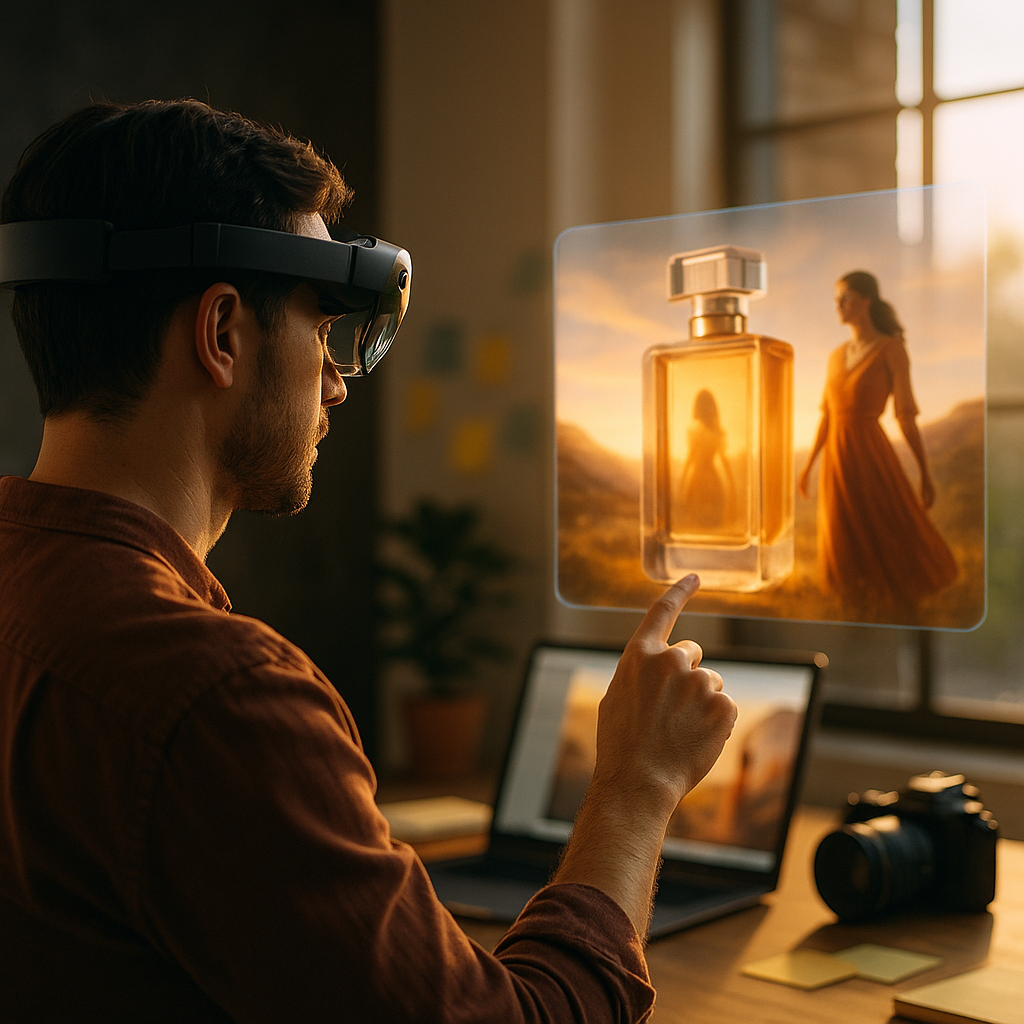
In 2025, spatial computing is pushing brand storytelling beyond screens and into lived environments. Instead of asking audiences to watch, it invites them to move, choose, and feel—turning campaigns into experiences. For narrative teams, that changes how plots are structured, how characters appear, and how trust is earned. The real question is simple: what will your story do when space becomes the canvas?
Spatial computing and immersive storytelling fundamentals
Spatial computing blends digital content with physical space, using devices like mixed-reality headsets, smartphones, and sensor-rich wearables to understand surfaces, depth, position, and context. In narrative brand content, that context becomes a storytelling engine. A scene can unfold differently depending on where someone stands, what they look at, and what objects are nearby.
Immersive storytelling in spatial environments differs from traditional video, social, or even interactive web formats in three critical ways:
- Presence: The audience feels co-located with characters, objects, or events. That perceived “being there” increases emotional impact but also raises expectations for realism and coherence.
- Embodied interaction: Users navigate with their bodies, gaze, hands, and voice. That means narrative beats must account for pacing driven by movement, not edits.
- Context awareness: The environment influences meaning. A product reveal on a kitchen counter lands differently than the same reveal floating in a subway station.
Brands often ask whether this is only for big budgets. It is not. Spatial narratives can be lightweight, such as a phone-based AR story layered on packaging, or premium, such as a mixed-reality episodic experience. The strategic choice is less about spectacle and more about what spatial adds: clarity, empathy, utility, or memorability.
To apply Google’s helpful-content expectations, start with the user’s intent: are they trying to learn, decide, or do something? Spatial narrative works best when it removes friction (show me how), reduces uncertainty (prove it in my space), or deepens identity (this reflects me).
Brand narrative content design for mixed reality
Spatial computing forces a shift from linear scripts to “narrative systems.” Instead of a single timeline, you design a set of scenes, rules, and triggers that hold together even when the audience behaves unpredictably. The goal is not to control every step, but to ensure the story remains legible and on-brand.
Key design principles for narrative brand content in mixed reality:
- Anchor the premise fast: In spatial experiences, drop-off happens quickly if people don’t understand what to do. Establish the setting, objective, and interaction model within the first 10–20 seconds of use.
- Write for “glanceability”: People won’t read long paragraphs in headsets or while holding up a phone. Use short lines, voice, and environmental cues. Treat text as signage, not prose.
- Make the product role explicit: Decide whether the product is a character, a tool, a reward, or a setting element. Ambiguity here leads to experiences that feel like tech demos rather than stories.
- Design beats around movement: Replace “cut to” with “walk to,” “look up,” “open,” or “place.” Pacing is embodied; the narrative must tolerate slower exploration without losing momentum.
- Build a fail-soft structure: If users skip a clue or place an object wrong, the experience should recover gracefully. Offer subtle guidance through sound, lighting, or character prompts.
A practical way to plan is to map each moment to three layers: story (what it means), interaction (what the user does), and spatial logic (where it happens and why there). This avoids the common pitfall of adding AR overlays that do not change understanding or behavior.
Many teams also need an internal content rulebook. Define tone, safety boundaries, accessibility standards, and measurable outcomes before production starts. Spatial experiences are harder to “fix in post,” so governance is part of creative quality.
AR brand experiences and audience engagement shifts
Spatial computing changes engagement from passive attention to active participation. That can raise brand affinity, but only if the experience respects the user’s time and environment. In 2025, audiences are sensitive to friction, privacy risks, and gimmicks. They will opt out quickly if the experience feels intrusive or unclear.
Engagement shifts to plan for:
- From impressions to interactions: Success is less about reach and more about meaningful actions—placing, trying, configuring, exploring, or sharing.
- From “watch time” to “task completion”: Spatial narratives often blend story and utility. People may come for entertainment but stay for guidance, personalization, or reassurance.
- From one-size-fits-all to situational relevance: The same story can adapt to a living room, store aisle, or event venue. That adaptability should serve the narrative, not fragment it.
To answer the follow-up question “What makes spatial engagement feel satisfying?”: users need clear feedback. Every action should produce a visible or audible response that advances the story. If they place an object, the world should react. If they look at a character, the character should acknowledge them. Responsiveness builds the feeling of presence.
Another common concern is motion fatigue and cognitive load. Keep interactions simple, avoid forcing constant arm movement, and offer seated or short-session options. A strong spatial narrative favors precision over volume: fewer, better moments with clear emotional beats.
Finally, spatial content can strengthen community when designed for co-presence. Multi-user scenes—on-site or remote—can turn brand narratives into shared rituals, such as collaborative problem-solving or collective reveals. When you do this, moderation, safety, and consent become part of the narrative design, not just platform policy.
3D content strategy and production pipeline changes
Spatial storytelling raises the bar for craft. You are no longer only designing frames; you are designing spaces. That impacts budgets, schedules, and team composition, but it also creates reusable assets that can amortize over campaigns.
Core pipeline shifts for a modern 3D content strategy:
- Asset libraries become brand infrastructure: Build a coherent set of 3D products, environments, materials, lighting presets, and animation rigs. Treat them as long-term brand assets with version control.
- Real-time engines become central: Many spatial experiences rely on real-time rendering for interactivity. That means creative and technical teams collaborate earlier, and performance constraints shape story decisions.
- Spatial audio is not optional: Audio cues guide attention and sell presence. Use directional sound for narrative focus, and ensure voice clarity in noisy environments.
- Testing expands from “does it play” to “does it fit”: You must test in varied rooms, lighting conditions, and device capabilities. Spatial mapping differences can change how scenes land.
Teams often ask whether they need cinematic realism. Not always. Stylization can be more recognizable and lighter to run. The real requirement is consistency: physics, scale, and interaction rules must behave predictably. If a virtual object clips through a table or changes size unexpectedly, the story’s credibility breaks.
Build for accessibility from the start. Provide multiple input options (hand, gaze, controller, touch), avoid reliance on color alone, and include captions for essential audio. Spatial experiences can exclude users quickly if accessibility is treated as an add-on.
From an EEAT perspective, document your production decisions. Maintain clear specs for model scale, texture resolution, privacy-safe analytics, and content review. This not only improves quality but also supports internal accountability if stakeholders ask “why did we build it this way?”
Ethics, privacy, and trust in spatial marketing
Spatial computing can observe environments in ways that feel intimate: room layouts, objects, and potentially bystanders. Narrative brand content must earn trust through restraint, clarity, and user control. In 2025, privacy expectations are high, and regulatory scrutiny is real. Trust is not a tagline; it is a design requirement.
Practical trust-building measures:
- Explain data use in plain language: Tell users what you sense, what you store, and what you don’t. Keep it short, specific, and visible at the moment it matters.
- Default to minimal collection: If spatial mapping is needed only for placement, avoid storing detailed scans. Use on-device processing where possible.
- Offer granular controls: Let users opt out of analytics, mute microphones, and limit location features without breaking the experience.
- Design for bystander safety: Avoid encouraging use in risky environments, include boundary warnings, and reduce attention traps that pull eyes away from real-world hazards.
- Label persuasion tactics: If the experience includes scarcity cues, endorsements, or AI-driven personalization, disclose it. Hidden manipulation damages brand equity.
There is also a narrative ethics layer: spatial stories can feel psychologically stronger than video because they are “around you.” Be cautious with fear, shock, or intense intimacy, especially in categories that involve health, finances, or children. The most effective spatial brand narratives tend to be empowering: they help users understand, choose, and act with confidence.
To align with EEAT, incorporate real expertise into the process: privacy counsel, accessibility specialists, and user researchers. Document approvals and keep a content risk register. These steps are rarely visible to the audience, but they directly reduce harmful outcomes and reputational risk.
Measuring spatial analytics and narrative ROI
Spatial content can be measured rigorously, but the metrics must match the medium. Views and clicks alone do not describe embodied experiences. You need behavioral signals that reflect comprehension, engagement quality, and downstream business impact.
Useful spatial analytics for narrative content:
- Activation rate: The percentage of users who grant permissions and start the experience after landing on it.
- Time-to-first-delight: How quickly users reach a rewarding moment (reveal, transformation, character interaction). This correlates with retention.
- Completion and re-entry: Finishing a chapter, returning for another scene, or replaying to explore alternate paths.
- Interaction depth: Number of meaningful actions taken (placements, customizations, choices), not random taps.
- Spatial friction markers: Abandonment during scanning, repeated failed placements, excessive help prompts—signals your design needs simplification.
- Brand lift and conversion: Survey-based lift (recall, preference) plus attributable actions (add-to-cart, store visit intent, qualified lead, subscription).
Answering the common follow-up “How do we connect story to business outcomes?”: tie each narrative beat to a measurable intent shift. For example, a scene that demonstrates fit in a real room should correlate with fewer returns or higher purchase confidence. A character-led tutorial should correlate with fewer support tickets or higher feature adoption.
Use experimentation carefully. A/B testing in spatial media is possible, but ensure variants differ in one meaningful dimension (intro clarity, interaction count, narrative voice) and that you account for device and environment variability. When reporting results, include limitations: sample bias, device mix, and permission opt-in effects.
FAQs
What is spatial computing in brand storytelling?
It is the use of AR and mixed-reality technologies to place interactive story elements into real environments, allowing audiences to move, interact, and influence narrative outcomes through spatial context.
How will spatial computing change narrative brand content?
It shifts storytelling from linear viewing to embodied participation. Brands will design narrative systems with scenes triggered by location, gaze, and interaction, making stories more personal and harder to fake.
Do spatial experiences require a headset?
No. Many successful spatial narratives run on smartphones through AR. Headsets can deepen presence, but mobile remains a practical entry point for reach and rapid iteration.
What types of brands benefit most from spatial narratives?
Brands that need demonstration or contextual confidence—home, retail, automotive, travel, education, and wellness—often gain the most. Entertainment-driven brands also benefit when they can extend worlds into real places.
How do you keep spatial brand content accessible?
Offer multiple input methods, provide captions and clear audio, avoid color-only cues, keep interactions low-effort, and ensure the experience works in short sessions with clear guidance.
What are the biggest risks in spatial marketing?
Privacy overreach, confusing interactions, physical safety issues, and experiences that feel like gimmicks. Strong disclosures, minimal data collection, user control, and rigorous testing reduce these risks.
How do you measure ROI for spatial narrative campaigns?
Combine spatial engagement metrics (activation, completion, interaction depth) with business metrics (brand lift, conversion, retention). Map each narrative beat to a measurable intent shift to prove causality.
Spatial computing is reshaping brand storytelling by making space, movement, and context part of the plot. In 2025, the winners will be brands that design clear interaction-first narratives, invest in reusable 3D foundations, and treat privacy and accessibility as core creative constraints. Build fewer, stronger moments that earn trust and drive action. When your story can live in someone’s world, it must deserve the space.
Top Influencer Marketing Agencies
The leading agencies shaping influencer marketing in 2026
Agencies ranked by campaign performance, client diversity, platform expertise, proven ROI, industry recognition, and client satisfaction. Assessed through verified case studies, reviews, and industry consultations.
Moburst

-
2

The Shelf
Boutique Beauty & Lifestyle Influencer AgencyA data-driven boutique agency specializing exclusively in beauty, wellness, and lifestyle influencer campaigns on Instagram and TikTok. Best for brands already focused on the beauty/personal care space that need curated, aesthetic-driven content.Clients: Pepsi, The Honest Company, Hims, Elf Cosmetics, Pure LeafVisit The Shelf → -
3

Audiencly
Niche Gaming & Esports Influencer AgencyA specialized agency focused exclusively on gaming and esports creators on YouTube, Twitch, and TikTok. Ideal if your campaign is 100% gaming-focused — from game launches to hardware and esports events.Clients: Epic Games, NordVPN, Ubisoft, Wargaming, Tencent GamesVisit Audiencly → -
4

Viral Nation
Global Influencer Marketing & Talent AgencyA dual talent management and marketing agency with proprietary brand safety tools and a global creator network spanning nano-influencers to celebrities across all major platforms.Clients: Meta, Activision Blizzard, Energizer, Aston Martin, WalmartVisit Viral Nation → -
5

The Influencer Marketing Factory
TikTok, Instagram & YouTube CampaignsA full-service agency with strong TikTok expertise, offering end-to-end campaign management from influencer discovery through performance reporting with a focus on platform-native content.Clients: Google, Snapchat, Universal Music, Bumble, YelpVisit TIMF → -
6

NeoReach
Enterprise Analytics & Influencer CampaignsAn enterprise-focused agency combining managed campaigns with a powerful self-service data platform for influencer search, audience analytics, and attribution modeling.Clients: Amazon, Airbnb, Netflix, Honda, The New York TimesVisit NeoReach → -
7

Ubiquitous
Creator-First Marketing PlatformA tech-driven platform combining self-service tools with managed campaign options, emphasizing speed and scalability for brands managing multiple influencer relationships.Clients: Lyft, Disney, Target, American Eagle, NetflixVisit Ubiquitous → -
8

Obviously
Scalable Enterprise Influencer CampaignsA tech-enabled agency built for high-volume campaigns, coordinating hundreds of creators simultaneously with end-to-end logistics, content rights management, and product seeding.Clients: Google, Ulta Beauty, Converse, AmazonVisit Obviously →