


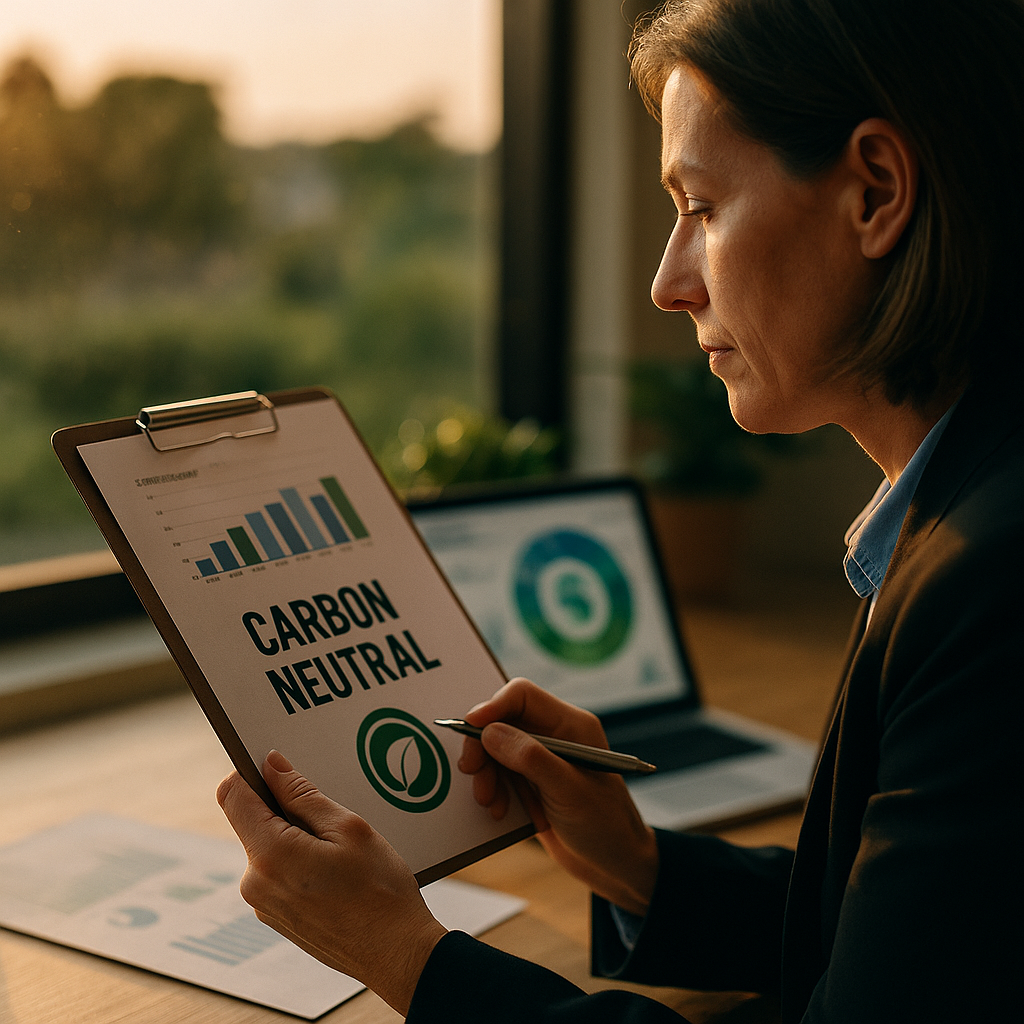
Transparency requirements for carbon neutral marketing claims are tightening in 2025, and regulators, platforms, and customers now expect proof—not slogans. Brands must explain boundaries, calculations, reductions, and any reliance on carbon credits in plain language. This article shows how to build credible claims, avoid greenwashing risk, and design disclosures that stand up to scrutiny. Ready to pressure-test your “carbon neutral” message?
Regulatory landscape and carbon neutral claim compliance
“Carbon neutral” is no longer a soft brand promise. It is a measurable environmental claim that can trigger advertising, consumer protection, and competition law scrutiny. In 2025, enforcement pressure is rising across multiple jurisdictions, and the practical takeaway is consistent: if you cannot substantiate a claim quickly with documented evidence, do not run it.
What regulators typically require:
- Truthful, not misleading: The overall impression must be accurate. Fine print cannot contradict a headline claim.
- Clear scope: Specify what is carbon neutral (a product, a service, a shipment, an event, or the whole company) and what is excluded.
- Verifiable methodology: Show how emissions were measured and which standard or protocol you used.
- Priority to reductions: Demonstrate that reductions come first and offsetting is not presented as a substitute for cutting emissions.
- Specificity over vagueness: Avoid blanket claims such as “net-zero” or “climate positive” unless you can support them with robust evidence and definitions.
Likely follow-up: “Do we need legal review for every campaign?” You need a repeatable review process, not a bottleneck. Build a claim library with pre-approved wording tied to documented substantiation, and route only novel or high-risk claims to legal counsel.
Defining boundaries with marketing claim substantiation
Many carbon neutral claims fail because the boundary is unclear. Customers interpret “carbon neutral” broadly, so you must define the boundary upfront and align it with how the product is actually delivered.
Start with a precise claim statement: “Carbon neutral” should always be paired with the unit of analysis, such as “carbon neutral for the lifecycle of Product X (cradle-to-grave)” or “carbon neutral for inbound shipping to customer addresses in Region Y.”
Set boundaries that match how decisions are made:
- Organizational boundary: Which entities, sites, and operations are included?
- Operational boundary: Which emission sources are included (fuel, electricity, logistics, purchased goods, employee travel)?
- Temporal boundary: Which period does the claim cover (calendar year, product batch, campaign window)?
- Geographic boundary: Does it apply globally or only in certain markets?
Answer the question customers will ask next: “Is the whole product carbon neutral?” If your claim is limited to a component (for example, “packaging” or “delivery”), state that immediately in the headline or the first line of disclosure. If you rely on offsets for a portion of emissions, disclose that proportion plainly.
Common high-risk ambiguity: Using a product label that implies full lifecycle neutrality when you only offset operational emissions. If the average buyer would assume “everything,” write “operational emissions” or “manufacturing emissions” explicitly.
Measurement and reporting using carbon footprint disclosure
Substantiation depends on the quality of your carbon accounting. The best marketing teams in 2025 partner closely with sustainability and finance teams so that the numbers used in claims match internal reporting and can be audited.
What strong measurement looks like:
- Recognized standards: Use established carbon accounting frameworks and document which version and scope you applied.
- Data hierarchy: Prefer primary data from suppliers and operations; use secondary data only when necessary and explain assumptions.
- Materiality focus: Cover the largest sources of emissions rather than polishing small categories while ignoring major ones.
- Uncertainty transparency: State when results are estimates and why, without burying it.
What to disclose publicly (without overwhelming people): Provide a short summary in marketing materials and link to a more detailed page. The detailed page should include the emissions total, boundary description, calculation approach, key assumptions, and who verified it.
Practical guidance for a disclosure page:
- Claim: The exact wording used in ads and packaging.
- Scope: What’s included and excluded (with examples).
- Emissions: Total tCO2e and the coverage period.
- Reductions: Actions taken and evidence (energy procurement, efficiency, supplier changes, logistics changes).
- Neutralization: Amount offset, type of credits, project details, retirement documentation, and registry links.
- Assurance: Any third-party review and its level (limited vs reasonable assurance), plus the provider’s name.
Follow-up question: “Do we have to publish our full dataset?” Not usually. You do need to provide enough detail that a reasonable reviewer can understand the method and confirm the claim is not misleading.
Offsets, removals, and carbon offset transparency
Offsets are the most scrutinized element of carbon neutral marketing. Claims often fail when brands imply that purchasing credits equals eliminating emissions. The safest approach is to explain exactly what the credits are, how they are verified, and how you ensure they are not double-counted.
Use precise language:
- “We reduced emissions and offset the remainder” is clearer than “we are carbon neutral,” standing alone.
- Distinguish avoidance vs removal: Avoidance credits prevent emissions elsewhere; removal credits take carbon out of the atmosphere. Do not blend them without explaining proportions.
- Explain permanence and risk: Some projects have reversal risks. Describe how the program addresses that risk.
Minimum transparency for credits:
- Project name, location, and project type
- Standard/program and methodology used
- Vintage (issuance period) and quantity purchased
- Registry ID(s) and retirement/cancellation evidence
- Whether credits are removal or avoidance, and why chosen
Answer the next question proactively: “Why not just reduce more?” Provide a simple decarbonization roadmap: what you have already reduced, what is in progress, and what cannot yet be reduced due to technical or supplier constraints. This strengthens credibility and aligns with the expectation that offsets are a bridge, not a destination.
Avoid these offset-driven pitfalls:
- Overclaiming: Claiming “zero emissions” when you are netting emissions with credits.
- Cherry-picking: Highlighting a single high-quality project while using lower-quality credits for the bulk without disclosure.
- No retirement proof: If you cannot show retirement details, your claim is fragile.
Clear messaging and greenwashing risk mitigation
Even accurate numbers can lead to misleading marketing if the communication is unclear. Transparency is a design problem: how you present the claim matters as much as what sits behind it.
Build a claim that matches consumer interpretation: Place the scope and the qualifier close to the claim, not behind a separate click. If you are space-limited (for example, on a label), include a short qualifier and a scannable link to full details.
Examples of stronger phrasing:
- Better: “Carbon neutral delivery (we measured delivery emissions and offset the remainder with verified credits).”
- Better: “Product X lifecycle emissions measured and balanced: 70% reduced through manufacturing changes, 30% offset via retired credits.”
- Use caution: “Climate friendly,” “planet positive,” “eco,” and “clean” without defined meaning and evidence.
Design disclosures people actually read:
- Plain language: Write for non-experts. Define terms like “tCO2e,” “Scope 3,” and “retirement.”
- Comparisons with context: If you compare to a baseline, state the baseline and the method.
- Consistency: Ensure product pages, ads, packaging, and investor materials tell the same story.
Internal controls that reduce risk:
- Claim approval workflow: Marketing, sustainability, and legal sign-off for high-impact claims.
- Evidence binder: A centralized repository with calculations, invoices, registry retirements, and assurance statements.
- Platform readiness: Some ad platforms request substantiation for environmental claims. Prepare a standard evidence pack.
Audits, assurance, and third-party verification
EEAT-friendly content and credible claims rely on demonstrable expertise and independent checks. While third-party verification is not always legally required, it can materially strengthen defensibility and customer trust—especially for large-scale claims.
What verification should cover:
- Emissions inventory review: Boundary, data sources, calculations, and consistency.
- Offset due diligence: Credit quality screening, registry checks, and retirement confirmation.
- Claim-to-evidence alignment: Ensuring the marketing language matches what the evidence supports.
Levels of assurance: Many organizations use limited assurance as an initial step and expand over time. If you cite assurance publicly, name the provider and describe what was assured. Do not imply full audit coverage if only part of the footprint was reviewed.
Answer the budget question: “What if we cannot afford assurance?” Prioritize verification for the highest-reach claims and highest-risk products. You can also begin by verifying the methodology and boundary even if you cannot verify every supplier datapoint. The key is to be explicit about what has and has not been verified.
Operationalize ongoing compliance: Carbon neutral claims are not “set and forget.” Refresh calculations at the interval implied by the claim (for example, annual claims need annual updates). If your footprint changes materially due to supply chain shifts or growth, update disclosures and adjust credits accordingly.
FAQs
What counts as a “carbon neutral” marketing claim?
A carbon neutral claim asserts that emissions associated with a defined scope (product, service, shipment, event, or organization) have been measured and reduced, with remaining emissions neutralized—typically through retired carbon credits. The scope must be stated clearly to avoid misleading impressions.
Do we need to include Scope 3 emissions to claim carbon neutral?
Not always, but excluding major Scope 3 sources increases risk if consumers would reasonably assume they are included. If you exclude Scope 3, disclose the exclusion prominently and explain why. For product lifecycle claims, Scope 3 is often material and difficult to omit credibly.
Can we say “zero emissions” instead of “carbon neutral”?
Only if emissions are truly zero within the stated boundary without offsetting. If you rely on offsets, “zero emissions” is likely misleading. Use “measured and balanced,” “net emissions balanced,” or “carbon neutral” with clear offset disclosure.
How specific should we be about carbon credits?
Specific enough that someone can verify what you bought and that it was retired. Include project type, location, standard, vintage, quantity, and registry retirement IDs. If you use a portfolio, disclose portfolio composition and quality criteria.
Is a QR code link to disclosures enough?
A QR code can help, but key qualifiers must appear close to the claim. Use the QR code for expanded details, not to hide material limitations. If space is tight, include a short qualifier such as “delivery only” or “offsets used” next to the claim.
What documentation should we keep on file?
Keep your calculation model, activity data sources, emission factors, boundary decisions, internal approvals, supplier attestations where relevant, offset purchase records, registry retirement evidence, and any third-party assurance statements. Store them in a version-controlled repository tied to each claim.
How often should we update a carbon neutral claim?
Update as often as the claim implies. Annual claims need annual recalculation and fresh credit retirement. Batch- or campaign-specific claims should be updated per batch or campaign. Also update when there is a material change in operations or supply chain inputs.
In 2025, credible carbon neutral marketing depends on disciplined transparency: define the boundary, measure emissions with a defensible method, reduce first, and disclose any offsets with verifiable retirement proof. Communicate the scope in plain language where people will see it, not buried in fine print. Treat every claim as an auditable statement, and your marketing can stay persuasive while staying compliant.
Top Influencer Marketing Agencies
The leading agencies shaping influencer marketing in 2026
Agencies ranked by campaign performance, client diversity, platform expertise, proven ROI, industry recognition, and client satisfaction. Assessed through verified case studies, reviews, and industry consultations.
Moburst

-
2

The Shelf
Boutique Beauty & Lifestyle Influencer AgencyA data-driven boutique agency specializing exclusively in beauty, wellness, and lifestyle influencer campaigns on Instagram and TikTok. Best for brands already focused on the beauty/personal care space that need curated, aesthetic-driven content.Clients: Pepsi, The Honest Company, Hims, Elf Cosmetics, Pure LeafVisit The Shelf → -
3

Audiencly
Niche Gaming & Esports Influencer AgencyA specialized agency focused exclusively on gaming and esports creators on YouTube, Twitch, and TikTok. Ideal if your campaign is 100% gaming-focused — from game launches to hardware and esports events.Clients: Epic Games, NordVPN, Ubisoft, Wargaming, Tencent GamesVisit Audiencly → -
4

Viral Nation
Global Influencer Marketing & Talent AgencyA dual talent management and marketing agency with proprietary brand safety tools and a global creator network spanning nano-influencers to celebrities across all major platforms.Clients: Meta, Activision Blizzard, Energizer, Aston Martin, WalmartVisit Viral Nation → -
5

The Influencer Marketing Factory
TikTok, Instagram & YouTube CampaignsA full-service agency with strong TikTok expertise, offering end-to-end campaign management from influencer discovery through performance reporting with a focus on platform-native content.Clients: Google, Snapchat, Universal Music, Bumble, YelpVisit TIMF → -
6

NeoReach
Enterprise Analytics & Influencer CampaignsAn enterprise-focused agency combining managed campaigns with a powerful self-service data platform for influencer search, audience analytics, and attribution modeling.Clients: Amazon, Airbnb, Netflix, Honda, The New York TimesVisit NeoReach → -
7

Ubiquitous
Creator-First Marketing PlatformA tech-driven platform combining self-service tools with managed campaign options, emphasizing speed and scalability for brands managing multiple influencer relationships.Clients: Lyft, Disney, Target, American Eagle, NetflixVisit Ubiquitous → -
8

Obviously
Scalable Enterprise Influencer CampaignsA tech-enabled agency built for high-volume campaigns, coordinating hundreds of creators simultaneously with end-to-end logistics, content rights management, and product seeding.Clients: Google, Ulta Beauty, Converse, AmazonVisit Obviously →