


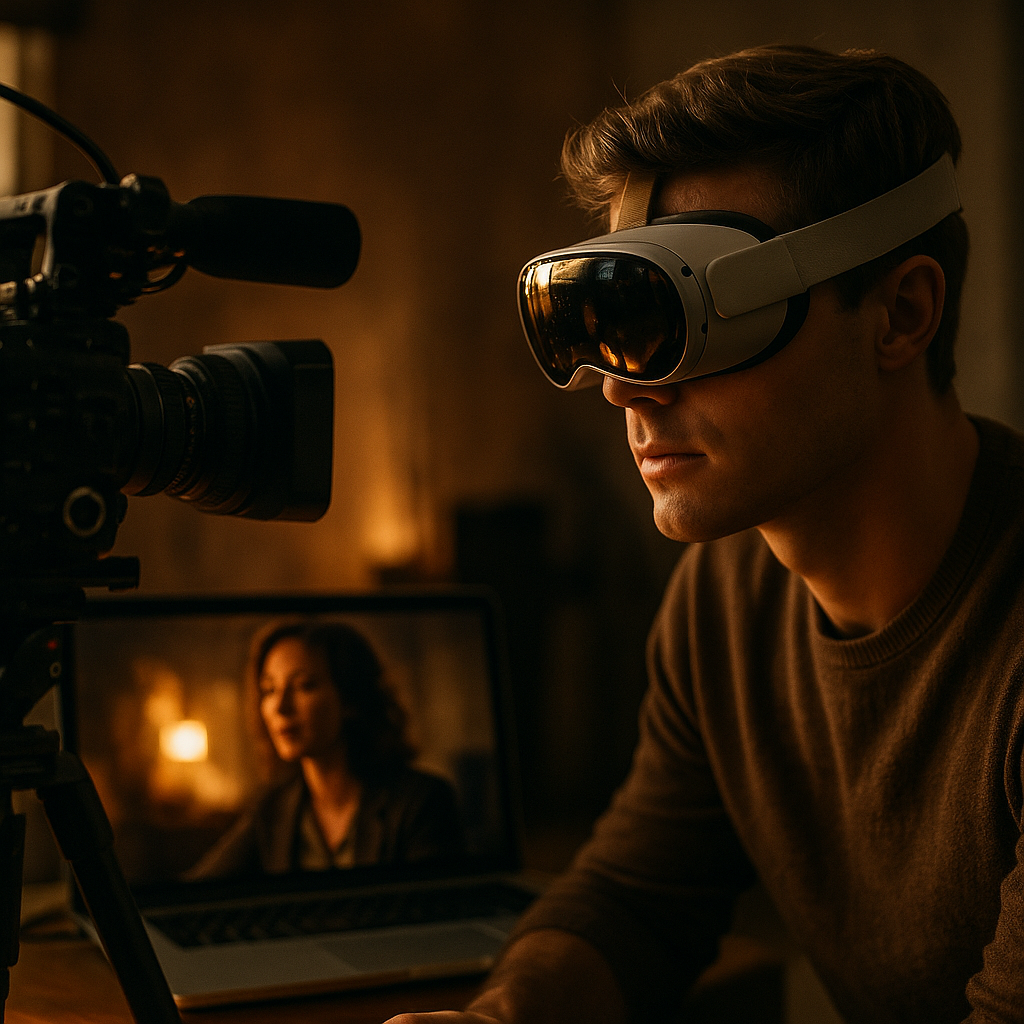
The Impact Of Spatial Computing On The Future Of Narrative Video is reshaping how stories are written, shot, and experienced in 2025. Instead of watching a fixed frame, audiences increasingly inhabit scenes, explore perspectives, and influence pacing through attention and movement. For creators, this shift changes everything from blocking to editing to distribution. The real question is not if narrative evolves, but who learns these rules first.
Spatial computing in storytelling: from framed scenes to lived scenes
Spatial computing blends digital content with the physical world (or a simulated one) and anchors it to space so it feels present, stable, and interactive. In narrative video, that means the “screen” stops being the primary container. The viewer becomes a camera operator of sorts, using head movement, gaze, and sometimes hands or controllers to discover story beats.
This change forces a new set of storytelling assumptions:
- Attention is earned, not forced. You cannot rely on a cut to make someone look where you want; you must guide attention with light, motion, sound, character behavior, and spatial composition.
- Space becomes plot. Set design is no longer background. The environment can reveal backstory, foreshadow events, or hide narrative rewards.
- Viewers have agency, even without choices. Even when the story is linear, users choose where to look. That alters suspense, comedic timing, and emotional emphasis.
Creators often ask whether spatial narratives must be interactive. Not necessarily. Many compelling spatial experiences remain linear, but they are spatially legible: the viewer can explore without missing critical beats. The craft lies in building a story that remains coherent across multiple attention paths.
Immersive video production: new grammar for directing, editing, and performance
Immersive narrative video demands a different production grammar. Traditional film language uses framing, lens choice, and montage to control meaning. Spatial experiences still use those tools, but they share the stage with environmental cues, spatial audio, and viewer movement.
Directing and blocking change first. Actors can no longer rely on “playing to camera.” Performances must read from multiple angles and distances. Directors stage action in zones: close, mid, and far, ensuring key beats remain understandable even if the viewer stands off-axis.
Editing becomes less about rapid cutting and more about comfortable transitions. Hard cuts can disorient when the viewer’s body is “in” the scene. Many teams use motivated transitions: characters crossing the viewer’s path, lights dimming, doors opening, or audio cues that pull attention before a scene change. Where cuts remain, they’re often paired with spatial anchors (a fixed object, a consistent horizon line) to reduce discomfort.
Cinematography shifts toward “worldography.” Instead of composing a rectangle, you compose a volume. You still need intentional composition: negative space can isolate a character; layered depth can create tension; occlusion can hide reveals. But you design these effects so they work without assuming a single viewpoint.
Sound becomes a primary directing tool. Spatial audio can steer attention with subtlety, turning the viewer’s head before a crucial moment. For many projects, audio design carries the narrative load that editing once carried.
Practical follow-up: how do you prevent viewers from missing the plot? Use redundancy without repetition. Critical information should be conveyed through at least two channels (dialogue plus environmental signage, or action plus audio cue). Also, design “attention funnels” that naturally re-center the viewer: a character approaches, a light turns on, a loud event occurs behind the viewer, or the environment itself guides movement.
XR narrative design: agency, pacing, and emotional control without losing coherence
Extended reality (XR) includes VR, AR, and mixed reality. Each mode affects narrative design differently, but they share a key challenge: balancing agency with story clarity. Too much freedom can dilute pacing; too little can feel like a gimmick.
Three common XR narrative structures are emerging as reliable patterns:
- Guided linear immersion: The story is linear, but the viewer can explore. The creator guides attention through staging, audio, and environmental cues.
- Hub-and-spoke scenes: The viewer explores a central space (the hub) and triggers narrative “spokes” (memories, conversations, flashbacks) in a controlled order or flexible sequence.
- Branching micro-decisions: Choices affect tone, perspective, or character relationships more than plot. This preserves coherence while still making agency meaningful.
Pacing needs special care. In traditional video, pacing is editorial. In spatial narrative, pacing becomes behavioral: it depends on how quickly people explore. Effective experiences use “soft gates” (a character waits, a door stays locked until a line finishes, an event escalates if you linger) rather than intrusive prompts.
Emotional control is also different. In a headset, proximity feels intimate. A character whispering near the viewer can be powerful, but it can also feel uncomfortable if not motivated. Ethical, audience-first design matters: respect personal space, avoid jump scares that rely on disorientation, and provide comfort options.
Follow-up: do you need interactivity to justify XR? No. Presence alone can justify the medium when the story benefits from embodiment: grief in a shared room, awe at scale, or tension from being physically “near” a threat. Interactivity should serve theme, not marketing.
Volumetric capture and virtual production: believable characters and worlds at scale
Two production approaches are driving the quality leap in spatial narratives: volumetric capture (recording performers in 3D) and virtual production (using real-time engines and digital sets to light, stage, and iterate quickly). Together, they reduce the gap between cinematic intent and spatial delivery.
Volumetric capture helps when performance realism matters. A viewer can walk around a character, so flat video tricks break easily. Volumetrics preserve subtle motion and body language from multiple angles, which supports drama and nuanced acting. The trade-offs are cost, large data footprints, and constraints on lighting and wardrobe (fine patterns and reflective materials can create artifacts).
Virtual production improves iteration. Story teams can block scenes in a real-time engine, test sightlines, adjust scale, and validate comfort before final assets are locked. This is especially valuable because spatial story problems are often discovered late if you wait for final renders.
World consistency becomes an EEAT issue as well as a craft issue. Viewers trust a world that behaves consistently: physics, lighting logic, and character eye-lines need to make sense from multiple perspectives. Inconsistent spatial logic breaks immersion faster than a minor continuity error in 2D film.
Follow-up: what should indie creators prioritize? Start with strong audio, coherent spatial blocking, and a small number of high-quality interactive beats. You can create a powerful narrative in a limited space with thoughtful staging. Expansive worlds are not required; clarity and emotional intention are.
Interactive storytelling analytics: measuring attention, comfort, and narrative comprehension
Spatial computing adds new measurement signals, which can improve storytelling when used responsibly. Unlike traditional video metrics (views, completion rate), spatial experiences can capture behavioral signals such as gaze direction, dwell time in areas, and movement patterns. These insights help creators answer practical questions: Did viewers notice the clue? Did they understand the relationship? Where did they feel lost?
Useful metrics for narrative teams include:
- Attention maps: Where viewers look during key beats; helps validate staging and audio cues.
- Navigation friction: Points where viewers stop, backtrack, or linger too long; often signals unclear objectives or confusing spatial layout.
- Comfort indicators: Session length, abrupt exits, and user-selected comfort settings; helps balance intensity with accessibility.
- Comprehension checks: Optional end-of-scene prompts or non-intrusive story recalls; confirms whether exploration harmed understanding.
EEAT and trust: Treat analytics with care. If you collect behavioral data, explain what you collect, why, and how it’s protected. Avoid designing stories that manipulate attention through dark patterns. The most effective long-term strategy is straightforward: use data to reduce confusion and improve comfort, not to pressure engagement.
Follow-up: will analytics make stories formulaic? They can, if teams chase heatmaps rather than meaning. Use analytics like a script note: it highlights where intent and perception diverge. The creative decision still belongs to the storyteller.
Spatial video platforms and distribution: monetization, accessibility, and ethical design
Distribution determines what kinds of stories get funded. In 2025, spatial video reaches audiences through headsets, phones (via AR), and increasingly through mixed reality devices that blend digital characters with real rooms. Each channel implies different constraints for narrative video.
Monetization is diversifying:
- Premium releases: Paid spatial films or episodic experiences, often bundled with behind-the-scenes content.
- Subscription libraries: Platforms that reduce risk for experimentation but raise discoverability challenges.
- Brand-funded narratives: Effective when the brand role is thematic or infrastructural (enabling the world), not intrusive.
- Hybrid models: A short free “chapter one” with paid continuation can work when the hook is clear and the experience is polished.
Accessibility is non-negotiable for sustainable growth. Provide seated and standing modes, locomotion options, readable subtitles in 3D space, adjustable audio levels, and safe area boundaries. Narrative teams should plan accessibility early because retrofitting it can break timing and staging.
Ethical design matters more in spatial media because it feels more personal. Avoid exploiting proximity, biometric inference, or compulsive loops. A strong EEAT posture includes transparent onboarding, clear comfort controls, and respectful data practices.
Follow-up: what skills should writers and directors learn next? Spatial blocking, attention design, and audio-first storytelling. Also learn to collaborate with engine teams, because narrative choices now depend on technical constraints like tracking stability, performance budgets, and scene streaming.
FAQs
What is spatial computing in narrative video?
Spatial computing lets digital story elements exist in 3D space, anchored to the real world or a virtual environment. In narrative video, it shifts storytelling from a fixed frame to an experience where viewers can look around, move, and sometimes interact, which changes directing, pacing, and editing.
How does spatial computing change the role of the viewer?
The viewer becomes an active participant in attention and perspective. Even without explicit choices, their gaze and movement affect what they notice first, how suspense builds, and which details feel most important.
Do spatial narratives require branching choices?
No. Many successful spatial stories are linear. The key is designing scenes so the viewer can explore without missing essential plot information, using spatial audio, blocking, and environmental cues to guide attention.
What are the biggest production challenges for immersive narrative video?
Maintaining comfort, guiding attention without heavy-handed prompts, ensuring performances read from multiple angles, and keeping world logic consistent. Data size and real-time performance constraints also shape creative decisions.
Is volumetric capture necessary for believable characters?
It helps, especially for intimate drama where subtle performance matters. But it’s not mandatory. High-quality animation, strong voice performance, and careful staging can deliver believable characters within smaller budgets.
How can creators measure whether viewers understood the story?
Use attention maps, navigation friction analysis, and optional comprehension checks. Combine quantitative signals with qualitative playtests, because confusion often comes from a few specific moments that metrics alone won’t explain.
What should a filmmaker learn first to work in spatial storytelling?
Start with attention design (light, motion, staging), spatial audio principles, and comfort-focused pacing. Then learn real-time workflow basics so you can iterate scenes quickly and test story clarity early.
Will spatial computing replace traditional narrative video?
It will expand narrative options rather than replace them. Traditional film remains efficient for many stories, while spatial formats excel when presence, scale, and embodied perspective deepen the emotional impact.
How do you keep spatial storytelling ethical and trustworthy?
Provide clear comfort controls, avoid manipulative engagement patterns, and be transparent about data collection. Design for accessibility from the start and prioritize audience well-being alongside creative ambition.
Conclusion
Spatial computing is changing narrative video by turning space into a storytelling tool and the viewer into an active participant in attention and perspective. In 2025, the winners will be creators who combine cinematic intent with spatial craft: audio-led guidance, coherent world rules, comfort-first pacing, and ethical data practices. Treat presence as narrative power, not a novelty, and your stories will travel further.
Top Influencer Marketing Agencies
The leading agencies shaping influencer marketing in 2026
Agencies ranked by campaign performance, client diversity, platform expertise, proven ROI, industry recognition, and client satisfaction. Assessed through verified case studies, reviews, and industry consultations.
Moburst

-
2

The Shelf
Boutique Beauty & Lifestyle Influencer AgencyA data-driven boutique agency specializing exclusively in beauty, wellness, and lifestyle influencer campaigns on Instagram and TikTok. Best for brands already focused on the beauty/personal care space that need curated, aesthetic-driven content.Clients: Pepsi, The Honest Company, Hims, Elf Cosmetics, Pure LeafVisit The Shelf → -
3

Audiencly
Niche Gaming & Esports Influencer AgencyA specialized agency focused exclusively on gaming and esports creators on YouTube, Twitch, and TikTok. Ideal if your campaign is 100% gaming-focused — from game launches to hardware and esports events.Clients: Epic Games, NordVPN, Ubisoft, Wargaming, Tencent GamesVisit Audiencly → -
4

Viral Nation
Global Influencer Marketing & Talent AgencyA dual talent management and marketing agency with proprietary brand safety tools and a global creator network spanning nano-influencers to celebrities across all major platforms.Clients: Meta, Activision Blizzard, Energizer, Aston Martin, WalmartVisit Viral Nation → -
5

The Influencer Marketing Factory
TikTok, Instagram & YouTube CampaignsA full-service agency with strong TikTok expertise, offering end-to-end campaign management from influencer discovery through performance reporting with a focus on platform-native content.Clients: Google, Snapchat, Universal Music, Bumble, YelpVisit TIMF → -
6

NeoReach
Enterprise Analytics & Influencer CampaignsAn enterprise-focused agency combining managed campaigns with a powerful self-service data platform for influencer search, audience analytics, and attribution modeling.Clients: Amazon, Airbnb, Netflix, Honda, The New York TimesVisit NeoReach → -
7

Ubiquitous
Creator-First Marketing PlatformA tech-driven platform combining self-service tools with managed campaign options, emphasizing speed and scalability for brands managing multiple influencer relationships.Clients: Lyft, Disney, Target, American Eagle, NetflixVisit Ubiquitous → -
8

Obviously
Scalable Enterprise Influencer CampaignsA tech-enabled agency built for high-volume campaigns, coordinating hundreds of creators simultaneously with end-to-end logistics, content rights management, and product seeding.Clients: Google, Ulta Beauty, Converse, AmazonVisit Obviously →