


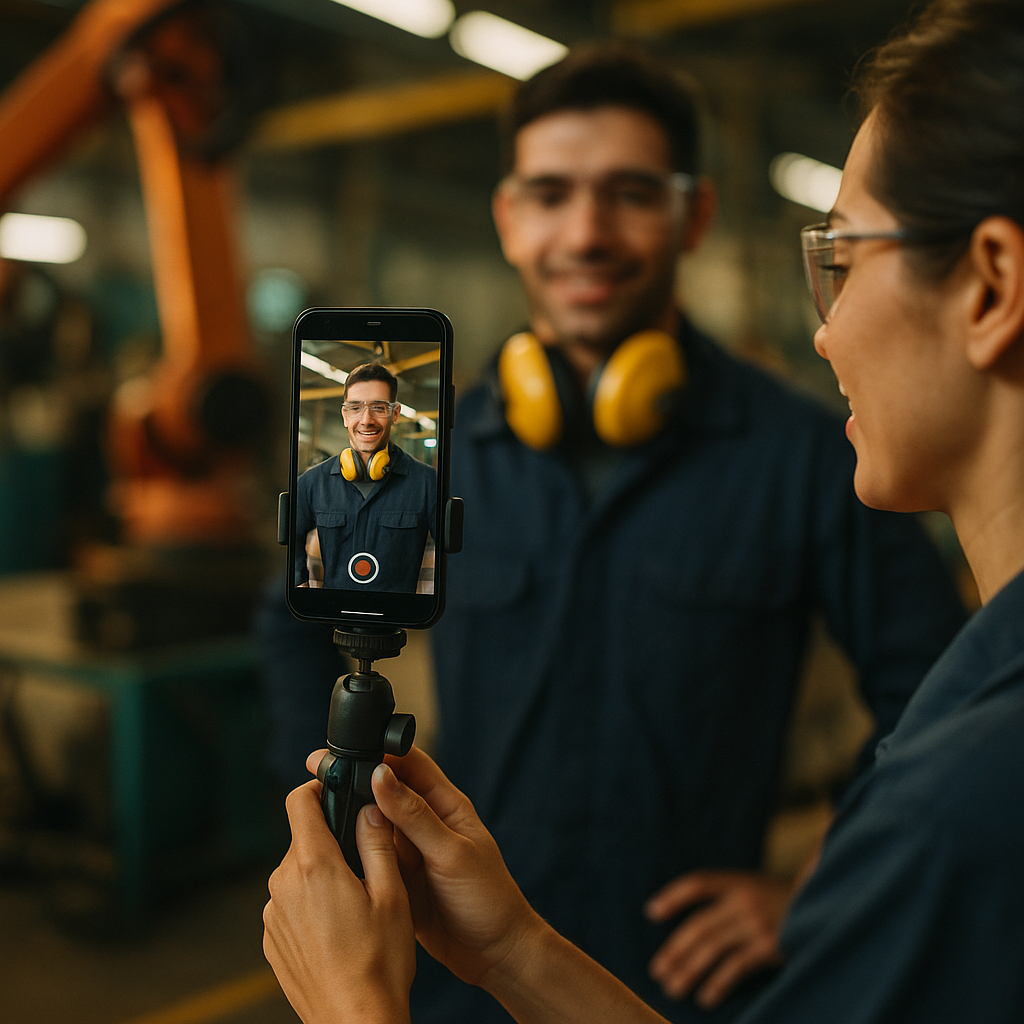
In 2025, recruiting teams face a tough reality: skilled candidates expect transparency, speed, and culture proof. This case study shows how a traditional manufacturer used social video recruiting to attract technicians, engineers, and frontline leaders without inflating salaries or overpromising. You’ll see the strategy, workflow, and metrics behind the turnaround—and the exact content that changed applicant behavior.
Manufacturing talent shortage: the hiring challenge
The company in this case study is a mid-sized, multi-site manufacturer with decades of history, stable customers, and a strong safety record. It also had a reputation problem with candidates. Even when pay and benefits were competitive, job seekers assumed the work would be monotonous, the environment outdated, and advancement limited.
Internal data from the prior 12 months showed three persistent issues:
- Low applicant volume for skilled roles (maintenance, CNC, quality, process engineering), especially on second and third shifts.
- High drop-off between application start and completion, and again between first contact and interview attendance.
- Mismatched expectations leading to early attrition: new hires cited “not what I expected” and “unclear growth path.”
Recruiters were already posting on the major job boards and running referral bonuses. The bottleneck wasn’t awareness alone; it was trust. Candidates needed to see the workplace, the people, and the pace of work before they would invest time in an application.
Leadership set a clear goal for the next two quarters: increase qualified applicants while reducing early turnover. HR owned the outcome, but success required plant managers, safety, and frontline supervisors to participate. The team chose social video because it could communicate credibility quickly and answer questions candidates were already asking privately.
Social video recruiting strategy: audience, message, channels
The company built its plan around one idea: reduce uncertainty before the application. Instead of using video as a brand billboard, they used it as a practical preview of work and a direct response to candidate objections.
Audience segmentation came first. HR and operations defined four priority audiences:
- Skilled trades (maintenance, electricians, toolmakers): care about safety culture, schedule predictability, and equipment quality.
- Early-career technicians: care about training, mentorship, and modern tools.
- Engineers and quality: care about continuous improvement, autonomy, and cross-functional impact.
- Shift supervisors: care about leadership support, team stability, and decision rights.
Messaging focused on proof, not promises. Every video had to answer at least one of these questions in plain language:
- What does a normal shift look like?
- What training do I get in the first 30 days?
- What equipment and processes will I work with?
- How do you handle safety and overtime?
- What does growth look like after 6–12 months?
Channel selection matched candidate behavior. The team prioritized:
- LinkedIn for engineers, quality, and supervisors (longer captions, career-path clarity).
- TikTok and Instagram Reels for early-career and trades (short, specific, authentic).
- YouTube Shorts as a searchable library, embedded on job pages.
They also used paid targeting carefully: small budgets aimed at people within commuting distance and those with relevant skills, while organic content built credibility over time. The recruiting team committed to a consistent cadence: three short videos per week plus one longer monthly “inside the role” feature.
Employee-generated content: authentic stories and safety
Traditional manufacturers often hesitate with video because of safety, IP, and brand-control concerns. This company solved that with a simple governance model that protected the business without killing authenticity.
Content rules (one page) were approved by safety and legal:
- No filming proprietary customer specs, whiteboards with sensitive data, or restricted process steps.
- PPE must be worn correctly in any production-area shot.
- No filming of incidents, near-misses, or unsafe behavior (even as “awareness”).
- Use first names only unless an employee opts into full name/title.
Who appeared on camera mattered. They didn’t rely on executives. They recruited “role champions” from each site: one maintenance tech, one CNC operator, one quality tech, one engineer, and one shift supervisor. HR coached them lightly on clarity and tone, but they kept their natural voice.
Video formats that performed shared a few traits: they were specific, showed real environments, and respected the audience’s time. The top recurring series included:
- “60 seconds on the floor”: a quick walkthrough of a work cell, highlighting tools, team size, and safety practices.
- “My first 30 days”: new hires describing onboarding, who helped them, and what surprised them.
- “Shift reality check”: supervisors explaining schedule patterns, overtime rules, and how time-off requests work.
- “Fix-it Friday”: maintenance explaining a common machine issue (no proprietary details) and how the team approaches root cause.
To reinforce credibility, videos often included verifiable details: certification support, apprenticeship pathways, training hours, and examples of internal mobility. When employees described growth, they referenced what changed in responsibilities, not vague “opportunity.”
Safety leaders also participated, which helped. A short recurring clip—“Safety is how we plan the job”—showed pre-task briefs and lockout/tagout expectations. Candidates who cared about safety leaned in, and candidates who didn’t were less likely to apply, improving fit.
Recruitment funnel optimization: from views to hires
Views don’t equal applicants. The team treated social video as the top of a measurable funnel and rebuilt the steps underneath it.
Step 1: Video-to-job-page alignment. Each role family had a dedicated landing page with:
- A 30–45 second pinned video preview of the role
- A plain-language list of “what you’ll do in week one”
- Shift details, pay range, and overtime rules stated clearly
- A short section called “Before you apply” answering common concerns
Step 2: Reduce application friction. They cut the application to essentials, added mobile-first forms, and made it possible to apply with a resume upload or a short work-history entry. For hourly roles, they offered a “text-to-apply” option promoted in video captions.
Step 3: Speed-to-lead. Recruiting committed to contacting qualified applicants within one business day. They created templated messages that referenced the exact video a candidate watched or the role series they engaged with, which made outreach feel personal without adding workload.
Step 4: Interview show rate support. Candidates received a short “what to expect” video the moment they scheduled, including where to park, what to bring, and who they’d meet. That lowered anxiety and reduced no-shows.
Step 5: Preboarding continuity. Once someone accepted, they received a playlist: day-one prep, safety basics, and “meet your team” clips. This reinforced the decision and reduced the risk of candidates backing out for another offer.
Throughout, HR tracked conversion points. Instead of asking, “Did this video go viral?” they asked:
- Which video themes correlate with completed applications?
- Which roles see the biggest drop-off after first contact?
- Which content reduces “surprise” reasons for early resignation?
This measurement discipline kept the work focused on hiring outcomes, not vanity metrics.
Employer brand credibility: EEAT signals that increased trust
Manufacturing candidates evaluate risk. They want to know if leadership is stable, if safety is real, and if training exists beyond posters on the wall. The company strengthened trust by building EEAT into every piece of content.
Experience: Real employees demonstrated real routines. Instead of scripted testimonials, videos showed tool checkouts, shift handoffs, and structured troubleshooting. Candidates could see the pace and environment.
Expertise: When technical topics came up, the on-camera employee explained the “why,” not just the “what.” For example, maintenance described a preventive approach, and quality described how nonconformances are handled. This signaled competence and seriousness.
Authoritativeness: The company connected content to credible markers: training hours, certification reimbursement, mentorship structure, and clearly defined job levels. They also highlighted cross-functional improvement meetings and safety audits without overstating results.
Trustworthiness: They addressed the uncomfortable topics directly. A supervisor explained overtime expectations and how the company manages surge periods. HR clarified background check timing and pay progression criteria. Candidates responded well because transparency reduced fear of hidden conditions.
They also avoided misleading editing. When showing the plant, they included normal noise levels and realistic shots, not only polished angles. Comments and DMs often referenced this honesty: people said the facility “looked real,” which is exactly what the brand needed.
Finally, they built a consistent, reviewable content archive. Job seekers researching the company could find multiple role-specific clips, not a single corporate overview. This repetition across weeks served as proof that the culture was stable, not a campaign.
Hiring metrics and ROI: results, learnings, next steps
Within two quarters, the program produced measurable changes across the funnel. The company attributed improvements to a mix of higher intent applicants and reduced uncertainty, supported by faster follow-up and clearer job information.
Key outcomes tracked internally included:
- Higher qualified applicant volume for skilled roles after role-specific video series launched.
- Improved application completion after simplifying forms and adding video previews to landing pages.
- Better interview attendance after sending “what to expect” videos and clear logistics.
- Lower early attrition in roles where “shift reality check” content set expectations upfront.
What worked best was surprisingly consistent:
- Specificity beat polish: simple clips with clear details outperformed cinematic edits.
- Frontline voices beat executives: candidates trusted peers more than leadership messages.
- Process transparency reduced churn: explaining schedules, training, and safety early improved fit.
What they changed after the first month:
- They shortened intros; viewers wanted the role details immediately.
- They standardized captions to include shift, location, and how to apply.
- They built a monthly content calendar tied to the hiring forecast so videos matched open requisitions.
Operationalizing the program mattered as much as creative output. HR appointed one “content owner” who coordinated filming windows, ensured safety review, and tracked performance. Plant leaders agreed to protect a small amount of time each month for role champions to film updates. That made the program sustainable.
Next steps focused on depth: more “day in the life” sequences for hard-to-fill roles, bilingual captions where relevant, and a structured employee referral prompt integrated into the video series (“Tag someone who’d like this shift schedule”).
FAQs about social video recruiting in manufacturing
-
What kind of social videos attract skilled trades candidates?
Short, practical clips work best: tools and equipment shown clearly, safety practices demonstrated, shift schedules explained, and real technicians describing training and support. Avoid generic culture montages and focus on what the job looks like week to week.
-
How do you use social video without exposing proprietary processes?
Create clear filming rules, involve safety and legal early, and film “workflow moments” that don’t reveal sensitive specs. You can show teamwork, preventive maintenance habits, and onboarding routines without recording restricted details or customer information.
-
Which platforms should a manufacturer prioritize in 2025?
Use LinkedIn for professional and leadership roles, and short-form platforms like TikTok, Instagram Reels, and YouTube Shorts for technician and trades pipelines. Repurpose the same core clips with platform-appropriate captions and calls to action.
-
How do you connect video views to actual hires?
Link each video to a role-specific landing page, track clicks and application starts, and ask candidates in screening calls which video they saw. Pair content with faster response times and an easier application process so interest converts into interviews.
-
How often should a recruiting team post?
A consistent cadence matters more than volume. Many manufacturers succeed with two to three short videos per week plus one deeper monthly feature tied to open roles. Consistency builds a library that candidates can review before applying.
-
Do employees need media training to be on camera?
Not full training. Provide a simple checklist: speak in specifics, keep it under a minute, avoid jargon unless you explain it, and follow safety and confidentiality rules. Authentic delivery typically outperforms scripted performances.
This case study proves that social video can modernize manufacturing hiring without changing the core business. By showing real work, answering hard questions early, and tightening the funnel from view to interview, the company increased candidate trust and improved fit. The takeaway is simple: make your workplace visible, make expectations explicit, and measure content by hires—not hype.
Top Influencer Marketing Agencies
The leading agencies shaping influencer marketing in 2026
Agencies ranked by campaign performance, client diversity, platform expertise, proven ROI, industry recognition, and client satisfaction. Assessed through verified case studies, reviews, and industry consultations.
Moburst

-
2

The Shelf
Boutique Beauty & Lifestyle Influencer AgencyA data-driven boutique agency specializing exclusively in beauty, wellness, and lifestyle influencer campaigns on Instagram and TikTok. Best for brands already focused on the beauty/personal care space that need curated, aesthetic-driven content.Clients: Pepsi, The Honest Company, Hims, Elf Cosmetics, Pure LeafVisit The Shelf → -
3

Audiencly
Niche Gaming & Esports Influencer AgencyA specialized agency focused exclusively on gaming and esports creators on YouTube, Twitch, and TikTok. Ideal if your campaign is 100% gaming-focused — from game launches to hardware and esports events.Clients: Epic Games, NordVPN, Ubisoft, Wargaming, Tencent GamesVisit Audiencly → -
4

Viral Nation
Global Influencer Marketing & Talent AgencyA dual talent management and marketing agency with proprietary brand safety tools and a global creator network spanning nano-influencers to celebrities across all major platforms.Clients: Meta, Activision Blizzard, Energizer, Aston Martin, WalmartVisit Viral Nation → -
5

The Influencer Marketing Factory
TikTok, Instagram & YouTube CampaignsA full-service agency with strong TikTok expertise, offering end-to-end campaign management from influencer discovery through performance reporting with a focus on platform-native content.Clients: Google, Snapchat, Universal Music, Bumble, YelpVisit TIMF → -
6

NeoReach
Enterprise Analytics & Influencer CampaignsAn enterprise-focused agency combining managed campaigns with a powerful self-service data platform for influencer search, audience analytics, and attribution modeling.Clients: Amazon, Airbnb, Netflix, Honda, The New York TimesVisit NeoReach → -
7

Ubiquitous
Creator-First Marketing PlatformA tech-driven platform combining self-service tools with managed campaign options, emphasizing speed and scalability for brands managing multiple influencer relationships.Clients: Lyft, Disney, Target, American Eagle, NetflixVisit Ubiquitous → -
8

Obviously
Scalable Enterprise Influencer CampaignsA tech-enabled agency built for high-volume campaigns, coordinating hundreds of creators simultaneously with end-to-end logistics, content rights management, and product seeding.Clients: Google, Ulta Beauty, Converse, AmazonVisit Obviously →