


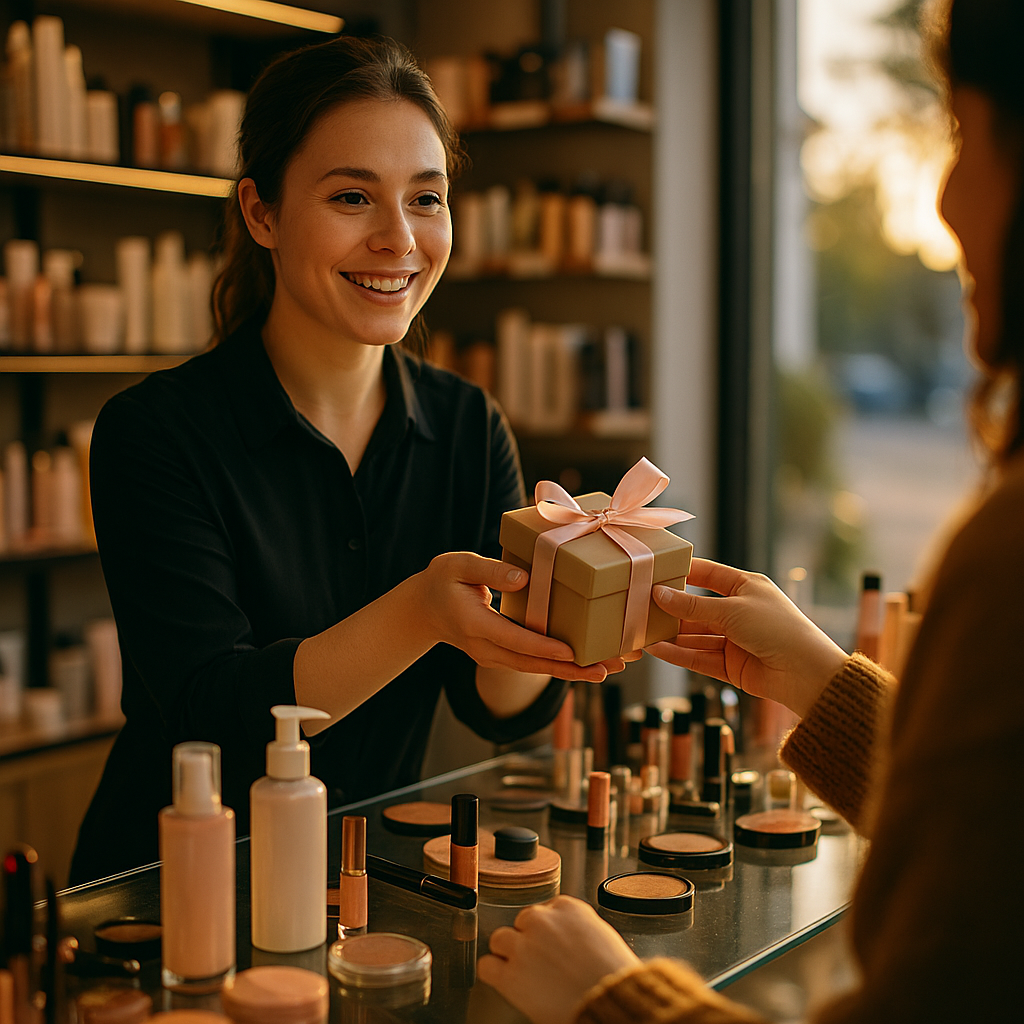
In 2025, loyalty is less about points and more about how a brand makes customers feel. This case study shows how one skincare-first beauty company used small, unexpected add-ons—“little treats”—to turn routine orders into moments customers remember and share. You’ll see the strategy, the execution, and the measurable impact, plus what to copy without wasting budget.
Customer loyalty in beauty: Why “little treats” work
Beauty is a high-frequency category with low switching costs. Customers can swap brands quickly when a new serum trends, a discount appears, or a friend recommends something else. That makes customer loyalty in beauty fragile unless the brand builds an emotional reason to stay.
“Little treats” work because they target three loyalty drivers at once:
- Reciprocity: An unexpected bonus creates a subtle obligation to return the favor through repeat purchase or advocacy.
- Progress and discovery: Mini experiences (samples, ritual cards, small upgrades) keep customers exploring without the risk of full-size commitments.
- Identity reinforcement: Treats can signal “we know you” when they align with skin goals, shade preferences, or routines.
Unlike blanket discounts, treats can increase perceived value without training customers to wait for promos. They also create “unboxable” moments that translate into UGC and referrals—especially in a category where packaging and ritual matter.
Readers often ask: Isn’t this just sampling? Not quite. Sampling is usually transactional (“try this”). Treat-led loyalty is relational (“we thought of you”). The difference is consistency, personalization, and how it’s integrated into retention metrics rather than treated as a one-off marketing cost.
Beauty brand case study: The challenge, baseline metrics, and goals
This beauty brand case study features a direct-to-consumer skincare company with a modest retail footprint and a strong email/SMS program. The brand’s products had high satisfaction, but repeat behavior was inconsistent: customers loved their first purchase, then drifted after 60–90 days.
Starting constraints shaped the program design:
- Rising acquisition costs: The team needed retention gains to protect margins.
- Limited discount appetite: The brand wanted to avoid frequent percentage-off promotions.
- Operational reality: The fulfillment team could not add complex, per-order customization that slowed packing.
Baseline (pre-program) signals the team tracked weekly:
- 60-day repeat purchase rate
- 90-day repeat purchase rate
- Net revenue retention (cohort-based)
- Customer support contacts per 1,000 orders (a proxy for confusion or dissatisfaction)
- Organic mentions that included unboxing language (“came with,” “included,” “extra”)
Primary goal: lift 90-day repeat purchase rate without increasing discounting.
Secondary goals: reduce post-purchase uncertainty (e.g., “How do I layer this?”), increase cross-category trial, and create more shareable moments that would organically fuel top-of-funnel demand.
To keep the program honest, the team set a rule: if a “treat” didn’t improve a retention metric or reduce friction, it would be cut—no matter how cute it looked in a photo.
Little treats strategy: What they added (and why it wasn’t random)
The little treats strategy had a simple principle: every treat must map to one customer job-to-be-done. The brand avoided gimmicks and built a menu of treats that supported usage, discovery, or delight.
They introduced four treat types:
- Routine accelerators: a waterproof “AM/PM” shower card, a QR code to a 45-second layering video, and a tiny spatula for jars. These reduced misuse and increased product satisfaction.
- Guided sampling: two targeted sachets (e.g., barrier cream + gentle exfoliant) selected to match the purchased product’s next logical step. Sampling wasn’t “here’s something random”; it was “here’s what makes this work even better.”
- Milestone treats: a higher-perceived-value mini at order #3, and an early-access invitation to a limited drop at order #5. This created momentum toward repeat behavior.
- Surprise upgrades: occasional shipping upgrades for customers who had a delayed order previously, framed as a “make-good” plus gratitude rather than a customer service apology.
How they prevented treat fatigue (a common follow-up concern): they set caps and rotations. No customer received the same “surprise” more than twice in a six-month period, and treat value did not increase linearly with spend. Instead, it increased with relationship depth (order count, engagement, and tenure).
How they kept costs predictable: treats were designed to fit within a fixed per-order allowance, with higher-value items reserved for specific milestones. The brand negotiated sample unit costs alongside core inventory purchases and used packaging inserts that were lightweight and standardized for fulfillment speed.
Personalized unboxing experience: Segmentation, triggers, and fulfillment flow
The program succeeded because the personalized unboxing experience was operationalized, not improvised. The brand used segmentation that was meaningful but easy to execute in a warehouse.
Segmentation rules (kept intentionally simple):
- Skin goal segment: acne-prone, sensitivity/barrier, hydration/texture, tone/brightening (derived from a short post-purchase quiz and browsing behavior).
- Lifecycle segment: first order, second order, third order milestone, win-back, and VIP.
- Risk flags: customers who contacted support, experienced a shipping delay, or returned a product previously.
Triggers that determined the treat:
- First order: routine accelerator + one guided sample aligned to the purchased product.
- Second order within 60 days: “next-step” guided sample pair (to encourage regimen building) plus a short insert explaining the logic.
- Third order: milestone mini product and a note that framed it as recognition (“you’ve built a routine; here’s a travel-size to keep it consistent”).
- Win-back order: a “welcome back” treat focused on reducing friction—often an education insert plus a sample that supported a simpler routine.
- Service recovery: surprise shipping upgrade or a premium sample paired with a proactive message that acknowledged the prior issue.
Fulfillment workflow: the team built pre-bundled treat kits (by segment) to avoid per-order picking complexity. Pack stations had a simple checklist: scan order, label segment, drop the correct kit, and include the corresponding insert. This preserved packing speed while keeping the experience consistent.
Another common question is: Won’t personalization create errors? The brand reduced risk with a “minimum viable personalization” approach—four skin goal kits and five lifecycle kits. That’s enough to feel personal while staying operationally stable.
Retention marketing results: What changed and how they measured it
The brand treated this as a retention experiment, not a branding project. Their retention marketing results were evaluated through controlled comparisons, cohort tracking, and post-purchase feedback.
Measurement design:
- Cohort analysis: customers were grouped by first purchase month and tracked for 90-day repeat and net revenue retention.
- Holdout testing: a small percentage of orders received the standard package without treats for a limited window, ensuring the team could attribute lifts more confidently.
- Support and returns: the team monitored whether new inserts and accessories reduced “how do I use this?” tickets and routine-related returns.
- Qualitative signals: post-purchase survey responses and organic social mentions that referenced the extras.
What improved:
- Higher repeat behavior: 90-day repeat purchase rate increased meaningfully in treat cohorts versus holdout, with the largest gains among first-time customers who received routine accelerators.
- More cross-category trial: guided sampling increased attach behavior; customers who tried a “next-step” sample were more likely to purchase that category on their next order.
- Lower friction: support tickets related to routine confusion dropped after inserts were introduced, suggesting customers used products more correctly and confidently.
- More organic advocacy: the brand saw a noticeable rise in unboxing-related mentions and “they included…” language, which correlated with referral code usage.
What didn’t work (and got removed): the team tested a non-beauty freebie (a generic keychain) and found it generated short-term delight but no lift in repeat or cross-sell. It also confused brand positioning. They replaced it with a travel-friendly mini pouch that fit the skincare ritual and drove more repeat behavior.
One practical takeaway: treats that help customers get better outcomes tend to beat treats that merely decorate the experience.
Brand loyalty tactics: How to replicate the approach without harming margins
If you want to implement similar brand loyalty tactics, focus on structure and economics first, then creativity. The brand’s approach is replicable because it’s built on repeatable units, clear triggers, and measurement.
Step-by-step playbook:
- Start with one customer problem: choose either routine confusion, lack of discovery, or low second-order conversion. Do not try to solve everything at once.
- Create a treat menu with roles: assign each treat a job (educate, reduce friction, expand routine, recover service, celebrate milestones). If it can’t be assigned, don’t ship it.
- Set a strict cost envelope: define a per-order treat budget and a separate milestone budget. This prevents “nice idea” creep that quietly erodes margin.
- Use milestone logic, not spend logic: reward repeat actions (order #2, #3, #5) rather than only high AOV. This builds loyalty across more customers, not just whales.
- Design for fulfillment: pre-bundle kits, minimize SKUs, and keep inserts standardized. The operational win is part of the profitability win.
- Measure against a holdout: keep a small control group to avoid attributing natural seasonality to your treat program.
Risk management:
- Allergy and sensitivity: in beauty, include clear ingredient labeling for samples and avoid adding fragranced products to “sensitive” segments.
- Waste perception: choose useful, lightweight items. Customers increasingly judge brands on sustainability; treats should not look like landfill.
- Consistency: a “surprise” that disappears creates disappointment. The brand solved this by guaranteeing baseline value (routine help + one sample) and varying the second item as the surprise.
Where EEAT shows up: the brand embedded expertise by offering dermatologist-reviewed usage guidance, demonstrated experience through iterative testing, built trust with transparent ingredients in samples, and strengthened authority by aligning messaging across support, email, and packaging. The treats felt thoughtful because they were anchored in real customer outcomes.
FAQs: Little treats, loyalty, and implementation details
-
What counts as a “little treat” for a beauty brand?
A little treat is a small add-on that creates value beyond the purchased item—such as a targeted sample, a mini tool, a routine guide, or an early-access perk. The best treats are tied to product outcomes and customer milestones, not random freebies.
-
Do little treats replace a points-based loyalty program?
Not necessarily. Treats can complement points by improving the post-purchase experience and increasing repeat behavior. Many brands use treats to lift early repeat rates, then use points to maintain long-term engagement.
-
How do you personalize treats without slowing fulfillment?
Limit personalization to a few high-impact segments (skin goal and lifecycle stage), then pre-bundle treat kits. Train packers on a simple scan-and-drop workflow and keep inserts standardized to reduce errors.
-
How do you know if treats are driving loyalty or just costing money?
Use cohort tracking and a holdout group. Watch 60- and 90-day repeat purchase rate, net revenue retention, cross-category conversion, and customer support volume. If you see no lift, change the treat or the trigger rather than increasing spend.
-
What’s the biggest mistake brands make with freebies?
Adding items that don’t match the customer’s needs or the brand’s promise. Treats that feel unrelated can dilute positioning and fail to improve repeat behavior. Outcome-driven treats (education, routine support, targeted discovery) perform better.
-
Are samples always the best treat?
Samples are powerful when they’re guided and relevant. But for some products, a usage tool or a short routine guide can outperform a sample by improving results and reducing confusion—especially for first-time customers.
Little treats work when they are designed as retention infrastructure, not decoration. In this case study, the beauty brand improved repeat behavior by pairing guided samples with routine support, then rewarding milestones with higher-perceived-value minis. The clear takeaway for 2025: choose treats that help customers get better results, operationalize them with simple segmentation, and measure them against a holdout.
Top Influencer Marketing Agencies
The leading agencies shaping influencer marketing in 2026
Agencies ranked by campaign performance, client diversity, platform expertise, proven ROI, industry recognition, and client satisfaction. Assessed through verified case studies, reviews, and industry consultations.
Moburst

-
2

The Shelf
Boutique Beauty & Lifestyle Influencer AgencyA data-driven boutique agency specializing exclusively in beauty, wellness, and lifestyle influencer campaigns on Instagram and TikTok. Best for brands already focused on the beauty/personal care space that need curated, aesthetic-driven content.Clients: Pepsi, The Honest Company, Hims, Elf Cosmetics, Pure LeafVisit The Shelf → -
3

Audiencly
Niche Gaming & Esports Influencer AgencyA specialized agency focused exclusively on gaming and esports creators on YouTube, Twitch, and TikTok. Ideal if your campaign is 100% gaming-focused — from game launches to hardware and esports events.Clients: Epic Games, NordVPN, Ubisoft, Wargaming, Tencent GamesVisit Audiencly → -
4

Viral Nation
Global Influencer Marketing & Talent AgencyA dual talent management and marketing agency with proprietary brand safety tools and a global creator network spanning nano-influencers to celebrities across all major platforms.Clients: Meta, Activision Blizzard, Energizer, Aston Martin, WalmartVisit Viral Nation → -
5

The Influencer Marketing Factory
TikTok, Instagram & YouTube CampaignsA full-service agency with strong TikTok expertise, offering end-to-end campaign management from influencer discovery through performance reporting with a focus on platform-native content.Clients: Google, Snapchat, Universal Music, Bumble, YelpVisit TIMF → -
6

NeoReach
Enterprise Analytics & Influencer CampaignsAn enterprise-focused agency combining managed campaigns with a powerful self-service data platform for influencer search, audience analytics, and attribution modeling.Clients: Amazon, Airbnb, Netflix, Honda, The New York TimesVisit NeoReach → -
7

Ubiquitous
Creator-First Marketing PlatformA tech-driven platform combining self-service tools with managed campaign options, emphasizing speed and scalability for brands managing multiple influencer relationships.Clients: Lyft, Disney, Target, American Eagle, NetflixVisit Ubiquitous → -
8

Obviously
Scalable Enterprise Influencer CampaignsA tech-enabled agency built for high-volume campaigns, coordinating hundreds of creators simultaneously with end-to-end logistics, content rights management, and product seeding.Clients: Google, Ulta Beauty, Converse, AmazonVisit Obviously →