


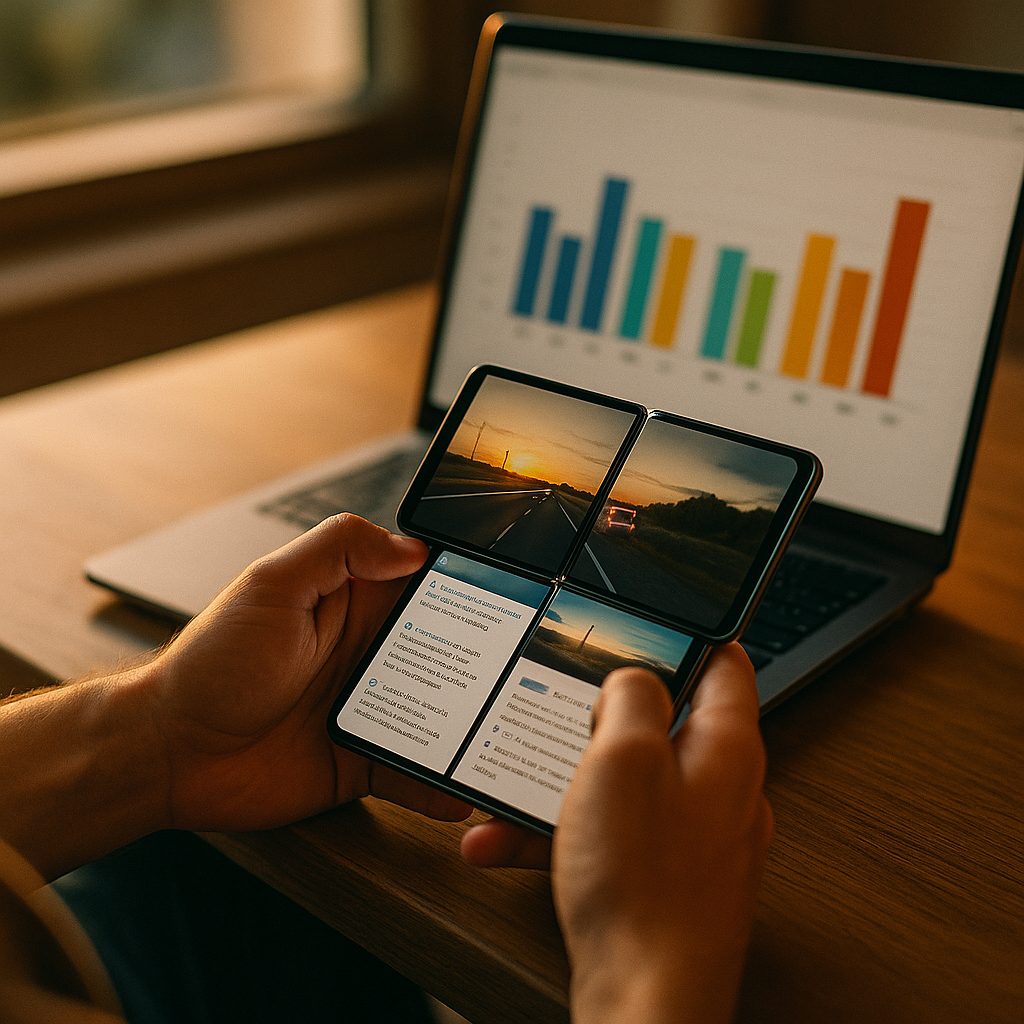
In 2025, audiences rarely give one device their full attention. Designing Content Specifically For The Dual-Screen User Habit means planning for people who scroll on a phone while watching video, joining a meeting, or shopping on a laptop. This shift changes how you structure pages, write copy, and measure success. If your content doesn’t guide split attention, it leaks conversions—so what should you change first?
Understanding the dual-screen behavior and why it changes content
Dual-screen behavior is the habit of using two devices at the same time—most often a phone plus a laptop, tablet, or TV. It’s not a niche scenario; it’s now a default mode during work, live events, streaming, shopping research, and social browsing. The key implication isn’t simply “users are distracted.” It’s that users create their own workflow across screens, and your content must fit into that workflow.
In practice, the phone often becomes the control surface (searching, comparing, messaging, saving), while the larger screen becomes the context screen (watching, reading longform, filling forms, evaluating details). Users bounce between them quickly, so they reward content that:
- Reassures fast (instant clarity on value, credibility, and next steps)
- Resumes easily (they can pick up where they left off after switching devices)
- Synchronizes intent (they can continue the same task without rethinking it)
Designing for dual-screen is therefore a strategic decision: you’re not only optimizing layouts—you’re reducing cognitive overhead. That means anticipating questions, surfacing the “why trust you?” proof early, and making actions portable (save, share, continue, compare). Throughout this article, you’ll see how to translate that into page structure, writing patterns, UX, and measurement without sacrificing depth.
Building a second-screen content strategy around intent, not devices
A strong second-screen content strategy starts with intent mapping. Instead of asking “Is this mobile or desktop?”, ask “What is the user trying to accomplish, and which screen are they likely to use for each step?” Dual-screen users don’t follow a linear funnel; they assemble it.
Use a simple intent map for key journeys:
- Discover: quick searches, social snippets, short video clips, notifications (often on phone)
- Evaluate: comparisons, reviews, specs, pricing, credibility checks (split across both)
- Decide: checkout, sign-up, booking, form filling (often on larger screen, but initiated on phone)
- Confirm: receipts, onboarding steps, FAQ, support (often on phone after purchase)
Then build content “handoff points” that match those transitions:
- Handoff links: “Email me this,” “Copy link,” “Save to account,” “Add to calendar,” “Send to phone”
- Handoff summaries: a short section near the top that states who it’s for, what it does, what it costs (if relevant), and the next step
- Handoff-proof CTAs: buttons that still make sense out of context (avoid “Click here”; use “Compare plans,” “See pricing,” “Book a demo”)
Answering likely follow-up questions inside the content is critical because dual-screen users frequently pause mid-journey. If your page doesn’t anticipate “Will this work with my setup?”, “What’s included?”, “How long does it take?”, or “What’s the return policy?”, they’ll open new tabs on the other device and drift away. Make those answers skimmable, credible, and close to the decision point.
For EEAT, be explicit about who is speaking: add author attribution, role-based expertise, and clear sourcing for any claims. When you reference performance or outcomes, frame them as what you observed, under what conditions, rather than vague promises.
Applying multiscreen UX principles: structure, scannability, and continuity
Multiscreen UX is the craft of designing experiences that survive interruptions, switching, and partial attention. It’s less about flashy features and more about predictable structure and continuity. Three principles matter most: front-load meaning, chunk information, and make resuming effortless.
1) Front-load meaning
Your first screenful should communicate:
- What this is (plain-language descriptor)
- Who it’s for (audience fit)
- Why it matters (outcome, not features)
- What to do next (one primary action)
This reduces the cost of re-orienting after a device switch. It also aligns with helpful-content expectations: clarity beats cleverness.
2) Chunk information for split attention
Dual-screen users scan aggressively. Use short paragraphs, purposeful emphasis, and lists that summarize decisions. Replace “wall of text” explanations with modular blocks:
- Decision blocks: pros/cons, “best for” statements, constraints
- Proof blocks: testimonials with context, certifications, methodology notes
- Action blocks: clear CTAs with what happens after clicking
3) Make resuming effortless
People resume content constantly. Support that with:
- Sticky progress cues in long pages (section headings that reflect real questions)
- Persistent navigation labels that match user language (“Pricing,” “Reviews,” “How it works”)
- Save state for forms and configurators (don’t punish switching)
Also consider continuity at the system level: consistent terminology, consistent plan names, consistent benefits phrasing across devices and channels. When a user sees your brand message on a phone and then lands on a desktop page, any mismatch feels like risk.
Optimizing mobile companion content for second-screen moments
Mobile companion content is the content that supports what a user is doing on another screen. Think: scanning a QR code during a live stream, checking specs during a webinar, or searching “is this legit?” while watching an ad on TV. Your goal is to deliver answers fast, with strong credibility signals.
Design mobile companion content around four micro-moments:
- Verify: legitimacy, reviews, security, guarantees
- Compare: plans, alternatives, key differentiators
- Clarify: setup steps, compatibility, availability, pricing details
- Commit: quick lead capture, reservation, add-to-cart, or “continue on desktop”
Practical patterns that work well on phones:
- One-sentence value statement followed by a short list of what’s included
- Trust stack: identifiable company details, support options, clear policies, and third-party proof where relevant
- Tap-friendly comparison: a concise plan grid or bullet comparison with a default recommendation (explain the criteria)
- Low-friction capture: “Send me the details,” “Text me the link,” “Email the quote,” “Save to my account”
To follow EEAT best practices, make your proof tangible and recent: show who wrote the guidance (role and qualifications), how your recommendations are formed (testing approach or selection criteria), and how users can reach support. If you mention performance, avoid inflated claims and provide context: “Measured on X device types,” “Based on customer support logs,” or “From post-purchase survey results.”
Answer the common follow-up questions directly on mobile pages, near the relevant CTA:
- “Will I lose my place if I switch devices?” Provide a “Save and continue later” path.
- “What happens after I submit?” Explain the next step and timing.
- “What if I need help?” Offer one-tap support options and response expectations.
Leveraging cross-device analytics to measure what split attention really does
Cross-device analytics is where many teams struggle, because dual-screen behavior fragments sessions. If you only look at last-click conversions or single-device funnels, you’ll underestimate content performance and optimize the wrong things.
Start by aligning measurement with dual-screen realities:
- Track “handoff events”: copy link, share, save, email-to-self, add to calendar, QR scans, sign-in, and “continue later.”
- Separate micro-conversions from macro-conversions: a mobile page may not “close” the sale, but it can drive qualified handoff.
- Measure time-to-decision, not just session duration: dual-screen users often convert after multiple short visits.
In 2025, privacy expectations and platform limits mean you should rely on a robust combination of:
- First-party data (logged-in behavior, consented email events, saved items)
- Modeled attribution where appropriate (clearly documented assumptions)
- Experimentation (A/B tests on messaging, structure, and handoff features)
What should you test first? Prioritize tests that reduce friction across screens:
- “Send to my email” vs. “Save to account” placement near key decision sections
- Short proof-first layout vs. feature-first layout on mobile companion pages
- FAQ placement: embedded next to CTAs vs. at page bottom
To keep your insights trustworthy (EEAT for measurement), document your analytics setup: what events mean, what is inferred, what is directly observed, and what traffic is excluded (bots, internal, test environments). When stakeholders ask, “Why did mobile conversions drop?”, you’ll be able to answer: “They didn’t—mobile is initiating more handoffs, and desktop is completing them.”
Implementing EEAT content design for credibility across two screens
EEAT content design is how you make expertise, experience, authoritativeness, and trust visible in the moments users actually judge you—often while cross-checking information on a second device. Dual-screen users frequently verify claims in real time, so your content must be easy to validate.
Strengthen experience and expertise signals:
- Show the author and reviewer (name, role, relevant credentials, and what they did)
- Explain your process (how you tested, evaluated, or compiled information)
- Use precise language (define terms, avoid vague “best” claims without criteria)
Build trust fast:
- Make policies easy to find: returns, cancellation, warranty, privacy, security
- Offer verifiable contact options: support channels with expected response times
- Keep pricing and constraints clear: fees, limitations, compatibility, and requirements
Increase authoritativeness without padding:
- Link to primary sources when citing facts (standards bodies, peer-reviewed work, official docs)
- Use real customer evidence responsibly: testimonials with context (industry, use case), not anonymous hype
- Maintain content freshness: visible “last reviewed” signals and update notes when changes matter
Answer follow-up questions where they naturally occur. If you mention a “two-minute setup,” include what “setup” includes. If you recommend a plan, explain what would disqualify someone from it. This reduces the need for second-device verification and makes your page the most complete answer—exactly what helpful content aims to be.
FAQs about designing content for the dual-screen user habit
What is the most common dual-screen pairing?
Phone plus laptop/desktop is the most common in work and shopping contexts, while phone plus TV dominates live events and streaming. Design for quick mobile verification and deeper desktop evaluation.
How do I create “continue on another device” without building an app?
Use simple handoff mechanisms: “Email me this link,” “Copy link,” QR codes, and “Save to account.” If you support login, syncing saved items and form progress is often enough to feel seamless.
Should I write shorter content because users are distracted?
No. Write more structured content. Dual-screen users want depth, but they consume it in chunks. Use scannable sections, summaries, and decision blocks so they can pause and resume.
Which pages should I optimize first for dual-screen behavior?
Start with high-intent pages: pricing, product/service detail, comparison pages, webinar/event landing pages, and checkout or booking flows. These are where switching devices most often breaks continuity.
How do I measure success if conversion happens on another device?
Track handoff events (save, share, email-to-self, QR scans, sign-in) and evaluate assisted conversions and time-to-decision. Treat mobile as a conversion initiator and desktop as a frequent completion channel.
What are the biggest mistakes teams make with dual-screen content?
They hide credibility signals, bury answers to obvious questions, and rely on single-session analytics. They also use vague CTAs that don’t travel well across devices, such as “Learn more” without context.
Dual-screen habits aren’t a temporary distraction; they’re how people research, verify, and decide in 2025. When you design for split attention, you prioritize fast clarity, credible proof, and frictionless handoffs between devices. Map intent, structure pages for scanning and resuming, and track cross-device micro-conversions. The takeaway is simple: build continuity, and your content will keep converting even when attention is divided.
Top Influencer Marketing Agencies
The leading agencies shaping influencer marketing in 2026
Agencies ranked by campaign performance, client diversity, platform expertise, proven ROI, industry recognition, and client satisfaction. Assessed through verified case studies, reviews, and industry consultations.
Moburst

-
2

The Shelf
Boutique Beauty & Lifestyle Influencer AgencyA data-driven boutique agency specializing exclusively in beauty, wellness, and lifestyle influencer campaigns on Instagram and TikTok. Best for brands already focused on the beauty/personal care space that need curated, aesthetic-driven content.Clients: Pepsi, The Honest Company, Hims, Elf Cosmetics, Pure LeafVisit The Shelf → -
3

Audiencly
Niche Gaming & Esports Influencer AgencyA specialized agency focused exclusively on gaming and esports creators on YouTube, Twitch, and TikTok. Ideal if your campaign is 100% gaming-focused — from game launches to hardware and esports events.Clients: Epic Games, NordVPN, Ubisoft, Wargaming, Tencent GamesVisit Audiencly → -
4

Viral Nation
Global Influencer Marketing & Talent AgencyA dual talent management and marketing agency with proprietary brand safety tools and a global creator network spanning nano-influencers to celebrities across all major platforms.Clients: Meta, Activision Blizzard, Energizer, Aston Martin, WalmartVisit Viral Nation → -
5

The Influencer Marketing Factory
TikTok, Instagram & YouTube CampaignsA full-service agency with strong TikTok expertise, offering end-to-end campaign management from influencer discovery through performance reporting with a focus on platform-native content.Clients: Google, Snapchat, Universal Music, Bumble, YelpVisit TIMF → -
6

NeoReach
Enterprise Analytics & Influencer CampaignsAn enterprise-focused agency combining managed campaigns with a powerful self-service data platform for influencer search, audience analytics, and attribution modeling.Clients: Amazon, Airbnb, Netflix, Honda, The New York TimesVisit NeoReach → -
7

Ubiquitous
Creator-First Marketing PlatformA tech-driven platform combining self-service tools with managed campaign options, emphasizing speed and scalability for brands managing multiple influencer relationships.Clients: Lyft, Disney, Target, American Eagle, NetflixVisit Ubiquitous → -
8

Obviously
Scalable Enterprise Influencer CampaignsA tech-enabled agency built for high-volume campaigns, coordinating hundreds of creators simultaneously with end-to-end logistics, content rights management, and product seeding.Clients: Google, Ulta Beauty, Converse, AmazonVisit Obviously →