


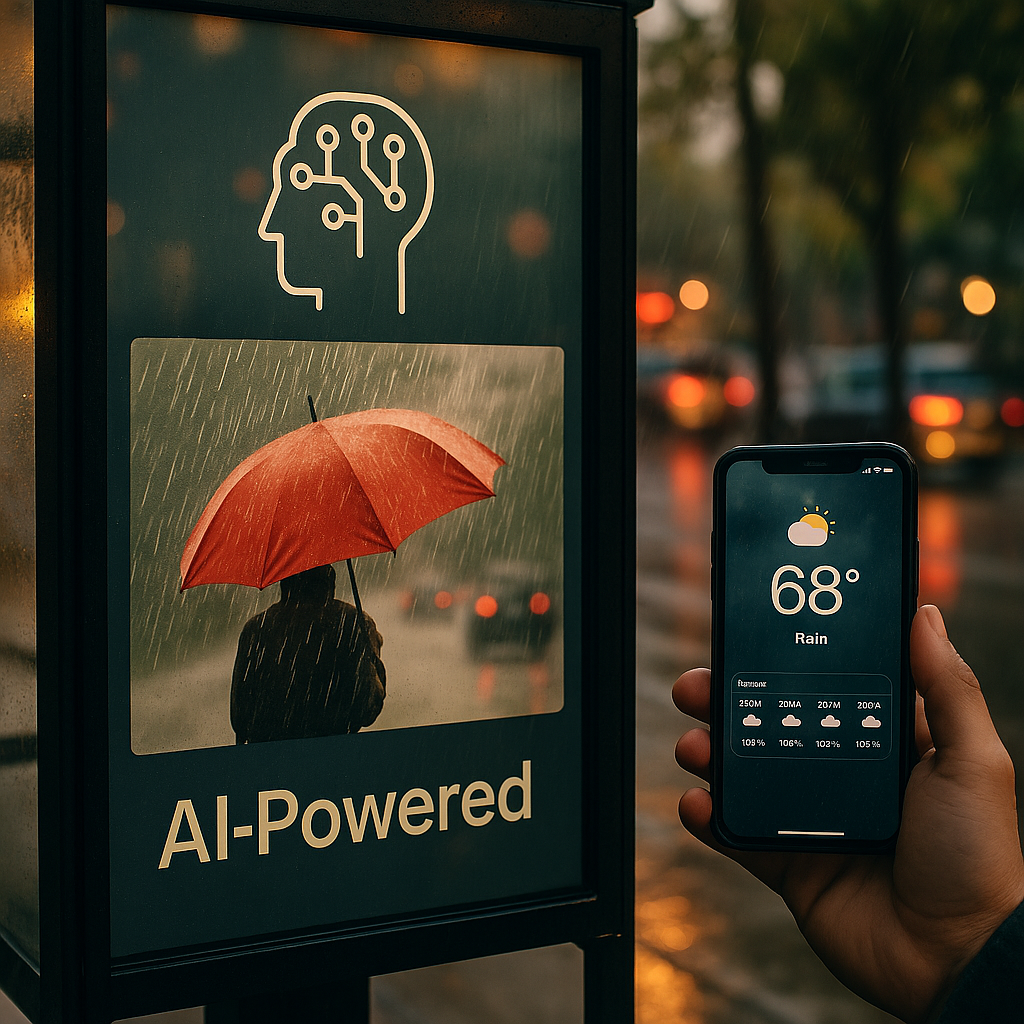
Using AI To Personalize Dynamic Creative Based On Live Atmospheric Data is changing how brands earn attention in 2025: ads now react to weather, air quality, UV, pollen, and even wildfire smoke in real time. Instead of guessing what audiences feel, teams can match creative to conditions people are experiencing now. Done well, this boosts relevance without sacrificing trust—so what does “done well” look like?
Real-time weather targeting: what “atmospheric data” really includes
Most marketers say “weather targeting” when they really mean “atmospheric context.” In practice, live atmospheric data can include far more than temperature and rain:
- Weather conditions: precipitation type/intensity, cloud cover, wind speed, humidity, apparent temperature (“feels like”).
- Air quality: AQI, PM2.5/PM10, ozone, smoke plumes, dust events.
- Health-relevant signals: pollen counts (tree/grass/ragweed), mold risk, UV index, heat index, cold stress.
- Severe event indicators: lightning risk, flood advisories, heat alerts.
- Microclimate and time-of-day: neighborhood-level variance, sunrise/sunset, dew point shifts that change comfort.
When you connect these signals to creative decisions, you move from generic messaging (“It’s raining!”) to the kind of utility that feels personal (“High pollen this afternoon—try our non-drowsy formula before your commute”).
In 2025, the differentiator isn’t access to data—it’s how responsibly you translate it into messaging. That means choosing signals that matter to the product, mapping them to user needs, and being transparent enough that the experience feels helpful rather than invasive.
AI dynamic creative optimization: how models turn live data into ad variations
AI-driven dynamic creative optimization (DCO) uses rules, predictions, or both to assemble ads from modular components (headlines, images, CTAs, offers, product sets). Live atmospheric data becomes an input feature that influences what is served and when.
There are three common approaches, often used together:
- Rules-based personalization: Deterministic logic such as “If AQI > 150, prioritize indoor fitness messaging.” This is easy to audit and is a strong baseline.
- Predictive selection: A model estimates which creative variant will perform best given context (location, time, device, atmospheric signals, and consented first-party cues). The system chooses the best option under constraints.
- Generative assistance: AI drafts copy or suggests imagery within pre-approved templates and brand guardrails. The best teams still keep human review and enforce policy checks.
To keep this aligned with Google’s helpful-content expectations and EEAT, treat AI as an optimizer, not an author of unbounded claims. Require sourceable statements, avoid medical promises, and block sensitive inference (for example, never implying someone has asthma because AQI is high).
Also build for continuity: if the atmosphere shifts mid-campaign, your creative should shift smoothly, not jerk between extremes. A simple solution is hysteresis—only switch to a new creative state when thresholds are exceeded for a set duration, reducing noisy changes that confuse users.
Contextual advertising automation: building the data-to-creative pipeline
A reliable system needs more than a weather API key. It needs an end-to-end pipeline that can ingest, validate, decide, render, and measure—fast.
1) Data sourcing and verification
- Choose reputable providers for meteorology, AQI, and pollen; document update frequency, geographic coverage, and latency.
- Validate inputs: missing values, outliers (e.g., negative humidity), and stale timestamps should trigger fallbacks.
- Use a “confidence score” per signal; if confidence is low, default to a safe, general creative.
2) Decisioning layer
- Define a taxonomy of “atmospheric states” (e.g., Hot & Humid, Cold & Windy, High Pollen, Unhealthy Air, Clear & Mild).
- Map each state to allowed messaging, imagery, product sets, and compliance notes.
- Incorporate business constraints: inventory, delivery windows, regional legal restrictions, and budget pacing.
3) Creative assembly
- Design modular templates so swapping one component (headline) doesn’t break layout or meaning.
- Use brand-safe variation libraries rather than fully open-ended generation.
- Pre-approve variants with legal/compliance, especially for health, financial, or regulated categories.
4) Activation across channels
- Connect decisioning to ad servers and platforms, plus onsite personalization (hero banners, product recommendations) for consistency.
- Coordinate frequency and sequencing so a user doesn’t see contradictory messages in the same hour.
5) Measurement and learning
- Track performance by atmospheric state, creative variant, and time window.
- Use incrementality where possible (geo-holdouts, PSA tests, or platform lift studies) to avoid over-crediting correlation.
Readers usually ask: “Do we need real-time every minute?” Often, no. For many use cases, 10–30 minute refresh cycles are enough, especially when you add hysteresis and sensible state definitions.
Personalized marketing with atmospheric triggers: high-impact use cases by industry
Atmospheric triggers work best when they solve a practical problem or reduce decision friction. Here are use cases that tend to perform because the connection is obvious to the audience.
Retail and ecommerce
- Apparel: shift from coats to midlayers as wind chill rises; highlight breathable fabrics during high humidity.
- Footwear: promote waterproof options during rain states; focus on grip during icy conditions.
- Home goods: air purifiers during poor AQI; humidifiers during dry cold snaps; dehumidifiers during damp periods.
CPG and health-adjacent categories
- Hydration: heat index triggers for electrolyte messaging (without implying medical outcomes).
- Allergy support: pollen triggers with educational copy and clear disclaimers; avoid diagnosing or targeting sensitive traits.
Travel and mobility
- Rideshare/transit: rain or extreme heat can shift messaging toward convenience and comfort.
- Hospitality: “indoor amenities” during storms; “outdoor experiences” during clear mild states.
Quick-service restaurants and delivery
- Cold/windy states can boost warm comfort-food positioning; hot states can prioritize chilled beverages and lighter options.
- Use time-of-day plus atmospheric states to avoid awkward mismatches (e.g., iced coffee at night).
Energy and utilities
- Heat alerts can support demand-response education; cold snaps can highlight insulation and efficiency tips.
Two practical guidelines keep these efforts credible: (1) always connect the atmospheric trigger to a real product benefit, and (2) keep the tone service-oriented. People accept context; they reject manipulation.
Privacy-safe location intelligence: compliance, consent, and trust in 2025
Live atmospheric personalization often depends on location, which raises immediate privacy questions. Strong outcomes require strong governance.
Use the least sensitive method that works
- Prefer coarse location (city/region) over precise GPS unless you truly need hyperlocal signals.
- Where possible, personalize based on declared location (store selection, shipping ZIP) rather than device geolocation.
Be explicit about data use
- Explain what you use (e.g., “local weather conditions”), why (to show relevant products), and what you don’t do (no selling of precise location).
- Offer clear controls: opt-out of personalization, manage preferences, and access policy details.
Avoid sensitive inference
- High pollen does not mean a person has allergies; unhealthy air does not mean a person has a respiratory condition.
- Keep copy contextual: “Pollen is high today” rather than “Your allergies are acting up.”
Secure the pipeline
- Log access, encrypt data in transit and at rest, and minimize retention of any location-linked event streams.
- Maintain audit trails for creative decisions, especially if AI selects or generates variants.
EEAT isn’t just about author credentials—it’s about operational credibility. If a user or regulator asks “How did this ad decide what to show?” you should be able to answer with a clear, documented chain of logic and controls.
Conversion lift measurement: experiments, attribution, and creative guardrails
Atmospheric personalization can look impressive in dashboards while delivering less incremental value than expected. Measurement discipline turns novelty into profit.
Start with a testable hypothesis
- Example: “During High Humidity states, breathable-fabric messaging increases add-to-cart rate versus evergreen creative.”
Use experiment designs that reduce bias
- Geo-experiments: run atmospheric DCO in a set of matched regions and hold out others with evergreen creative.
- Time-sliced tests: alternate DCO on/off during comparable forecast windows (useful when geo isn’t feasible).
- Creative split within state: compare two messages inside the same atmospheric state to isolate creative impact.
Measure what matters
- Track incremental conversions, revenue, and profit, not just CTR.
- Monitor brand safety and sentiment: complaint rate, hide/report actions, landing-page engagement, unsubscribe rate.
- Watch for distribution drift: if a region spends most days in one state, your learning may not generalize elsewhere.
Implement guardrails
- Cap frequency per user and per state to prevent repetitive “It’s hot!” messaging.
- Block unsafe combinations (e.g., severe weather alerts + playful tone).
- Require human approval for any net-new claim; use AI to vary phrasing, not facts.
A common follow-up: “How many variants do we need?” Aim for enough to cover major states and product categories without fragmenting data. Many teams start with 5–8 atmospheric states and 2–4 variants per state, then scale based on evidence.
FAQs
What live atmospheric data is most useful for dynamic creative?
Start with signals that clearly affect intent: temperature/feels-like, precipitation, humidity, wind, UV, AQI, and pollen. Choose 2–4 signals that match your product, then expand after you prove lift.
Do I need precise GPS location to personalize ads by weather?
Usually not. City- or ZIP-level context is often sufficient for weather and many AQI use cases. Use the least precise option that still provides accurate targeting, and prefer declared location when available.
How do we avoid ads that feel creepy or insensitive?
Keep messaging contextual, not personal. Reference conditions (“Air quality is unhealthy today”) rather than implying user health or behavior. Add tone guidelines for severe events, and use opt-outs for personalization.
Can generative AI write the ad copy automatically?
It can draft variations, but you should constrain it to approved templates, require brand and legal review for net-new claims, and log which prompts/versions were used. In regulated categories, keep a strict human-in-the-loop process.
How quickly should creative update when conditions change?
Fast updates help, but constant switching can hurt clarity. Many programs refresh every 10–30 minutes and apply threshold duration rules so creative changes only when conditions stay meaningfully different.
What KPIs best show value from atmospheric personalization?
Use incremental conversions, revenue per impression, and profit impact by atmospheric state. Pair performance metrics with trust metrics like complaint rate, bounce rate, and unsubscribe rate to ensure relevance doesn’t damage brand perception.
What’s the biggest implementation risk?
Data quality and governance. If the feed is stale or wrong, creative becomes inaccurate and trust drops. Put validation, fallbacks, and monitoring in place before scaling.
AI-driven creative that responds to the atmosphere works best when it prioritizes user value over novelty. In 2025, the winners translate reliable weather, air quality, and seasonal signals into modular messaging that stays on-brand, respects privacy, and proves incremental impact through disciplined testing. Build a verified data pipeline, define clear atmospheric states, and enforce guardrails—then let relevance compound into measurable growth.
Top Influencer Marketing Agencies
The leading agencies shaping influencer marketing in 2026
Agencies ranked by campaign performance, client diversity, platform expertise, proven ROI, industry recognition, and client satisfaction. Assessed through verified case studies, reviews, and industry consultations.
Moburst

-
2

The Shelf
Boutique Beauty & Lifestyle Influencer AgencyA data-driven boutique agency specializing exclusively in beauty, wellness, and lifestyle influencer campaigns on Instagram and TikTok. Best for brands already focused on the beauty/personal care space that need curated, aesthetic-driven content.Clients: Pepsi, The Honest Company, Hims, Elf Cosmetics, Pure LeafVisit The Shelf → -
3

Audiencly
Niche Gaming & Esports Influencer AgencyA specialized agency focused exclusively on gaming and esports creators on YouTube, Twitch, and TikTok. Ideal if your campaign is 100% gaming-focused — from game launches to hardware and esports events.Clients: Epic Games, NordVPN, Ubisoft, Wargaming, Tencent GamesVisit Audiencly → -
4

Viral Nation
Global Influencer Marketing & Talent AgencyA dual talent management and marketing agency with proprietary brand safety tools and a global creator network spanning nano-influencers to celebrities across all major platforms.Clients: Meta, Activision Blizzard, Energizer, Aston Martin, WalmartVisit Viral Nation → -
5

The Influencer Marketing Factory
TikTok, Instagram & YouTube CampaignsA full-service agency with strong TikTok expertise, offering end-to-end campaign management from influencer discovery through performance reporting with a focus on platform-native content.Clients: Google, Snapchat, Universal Music, Bumble, YelpVisit TIMF → -
6

NeoReach
Enterprise Analytics & Influencer CampaignsAn enterprise-focused agency combining managed campaigns with a powerful self-service data platform for influencer search, audience analytics, and attribution modeling.Clients: Amazon, Airbnb, Netflix, Honda, The New York TimesVisit NeoReach → -
7

Ubiquitous
Creator-First Marketing PlatformA tech-driven platform combining self-service tools with managed campaign options, emphasizing speed and scalability for brands managing multiple influencer relationships.Clients: Lyft, Disney, Target, American Eagle, NetflixVisit Ubiquitous → -
8

Obviously
Scalable Enterprise Influencer CampaignsA tech-enabled agency built for high-volume campaigns, coordinating hundreds of creators simultaneously with end-to-end logistics, content rights management, and product seeding.Clients: Google, Ulta Beauty, Converse, AmazonVisit Obviously →